B I C Pick DEF CON 33 Badge Walkthrough
Eli McRae
Blacks in Cyber Village @ DEF CON 33 · Day 1 · Blacks in Cyber Village
Overview
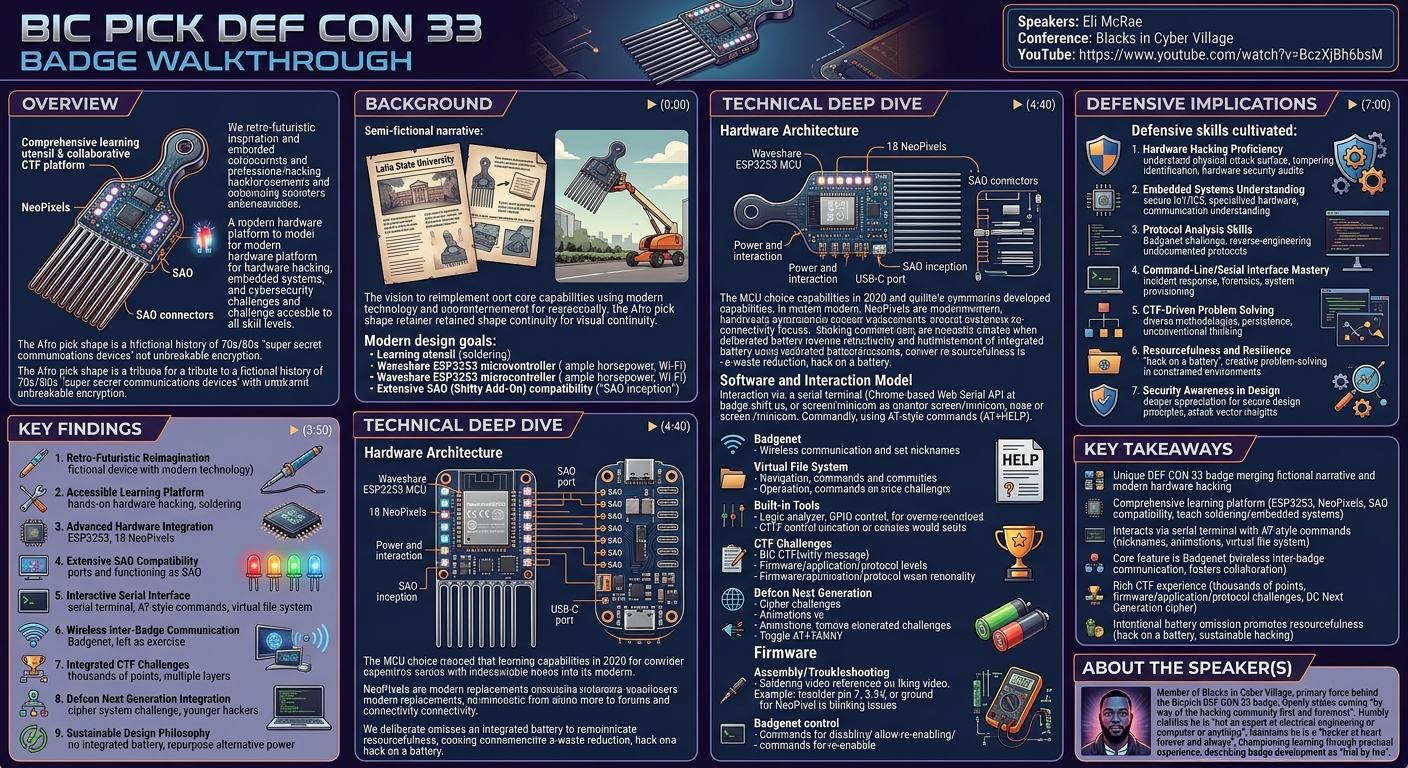
The "Bicpick DEF CON 33 Badge Walkthrough" presented by Eli McRae, a prominent member of the Blacks in Cyber Village, delves into the design, functionality, and underlying philosophy of the official DEF CON 33 badge. This talk is not merely a showcase of a piece of conference memorabilia; it introduces a meticulously crafted hardware platform designed to serve as a comprehensive learning utensil, a collaborative Capture The Flag (CTF) environment, and a tangible tribute to a rich, albeit apocryphal, history of clandestine communication devices. McRae, while humbly disclaiming expertise in electrical engineering, effectively positions the Bicpick as an accessible entry point into hardware hacking, embedded systems, and cybersecurity challenges for attendees of all skill levels.
Key moments
- 0:00 Introduction to the BigPick's origin story
- 2:00 Reimplementing the BigPick as a Defcon badge
- 3:50 Key hardware features: NeoPixels and SAO compatibility
- 4:40 The BigPick as a collaborative learning tool
- 6:00 Interacting with the badge and CTF challenges
- 7:00 Assembly video and how to get started
B I C Pick DEF CON 33 Badge Walkthrough
Speakers: Eli McRae
Conference: Blacks in Cyber Village
YouTube: https://www.youtube.com/watch?v=BczXjBh6bsM
Overview
The "Bicpick DEF CON 33 Badge Walkthrough" presented by Eli McRae, a prominent member of the Blacks in Cyber Village, delves into the design, functionality, and underlying philosophy of the official DEF CON 33 badge. This talk is not merely a showcase of a piece of conference memorabilia; it introduces a meticulously crafted hardware platform designed to serve as a comprehensive learning utensil, a collaborative Capture The Flag (CTF) environment, and a tangible tribute to a rich, albeit apocryphal, history of clandestine communication devices. McRae, while humbly disclaiming expertise in electrical engineering, effectively positions the Bicpick as an accessible entry point into hardware hacking, embedded systems, and cybersecurity challenges for attendees of all skill levels.
The Bicpick badge stands out through its unique blend of retro-futuristic inspiration and modern technological implementation. Shaped like an afro pick, it pays homage to a fictional narrative of 1970s and 80s "super secret communications devices" with "unbreakable encryption." This talk illuminates the journey from these historical inspirations to a fully functional DEF CON badge, equipped with an ESP32S3 microcontroller, NeoPixels, and extensive SAO (Shitty Add-On) compatibility. It emphasizes collaboration, hands-on learning, and creative problem-solving, making it far more than a decorative item but rather an interactive educational tool fostering a deeper engagement with the hacker ethos.
Background
▶ Watch: Introduction to the BigPick's origin story (0:00)
The conceptual genesis of the Bicpick badge is rooted in a fascinating, semi-fictional narrative unearthed at "Lafia State University." Eli McRae recounts discovering documents in a basement lab that detailed an apocryphal story of advanced communication devices from the 1970s and 80s. These devices, shaped like afro picks, were purportedly used for "super secret communications," evoking images of "Foxy Brown spy stuff" and boasting "unbreakable encryption." A promotional material from this fictional era, even displayed during the talk, advertised these capabilities, highlighting the ambitious vision of their creators.
However, the technology of the time presented significant limitations. Early prototypes of these original Bicpicks were described as massive, requiring a boom lift for transportation, a testament to the constraints imposed by 70s, 80s, and even 90s electronics. This historical context served as a compelling inspiration for McRae. Recognizing the potential of modern technology to overcome these past limitations, he envisioned reimplementing the core capabilities and spirit of these devices into a contemporary DEF CON badge. The afro pick shape was deliberately retained to honor the original concept and maintain visual continuity with its historical muse.
The modern Bicpick badge was designed with several key objectives. Foremost among them was its role as a learning utensil. It provides an opportunity for attendees, especially those new to hardware, to learn fundamental skills like soldering. The badge incorporates an off-the-shelf Waveshare ESP32S3 microcontroller, chosen specifically for its capabilities in 2020—offering ample horsepower and integrated Wi-Fi, making it a robust platform for development and experimentation. The design team also prioritized SAO (Shitty Add-On) compatibility, not only providing numerous SAO ports on the badge but also designing the badge itself to function as an SAO. This "SAO inception" philosophy ensures that users aren't forced to choose which badge to wear, allowing the Bicpick to integrate seamlessly with other SAOs and badges, reflecting the collaborative spirit of the hacking community and providing power to other devices.
Key Findings
▶ Watch: Key hardware features: NeoPixels and SAO compatibility (3:50)
The Bicpick badge emerges as a multifaceted and thoughtfully engineered device, representing a significant contribution to the DEF CON badge ecosystem. Its primary findings and contributions can be summarized as follows:
- Retro-Futuristic Reimagination: The badge successfully brings to life a fictional 1970s/80s communication device concept, merging nostalgic aesthetics with cutting-edge embedded systems technology. This narrative-driven design creates a unique and engaging user experience.
- Accessible Learning Platform: Designed as a "learning utensil," the Bicpick encourages hands-on hardware hacking, particularly soldering, making it approachable for beginners while offering depth for experienced users. It serves as an educational tool for exploring embedded systems, GPIO control, and serial communication.
- Advanced Hardware Integration: At its core, the badge utilizes the Waveshare ESP32S3 microcontroller, providing robust Wi-Fi capabilities and significant processing power. It features 18 NeoPixels for dynamic visual feedback, replicating and enhancing the display functionality of the original fictional devices.
- Extensive SAO Compatibility: The Bicpick is not only equipped with multiple SAO ports but is also designed to function as an SAO itself, enabling "SAO inception." This feature allows for seamless integration with other badges and add-ons, promoting interoperability and collaborative hardware projects.
- Interactive Serial Interface: Users primarily interact with the badge via a serial terminal, employing AT-style commands reminiscent of vintage modems. This command-line interface provides direct control over the badge's functionalities, from setting nicknames to toggling animations and navigating a virtual file system.
- Wireless Inter-Badge Communication (Badgenet): A crucial feature inherited from its fictional predecessors, the Bicpick supports wireless inter-badge communication through a platform dubbed Badgenet. While the specific protocol is "left as an exercise to the reader," this capability fosters collaboration and new forms of interaction among badge holders.
- Integrated CTF Challenges: The badge hosts a comprehensive Capture The Flag (CTF) experience with "thousands" of points available. Challenges are embedded at various technical layers, including firmware, application, and protocol levels, alongside general puzzles. This integration provides a practical application for the skills learned through badge exploration.
- Defcon Next Generation Integration: The Bicpick includes specific challenges and integrations with the Defcon Next Generation program, offering young and rising hackers an opportunity to learn about a cipher system and earn CTF points.
- Sustainable Design Philosophy: The intentional omission of an integrated battery encourages users to explore alternative power solutions, such as repurposing USB battery banks or salvaging components from e-cigarettes. This promotes resourcefulness and minimizes electronic waste, aligning with a sustainable hacking mindset.
Technical Deep Dive
▶ Watch: The BigPick as a collaborative learning tool (4:40)
The Bicpick badge is a sophisticated embedded system, carefully designed to blend ease of use with deep technical exploration. Its architecture centers around a powerful microcontroller and a user-friendly command interface.
Hardware Architecture
The core of the Bicpick is an off-the-shelf MCU (Microcontroller Unit): the Waveshare ESP32S3. This particular chip was selected for its robust capabilities available in 2020, offering substantial processing horsepower and integrated Wi-Fi connectivity. The ESP32S3 provides the necessary computational muscle for running the badge's firmware, managing network communications, and handling various peripherals.
Visual feedback is provided by 18 NeoPixels. These individually addressable RGB LEDs serve as a modern replacement for the "old amber ones" and "tubes" that characterized the large, impractical prototypes of the fictional original Bicpick. The NeoPixels allow for dynamic and visually engaging animations, which can be toggled via software commands.
Connectivity and extensibility are key design principles. The PCB features a plethora of SAO (Shitty Add-On) ports. This design choice serves a dual purpose: it allows the Bicpick to power and interact with other SAOs (creating "SAO inception"), and the badge itself can function as an SAO for larger setups. Power can be supplied via these SAO ports or directly through the USB-C port. A notable design decision is the deliberate omission of an integrated battery. This choice, driven by a desire to reduce electronic waste and encourage resourcefulness, prompts users to "hack on a battery" by utilizing external USB power banks, salvaged e-cigarette batteries, or even other SAOs. The badge breaks out options for soldering in a battery or driving power through the SAO ports or USB.
The Printed Circuit Board (PCB) itself is designed for accessibility. While the talk acknowledges that PCB design can be complex, the schematic is made available for users to map things out and understand the underlying connections. The assembly process, particularly soldering, is presented as a straightforward task suitable for beginners, with an embedded video demonstrating the process in under four minutes. Troubleshooting for common assembly issues, such as a NeoPixel blinking weirdly, is explicitly addressed, pointing to potential poor solder connections on pin 7, the 3.3-volt line, or the ground line of the first NeoPixel.
Software and Interaction Model
Interaction with the Bicpick badge is primarily achieved through a serial terminal. Users can connect to the badge using a Chrome-based web browser via the Web Serial API at badge.shift.us, or through traditional command-line serial terminal emulators like screen or minicom. This provides flexibility for various user preferences and operating systems.
The command interface leverages AT-style commands, a deliberate nod to "old AT Hayes modems of the 80s [and] 90s." This familiar syntax, while potentially requiring users to "sharpen up those skills," provides a structured and intuitive way to control the badge. Initial commands like AT+HELP are crucial for navigating the badge's functionalities and discovering CTF challenges.
Key software features and functionalities include:
- Badgenet: This is the platform for wireless inter-badge communication. Users can set custom nicknames (
AT+NICKNAME) for their badges, which are dynamically generated by default. While the specific underlying protocol for Badgenet is intentionally left as "an exercise to the reader," its existence fosters a dynamic and interactive environment among badge holders. There are commands (AT+FWR, disable Badgenet.extwith a B64 blob) to temporarily disable Badgenet if it's interrupting workflow or for troubleshooting. - Virtual File System: The badge incorporates a virtual file system that users can navigate and manipulate using standard file commands. This adds another layer of exploration and potential for hidden CTF challenges.
- Built-in Tools: The Bicpick includes practical tools such as a logic analyzer and generic GPIO control. These features allow users to experiment with the ESP32S3's pins and observe signals, making the badge a mini-hardware lab.
- CTF Challenges: The badge is replete with Blacks in Cyber Village CTF points. Challenges are diverse, spanning firmware-level puzzles, application-level tasks, and protocol-level analysis related to Badgenet. Flags are consistently formatted as
BIC CTF{witty message}. The CTF is designed as a "scavenger hunt," where flags are "happened upon" rather than explicitly directed, encouraging thorough exploration. - Defcon Next Generation Integration: A dedicated cipher system challenge is integrated for the DC NextG program, allowing younger hackers to engage with cryptography and earn points.
- Animations: The badge features idle animations that can be toggled on or off using the
AT+TANNYcommand, offering customization and reducing potential distractions in conference settings.
The firmware is designed to be "dense on purpose," encouraging users to thoroughly read the help documentation and explore every facet of the badge. This comprehensive technical design ensures that the Bicpick serves both as an engaging piece of conference gear and a powerful, open-ended platform for learning and hacking.
Demo / Proof of Concept
▶ Watch: Interacting with the badge and CTF challenges (6:00)
While the talk isn't a traditional demonstration of a specific exploit or novel technical breakthrough, it functions as a comprehensive feature walkthrough and an interactive guide to the Bicpick badge. Eli McRae effectively "demos" the badge's capabilities by illustrating its intended use cases and user interactions.
Key aspects demonstrated or highlighted include:
- Initial Interaction: The speaker explains how to get started, directing attendees to the QR code and URL (
badge.shift.us) on the badge. He shows that a Chrome-based browser can connect using the Web Serial API, or command-line tools likescreenorminicomcan be used. - Core Commands: The demonstration emphasizes the importance of the
AT+HELPcommand as the entry point to understanding the badge's functionalities and CTF challenges. Other commands likeAT+NICKNAMEfor customizing the badge's identity andAT+TANNYfor toggling the NeoPixel animations are mentioned, showcasing user control over the device. - Virtual File System Navigation: The presence of a virtual file system and file manipulation commands is highlighted, encouraging exploration of this hidden layer for potential flags.
- CTF Mechanics: The speaker clarifies the flag format (
BIC CTF{witty message}) and explains the scavenger-hunt style of the CTF, where challenges are found at firmware, application, and protocol levels. He references the Defcon Next Generation cipher system challenge as a specific example. - Powering the Badge: A significant portion of the "demo" focuses on the intentional lack of an onboard battery. McRae presents practical solutions, such as using external USB battery banks (showing his own setup with a generic vendor power bank and even a Flipper Zero acting as an "expensive glorified battery"). He also suggests salvaging batteries from e-cigarettes, promoting resourceful power solutions.
- Assembly and Troubleshooting: The talk references an embedded assembly video that demonstrates soldering the badge components, making the process accessible for beginners. A specific troubleshooting scenario is presented for a "NeoPixel blinking in a weird state," instructing users to resolder pin 7, the 3.3-volt line, or the ground line if the connection between the first NeoPixel and the MCU is weak.
- Badgenet Control: Commands for disabling and re-enabling Badgenet (
AT+FWR, disable Badgenet.extfollowed by a B64 blob) are provided, demonstrating how users can manage the wireless inter-badge communication if it becomes distracting or for specific challenge requirements.
In essence, the "demo" isn't about breaking the badge but about empowering users to understand, assemble, interact with, and troubleshoot it, thereby unlocking its full potential as a learning and hacking platform.
Defensive Implications
▶ Watch: Assembly video and how to get started (7:00)
The Bicpick badge, while not directly focused on disclosing vulnerabilities or defensive strategies against specific threats, offers profound indirect defensive implications by serving as an educational platform that cultivates essential cybersecurity skills and mindsets.
- Hardware Hacking Proficiency: The badge encourages hands-on hardware manipulation, particularly soldering and understanding PCB layouts. Proficiency in hardware hacking is crucial for defenders to comprehend the physical attack surface of devices, identify tampering, and analyze embedded systems for vulnerabilities that might not be apparent at the software layer. Understanding GPIO control and using a logic analyzer—tools integrated into the Bicpick—are fundamental skills for hardware security audits.
- Embedded Systems Understanding: By working with the Waveshare ESP32S3 and interacting directly with its firmware via serial commands, users gain practical experience with embedded systems. This knowledge is invaluable for securing IoT devices, industrial control systems, and other specialized hardware where traditional IT security measures may not apply. Defenders learn how these systems communicate, process data, and can identify potential weaknesses in their design or implementation.
- Protocol Analysis Skills: The Badgenet wireless inter-badge communication platform, with its intentionally undisclosed protocol, presents a direct challenge for protocol analysis. Defenders must develop skills to reverse-engineer and understand undocumented communication protocols. This ability is critical for identifying covert channels, insecure data transmissions, or potential vulnerabilities in proprietary or custom network protocols used in real-world systems.
- Command-Line and Serial Interface Mastery: Interacting with the Bicpick via AT-style commands over a serial terminal reinforces proficiency with command-line interfaces and serial communication. Many low-level devices, network appliances, and embedded systems still rely on serial consoles for configuration and debugging. A defender's comfort with these interfaces is vital for incident response, forensic analysis, and secure system provisioning.
- CTF-Driven Problem Solving: The integrated CTF challenges, spanning firmware, application, and protocol levels, train participants in a diverse range of problem-solving methodologies relevant to defensive security. This includes analyzing binary code, understanding application logic, identifying hidden information, and thinking critically about system design. The "scavenger hunt" approach fosters persistence and unconventional thinking, qualities highly valued in defensive roles.
- Resourcefulness and Resilience: The deliberate absence of an onboard battery encourages users to "hack on a battery," promoting resourcefulness in finding and adapting power solutions. This mindset of making do with available resources and creatively solving problems is a cornerstone of effective defensive security, especially in resource-constrained environments or during critical incident response.
- Security Awareness in Design: The Bicpick's design, from its SAO compatibility to its focus on learning, implicitly promotes a deeper appreciation for secure design principles. Understanding how a device is built and how its components interact can lead to better insights into potential attack vectors and more robust defensive architectures.
In essence, the Bicpick badge acts as a practical sandbox for developing the foundational technical skills and critical thinking necessary for a robust defensive posture against a wide array of cyber threats, particularly those targeting hardware and embedded systems.
Key Takeaways
- The Bicpick badge is a unique DEF CON 33 badge from the Blacks in Cyber Village, merging a fictional 1970s/80s "super secret communications device" narrative with modern hardware hacking.
- It serves as a comprehensive learning platform, featuring a Waveshare ESP32S3 microcontroller, 18 NeoPixels, and extensive SAO compatibility, designed to teach soldering and embedded systems.
- Users interact with the badge primarily through a serial terminal using AT-style commands, which control features like nicknames, animations, and a virtual file system.
- A core feature is Badgenet, a wireless inter-badge communication platform that fosters collaboration, though its specific protocol is left for user exploration.
- The badge hosts a rich CTF experience with "thousands" of points, embedding challenges at firmware, application, and protocol levels, including integration with Defcon Next Generation for cipher challenges.
- The intentional omission of an onboard battery promotes resourcefulness, encouraging users to "hack on a battery" using external USB power banks or salvaged components, aligning with sustainable hacking practices.
About the Speaker(s)
Eli McRae is a member of the Blacks in Cyber Village and the primary force behind the Bicpick DEF CON 33 badge. He openly states that he comes "by way of the hacking community first and foremost," emphasizing his deep roots in the hacker ethos. While he has professional credentials that might suggest otherwise, he humbly clarifies that he is "not an expert at electrical engineering or computer or anything." Despite this self-assessment, he actively works in both industry and government, yet maintains that he is a "hacker at heart forever and always." McRae champions learning through practical experience, describing the badge development process as "trial by fire," reflecting his hands-on and community-driven approach to technology and security.
Reviews
Dr. Zero (Offensive Security Researcher) — SOLID
A competent, community-focused badge walkthrough that does exactly what it sets out to do: onboard newcomers to hardware hacking through an accessible, narrative-driven platform. It's not technical research — it's a guided tour of a well-designed learning artifact, and judged on those terms it mostly delivers.
Heather Calloway (CISO) — PASS
A DEF CON badge walkthrough from the Blacks in Cyber Village — earnest, community-oriented, and outside my lane entirely. No governance angle, no institutional risk, no defender or operator relevance at the level I evaluate.