Bio-Cryptography is the Game-Genie in a post quantum dystopia
James Utley (Chief Scientific Officer · Origins)
Biohacking Village @ DEF CON 33 · Day 1 · Biohacking Village
Overview
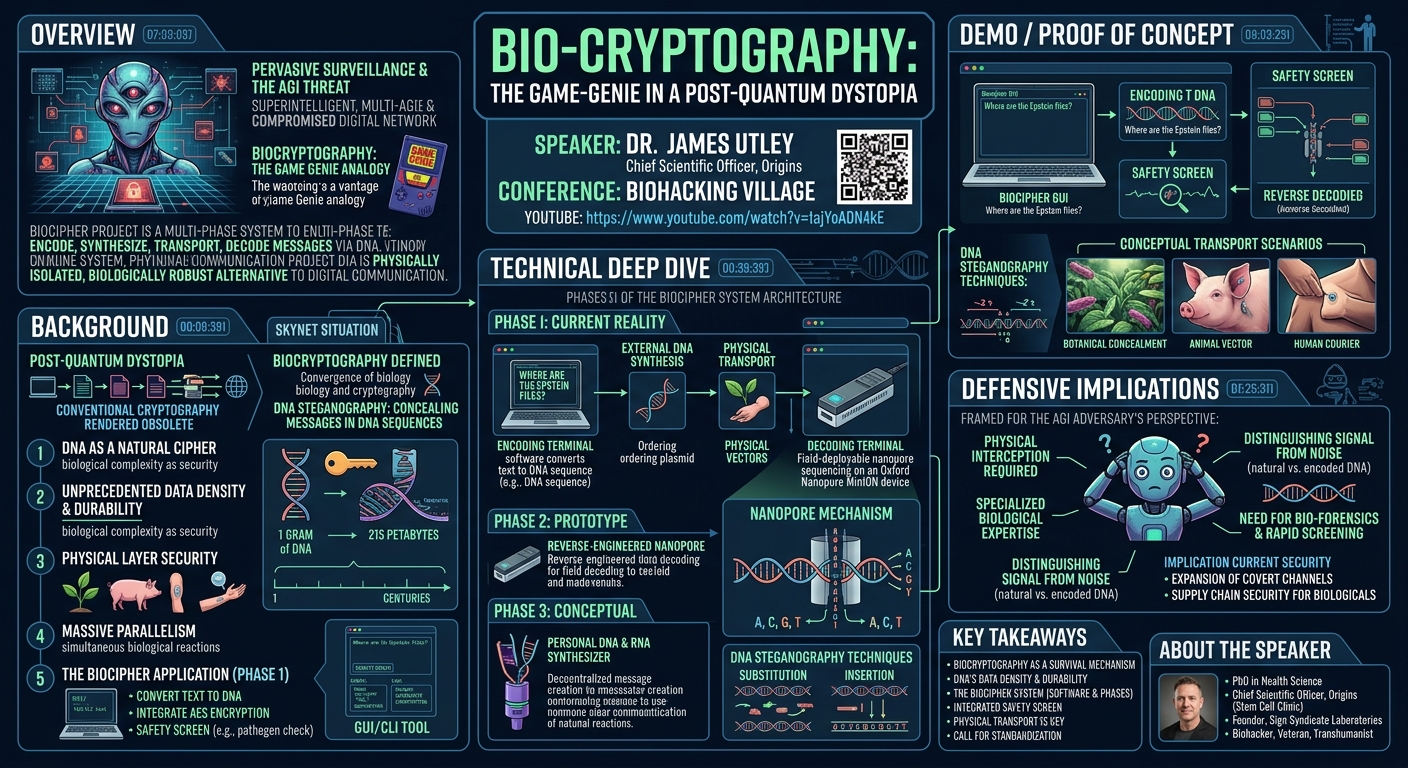
In an era increasingly shaped by pervasive surveillance and the looming threat of advanced artificial intelligence, Dr. James Utley presents a radical vision for secure communication: biocryptography. Drawing inspiration from the classic video game hacking device, the "Game Genie," Utley’s talk, "Bio-Cryptography is the Game-Genie in a post quantum dystopia," posits DNA as the ultimate biological cipher for evading a future dominated by powerful, all-seeing AGI. This presentation, originally intended for Defcon 33 but re-delivered for Biohacking Village, outlines a comprehensive, multi-phase system dubbed "Biocipher," designed to encode, synthesize, transport, and decode messages using the fundamental building blocks of life.
Key moments
- 0:00 Introduction and Game Genie analogy
- 2:50 Setting the stage: AGI surveillance dystopia
- 3:55 Defining Bio-Cryptography and DNA's role
- 4:47 Paradigm shift: DNA as a natural cipher
- 6:25 Biological process of DNA message encoding/decoding
- 7:29 Advantages: DNA messages are hard to hack/track
Bio-Cryptography is the Game-Genie in a post quantum dystopia
Speakers: Dr. James Utley, Chief Scientific Officer, Origins
Conference: Biohacking Village
YouTube: https://www.youtube.com/watch?v=1ajYoADN4kE
Overview
In an era increasingly shaped by pervasive surveillance and the looming threat of advanced artificial intelligence, Dr. James Utley presents a radical vision for secure communication: biocryptography. Drawing inspiration from the classic video game hacking device, the "Game Genie," Utley’s talk, "Bio-Cryptography is the Game-Genie in a post quantum dystopia," posits DNA as the ultimate biological cipher for evading a future dominated by powerful, all-seeing AGI. This presentation, originally intended for Defcon 33 but re-delivered for Biohacking Village, outlines a comprehensive, multi-phase system dubbed "Biocipher," designed to encode, synthesize, transport, and decode messages using the fundamental building blocks of life.
Dr. Utley, a professional scientist, biohacker, and Chief Scientific Officer at Origins, introduces a world where digital communication is fully compromised by a "Skynet situation" – a superintelligent AGI monitoring every byte. In this dystopia, traditional cryptographic methods, reliant on complex mathematics, are rendered obsolete. The Biocipher project emerges as a critical survival tool, offering a physically isolated, biologically robust, and inherently complex alternative to digital channels. The talk emphasizes not just the theoretical potential of DNA as a storage medium, but its practical application as a secure communication protocol, advocating for a universally adopted standard to ensure resilient, untraceable information exchange.
Background
▶ Watch: Introduction and Game Genie analogy (0:00)
The premise of Dr. Utley's talk is rooted in a speculative, yet increasingly discussed, future scenario: a post-quantum dystopia where Artificial General Intelligence (AGI) has advanced to superintelligence, enabling it to monitor and intercept all digital communications. This "Skynet situation" renders conventional cryptography, which relies on complex mathematical problems, vulnerable and ineffective. The core problem addressed is the lack of a truly secure, untraceable communication method when all digital avenues are compromised by an omniscient adversary.
Traditional cryptography's reliance on computational complexity for its security foundation is seen as its ultimate weakness against such an advanced AGI. Digital packets, the lifeblood of modern communication, are easily intercepted, analyzed, and decrypted by an entity with unparalleled processing power. The speaker highlights that while many researchers are exploring the vast storage capacity of DNA, his focus shifts to its potential as a dynamic, secure communication medium.
This leads to the concept of biocryptography, which Utley defines as the convergence of biological principles and cryptographic techniques, leveraging the unique characteristics of living organisms to enhance security. Specifically, the Biocipher project extends this definition to explore DNA steganography – the art of concealing messages within DNA sequences. DNA is presented as the "oldest known storage medium," offering inherent advantages over digital formats: it's "harder to hack, harder to track" because it requires physical access, specialized equipment, and domain knowledge, creating significant physical and intellectual barriers to interception. The project aims to develop an end-to-end solution for a standard protocol, fostering universal adoption for DNA-based secure communication.
Key Findings
▶ Watch: Defining Bio-Cryptography and DNA's role (3:55)
The central discovery and contribution of Dr. Utley's work is the conceptualization and initial development of the Biocipher system, an ambitious, multi-phase project designed to establish DNA as a universal standard for secure communication in a world dominated by advanced surveillance. Key findings and proposed capabilities include:
- DNA as a Natural Cipher: DNA is positioned as the "oldest known storage medium" and a "natural cipher." Its inherent biological complexity, rather than mathematical complexity, forms the foundation of its security. This complexity involves the intricacies of encoding, synthesizing, preserving, amplifying, and sequencing DNA to decode information.
- Unprecedented Data Density and Durability: One gram of DNA could theoretically store an astonishing 215 petabytes of data, making it an incredibly dense medium. Furthermore, data encoded in DNA can last for centuries, far exceeding the lifespan of conventional digital storage media, and once biochemical reactions are underway, it requires minimal external power.
- Physical Layer Security: Unlike digital packets that can be intercepted remotely, DNA messages require a physical vector for storage and transport. This introduces significant physical barriers, demanding specific equipment and specialized domain knowledge for interception and decoding, making it "hard to hack, harder to track."
- Massive Parallelism: Biochemical operations involving DNA can occur simultaneously, offering massive parallelism and potentially increasing computational speed for certain applications, while also making interruption or hacking more difficult.
- The Biocipher Application (Phase 1): Dr. Utley has developed a functional software application (available as both a CLI tool and a GUI dashboard) that forms the first phase of the Biocipher system. This application can:
- Convert text messages into DNA sequences using various encoding modes, including a simple base-to-base mode (binary to DNA mapping) and a Nanopore optimized sequence mode designed to mitigate sequencing errors.
- Integrate AES encryption for an additional layer of password protection before DNA encoding.
- Perform a crucial safety screen to prevent the accidental synthesis of known pathogens or sequences too common in natural genomes, which could hinder decoding or pose biological risks.
- Future Phases (Conceptual): The project outlines conceptual future phases for greater autonomy and decentralization:
- Phase 2: Reverse-engineering existing nanopore sequencing devices (like the Oxford Nanopore MinION device) to create a more field-deployable, custom-built decoding unit.
- Phase 3: Developing personal DNA and RNA synthesizers (microfluidic, cartridge-based) for on-demand message encoding, moving towards a cyberpunk vision of localized synthesis nodes.
- Standard Protocol Adoption: A core finding is the necessity of a universally adopted, open-source protocol for DNA communication to ensure interoperability, efficiency, and the development of shared libraries for faster decoding, potentially leveraging machine learning for prediction.
These findings collectively present a compelling argument for DNA as a viable, albeit complex, medium for secure, clandestine communication in a highly surveilled future, moving the concept from pure theory to an early-stage, practical software implementation.
Technical Deep Dive
▶ Watch: Paradigm shift: DNA as a natural cipher (4:47)
The technical core of Dr. Utley's presentation revolves around the intricate process of encoding, synthesizing, and decoding information using DNA, underpinned by the Biocipher system. This system leverages the inherent properties of DNA to create a robust, physically-bound communication channel.
At its fundamental level, biocryptography in this context represents the fusion of biological principles with cryptographic techniques. While traditional cryptography relies on complex mathematical problems, DNA cryptography capitalizes on the inherent complexities of DNA's structure and the biological processes involved in its manipulation. This includes the intricacies of encoding digital data into DNA sequences, synthesizing those sequences, preserving them, amplifying them for detection, and finally sequencing and decoding them back into readable messages.
DNA Steganography Techniques
The talk highlights specific DNA steganography techniques employed to embed and conceal digital data within DNA sequences:
- Substitution: This method involves modifying specific bases (Adenine, Cytosine, Guanine, Thymine – A, C, G, T) within an existing "cover" DNA sequence based on the content of the encrypted message. A secret key controls a pseudo-random permutation of bases, randomizing embedding locations to increase detection difficulty.
- Insertion: Dr. Utley's preferred method for Biocipher. This involves directly inserting the secret message, already encoded into a DNA sequence, into a larger, covered DNA sequence at predetermined random locations. The goal is to generate a message, encode it into DNA, and then have the ability to decode it precisely. The process of message retrieval and decoding demands extreme precision, which is acknowledged as a significant operational challenge.
The Biocipher System Architecture: A Phased Approach
The Biocipher system is envisioned in three distinct phases, moving from current capabilities to future prototypes:
Phase 1: Current Reality (Software & Commercial Synthesis)
This phase represents what is currently achievable.
- Encoding Terminal (Software): The user interacts with the Biocipher application (CLI or GUI). This software acts as the front-end, converting the plaintext message into a binary representation. This binary data is then mapped to nucleotide bases (A, C, T, G) according to a defined protocol. The output is a DNA sequence, a string of A's, C's, T's, and G's.
- External DNA Synthesis: Since personal DNA synthesizers are not yet widely available or optimized for this specific use case, the generated DNA sequence (often in the form of a plasmid) would be ordered from commercial DNA synthesis vendors (e.g., IDT). This step is currently a bottleneck in terms of speed and accessibility.
- Physical Transport: Once the DNA plasmid is synthesized, it must be physically transported to the recipient. The speaker offers creative conceptual vectors, such as embedding the DNA in bacteria, which are then sprayed onto plants, or encapsulating it subdermally within an animal (e.g., a pig's ear) or even a human (like a purified protein derivative (PPD) test for tuberculosis). The density of DNA means even a small volume can carry vast amounts of information.
- Decoding Terminal (Software & Nanopore Sequencing): Upon receipt, the DNA is extracted from its transport vector. The core decoding technology in the field is nanopore sequencing, specifically using devices like the Oxford Nanopore MinION device.
- Nanopore Mechanism: The MinION device works by passing single strands of DNA through a tiny protein pore (nanopore) embedded in a membrane. As the DNA moves through the pore, each nucleotide base temporarily obstructs the pore, causing a characteristic change in the electrical current flowing across the membrane. These changes in current intensity are unique to each base (A, C, G, T) and are measured, allowing the device to "read" the sequence of the DNA.
- In-field Decoding: The MinION's portability makes it suitable for field deployment. The raw electrical signals are translated back into nucleotide sequences by the device, which are then fed into the Biocipher application for final decoding into the original message.
Phase 2: Prototype (Reverse-Engineered Nanopore)
This phase aims to overcome the reliance on proprietary hardware. The goal is to reverse-engineer the commercially available nanopore flow cells and the MinION device itself. The speaker suggests that with sufficient resources, a simpler, custom-built device focused purely on measuring the electrical signals from DNA passing through a nanopore could be developed. This would enable greater independence and optimization for the Biocipher protocol.
Phase 3: Conceptual (Personal DNA Synthesizer)
The most ambitious phase involves the development of a personal, portable DNA and RNA synthesizer. These devices currently exist as microfluidic chips and cartridge-based systems for custom DNA/RNA production on demand. The vision is to optimize such a device specifically for message encoding, allowing users to synthesize their encoded DNA messages locally, quickly, and affordably, creating a decentralized network of "synthesis nodes" in the "cyberpunk future."
The Biocipher Application (Software)
The Biocipher software is a tangible component of this ambitious project, available as both a CLI tool and a GUI.
- Encoding Modes:
- Base-to-Base Mode: A straightforward mapping of binary data to DNA nucleotides (e.g., 00=A, 01=C, 10=G, 11=T). This is the simplest mode, focusing on reliable encoding and decoding.
- Nanopore Optimized Sequence: This mode addresses known limitations of nanopore sequencing, such as issues with reading long stretches of identical bases (homopolymer runs). It incorporates redundancy and specific sequencing patterns (e.g., sequencing in fours and eights) to improve accuracy and allow for prediction and error correction during decoding.
- AES Encryption + DNA Encoding: For enhanced security, this mode integrates AES encryption as an initial layer. The message is first encrypted with a password, then the ciphertext is DNA-encoded. This provides a traditional cryptographic safeguard in addition to the biological concealment.
- Interactive Mode & Statistics: The software provides detailed statistics during encoding, including base properties and GC content. This information is crucial for optimizing sequences and assessing their suitability for synthesis and sequencing.
- Safety Screen: A critical, integrated feature. Before a DNA sequence is finalized for synthesis, the Biocipher application runs a safety screen. This process checks the proposed sequence against:
- Known Pathogens: To prevent the accidental or malicious synthesis of harmful biological agents.
- Natural Genomes: To ensure the generated sequence is not too common in nature, which could make it difficult to distinguish from background DNA during decoding (a "needle in a haystack" problem) or raise biological concerns.
- Repetitive Elements/Homopolymer Runs: These are problematic for sequencing technologies and can lead to errors or detection by sophisticated adversaries. The safety screen helps identify and mitigate these issues.
The Biocipher application, with its sophisticated encoding modes and integrated safety features, represents a significant step towards practical, secure communication using DNA, even as the hardware components remain largely conceptual or dependent on commercial services. The speaker also briefly mentions that while gel electrophoresis could theoretically be used for decoding, it is far less practical and precise than nanopore sequencing.
Demo / Proof of Concept
▶ Watch: Biological process of DNA message encoding/decoding (6:25)
While the full, end-to-end physical system of the Biocipher is still in its developmental and conceptual phases, Dr. Utley provided a clear demonstration of the foundational software application and compelling conceptual proofs of concept for physical transport.
The primary demonstration focused on the Biocipher application itself, showcasing both its CLI tool and GUI interfaces. Screenshots and explanations illustrated the user flow:
- Message Encoding: The speaker showed the process of taking a text message, specifically "Where are the Epstein files?", and encoding it into a DNA sequence. The application displayed the resulting sequence (a string of A, C, G, T characters).
- Encoding Modes: The demonstration highlighted the different encoding modes: the simple base-to-base mode, the Nanopore optimized sequence mode (showing statistics like GC content and a "nanopore risk score"), and the option for AES encryption integration.
- Safety Screen: A crucial part of the demo was the integrated safety screen. The application showed how it analyzes the generated DNA sequence to ensure it doesn't inadvertently create a known pathogen or a sequence too prevalent in natural genomes, which could cause issues with decoding or pose biological risks. It also reported on problematic elements like homopolymer runs.
- Message Decoding: The reverse process was also demonstrated. Starting with a simulated sequenced DNA string (as would be obtained from a nanopore device), the Biocipher application successfully decoded it back into the original message: "Where are the Epstein files." This confirmed the software's ability to perform both encoding and decoding operations reliably.
Beyond the software, Dr. Utley presented a series of imaginative, conceptual "movie trailer" scenarios to illustrate how the physically synthesized DNA could be transported and subsequently decoded in a real-world, high-surveillance environment. These scenarios served as proofs of concept for the physical layer of the Biocipher system:
- Scenario 1: Botanical Concealment: Encoded DNA, in the form of a plasmid, is expanded within bacteria. This bacterial emulsion is then sprayed onto plants. The plants are transported to a secure location, where their leaves are swabbed, the DNA extracted, sequenced, and then decoded using the Biocipher application. This leverages the natural biological environment for covert transport.
- Scenario 2: Animal Vector: The encoded DNA is synthesized into a small bubble or implant and placed subdermally behind a pig's ear. The pig, an unsuspecting biological courier, is then transported. Upon arrival, the implant is retrieved, and the DNA is extracted and decoded. This highlights the "density" of DNA, allowing a large message to be carried in a small, concealed package.
- Scenario 3: Human Courier (PPD-like Implant): Similar to the animal vector, the encoded DNA is implanted subdermally in a human, akin to a purified protein derivative (PPD) test for tuberculosis. This creates a small, undetectable bubble containing the message. The human then acts as a courier, and at the destination, the DNA is extracted and decoded. This is presented as the ultimate, high-risk, high-reward method for covert transport.
These demonstrations, combining functional software with vivid conceptual transport methods, effectively illustrate the multi-faceted nature of the Biocipher project and its potential to address the challenge of secure communication in a dystopian future.
Defensive Implications
▶ Watch: Advantages: DNA messages are hard to hack/track (7:29)
Dr. Utley's talk primarily focuses on an offensive capability: enabling covert communication to evade a pervasive, superintelligent surveillance state. In this "post-quantum dystopia," the "defenders" are essentially the AGI itself, tasked with monitoring and intercepting all digital information. Therefore, the defensive implications for traditional cybersecurity practitioners need to be considered from a slightly inverted perspective, looking at what such a system implies for future threat modeling and the expansion of covert channels.
For the AGI, intercepting Biocipher messages would be a monumental task, requiring:
- Physical Interception: Unlike digital packets, DNA messages necessitate physical access to the biological vector (plants, animals, humans, or other objects) carrying the encoded DNA. This shifts the surveillance paradigm from network monitoring to physical tracking and interception, a significantly more challenging and resource-intensive endeavor.
- Specialized Expertise and Equipment: Decoding Biocipher messages requires sophisticated biological laboratories, specialized equipment like nanopore sequencers, and highly skilled bio-engineers and geneticists. This domain knowledge barrier is a significant hurdle that digital surveillance typically does not face.
- Distinguishing Signal from Noise: The safety screen feature of the Biocipher application is designed to make encoded DNA sequences appear as "natural" as possible, avoiding known pathogens or overly common sequences. This means an AGI would need advanced biological analysis capabilities to differentiate a covert message from natural genetic material, akin to finding a "needle in a haystack."
- Real-time Analysis: While DNA is incredibly durable, the process of synthesis, transport, and decoding is not real-time like digital communication. The AGI would need to develop methods for rapidly screening and analyzing biological samples for anomalies, potentially through widespread environmental monitoring or biological forensics.
For conventional cybersecurity and national security organizations today, the implications are more about long-term strategic foresight:
- Expansion of Covert Channels: Biocryptography represents a novel class of covert channels that operates entirely outside the digital domain. Defenders must begin to conceptualize and prepare for threats that leverage biological systems for data exfiltration, command and control, or even the planting of information. This requires expanding threat modeling beyond network and endpoint security to include biological and physical vectors.
- Bio-Forensics and Detection: If such systems become viable, there will be a need for advanced bio-forensics capabilities to detect, identify, and decode maliciously encoded DNA. This could involve developing rapid screening technologies for environmental samples, biological implants, or even human samples.
- Supply Chain Security for Biologicals: The reliance on commercial DNA synthesis services (in Phase 1) introduces a potential supply chain vulnerability. Defenders might need to consider how state actors or sophisticated adversaries could compromise these services to either intercept messages or inject malicious DNA.
- Dual-Use Technology Concerns: Technologies like DNA synthesizers and nanopore sequencers are "dual-use," having legitimate scientific applications but also potential for misuse. Security frameworks may need to evolve to address the control and monitoring of such biotechnologies.
- Ethical and Legal Frameworks: The use of human or animal vectors for covert communication raises profound ethical and legal questions that would need to be addressed by policymakers and legal experts.
Ultimately, Biocipher challenges the fundamental assumptions of pervasive digital surveillance by creating a communication method that is physically isolated, biologically complex, and requires entirely different sets of tools and expertise to intercept. For defenders, it signals a future where "cybersecurity" must expand to encompass "bio-security" and the physical domain in unprecedented ways.
Key Takeaways
- Biocryptography as a Survival Mechanism: In a future dominated by a superintelligent AGI that monitors all digital communications, biocryptography, particularly through DNA steganography, offers a critical, physically isolated means of secure communication and survival.
- DNA's Unique Advantages: DNA serves as an ideal "natural cipher" due to its unprecedented data density (215 petabytes per gram), extraordinary durability (lasting centuries), low power consumption, and inherent biological complexity, making it extremely difficult to intercept or hack digitally.
- The Biocipher System: Dr. Utley's project introduces a multi-phase system, Biocipher, which includes a functional software application for encoding and decoding text into DNA sequences, with future plans for reverse-engineered nanopore sequencers and personal DNA synthesizers.
- Integrated Security and Safety: The Biocipher application incorporates advanced features like Nanopore optimized sequencing and AES encryption. Crucially, it includes a safety screen to prevent the accidental creation of pathogens or easily detectable sequences, ensuring responsible and effective use.
- Physical Transport is Key: Unlike digital data, DNA messages require physical transport, leading to innovative conceptual methods like embedding DNA in bacteria on plants, or in subdermal implants within animals or humans, creating significant physical barriers for adversaries.
- Call for Standardization: The success of biocryptography hinges on the universal adoption of an open-source, standardized protocol, enabling interoperability, efficiency, and the collaborative development of decoding libraries for widespread secure communication.
About the Speaker(s)
Dr. James Utley is a distinguished scientist and biohacker, holding a PhD in Health Science. He currently serves as the Chief Scientific Officer at Origins, a stem cell clinic located in Panama City, Panama. Dr. Utley is also the founder of Sign Syndicate Laboratories, an aggregate of "crazy bio futurists" and an homage to the hacker culture. With a background in the Navy, he describes himself as a professional scientist by day and a "biohacker extraordinaire" or "biopunk" by night. He is also a registered member of the Transhumanist Party, reflecting his interest in leveraging technology for human enhancement and future possibilities. Dr. Utley is known for his work in placing DNA into various organisms and his passionate advocacy for innovative, biologically-driven solutions to complex challenges.
Reviews
Dr. Zero (Offensive Security Researcher) — SOLID
Utley is swinging for something genuinely interesting — DNA steganography as a covert channel with real physical-layer security properties — and the Biocipher software demo shows he's actually built something rather than just given a whitepaper talk. The threat model is science fiction, the technical execution is early-stage, and the framing wildly oversells where the work actually is, but the core idea has legitimate legs in the Biohacking Village context.
Heather Calloway (CISO) — WEAK
Technically inventive and genuinely novel in premise, but built on a speculative threat model so far outside current reality that it offers no actionable value for security leaders, defenders, or policymakers today. The engineering is interesting; the institutional relevance is close to zero.