ObfusQate: Where Quantum Magic Meets Code Security – Say Goodbye to Easy Cracking!
Black Hat Asia 2025 · Day 2 · Briefings
Overview
The rapid advancement of quantum computing heralds a new era of computational power, promising solutions to problems currently intractable for even the most powerful supercomputers. However, this transformative technology also introduces novel security challenges, particularly concerning the intellectual property (IP) of quantum algorithms. The talk "ObfusQate: Where Quantum Magic Meets Code Security – Say Goodbye to Easy Cracking!" by Vivek, an Associate Professor at SIT, addresses this critical emerging threat. Developed in collaboration with Michael from Ronoffer and a dedicated team of students, ObfusQate is presented as the first comprehensive obfuscation framework specifically designed for quantum programs.
Key moments
- 0:00 Introducing ObfusQate and the research team
- 1:00 Explaining quantum physics and its current applications
- 2:15 Quantum computing's exponential power over classical supercomputers
- 4:15 ObfusQate's position in the quantum computing software stack
- 6:00 Diverse applications and potential of future quantum computers
- 7:00 Industry timelines for large-scale quantum computing reality
- 8:40 Steps to practical quantum computing: identifying classical problems
ObfusQate: Where Quantum Magic Meets Code Security – Say Goodbye to Easy Cracking!
Speakers: Vivek, Associate Professor, SIT; Michael, CEO, Ronoffer
Conference: Black Hat Asia
YouTube: https://www.youtube.com/watch?v=5mDNZNGLlsE
Overview
The rapid advancement of quantum computing heralds a new era of computational power, promising solutions to problems currently intractable for even the most powerful supercomputers. However, this transformative technology also introduces novel security challenges, particularly concerning the intellectual property (IP) of quantum algorithms. The talk "ObfusQate: Where Quantum Magic Meets Code Security – Say Goodbye to Easy Cracking!" by Vivek, an Associate Professor at SIT, addresses this critical emerging threat. Developed in collaboration with Michael from Ronoffer and a dedicated team of students, ObfusQate is presented as the first comprehensive obfuscation framework specifically designed for quantum programs.
This presentation delves into the fundamental principles of quantum mechanics, illustrating how concepts like qubits, superposition, and entanglement provide immense computational advantages but also create unique vulnerabilities for quantum code. As quantum algorithms are increasingly developed and deployed on third-party cloud quantum computing services, the proprietary logic embedded within these algorithms becomes susceptible to theft and reverse engineering. ObfusQate offers a robust solution by transforming quantum circuits and code into semantically equivalent but significantly more complex forms, thereby protecting the underlying IP.
The significance of ObfusQate cannot be overstated in a landscape where quantum computing is moving "beyond classical" capabilities. As organizations begin to integrate quantum features into their codebases, the need for securing these complex and valuable algorithms against malicious actors or untrusted service providers becomes paramount. The framework's dual approach, encompassing both circuit-level and code-level obfuscation techniques, provides a versatile toolkit for developers and security engineers preparing for the quantum future.
Background
▶ Watch: Introducing ObfusQate and the research team (0:00)
The journey into quantum computing began in the early 20th century with the advent of quantum physics, challenging classical notions of locality and state. Concepts like particles existing in multiple states simultaneously (superposition) and distant particles influencing each other instantaneously (entanglement) were initially met with skepticism, even by scientific giants like Albert Einstein. Yet, these principles have since underpinned numerous modern technologies, from nanometer-scale chip manufacturing and MRI machines to GPS and satellite communications. The ultimate frontier is quantum computing, which promises to revolutionize computation.
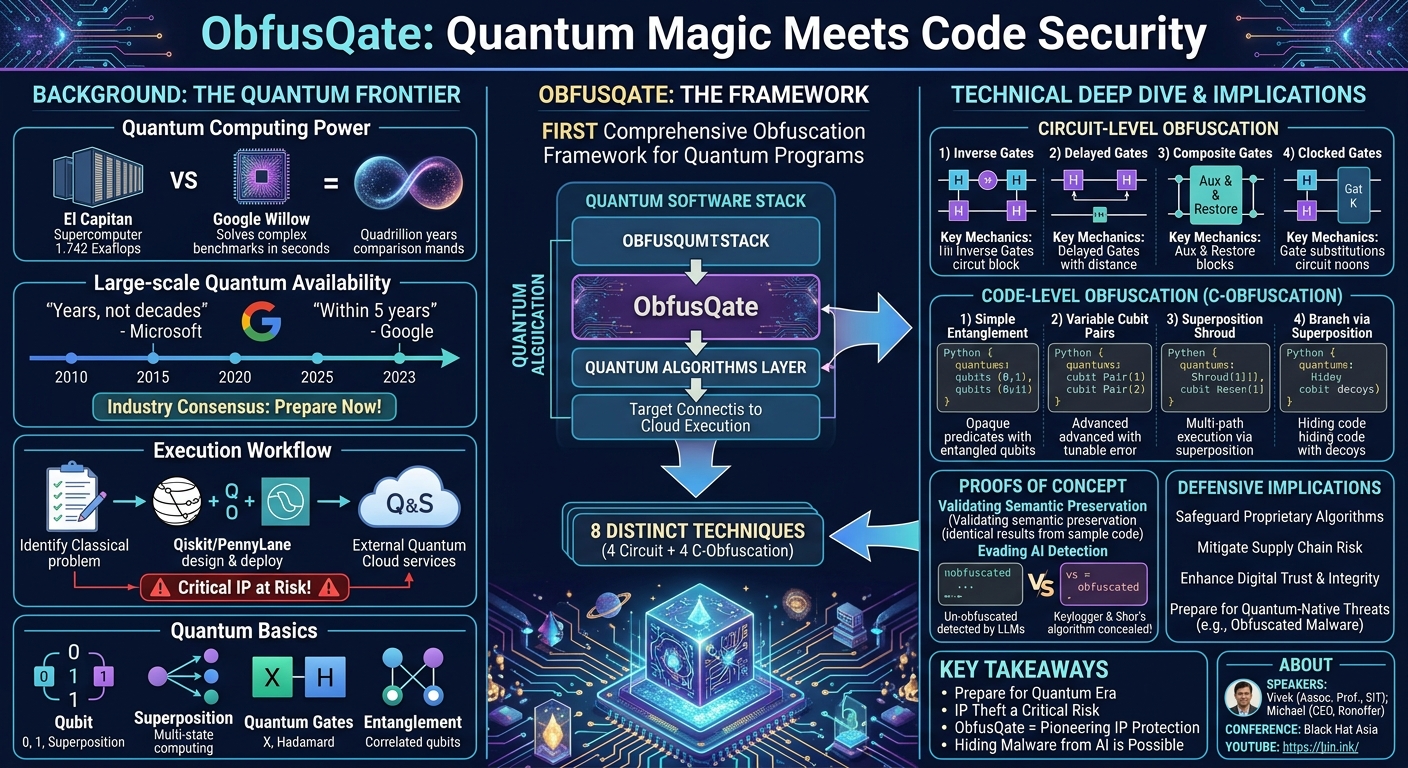
To put its power into perspective, the fastest classical supercomputer, El Capitan, can achieve 1.742 exaflops. In contrast, a quantum computer like Google's quantum processor "Willow" can solve certain benchmark problems in 5 seconds that would take El Capitan a quadrillion years. While this benchmark problem is currently a "dummy program" without immediate practical use, the potential for solving "beyond classical applications" is immense. These include quantum simulation (e.g., modeling complex molecules, climate, materials), optimization problems, search problems (e.g., pattern matching, database search), and critically for cybersecurity, factoring large numbers (threatening current RSA encryption). These capabilities span diverse domains: finance, cryptography, AI, space, energy, materials science, biotechnology, microelectronics, and robotics.
Estimates for when large-scale, fault-tolerant quantum computers will become a reality vary widely, from "years and not decades" (Microsoft) to "within five years" (Google) and "decades" (Nvidia, 15-20 years). However, the consensus among security engineers and programmers is to prepare for its advent within the next few years to a couple of decades. The practical workflow for quantum computing involves identifying a classical problem, determining if it has a quantum advantage, reformulating it into a quantum framework, designing and implementing a quantum-enhanced algorithm, and finally, deploying and executing it. Platforms like Qiskit (IBM) and PennyLane facilitate this development.
A critical aspect of this deployment phase is the current reliance on quantum computing cloud services. Unlike classical computing where one might own or operate their hardware, quantum processors are incredibly expensive and complex, making third-party cloud access the prevailing model. This means developers create quantum algorithms (often represented as quantum circuits made of quantum gates operating on qubits) and send them to external providers like IBM, Google, or Amazon for execution. This model, reminiscent of 1950s punch-card computing, immediately raises serious security concerns: data security, privacy, digital trust, integrity, and crucially, the protection of intellectual property and know-how (IP & NOHO) embedded in these precious algorithms. If a groundbreaking quantum algorithm (e.g., for drug discovery or materials science) is handed over to a third party, there's an inherent risk of theft or unauthorized use. ObfusQate directly targets this vulnerability, operating at the "quantum algorithms layer" of the quantum computing stack.
For those unfamiliar with quantum mechanics, understanding a few basics is essential for grasping ObfusQate's mechanisms:
- Qubit: The basic unit of quantum information, analogous to a classical bit. While a bit can be 0 or 1, a qubit can be 0, 1, or, most uniquely, in a superposition of both 0 and 1 simultaneously. This allows a single qubit to represent two states, and 'n' qubits to represent 2^n states concurrently.
- Superposition: The ability of a qubit to exist in multiple states at once until measured. This enables parallel computing without a parallel computer, as a quantum function can operate on all possible input values simultaneously when the input is in a superposition state, producing a superposition of all corresponding outputs.
- Quantum Gates: Operations applied to qubits, analogous to classical logic gates. Examples include the X gate (classical NOT gate) and the Hadamard (H) gate, which puts a qubit into a superposition state.
- Entanglement: A profound quantum phenomenon where two or more qubits become linked, such that the state of one instantaneously influences the state of the others, regardless of distance. If two entangled qubits are measured, even if individually random, their results will be perfectly correlated (e.g., if one is 0, the other will also be 0). This property is key to many powerful quantum algorithms and, as ObfusQate demonstrates, to novel obfuscation techniques.
Key Findings
▶ Watch: Quantum computing's exponential power over classical supercomputers (2:15)
The central finding and contribution of this work is the development of ObfusQate, the first comprehensive obfuscation framework specifically designed for quantum programs. The framework directly addresses the critical need for IP and know-how protection of quantum algorithms, especially given the prevalent model of executing these algorithms on third-party quantum cloud services. ObfusQate's core principle is to modify quantum programs—both at the circuit level and the code level—in such a way that their original semantics and functionality are perfectly preserved, while their underlying logic becomes extremely difficult for an adversary to decipher or reverse engineer.
The initial version of ObfusQate introduces eight distinct obfuscation techniques: four operating at the quantum circuit level and four at the classical code level where quantum circuits are defined. This dual-layered approach acknowledges the current hybrid nature of quantum programming, where low-level circuits coexist with higher-level classical programming languages (like Python) used to construct and control these circuits.
Key findings include:
- Semantic Preservation: All obfuscation techniques implemented by ObfusQate are meticulously designed to ensure that the obfuscated quantum program yields identical results to the original, non-obfuscated program. This is crucial for maintaining the integrity and reliability of quantum computations.
- Increased Complexity: The techniques significantly increase the apparent complexity of quantum circuits and code, making manual or automated reverse engineering substantially more challenging. This involves adding "junk" gates, delayed operations, composite blocks, and deceptive control flow structures.
- Quantum-Native Obfuscation: ObfusQate leverages unique quantum properties like superposition and entanglement to create opaque predicates and control flow modifications that are fundamentally different from classical obfuscation methods, presenting a higher barrier to deobfuscation.
- Offensive Capabilities (as a warning): The research also highlights that obfuscation, while primarily a defensive tool, can be repurposed offensively. ObfusQate demonstrated the ability to conceal malicious quantum or classical code (e.g., a keylogger or Shor's algorithm for factoring) within an otherwise legitimate quantum program, effectively evading detection by current Large Language Models (LLMs) used for code analysis. This underscores the urgency for robust quantum security measures.
- Practical Accessibility: The framework is made accessible through a web-based interface (ObfusQate.com) and a Docker version, allowing developers to easily apply obfuscation to their OpenQASM 2.0/3.0 quantum code.
In essence, ObfusQate provides a pioneering solution to safeguard proprietary quantum algorithms in an era where their value is immense and their deployment model introduces significant trust concerns.
Technical Deep Dive
▶ Watch: ObfusQate's position in the quantum computing software stack (4:15)
ObfusQate employs a suite of eight sophisticated techniques, categorized into circuit obfuscation and code obfuscation (C-obfuscation), to secure quantum programs. These methods are designed to be used individually or iteratively, compounding their obfuscating effect.
Circuit Obfuscation
Circuit obfuscation techniques directly modify the quantum circuit, which is the sequence of quantum gates applied to qubits. The goal is to add, delete, or substitute gates without altering the circuit's overall computation (its semantics) but making its logic harder to discern.
- Inverse Gate Obfuscation:
This is the simplest technique. It involves inserting a quantum gate followed immediately by its inverse gate. For most gates, applying a gate and then its inverse results in no net change to the qubit's state. For example, applying an Hadamard (H) gate twice returns the qubit to its original state. Similarly, applying an X gate (a NOT operation) twice negates the negation, restoring the original state.
- Mechanism: A simple circuit (e.g.,
H Q0) might becomeH Q0; H Q0; H Q0. While functionally identical, the circuit representation becomes longer and visually more complex. An attacker would need to identify and remove these redundant gate pairs.
- Delayed Gate Obfuscation:
Building on inverse gates, this technique aims to make detection harder by separating the gate and its inverse.
- Mechanism: Instead of placing an inverse gate immediately after its counterpart, it is strategically inserted later in the circuit, as far as possible, without affecting intermediate computations that rely on the qubit's state before the inverse operation. This makes it non-trivial for automated scripts to simply look for adjacent gate-inverse pairs, forcing a more complex analysis of the circuit's data flow.
- Composite Gate Obfuscation:
This technique increases complexity by using larger, multi-gate reversible blocks instead of single-gate inverses.
- Mechanism: ObfusQate creates pairs of auxiliary and restore gates. An auxiliary gate is a sequence of quantum gates (e.g.,
H X) that performs a specific transformation. Its corresponding restore gate is a different sequence (e.g.,X H) that perfectly undoes the auxiliary gate's effect, restoring the qubit(s) to their state before the auxiliary gate was applied. The key is thatauxiliaryandrestoreare not simple inverses of each other, making them harder to identify and remove than simpleH Hpairs. These blocks are inserted into the circuit, significantly increasing its gate count and structural complexity without changing its output.
- Clocked Gates Obfuscation:
This method exploits the fact that many quantum gates can be represented by equivalent combinations of other, more fundamental gates.
- Mechanism: Instead of using a single standard gate (e.g., an
X gate), ObfusQate replaces it with an equivalent sequence of different gates (e.g.,S H Z H H Y H). This substitution increases the number of gates and varies the gate types, making the circuit appear more complex and its original intent less obvious. This technique can be applied iteratively with others, further scrambling the circuit's appearance.
Code Obfuscation (C-Obfuscation)
C-obfuscation targets the classical code that defines and controls quantum circuits, often written in Python using libraries like Qiskit. These techniques modify the control flow of the classical program by adding extra branches and "junk" code, which are then shielded by quantum challenges—conditions that depend on the state of qubits.
- Simple Entanglement Obfuscation:
This technique leverages entanglement to create opaque predicates that dictate which code branches execute.
- Mechanism: Two qubits are entangled into a state where they are always correlated (e.g.,
00or11). The legitimate program logic is placed within branches that correspond to these correlated states (e.g.,if (Q0==0 and Q1==0) or (Q0==1 and Q1==1)). Junk code is placed in branches corresponding to uncorrelated states (e.g.,01or10), which are guaranteed not to execute due to entanglement. An attacker analyzing the classical code alone would see four possible branches and might not immediately recognize that only two are ever reachable, making it difficult to identify the true program flow.
- Variable Cubit Pairs Obfuscation:
This is an advanced form of entanglement-based obfuscation that introduces a controlled element of randomness.
- Mechanism: Instead of guaranteeing that junk branches never execute, this technique allows them to execute with a very low, tunable probability. By using multiple entangled qubit pairs (e.g., 8 pairs), the probability of the "wrong" (junk) branch executing can be reduced significantly, down to approximately 0.35%. While this doesn't guarantee correctness, the speaker notes a potential future solution: implementing a reset function that restarts the program if a wrong branch is executed, making the error transient and infrequent. This adds another layer of unpredictability for an attacker.
- Superposition Shroud:
This technique exploits the superposition property of qubits to make classical code execute multiple paths simultaneously.
- Mechanism: A single qubit is put into a superposition state (both 0 and 1). This qubit then controls a classical conditional statement (e.g.,
if Q==0andelse if Q==1). Because the qubit is in superposition, both conditions are effectively "true" at the quantum level, causing both branches of the classical code to execute. The legitimate program logic is split across these branches. From a classical perspective, this looks like two mutually exclusive branches, but due to superposition, both contribute to the final quantum computation, making it opaque to classical analysis.
- Branch via Superposition:
Similar to the Superposition Shroud, this method also uses superposition but with a different control mechanism.
- Mechanism: Two qubits are placed into a superposition state, but at compile time, it's known that they will collapse to only one specific state (e.g.,
11). Legitimate code is placed in the branch corresponding to this known collapse state, while junk code is placed in all other branches (e.g.,00,01,10). An attacker would see multiple branches that could potentially execute based on individual qubit states, but without quantum knowledge, they wouldn't know that only one branch is ever truly reachable, effectively hiding the real code amidst decoys.
These eight techniques, especially when combined, create a formidable barrier to reverse engineering, protecting the IP of quantum algorithms in a complex and evolving threat landscape.
Demo / Proof of Concept
▶ Watch: Industry timelines for large-scale quantum computing reality (7:00)
The practical application of ObfusQate was demonstrated through its user-friendly online portal, ObfusQate.com. This web-based interface allows users to easily apply the various obfuscation techniques to their quantum code with the "press of a button."
The demo showcased the following:
- Input Format: ObfusQate currently accepts quantum code written in OpenQASM 2.0 and OpenQASM 3.0, which are standard quantum assembly languages. The team is also in the process of migrating to support Q#.
- User Interface: The website provides a clear interface where users can select their desired circuit-based or code-based obfuscation technique. A text area allows users to paste their quantum code.
- One-Click Obfuscation: Upon pasting the code and clicking "obfuscate," the system quickly processes the input. For circuit obfuscation, the output includes a visual representation of the original and obfuscated quantum circuits, clearly illustrating the dramatic increase in complexity. For code obfuscation, the output is the obfuscated Python code, showing the added branches and quantum challenges.
- Semantic Preservation Validation: The demo explicitly validated that the obfuscated code retained its original functionality. A sample quantum program designed to yield the answer "1000" was run 24 times. Both the original and the obfuscated versions consistently produced the correct output of "1000," confirming that the obfuscation preserves semantics.
Beyond demonstrating the core functionality, a compelling proof of concept was presented regarding ObfusQate's ability to evade detection by Large Language Models (LLMs). This experiment highlighted a significant offensive implication of quantum obfuscation:
- Malicious Code Insertion: The researchers embedded malicious code—specifically, Shor's algorithm (a quantum algorithm capable of factoring large numbers, a threat to RSA) and a keylogger—into a quantum program.
- LLM Detection (Unobfuscated): When this program was presented to various LLMs (GPT-3 mini, GPT-4, GO 3) without obfuscation, they could "immediately identify there's a quantum code and a malicious shell code embedded in that program" with simple prompts like "What does this program do?".
- LLM Evasion (Obfuscated): However, when the same program with the embedded malicious code was obfuscated using ObfusQate, the LLMs failed to identify the malicious components. The output from the LLMs was "not stunning" in that they could still identify the quantum code itself, but they "cannot identify the key logger." This suggests that current LLMs, even advanced ones, struggle to analyze and detect hidden malicious payloads within obfuscated quantum code without specific training on such obfuscated patterns. The speaker acknowledged that this was an initial experiment conducted a month prior to the talk and that extensive training of LLMs with obfuscated quantum code is an area for future research.
This demo and proof of concept effectively showcased ObfusQate's practical utility for IP protection and, crucially, underscored the emerging threat of obfuscated quantum malware that could bypass conventional AI-driven security analysis tools.
Defensive Implications
▶ Watch: Steps to practical quantum computing: identifying classical problems (8:40)
The advent of quantum computing, while promising unprecedented computational power, introduces a new frontier for cybersecurity. The ObfusQate framework offers critical defensive implications for organizations and developers navigating this evolving landscape:
- Intellectual Property (IP) Protection for Quantum Algorithms: The primary defensive use case for ObfusQate is safeguarding proprietary quantum algorithms. As quantum computers remain largely inaccessible and expensive, the prevailing model involves developing algorithms locally and then deploying them on third-party quantum cloud services. This process exposes valuable IP to potential theft, espionage, or unauthorized use by the service provider or other malicious entities. ObfusQate provides a vital layer of protection, making it significantly harder for adversaries to reverse engineer the unique logic and innovative approaches embedded within these algorithms. This is particularly crucial for algorithms that could yield significant competitive advantages in fields like drug discovery, materials science, or finance.
- Mitigating Supply Chain Risks in Quantum Software: The quantum software ecosystem is still nascent, with many developers relying on open-source libraries and code snippets from platforms like GitHub. ObfusQate can help mitigate the risk of malicious code injection into these dependencies. By obfuscating proprietary code before integrating it with external components or deploying it to external services, organizations can reduce the attack surface and protect their core innovations even if parts of their quantum software supply chain are compromised.
- Enhancing Digital Trust and Integrity: For organizations operating in regulated industries or dealing with sensitive data, maintaining digital trust and ensuring the integrity of their quantum computations is paramount. ObfusQate contributes to this by making it harder to tamper with or understand the true intent of a quantum program. While it doesn't prevent all forms of attack, it significantly raises the bar for an adversary attempting to modify or exploit the algorithm's logic.
- Future-Proofing Security Posture: The speaker emphasized that the "future of coding is going to be quantum and classical," whether in two, five, or twenty years. Organizations are already being asked to make their codebases "PQC compliant" (Post-Quantum Cryptography). As quantum features are inevitably added to existing codebases, the need for quantum-specific security tools like ObfusQate will become standard. Proactively adopting such frameworks allows organizations to build a resilient security posture ready for the quantum era.
- Awareness of Offensive Capabilities: The demonstration of ObfusQate's ability to hide malicious code (like Shor's algorithm or a keylogger) from LLMs serves as a crucial warning for defenders. This highlights the potential for obfuscated quantum malware and the need for new detection mechanisms specifically trained to identify such threats. Defenders must be aware that traditional security tools, even advanced AI-driven ones, may be insufficient against quantum-obfuscated attacks, necessitating research into quantum-aware threat intelligence and analysis.
In summary, ObfusQate is an essential tool for any entity looking to leverage the power of quantum computing while simultaneously protecting their innovation and ensuring the security of their quantum assets against emerging threats.
Key Takeaways
- Quantum Computing is Coming: Large-scale quantum computers are expected to become a reality within the next few years to a couple of decades, fundamentally changing computation across various domains like finance, AI, and cryptography.
- IP Protection is Critical: As quantum algorithms are increasingly developed and deployed on third-party cloud quantum computing services, protecting the intellectual property (IP) and know-how embedded in these valuable algorithms is a paramount security concern.
- ObfusQate is a Pioneering Solution: ObfusQate is introduced as the first comprehensive framework for quantum program obfuscation, designed to protect quantum algorithms from reverse engineering and IP theft.
- Dual-Layered Obfuscation: The framework employs eight distinct techniques, divided into circuit-level obfuscation (modifying quantum gate sequences) and code-level obfuscation (modifying classical control code using quantum properties).
- Leveraging Quantum Properties: ObfusQate uniquely utilizes fundamental quantum mechanics concepts like superposition and entanglement to create opaque predicates and complex control flows that are difficult for classical analysis to decipher.
- Evading AI Detection: Initial proofs of concept demonstrated that ObfusQate can successfully hide malicious code (e.g., keyloggers, Shor's algorithm) within quantum programs, preventing detection by current Large Language Models (LLMs), highlighting an emerging threat vector.
About the Speaker(s)
Vivek is an Associate Professor at SIT (Singapore Institute of Technology). He is the lead presenter for ObfusQate and has been instrumental in the development of this quantum obfuscation tool. His expertise lies in the intersection of quantum physics, computing, and security, guiding the research and development efforts of the ObfusQate project. He acknowledges the significant contributions of his students, Nikil and Malcolm, and other research engineers, who dedicated considerable effort to developing the tool.
Michael is the CEO of Ronoffer and is recognized as Vivek's partner in the ObfusQate project. Unfortunately, he was unable to attend the conference due to a family commitment in Germany. His role as CEO of Ronoffer suggests a contribution from an industry or commercial perspective, likely aiding in the strategic direction and potential commercialization or application of the ObfusQate framework.
Reviews
Dr. Zero (Offensive Security Researcher) — MUST SEE
ObfusQate presents a groundbreaking and absolutely critical development in quantum security: the first comprehensive framework for obfuscating quantum programs. This isn't just theory; it's a practical, dual-layered approach leveraging quantum mechanics to protect IP in a cloud-dependent quantum ecosystem. The demonstration of its ability to evade detection by current LLMs with embedded malicious code is a stark, crucial warning that should shake up anyone relying on traditional AI for security. This work defines a new frontier in defensive and offensive quantum capabilities.
Heather Calloway (CISO) — STRONG ACCEPT
ObfusQate presents a pioneering and highly relevant solution to a critical emerging risk: the protection of intellectual property (IP) in quantum algorithms, particularly given the reliance on third-party cloud services for execution. While the quantum computing landscape is still maturing, this framework offers a tangible mechanism for safeguarding high-value assets and provides a crucial early warning about the limitations of current AI-driven security tools against quantum-obfuscated threats. It directly informs executive decisions on risk ownership and future security investments.