Opening Remarks, Tuesday: Breaking Ground
Daemon Tamer
BSides Las Vegas 2025 · Day 1
Overview
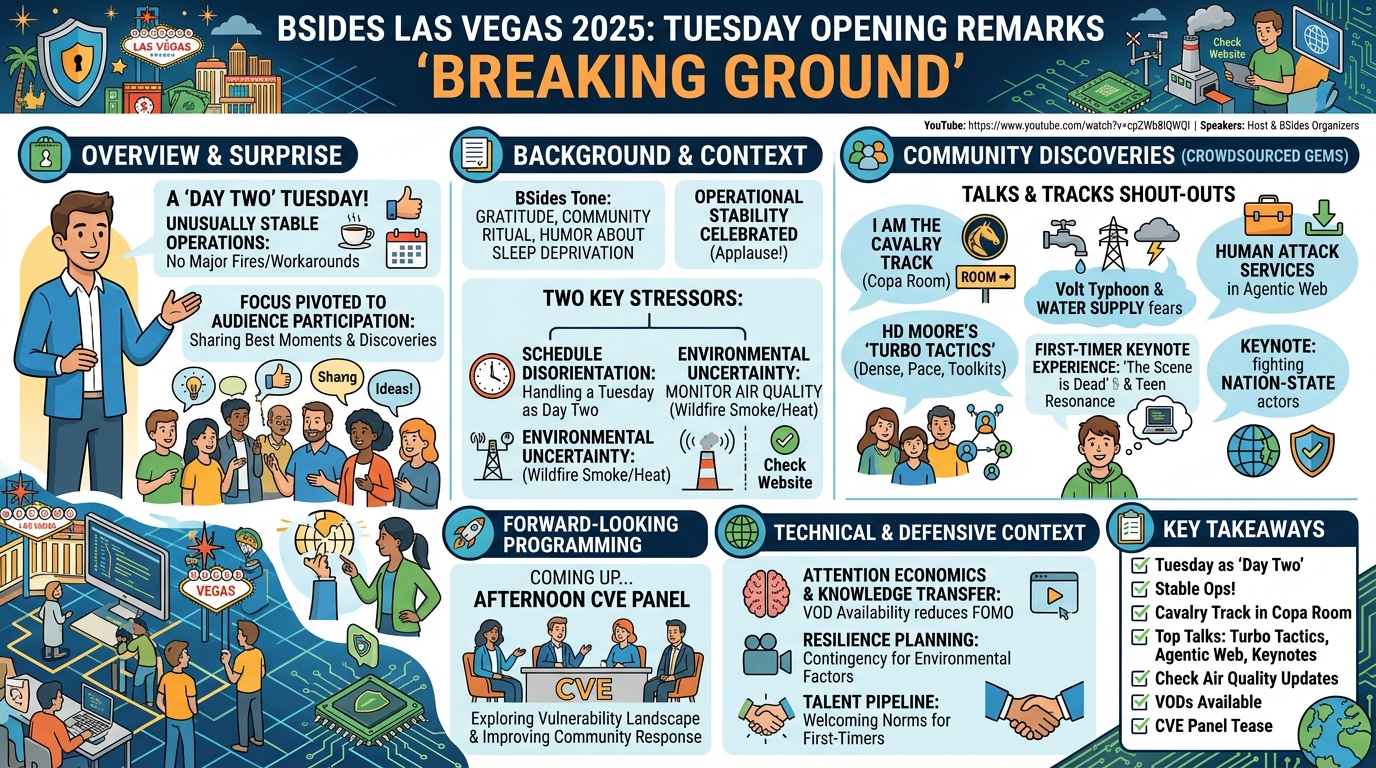
This recording captures Tuesday opening remarks for BSides Las Vegas 2025, framed by the host as the unusual “day two” experience of a Tuesday—reflecting the conference’s expanded schedule. Rather than a long list of crisis fixes, the host notes that operations are unexpectedly stable (“everything is on an even keel”), then pivots the session into audience participation: attendees share favorite moments from the prior day, recommended tracks, and memorable talks. Interwoven are practical logistics (air quality monitoring affecting outdoor plans), pointers to on-site programming (I Am The Cavalry track in the Copa room), and a forward-looking plug for an afternoon CVE panel. As conference content, it is meta: it documents community mood, serendipitous discovery, and how attendees narrate value back to one another in real time.
Key moments
- 0:00 Tuesday ‘day two’ welcome; organizer surprised there are no major operational fires to report.
- 0:45 Air-quality watch: evening events may move indoors; attendees told to monitor the conference website.
- 1:05 Audience shout-out: visit the I Am The Cavalry track downstairs in the Copa room.
- 1:25 Attendee favorite: fear-of-China / Volt Typhoon–style framing around water-supply risk (as described from a prior talk).
- 2:10 Praise for HD Moore’s ‘Turbo Tactics’ talk—density, pace, and intent to download slides.
- 2:35 Highlight: ‘human attack services’ talk as an introduction to the growing ‘agentic web’ idea.
- 3:05 First-time attendee reaction: ‘The Scene is Dead’ keynote landed as an intro to threat-intel themes.
- 4:05 Logistics close: VOD reminder, new stage for an afternoon CVE futures panel, community encouragement to connect.
Opening Remarks, Tuesday: Breaking Ground
Speakers: Host (name not stated in the recording), BSides Las Vegas organizers
Conference: BSides Las Vegas
YouTube: https://www.youtube.com/watch?v=cpZWb8iQWQI
Overview
This recording captures Tuesday opening remarks for BSides Las Vegas 2025, framed by the host as the unusual “day two” experience of a Tuesday—reflecting the conference’s expanded schedule. Rather than a long list of crisis fixes, the host notes that operations are unexpectedly stable (“everything is on an even keel”), then pivots the session into audience participation: attendees share favorite moments from the prior day, recommended tracks, and memorable talks. Interwoven are practical logistics (air quality monitoring affecting outdoor plans), pointers to on-site programming (I Am The Cavalry track in the Copa room), and a forward-looking plug for an afternoon CVE panel. As conference content, it is meta: it documents community mood, serendipitous discovery, and how attendees narrate value back to one another in real time.
Background
▶ Watch: Tuesday ‘day two’ welcome; organizer surprised there are no major operational... (0:00)
BSides events are locally run, volunteer-heavy security conferences whose tone often blends operational announcements with community ritual. This session follows that pattern: gratitude, gentle humor about sleep deprivation, and quick orientation for people navigating a multi-track venue. The host explicitly positions the moment as one where they would normally catalog fires and workarounds; the absence of major incidents becomes its own applause line.
Two contextual stressors appear in the remarks:
- Schedule disorientation — Holding “day two” on a Tuesday is called out as culturally weird, signaling how BSides Las Vegas structured extra programming (Monday activities referenced by attendees).
- Environmental uncertainty — Air quality issues are mentioned as a continuing watch item for evening events, with a possible move indoors if conditions worsen. The host asks attendees to monitor the conference website for updates.
If you treat a conference as a temporary city, “opening remarks” are the daily stand-up for that city: not always glamorous, but they synchronize thousands of semi-attentive humans who are simultaneously dehydrated, caffeinated, and trying to choose between three interesting sessions scheduled opposite each other. What is unusual here—by the host’s own surprise—is how little incident response the organizers need to perform on mic. That matters because it changes the emotional register of the room. When a conference is constantly apologizing for AV failures, room swaps, or badge printer meltdowns, attendees experience friction as the dominant story. When the host can credibly say operations are steady, the story becomes curiosity and serendipity instead. You can hear that pivot in the choice to ask, essentially, “What delighted you yesterday?” rather than “What broke?”
This also situates BSides Las Vegas within a broader Las Vegas summer security week context: people are time-zone shifted, sleep deprived, and socially overloaded. In that state, memory is fragile. A five-minute segment that helps attendees reconstruct “what was good” is not filler; it is cognitive scaffolding. It turns a blur of tracks into a handful of named anchors—anchors that later become hallway conversations, Slack threads, and post-conference viewing lists.
Key Findings
▶ Watch: Audience shout-out: visit the I Am The Cavalry track downstairs in the Copa r... (1:05)
Community discovery beats abstract marketing. When asked for favorites, attendees surface concrete artifacts: a downstairs track location (Copa), a talk framing Volt Typhoon-style infrastructure fears in a water-supply context, and multiple references to keynote content (including “The Scene is Dead” and a Monday keynote described as arguing “we’re all fighting nation-state actors”).
Talks function as shared references. HD Moore’s “Turbo Tactics” is praised for density and pace; the attendee explicitly plans to fetch the slide deck online. Another attendee highlights “human attack services in the agentic web” as an introduction to the agentic web concept and its consequences.
First-time attendee experience is visible. One participant describes “The Scene is Dead” as their first keynote ever and ties it to threat-intel themes and personal resonance with teenage online experiences—illustrating how flagship talks serve as orientation for newcomers.
Self-deprecating humor as social glue. The host jokes about sleep, air quality, pool access, and even unicorns as comedic culprits, maintaining energy without minimizing real safety issues (air quality is treated seriously; unicorns are not).
Programming foreshadowing. A CVE future panel is announced for lunch time, framed as examining how the community arrived at the current vulnerability landscape and whether it can be improved—positioned as timely given industry fatigue with scoring, noise, and coordination issues (details of panelists are not enumerated in these remarks).
Another subtle finding is how attendees narrate risk when they are not performing expertise for a CFP committee. The reference to fear about adversary actions affecting water supply is not presented as a refined intelligence briefing; it is presented as an emotional aftertaste of a track talk. That is a clue to what “landed” cognitively: not necessarily a chain of TTPs, but a mental model of cascading infrastructure dependence. Likewise, the appreciation for HD Moore’s dense tactics talk is framed as admiration for throughput—a signal that some audiences crave compressive “toolkit” delivery as a contrast to slower conceptual keynotes.
Finally, the segment makes visible first-timer experience in a way agenda pages do not. When someone says a keynote was their first and it connected to their teenage internet history, it reminds veterans that BSides is still an onboarding ramp into professional identity. The community’s tone in that moment—encouraging, playful, slightly teasing—matters for retention: cybersecurity’s cultural gatekeeping can be brutal online, but emceeing can model warmth without lowering standards.
Technical Deep Dive
▶ Watch: Praise for HD Moore’s ‘Turbo Tactics’ talk—density, pace, and intent to downl... (2:10)
There is no technical vulnerability content in the engineering sense. The closest “technical culture” content arrives through attendee references:
- Nation-state threat framing as a keynote theme.
- Volt Typhoon mentioned in passing as an example of infrastructure anxiety tied to water systems (specific technical claims are not elaborated in this recording).
- Agentic web referenced as an emerging paradigm with security implications (not defined deeply here).
For a reader seeking exploit knowledge, this session is purely contextual. For researchers studying conference cognition, it is useful primary text: it shows which ideas “stuck” overnight in attendee memory and which tracks people route others toward.
If you squint, there is still a systems lesson: attention economics at scale. A conference is a distributed system where each human node has limited bandwidth. Tracks compete like noisy neighbors on a shared wireless channel. In that analogy, opening remarks are a scheduling protocol—not allocating CPU time, but allocating collective memory. When the host repeats that videos will be available later, they are reducing panic-driven FOMO, which indirectly improves learning because attendees make better session choices when they believe they can catch up asynchronously.
Demo / Proof of Concept
▶ Watch: Highlight: ‘human attack services’ talk as an introduction to the growing ‘ag... (2:35)
No demonstration is performed. The session’s “show” is live audience mic sharing.
Defensive Implications
▶ Watch: Logistics close: VOD reminder, new stage for an afternoon CVE futures panel, ... (4:05)
Indirectly, the remarks reinforce lessons incident responders already know but conferences make visceral:
- Resilience planning must include environmental contingencies (air quality, indoor relocations).
- Knowledge transfer depends on asynchronous artifacts (recordings, slide decks) because human attention is sleep-limited during multi-day events.
- Cross-track serendipity—like discovering an I Am The Cavalry session downstairs—is part of how security professionals find interdisciplinary frames (policy, safety, ethics) that pure tool talks may omit.
For organizers, the session models a lightweight engagement tactic when schedules are stable: positive recall exercises can rebuild attention and community cohesion at day open.
From a physical safety perspective, the air-quality note is the most concrete operational item in the transcript. Wildfire smoke and heat are increasingly common disruptors for outdoor conference activities; the correct defensive posture is exactly what the host models: monitor conditions, pre-plan indoor alternates, communicate early, and avoid turning safety into a rumor mill. Attendees can help by treating those announcements as serious inputs rather than background noise.
From a talent pipeline perspective, the first-timer anecdote is a reminder that conferences are where career narratives begin. If you are a hiring manager, those humans are not only absorbing technical content; they are absorbing norms—what gets applause, what gets laughed off, what is treated as obvious. A welcoming emcee performance is not “HR fluff”; it shapes who feels entitled to return next year and who self-selects out.
Key Takeaways
- Tuesday “day two” opening underscores nontraditional scheduling and the importance of checking official channels for air quality updates.
- Attendee shout-outs highlight I Am The Cavalry programming in the Copa room as a discovered gem.
- Memorable talks named in-room include HD Moore’s rapid tactics talk, a session on agentic web human-attack services, and keynotes discussing nation-state threats and “The Scene is Dead.”
- The host reinforces VOD availability—attendees can revisit what they missed.
- An afternoon CVE panel is teased as a major topical conversation.
- The overall tone is stable operations plus community gratitude, useful as a snapshot of BSides Las Vegas 2025’s mid-conference morale.
- The segment is a useful pulse check for what themes felt urgent to attendees in the moment: infrastructure fear, nation-state framing, automation/agentic futures, and high-intensity tactical talks.
About the Speaker(s)
The host is not named in the transcript excerpt reviewed. They present as an organizer or emcee with visibility into venue operations, scheduling, and safety contingencies. Audience members who speak are not identified by name.
Reviews
Dr. Zero (Offensive Security Researcher) — WEAK
It’s fine as conference housekeeping, but there’s nothing here for someone hunting technical substance—just vibes, logistics, and attendee shout-outs.
Heather Calloway (CISO) — SOLID
Not a governance briefing—it's operational resilience theater at human scale: stable runsheets, environmental contingencies, and a reminder that learning continues async through recordings.