XSS is dead – Browser Security Features that Eliminate Bug Classes
Javan Rasokat (Senior Application Security Specialist · Sage)
BSides Las Vegas 2025 · Day 1
Overview
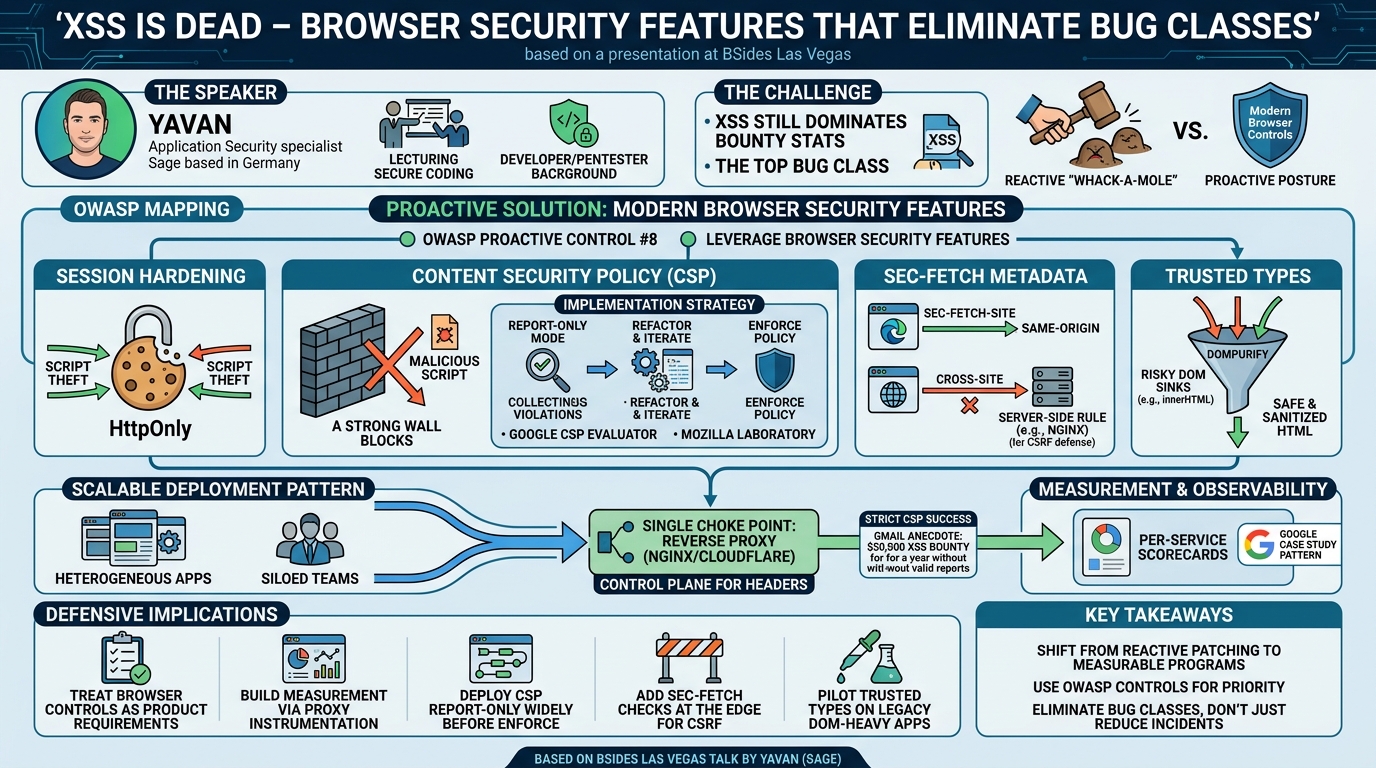
Yavan delivers a fast-paced survey arguing that cross-site scripting (XSS) remains a top bug class not because browsers lack defenses, but because organizations remain reactive, under-automate secure defaults, and delay adopting modern browser-enforced controls. The talk uses OWASP Proactive Controls (latest version referenced) to anchor browser features as a first-class practice—specifically control #8: leverage browser security features—and uses Google’s “security signals” research as a template for measuring adoption at scale via reverse proxies (e.g., nginx, Cloudflare). The speaker positions the shift as defense in depth that can eliminate certain vulnerability classes when deployed strictly, not merely reduce incident frequency.
Key moments
- 2:00 Problem statement: XSS still dominates bounty stats; reactive whack-a-mole vs proactive elimination.
- 6:00 OWASP Proactive Controls: new item #8—explicitly leverage browser security features for defense in depth.
- 8:00 Google 'security signals' pattern: proxy instrumentation, synthetic checks, per-service scorecards.
- 12:00 Sec-Fetch Metadata explained: curl lacks hints; browsers add Sec-Fetch-Site and related signals for CSRF defenses.
- 14:00 Strict CSP: Gmail bounty anecdote and iterative Report-Only → enforce migration with automation.
- 16:00 Trusted Types: policy wrappers around innerHTML and DOMPurify-style sanitization for DOM XSS reduction.
- 18:00 Mozilla quote on opt-in web security—controls require developer/proxy adoption because the platform cannot break compatibility.
- 20:00 Takeaways: shift from reactive patching to measurable header/CSP programs; commit to bug-class elimination.
XSS is dead – Browser Security Features that Eliminate Bug Classes
Speakers: Yavan (full surname unknown; as introduced), Application Security, Sage; based in Germany
Conference: BSides Las Vegas
YouTube: https://www.youtube.com/watch?v=ytA9FF5FhzE
Overview
Yavan delivers a fast-paced survey arguing that cross-site scripting (XSS) remains a top bug class not because browsers lack defenses, but because organizations remain reactive, under-automate secure defaults, and delay adopting modern browser-enforced controls. The talk uses OWASP Proactive Controls (latest version referenced) to anchor browser features as a first-class practice—specifically control #8: leverage browser security features—and uses Google’s “security signals” research as a template for measuring adoption at scale via reverse proxies (e.g., nginx, Cloudflare). The speaker positions the shift as defense in depth that can eliminate certain vulnerability classes when deployed strictly, not merely reduce incident frequency.
Background
▶ Watch: Problem statement: XSS still dominates bounty stats; reactive whack-a-mole vs... (2:00)
The speaker opens with HackerOne’s perspective that XSS remains among the most reported and rewarded issues, calling that “insane” given the age of the flaw. He attributes persistence to:
- Difficulty rolling out strict Content Security Policy (CSP).
- Incomplete coverage of input validation and output encoding in large systems.
- Attacker creativity bypassing defenses—supporting layered mitigations.
He contrasts reactive patching (bug-by-bug from pentests or bounties) with a proactive posture, using a whack-a-mole metaphor: constant new issues, stressed teams, insufficient time to fix root causes.
Personal context: Based in Germany, works on application security at Sage, lectures secure coding, background in development and pentesting, now focused on scaling controls.
The speaker’s central tension is familiar to anyone who has rolled out CSP on a revenue-critical site: browsers can enforce powerful policies, but applications are heterogeneous, teams are siloed, and regressions arrive continuously via marketing tags, A/B tests, and third-party widgets. The talk’s proposed escape hatch is not “try harder,” but instrument and migrate: use the edge proxy as a single choke point for header policy, measure coverage, and iterate with report-only telemetry rather than hoping each service owner becomes a CSP expert overnight.
Key Findings
▶ Watch: Google 'security signals' pattern: proxy instrumentation, synthetic checks, p... (8:00)
- OWASP mapping: Proactive Controls #1–#2 emphasize classic secure development; #8 explicitly adds browser security features, which the speaker treats as the missing enterprise habit for XSS reduction.
- Defense-in-depth examples:
- Session hardening via
HttpOnlycookies to block script theft of session tokens when XSS exists. - Browser-enforced policy via CSP to block execution even when developers miss encoding.
- Google case study pattern: Large ecosystems can instrument proxies to detect presence/absence of headers (CSP, CSRF protections, Sec-Fetch Metadata, etc.), classify apps (legacy vs modern frameworks), and produce per-service scorecards—making security posture measurable. The speaker notes this is not a commercial product; teams must build it.
- Sec-Fetch Metadata (2021): Major browsers add client hints such as
Sec-Fetch-Site, enabling servers to distinguish same-origin vs cross-site requests. A simple nginx rule pattern is suggested to block cross-site forms/posts that carry session cookies—mitigating CSRF as defense-in-depth.
- Strict CSP efficacy anecdote: Gmail is cited as operating under strict CSP, with HackerOne bounty raised to $50,000 for XSS after a year without valid XSS reports (as claimed in the talk—treat as speaker-reported).
- CSP rollout method: Start Report-Only, collect violations, iterate, refactor, leverage newer CSP features including
script-dynamic(as phrased) to handle third-party embeds; automate nonce/hash generation in CI for SPAs.
- Trusted Types: A CSP-related mechanism to reduce DOM-based XSS by wrapping risky DOM sinks (
innerHTML, etc.) and routing through sanitizers like DOMPurify. Firefox support described as in progress; polyfill mentioned for broader coverage.
- Tooling reality: CSP remains hard; speaker mentions Mozilla Laboratory (Firefox add-on) and Google CSP Evaluator as aids, plus custom CI scripting for hashes/nonces.
Technical Deep Dive
▶ Watch: Strict CSP: Gmail bounty anecdote and iterative Report-Only → enforce migrati... (14:00)
CSRF mechanics recap: Browsers may send cookies automatically; embedding destructive requests (e.g., <img> tags) can trigger authenticated actions. SameSite cookies are referenced indirectly; the speaker emphasizes Sec-Fetch as an additional server-side signal.
Header injection point: Reverse proxies become the control plane for security headers across heterogeneous services—critical for enterprises with hundreds of endpoints owned by different teams.
Trusted Types policy sketch: Replace direct innerHTML assignment with a policy function that sanitizes via DOMPurify, reducing the refactor burden for legacy codebases compared to rewriting all DOM interactions.
Standards philosophy quote: The talk closes with Frederik Braun (Mozilla) cited on the web’s opt-in security model: developers must choose protections because the platform cannot “break the web.”
How this fits a modern SDLC (expanded from the talk’s implications): For single-page applications, static analysis alone rarely proves that dynamically constructed HTML is safe; Trusted Types and strict CSP shift the burden toward compile-time or build-time guarantees (nonces/hashes) and runtime enforcement where developers use risky DOM APIs. For legacy server-rendered applications, the fastest win is often still output encoding—but the speaker argues encoding projects stall at scale, so browser policies become the backstop that keeps XSS from becoming session takeover when a template slips.
Sec-Fetch as an organizational wedge: Because Sec-Fetch Metadata is already sent by mainstream browsers, enabling validation at nginx/Cloudflare can be faster than rewiring every form with synchronized tokens—especially for older apps where CSRF defenses were inconsistent. The talk does not claim Sec-Fetch is sufficient in every architecture (subdomains, CORS-heavy APIs, and non-browser clients complicate life), but it presents the header family as a high ROI default for classic cookie-session web apps.
Measurement ethics and operations: Synthetic checks and scorecards can create gamification and perverse incentives (teams marking headers present but misconfigured). The Google paper is referenced as inspiration; implementing it well requires defining what counts as passing—e.g., CSP is not binary if unsafe-inline undermines the goal. The speaker hints at this with the “who thinks your CSP is strict?” audience question.
Demo / Proof of Concept
▶ Watch: Trusted Types: policy wrappers around innerHTML and DOMPurify-style sanitizat... (16:00)
No exploit demo is presented; the session uses diagrams, example curl vs browser header comparisons, and conceptual nginx snippets. The speaker references a 4-hour workshop version where more depth would exist; that content is not in this recording per transcript.
Defensive Implications
▶ Watch: Takeaways: shift from reactive patching to measurable header/CSP programs; co... (20:00)
- Treat browser controls as product requirements alongside code fixes—especially for XSS-heavy codebases where each bug predicts more bugs.
- Build measurement: if you cannot see which services lack CSP / Sec-Fetch validation, you cannot manage rollout.
- Deploy CSP Report-Only widely before enforce; pair with automation for violations triage.
- Add Sec-Fetch checks at the edge for CSRF defense where legacy patterns persist.
- Pilot Trusted Types on legacy DOM-heavy apps where full rewrites are uneconomical.
Common rollout failures (not exhaustive, but grounded in the talk’s themes): Teams deploy a report-only CSP and never graduate to enforcement; they add headers only on marketing pages but omit authenticated surfaces; they enable CSP on the origin but forget API subdomains that host JSONP-like behaviors; they adopt nonces without caching discipline and break CDNs. The antidote advocated here is proxy-level consistency plus violation analytics treated as product defects, not security trivia.
Key Takeaways
- XSS persistence is as much an engineering systems problem as a training problem: missing strict CSP and scalable automation.
- OWASP Proactive Controls now explicitly blesses browser security features—use that to win organizational priority.
- Proxy-level observability turns subjective “we’re secure” into scorecards and migration plans.
- Sec-Fetch Metadata is widely available and can block entire CSRF classes with simple edge rules.
- Trusted Types targets DOM XSS where server-side templating fixes do not reach.
- The web’s security model rewards opt-in controls early—waiting for universal defaults is not a strategy.
Workshop promise: The speaker notes a four-hour variant exists; if you are evaluating this talk as a primer, assume the missing depth is in CSP automation patterns, multi-tenant edge routing, and break-fix playbooks—none of which are fully present in the short session transcript.
Audience positioning: The talk is written for security engineers and application security leaders who already know XSS mechanics but lack a deployment strategy that survives organizational reality. It will not teach novel bypasses; it is closer to an architecture review checklist delivered as a narrative. If you need deep CSP bypass research, you will still need separate sources—here the emphasis is elimination via policy and safe DOM APIs, not exploitation craft.
Concrete “first week” rollout sketch (derived from the talk’s steps): pick one non-production environment, enable strict CSP Report-Only at the reverse proxy, ship violations to a centralized sink, bucket them by route and team, and convert the top three recurring violations into engineering tickets. Repeat until enforcement is possible without breaking checkout flows. In parallel, add Sec-Fetch validation rules for cookie-authenticated POST endpoints where you still rely on implicit browser behavior. Only then expand Trusted Types pilots on the worst DOM-heavy pages.
About the Speaker(s)
Yavan (surname not stated in the transcript) works in application security at Sage, lectures secure coding, is based in Germany, and describes a career path from developer to pentester/consultant to enterprise AppSec. Additional biographical details are unknown.
Reviews
Dr. Zero (Offensive Security Researcher) — SOLID
A competent AppSec architecture talk: good framing, useful references (OWASP #8, Sec-Fetch, Trusted Types), and a credible enterprise rollout story via reverse proxies. It is not breaking new research, but it packages modern browser mitigations into an actionable program shape.
Heather Calloway (CISO) — STRONG ACCEPT
This is how you make XSS reduction legible to leadership: scorecards, staged rollout, and proxy-enforced defaults. It translates technical headers into governance artifacts—policy coverage, migration metrics, and accountability per service owner.