Creator Panel Discussion
Nahamsec, Rhynorater, InsiderPHD
Bug Bounty Village @ DEF CON 33 · Day 1 · Bug Bounty Village
Overview
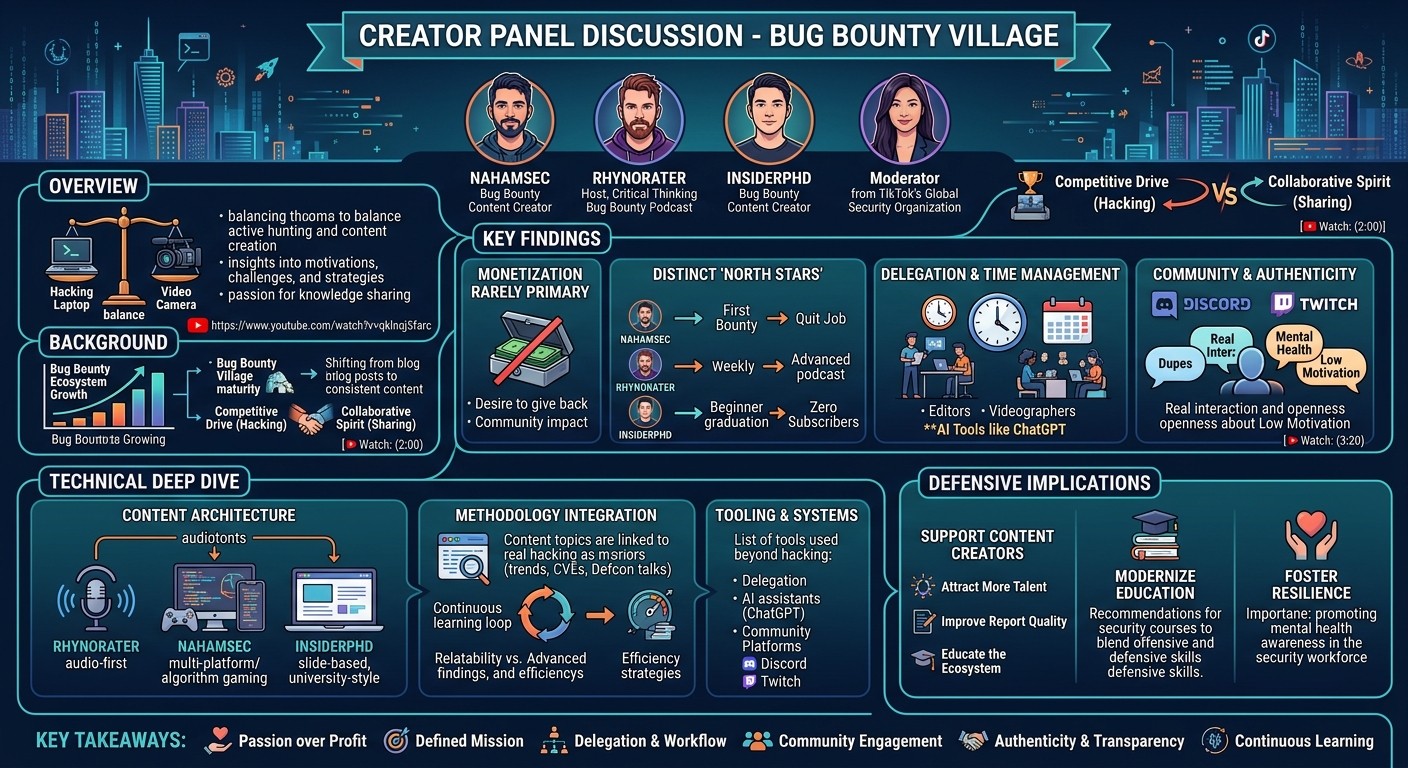
The "Creator Panel Discussion" at Bug Bounty Village, Defcon, brought together three prominent figures in the bug bounty and cybersecurity content creation space: Nahamsec (Ben), Rhynorater (Justin Gardner), and InsiderPHD (Katie). Moderated by Heranimo from TikTok's Global Security Organization, the panel delved into the intricate balance of actively participating in bug bounty hunting while simultaneously producing high-quality educational content. This talk provided a unique glimpse into the motivations, challenges, and strategies employed by these creators, revealing the dedication required to excel in both demanding fields.
Key moments
- 2:00 Panelists introduce themselves and their channels
- 2:30 Nahamsec's unexpected start streaming hacking companies
- 3:20 The reality of content monetization for hackers
- 5:20 InsiderPHD's journey: mentee experience to content creator
- 6:20 Balancing niche bug bounty content with broader appeal
Creator Panel Discussion
Speakers: Nahamsec, Bug Bounty Content Creator; Rhynorater, Host of Critical Thinking Bug Bounty Podcast; InsiderPHD, Bug Bounty Content Creator
Conference: Bug Bounty Village
YouTube: https://www.youtube.com/watch?v=qklnqj5farc
Overview
The "Creator Panel Discussion" at Bug Bounty Village, Defcon, brought together three prominent figures in the bug bounty and cybersecurity content creation space: Nahamsec (Ben), Rhynorater (Justin Gardner), and InsiderPHD (Katie). Moderated by Heranimo from TikTok's Global Security Organization, the panel delved into the intricate balance of actively participating in bug bounty hunting while simultaneously producing high-quality educational content. This talk provided a unique glimpse into the motivations, challenges, and strategies employed by these creators, revealing the dedication required to excel in both demanding fields.
The discussion highlighted that for many, content creation in this specialized cybersecurity niche is not primarily driven by monetization but by a passion for knowledge sharing and community building. The speakers articulated their distinct "north stars" for content, ranging from fostering advanced hacking skills to guiding beginners towards their first bounty. This conversation is particularly relevant for aspiring bug bounty hunters, content creators, and the wider cybersecurity community, offering actionable insights into sustaining effort, leveraging platforms, and maintaining authenticity in a rapidly evolving digital landscape. It underscores the symbiotic relationship between hacking and teaching, demonstrating how practitioners can contribute significantly to the collective growth of the security community.
Background
▶ Watch: Panelists introduce themselves and their channels (2:00)
The bug bounty ecosystem has experienced significant growth over the past decade, evolving from a nascent concept into a robust industry where individuals can earn substantial income by identifying and reporting vulnerabilities in real-world applications. This growth has naturally led to an increased demand for educational resources, mentorship, and community platforms where knowledge can be shared. However, the unique nature of bug bounty hunting—often solitary, highly competitive, and requiring constant adaptation to new threats and technologies—presents inherent challenges for individuals attempting to document and teach their findings.
Prior to the rise of dedicated content creators, knowledge sharing within the bug bounty space often occurred through blog posts, conference talks focused on specific vulnerabilities, or informal mentorship. The panelists represent a new wave of educators who have professionalized this sharing, creating consistent, structured, and often highly produced content. This shift has been crucial in democratizing access to bug bounty knowledge, breaking down barriers for newcomers, and fostering a more collaborative, albeit still competitive, environment. The establishment of dedicated spaces like the Bug Bounty Village at Defcon, now in its second year, signifies the maturity and recognition of this community, acknowledging the vital role that both active hunters and content creators play in its ongoing development. The panel discussion explored the tension between the competitive drive to find bugs and the collaborative spirit of sharing techniques, a dynamic that underpins much of the bug bounty community's identity.
Key Findings
▶ Watch: Nahamsec's unexpected start streaming hacking companies (2:30)
The panel discussion revealed several key insights into the intersection of bug bounty hunting and content creation, emphasizing the unique challenges and rewards of operating in this specialized niche.
Firstly, monetization is rarely the primary driver for bug bounty content creators. Nahamsec, with nearly 200,000 subscribers, candidly shared that he only earns a few hundred dollars a month from YouTube, a sentiment echoed by InsiderPHD, who noted her channel was recently demonetized. Rhynorater mentioned his podcast operated at a loss initially. The speakers consistently highlighted that their motivation stems from a desire to give back to the community, facilitate learning, and make a positive impact, such as Nahamsec's early efforts to raise $60,000 for the Leukemia Lymphoma Society through charity hacking events.
Secondly, each creator has a distinct "north star" or mission statement that guides their content strategy, even within the niche of bug bounty. Rhynorater’s "Critical Thinking Bug Bounty Podcast" aims to deliver "high-quality intermediate to advanced tier content" weekly, ensuring advanced hackers gain at least one actionable tidbit per episode. Nahamsec focuses on a journey, starting with basics to help people get their "first bounty," then encouraging them to "quit their jobs and do buck bounties" full-time or generate supplemental income. InsiderPHD, remarkably, aims for "zero subscribers," desiring that her content helps beginners find their first bug and move on to more advanced resources, signifying a successful graduation from her foundational teachings. This clarity of purpose allows them to resist the temptation to broaden their content for higher view counts, maintaining fidelity to their core audience.
Thirdly, effective time management and delegation are crucial for longevity. Balancing active bug hunting, which often involves intense, unpredictable periods like live hacking events, with consistent content production is a significant challenge. Rhynorater has successfully implemented a delegation model, employing 4-5 team members, including editors, allowing him to dedicate only 3-5 hours weekly to podcast production. This strategy, though initially operating at a loss, was deemed essential for the podcast's long-term sustainability. Nahamsec offloaded editing to a videographer, who, despite not being a hacker, learned enough to streamline the process significantly. InsiderPHD leverages her partner as an "unpaid intern" and uses AI tools like ChatGPT for script rewriting, focusing her own time on extensive research (slides can take 10 days) to make content creation as frictionless as possible.
Finally, the panel underscored the importance of community interaction and authenticity. Platforms like Discord and Twitch were highlighted as invaluable for fostering deep engagement. Nahamsec praised Twitch for its interactive nature, allowing raw, uncut interactions that built a strong community. Rhynorater’s Discord server actively recreates the dynamic conversations found at live hacking events, with a "cool research channel" where community members share bleeding-edge findings. All speakers emphasized reading comments and actively soliciting feedback, which directly influences content direction. They also stressed the importance of authenticity and being open about personal struggles, such as dealing with "dupes" (duplicate findings), mental health challenges, or periods of low motivation, to provide a realistic portrayal of the bug bounty journey and counteract the perception of a "perfect life" for successful hackers.
Technical Deep Dive
▶ Watch: The reality of content monetization for hackers (3:20)
While this panel discussion did not delve into specific exploit code or vulnerability details, it offered a profound "technical deep dive" into the methodologies, strategies, and architectures of building a sustainable career at the intersection of bug bounty hunting and content creation. The "technical" aspect here refers to the systematic approaches and tools employed to achieve success in both domains.
1. Content Architecture and Delivery:
The speakers outlined distinct content architectures tailored to their goals and target audiences:
- Rhynorater (Critical Thinking Bug Bounty Podcast): Focuses on an audio-first architecture, delivered weekly. The challenge is conveying complex technical concepts without visuals. This involves techniques like "mental vision" guidance when describing code snippets and a deliberate effort to make content consumable while mowing the lawn or washing dishes. The underlying "architecture" is a consistent, high-frequency release schedule supported by a robust delegation model involving editors and production staff, transforming a solo effort into a team-driven media outlet. The aim is to deliver intermediate to advanced tier content, pushing the boundaries of what can be taught via audio.
- Nahamsec (YouTube & Twitch): Employs a multi-platform strategy. YouTube serves as the primary long-form video platform, where he has "learned how to game" the algorithm by optimizing thumbnails, keywords, and video length (e.g., 11-minute videos often perform better than 20-minute deep dives). His content progresses from beginner basics (e.g., getting a first bounty) to intermediate strategies (e.g., how to make money). Twitch provides a "raw, uncut" live streaming environment, fostering real-time interaction and community building, akin to a continuous, interactive Q&A session. TikTok is used for short-form "hooks" to drive traffic to other platforms, despite challenges with "community guidelines" that often flag security-related content.
- InsiderPHD (YouTube): Her content architecture is highly academic and structured, designed to mimic a "university course." This involves extensive slide-based presentations (taking up to 10 days for research and creation) for long-form content, aiming for a notebook-and-pen learning experience. Her focus is on foundational knowledge for beginners, making complex concepts accessible and "frictionless" for consumption. She emphasizes "experimentation" in content styles to avoid stagnation, mirroring the need for diverse approaches in hacking.
2. Bug Bounty Methodology Integration:
The panelists demonstrated how their content creation directly reflects and informs their bug bounty methodologies:
- Topic Selection: Nahamsec selects topics based on "something cool that I have done," "trends," CVEs, and Defcon talks. This ensures relevance and practical applicability. His approach of "I want to learn the things that I don't know and teach it" highlights a continuous learning loop that benefits both his hacking skills and his audience.
- Relatability vs. Advanced Findings: InsiderPHD noted the challenge of creating beginner-friendly content as her own hacking skills advance. She actively seeks community feedback to understand "what beginners actually need," sometimes focusing on seemingly basic topics like "note-taking," which proved to be highly popular for its practical utility in overwhelming environments. Rhynorater, conversely, advocates for not abandoning "textbook IDORs" or basic vulnerabilities, emphasizing that "as a bug bounty hunter, I don't want to leave money on the table," even as he pursues advanced research. This dual approach ensures a comprehensive coverage of the bug bounty landscape.
- Efficiency and "Metagaming": Nahamsec discusses not just technical vulnerabilities but also efficiency strategies (e.g., "How do you do efficiency stuff? How do you save money? How do you pay your taxes?"). Rhynorater's podcast includes "bug bounty metagaming" topics, such as "how can you increase your report quality?" and "how can you advocate for your reports?" These non-technical aspects are crucial for professional success in bug bounty hunting, turning hacking into a sustainable career.
3. Tooling and Support Systems:
Beyond traditional hacking tools, the creators discussed their "tool stack" for content:
- Delegation: Rhynorater's use of editors and a team is a core "tool" for sustaining his podcast.
- AI Assistants: InsiderPHD and Nahamsec both utilize ChatGPT for "rewriting scripts" and generating panel questions, demonstrating how AI can streamline content production workflows.
- Community Platforms: Discord is a vital "tool" for audience engagement, feedback collection, and fostering a collaborative research environment ("cool research channel"). Twitch provides real-time interaction capabilities.
- Frictionless Production: InsiderPHD's focus on creating slides separately to minimize video production time (1 hour recording, 4 hours editing) illustrates a workflow optimization technique to maximize output despite limited resources.
In essence, the "technical deep dive" of this panel was not into what to hack, but how to hack a career in cybersecurity content creation while remaining an active and successful bug bounty hunter. It's a masterclass in operationalizing knowledge transfer and community engagement within a highly specialized field.
Demo / Proof of Concept
▶ Watch: InsiderPHD's journey: mentee experience to content creator (5:20)
This panel discussion, by its very nature, did not feature a traditional technical demonstration or a live proof of concept of a specific vulnerability exploit. The "demo" was implicitly provided through the speakers' shared experiences, personal anecdotes, and their established public platforms. Their collective body of work—hundreds of hours of educational videos, podcasts, and live streams—serves as the ultimate proof of concept for the strategies and philosophies they discussed.
For instance, Nahamsec's journey from streaming "hacking companies" on Twitch to building a massive YouTube following and organizing charity events demonstrates the proof of concept for community-driven learning and impact. InsiderPHD's "zero subscribers" mission, where former viewers approach her at conferences to say her content helped them land an AppSec role or find their first bug, is a testament to the effectiveness of her academic, beginner-focused approach. Rhynorater's consistent weekly podcast releases for nearly three years, supported by a dedicated team and thriving Discord community, exemplifies the proof of concept for sustained, high-quality, advanced technical content delivery through delegation and community engagement.
The speakers' candid discussion about the challenges of balancing content creation with active bug hunting, the initial lack of monetization, and the constant need for authenticity and community feedback, served as a meta-demonstration. It showcased the real-world operational realities of their dual careers, validating their advice through lived experience rather than a staged technical exploit. Their ability to inspire a new generation of hackers, evident in stories like the student who found a $25,000 Netflix bounty after watching Nahamsec's content, is perhaps the most impactful "proof of concept" presented throughout the discussion.
Defensive Implications
▶ Watch: Balancing niche bug bounty content with broader appeal (6:20)
While the panel primarily focused on the offensive aspects of bug bounty hunting and the mechanics of content creation, several defensive implications can be inferred for organizations, bug bounty program operators, and the broader security community.
Firstly, for organizations running bug bounty programs, the insights from this panel highlight the critical role of supporting and engaging with content creators. These creators act as force multipliers for security awareness and talent development. By fostering a positive relationship with influential creators, companies can:
- Attract More Talent: Creators like Nahamsec aim to guide people from their first bounty to full-time hacking. Programs that are seen as fair, responsive, and rewarding (e.g., TikTok paying $25,000-$35,000 bounties at live events) will naturally attract more skilled hunters, leading to a broader and deeper security assessment surface.
- Improve Report Quality: Rhynorater's focus on "bug bounty metagaming" (e.g., "how can you increase your report quality?") directly benefits program integrity. Organizations can encourage creators to cover topics that improve hunter-program interaction, leading to clearer, more actionable vulnerability reports and reducing the burden on triage teams.
- Educate the Ecosystem: When creators share techniques (even "secrets" as Rhynorater's dad called them), it elevates the overall skill level of the hacking community. This means that vulnerabilities are more likely to be found and reported responsibly through official channels, rather than being exploited maliciously. Companies could consider sponsoring educational content or providing resources to creators to ensure accurate and responsible dissemination of security knowledge.
Secondly, for security education and academic institutions, the panel's discussion on engaging learning styles has direct defensive implications:
- Modernizing Curriculum: InsiderPHD's success with "university course" style content and her students' engagement (e.g., smashing it with IDORs before it was even taught) demonstrates the power of practical, engaging, and real-world-applicable teaching. Academics should incorporate active hacking exercises, real-world bug bounty programs (VDPs), and guest speakers from the bug bounty community to make learning more effective. The suggestion to offer "20% on their final grade if you can pop a bug" is a radical but potentially highly effective way to train future defenders.
- Bridging the Gap: The panel highlighted that the best teachers are often those actively involved in hacking. Encouraging security professionals and active bug hunters to teach, or providing opportunities for educators to participate in bug bounty activities, ensures that defensive strategies taught in classrooms are current and relevant to the evolving threat landscape.
Thirdly, the emphasis on authenticity and mental health among creators has broad implications for the cybersecurity workforce. Acknowledging the "L after L" (losses/failures) and the mental toll of constant competition and vulnerability research can help foster a more supportive and resilient community of defenders. Organizations and community leaders should promote mental health resources (like Nahamsec partnering with Headspace) and create environments where it's safe to discuss challenges, reducing burnout and retaining talent in a field that desperately needs it.
In essence, by understanding the motivations and operational models of bug bounty content creators, organizations can strategically engage with this community to enhance their own defensive posture, improve security education, and contribute to a healthier, more skilled cybersecurity talent pipeline.
Key Takeaways
- Passion over Profit: Bug bounty content creation is primarily driven by a desire to share knowledge and build community, with monetization often being a secondary or non-existent factor, especially in initial stages.
- Defined Mission is Crucial: Successful creators have a clear "north star" for their content, whether it's fostering advanced technical skills, guiding beginners to their first bounty, or aiming to make themselves obsolete by empowering learners. This focus helps them navigate the "niche within a niche."
- Delegation and Workflow Optimization are Essential: Balancing active bug hunting with content creation requires effective time management, often necessitating delegation of tasks like editing and production, or leveraging AI tools to streamline workflows.
- Community Engagement is Paramount: Platforms like Discord and Twitch facilitate invaluable real-time interaction, feedback, and support, transforming content creation from a monologue into a dynamic dialogue that shapes content and fosters a strong community.
- Authenticity and Transparency Build Trust: Sharing personal struggles, acknowledging failures (like duplicate bounties or mental health challenges), and being genuine about the realities of the bug bounty journey helps build trust and provides a more realistic and relatable perspective for the audience.
- Continuous Learning and Experimentation: Both bug bounty hunting and content creation demand constant learning, adapting to new trends, and experimenting with new techniques or content formats to stay relevant and avoid stagnation.
About the Speaker(s)
Nahamsec (Ben) is a prominent figure in the bug bounty community and a prolific content creator. He is known for his engaging YouTube videos and Twitch streams, where he initially gained popularity by streaming hacking activities. His content focuses on guiding individuals into bug bounties, helping them secure their first bounty, and inspiring them to pursue bug bounty hunting as a full-time career or supplemental income. Ben has been instrumental in organizing charity hacking events, such as the Hong Kong event which raised nearly $60,000. He is also an advocate for mental health in the cybersecurity community, openly discussing his struggles and partnering with organizations like Headspace.
Rhynorater (Justin Gardner) is the host of the "Critical Thinking Bug Bounty Podcast." His podcast is dedicated to delivering high-quality, intermediate to advanced-tier content to the bug bounty community on a weekly basis, aiming to provide actionable insights that can change a hacker's style. Justin emphasizes the importance of consistency, delegation, and building a strong community around his content, notably through a vibrant Discord server that facilitates advanced technical discussions. He is an active full-time bug bounty hunter who prioritizes his hacking endeavors, especially during live hacking events, and brings an energetic, authentic approach to his podcast.
InsiderPHD (Katie), also known as Insider PhD, is a YouTube content creator with over 91,000 subscribers. Her channel focuses on providing academic, university-style education for aspiring bug bounty hunters, aiming to be "the bug bounty university course you wish your university offered." Katie's mission is to introduce individuals to the field, help them find their first bug, and ultimately empower them to become self-sufficient hackers, aspiring for "zero subscribers" as a measure of her success. She emphasizes structured learning, extensive research for her content, and actively listens to her community to ensure her videos remain relevant and helpful for beginners, despite her own advanced hacking skills.
Reviews
Dr. Zero (Offensive Security Researcher) — SOLID
A panel discussion, so judged as one: does the moderator force specificity, does disagreement surface, does anyone say something they couldn't have said in a blog post? Mostly yes on the first two counts, partially on the third. The three creators are genuine, their missions are distinct, and the operational detail — delegation models, workflow tooling, platform-specific strategies — is more concrete than most creator panels manage. Nothing here redefines how the bug bounty community operates, but it's honest and functional for its lane.
Heather Calloway (CISO) — PASS
A career and community panel for bug bounty content creators. Well outside my lane — no governance angle, no institutional risk, no defender operations relevance. No penalty, just a scope call.