Closing Note
Jayesh Singh Chauhan
Cloud Village @ DEF CON 33 · Day 1 · Cloud Village
Overview
Jayesh Singh Chauhan's "Closing Note" delivered at Cloud Village served as the definitive wrap-up for the 2023 iteration of the conference. Rather than presenting new technical research or a specific vulnerability, this address provided a comprehensive summary of the event's extensive offerings, celebrated the collective efforts of its organizers and volunteers, and recognized the achievements of participants in the highly competitive Capture The Flag (CTF) competition. The talk underscored Cloud Village's commitment to fostering a vibrant and knowledgeable cloud security community through diverse educational formats, including traditional talks, hands-on labs, and immersive challenges.
Key moments
- 0:00 Cloud Village 2023 overview and new initiatives
- 2:15 Cloud Security CTF 2023 statistics and workshop details
- 3:00 Announcing first place CTF winners: GMO
- 4:45 Call for CTF write-ups and top team prizes
- 5:15 Thanking all Cloud Village organizing teams
- 6:40 Success of the new hands-on Labs initiative
- 8:05 Final thank you to the community and looking forward
Closing Note
Speakers: Jayesh Singh Chauhan
Conference: Cloud Village
YouTube: https://www.youtube.com/watch?v=bN2GDa_KXpA
Overview
Jayesh Singh Chauhan's "Closing Note" delivered at Cloud Village served as the definitive wrap-up for the 2023 iteration of the conference. Rather than presenting new technical research or a specific vulnerability, this address provided a comprehensive summary of the event's extensive offerings, celebrated the collective efforts of its organizers and volunteers, and recognized the achievements of participants in the highly competitive Capture The Flag (CTF) competition. The talk underscored Cloud Village's commitment to fostering a vibrant and knowledgeable cloud security community through diverse educational formats, including traditional talks, hands-on labs, and immersive challenges.
The significance of this closing address extends beyond a mere logistical summary. It acts as a powerful testament to the organizational prowess required to host a major cybersecurity conference and highlights the evolving landscape of security education. By detailing the scale of engagement—from the number of talks and labs to the hundreds of CTF participants—Chauhan painted a clear picture of Cloud Village's impact. The talk matters because it articulates the ethos of a community-driven event, emphasizing collaboration, practical skill development, and the crucial role of volunteers in advancing the collective understanding of cloud security. It frames the entire conference as a success story, built on shared passion and dedication.
Background
▶ Watch: Cloud Village 2023 overview and new initiatives (0:00)
The Cloud Village operates within the broader context of the cybersecurity conference circuit, specifically addressing the unique and rapidly evolving challenges inherent in cloud security. As organizations increasingly migrate their infrastructure, applications, and data to public, private, and hybrid cloud environments, the attack surface expands, and traditional security paradigms often prove insufficient. This shift necessitates a continuous learning environment where practitioners can share insights, discover new vulnerabilities, and develop robust defensive strategies. Cloud Village fills this critical niche by curating content specifically tailored to the nuances of cloud security, ranging from infrastructure-as-code vulnerabilities to container orchestration security and serverless computing risks.
Prior to the 2023 event, Cloud Village had established itself as a significant contributor to this educational ecosystem. The speaker alluded to past iterations and the continuous evolution of the event, notably mentioning a strategic shift in their educational delivery. Specifically, workshops were transitioned into a more structured "lab format." This change was designed to maximize hands-on learning opportunities for attendees, allowing for more dedicated time for practical application under the guidance of seasoned cloud practitioners. This adaptation reflects a broader trend in cybersecurity education, recognizing that theoretical knowledge must be complemented by practical experience to truly embed skills and prepare defenders for real-world scenarios. The core "problem" that Cloud Village, and by extension this closing note, addresses is the imperative for continuous skill development and knowledge sharing within a rapidly changing threat landscape, ensuring that the community remains agile and resilient against emerging cloud-based threats.
Key Findings
▶ Watch: Announcing first place CTF winners: GMO (3:00)
While this "Closing Note" did not present new technical findings in the traditional research sense, it delivered crucial insights into the operational success and community engagement of Cloud Village 2023. The talk provided a comprehensive statistical overview of the event's scope and impact, effectively highlighting its key contributions to the cloud security community.
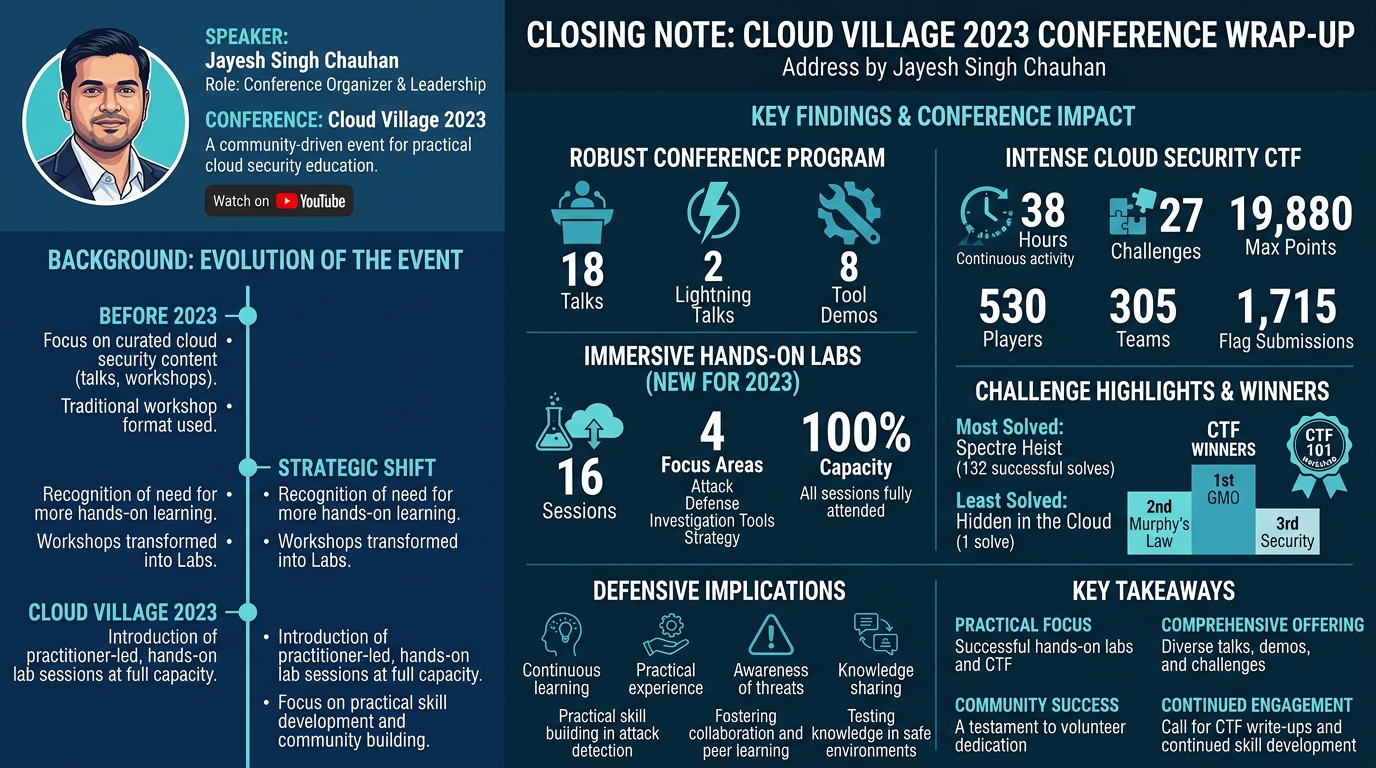
The conference program was robust, featuring a total of 18 talks, complemented by 2 lightning talks and 8 dedicated tool demos. This diverse speaking track ensured a wide range of topics and perspectives were covered, from cutting-edge research to practical application of security tools.
A significant new initiative for 2023 was the introduction of labs. These hands-on sessions were categorized into attack, defense, investigation tools, and strategy, designed to provide practical experience. The initiative proved immensely popular, with all 16 lab sessions running at full capacity. This demonstrates a strong community demand for practical, instructor-led training, moving beyond purely theoretical presentations.
The heart of the competitive element at Cloud Village was the 38-hour non-stop cloud security CTF. This year saw substantial participation, with 305 teams registered and a total of 530 individual players engaging with the challenges. Across 27 unique challenges, participants could accumulate a maximum of 19,880 points. The competition generated considerable activity, evidenced by 1,715 flag submissions throughout the event.
Two specific CTF challenges stood out:
- The most frequently solved challenge was Spectre Heist, which garnered 132 successful solves, indicating it was both engaging and accessible to a broad segment of participants.
- Conversely, the challenge titled Hidden in the Cloud proved to be the most elusive, recording only one solve, highlighting its extreme difficulty and the advanced skills required to conquer it.
In a move to further support participants, a CTF 101 workshop was introduced, offering a dedicated space for players to meet challenge creators, discuss roadblocks, and gain deeper insights, ensuring a more complete learning experience even for those who struggled.
The top-performing teams in the CTF were formally recognized and awarded:
- GMO
- Murphy's Law
- Security
These details collectively underscore the vibrant, interactive, and educational environment cultivated by Cloud Village, showcasing its capacity to attract, educate, and challenge a broad spectrum of cloud security professionals and enthusiasts.
Technical Deep Dive
▶ Watch: Call for CTF write-ups and top team prizes (4:45)
This "Closing Note" by Jayesh Singh Chauhan served as a summary and celebratory address for the Cloud Village 2023 conference, rather than a technical presentation itself. Consequently, it did not include a technical deep dive into any specific cloud security vulnerability, protocol, architecture, or exploit chain. The talk's primary focus was on the organizational achievements, participation statistics, and acknowledgments of the numerous individuals who contributed to the event's success.
To provide context for what a "Technical Deep Dive" would typically entail at a conference like Cloud Village, it's important to understand the types of content that were presented in the 18 talks and 8 tool demos mentioned by the speaker. These sessions would have delved into specific technical aspects of cloud security, such as:
- Identity and Access Management (IAM) Misconfigurations: Analyzing common pitfalls in cloud IAM policies (e.g., AWS IAM, Azure AD, GCP IAM), demonstrating how overly permissive roles or service accounts can lead to privilege escalation, and exploring automated tools for detecting and remediating these issues. This might involve discussing specific services like AWS STS, Azure Managed Identities, or GCP Service Accounts.
- Container and Kubernetes Security: Deep dives into vulnerabilities within container images (e.g., using Trivy or Clair for static analysis), misconfigurations in Kubernetes clusters (e.g., exposed dashboards, insecure API servers, privilege escalation via pod security policies), and runtime protection strategies using tools like Falco or Open Policy Agent (OPA).
- Serverless Function Exploitation: Exploring vulnerabilities in AWS Lambda, Azure Functions, or Google Cloud Functions, such as injection attacks, insecure third-party dependencies, or excessive permissions, and demonstrating how these can be exploited to gain unauthorized access or exfiltrate data.
- Cloud Native Supply Chain Attacks: Investigating how attackers compromise software development pipelines in cloud environments, from vulnerable CI/CD configurations (e.g., GitHub Actions, GitLab CI) to malicious dependencies in container registries or package managers. This could involve discussions on tools like Sigstore for software signing and verification.
- Data Security in Cloud Storage: Technical analyses of insecure configurations in object storage (e.g., publicly exposed S3 buckets, Azure Blob Storage, GCP Cloud Storage), encryption key management issues (e.g., AWS KMS, Azure Key Vault), and data exfiltration techniques.
- Network Security in Cloud Environments: Detailing complex network segmentation strategies, analyzing virtual private cloud (VPC) configurations, firewall rules, and demonstrating how misconfigured network access controls can be bypassed.
- Infrastructure as Code (IaC) Security: Examining security flaws in IaC templates written in Terraform, CloudFormation, or Azure Resource Manager (ARM) templates, and presenting automated static analysis tools (e.g., Checkov, Terrascan) to identify and prevent these issues pre-deployment.
The CTF challenges themselves, such as Spectre Heist and Hidden in the Cloud, would have required participants to apply technical knowledge across these domains, often involving hands-on exploitation of simulated cloud environments. While the closing note mentioned these challenges, it did not elaborate on their specific technical mechanics or the solutions required. The "Technical Deep Dive" content was therefore distributed across the individual sessions of Cloud Village, offering specialized knowledge that this overarching summary, by its very nature, could not encompass.
Demo / Proof of Concept
▶ Watch: Success of the new hands-on Labs initiative (6:40)
The "Closing Note" delivered by Jayesh Singh Chauhan did not feature any live demonstration or proof of concept. As a summary and awards ceremony for the Cloud Village 2023 conference, its purpose was to recap the event, acknowledge contributors, and congratulate winners, rather than to showcase specific technical exploits or tools.
However, it is pertinent to note that the broader Cloud Village program, as highlighted by the speaker, did include opportunities for such demonstrations. Chauhan specifically mentioned 8 tool demos as part of the conference agenda. These sessions would have been dedicated slots where speakers or vendors could present live walkthroughs of security tools, illustrate their functionality, demonstrate how they identify vulnerabilities, or show how they can be used to perform specific security tasks in a cloud environment. Examples of such demos might include:
- Automated Cloud Security Posture Management (CSPM) tools: Demonstrating how a tool like Palo Alto Networks Prisma Cloud, Orca Security, or Wiz can scan cloud environments for misconfigurations, compliance violations, and critical vulnerabilities.
- Cloud Native Application Protection Platforms (CNAPP): Showcasing how these platforms integrate various security capabilities across development, deployment, and runtime, including container scanning, runtime protection, and API security.
- Cloud Incident Response Tools: Illustrating the use of forensic tools or automation scripts to detect, analyze, and respond to security incidents within cloud infrastructure, perhaps demonstrating how to isolate compromised resources or collect evidence from cloud logs.
- Specialized Exploitation Frameworks: Presenting new open-source or commercial tools designed to exploit specific cloud vulnerabilities, such as those targeting serverless functions, Kubernetes clusters, or specific cloud service APIs.
Furthermore, the mention of a "physical challenge" within the CTF suggests a hands-on, interactive element that likely involved some form of physical interaction with hardware or a simulated environment, which could be considered a form of demonstration or practical application of security principles. However, no specific details about this challenge or its mechanics were provided in the closing remarks. While the Cloud Village conference clearly values and incorporates demonstrations as a crucial part of its educational offering, this particular closing address focused on the meta-level summary of the event rather than individual technical showcases.
Defensive Implications
▶ Watch: Final thank you to the community and looking forward (8:05)
As a conference wrap-up, Jayesh Singh Chauhan's "Closing Note" does not directly offer specific defensive implications or actionable security advice for mitigating particular threats or vulnerabilities. The talk’s focus was on the organizational success and community aspects of Cloud Village 2023, rather than the technical content of the talks, labs, or CTF challenges themselves. Therefore, it does not detail new defensive strategies, patch recommendations, or configuration best practices.
However, the talk implicitly carries significant defensive implications by virtue of summarizing an event dedicated to cloud security education and skill development. The very existence and success of Cloud Village, as highlighted in the closing remarks, underscore the ongoing need for robust defensive capabilities in cloud environments. The defensive implications can be derived from the conference's overall mission and the types of activities it promotes:
- Continuous Learning and Skill Development: The emphasis on 18 talks, 2 lightning talks, 8 tool demos, and especially the 16 hands-on labs directly supports the continuous professional development of cloud security defenders. By attending such sessions, practitioners gain knowledge about emerging threats, new defensive tools, and best practices for securing cloud infrastructure. The shift to a lab format, run by "seasoned cloud practitioners," directly aims to equip defenders with practical skills in attack prevention, detection, and response.
- Practical Experience through CTFs: The 38-hour cloud security CTF, with its 27 challenges and over 500 players, provides an invaluable platform for defenders to test their knowledge in a simulated, safe environment. Participating in CTFs helps individuals understand attacker methodologies, identify common vulnerabilities (like those potentially explored in "Spectre Heist" or "Hidden in the Cloud"), and develop problem-solving skills crucial for real-world incident response. The CTF 101 workshop further ensures that even less experienced participants can engage and learn, fostering a broader base of skilled defenders.
- Community and Knowledge Sharing: The extensive acknowledgment of the speaker ops, CTF, social media, labs, line management, crowd control, and review teams highlights the collaborative nature of the security community. This collective effort facilitates knowledge sharing, which is a cornerstone of effective defense. Defenders benefit immensely from community forums where they can learn from peers, discuss challenges, and collectively raise the bar for cloud security.
- Awareness of Evolving Threats: While not detailed in this specific talk, the diverse range of topics covered in Cloud Village talks (as inferred from a general cloud security conference agenda) would inherently inform defenders about the latest attack vectors, misconfigurations, and compliance challenges in cloud environments. Staying current with these trends is a fundamental defensive posture.
In essence, while Jayesh Singh Chauhan’s "Closing Note" did not deliver specific defensive tactics, it strongly advocated for the educational pathways and community engagement vital for building a strong, adaptable, and informed defensive posture against the ever-evolving landscape of cloud threats. The call for CTF write-ups further encourages post-event analysis and knowledge dissemination, extending the defensive learning cycle beyond the conference itself.
Key Takeaways
- Comprehensive Educational Offering: Cloud Village 2023 featured a robust program including 18 talks, 2 lightning talks, 8 tool demos, and a highly successful new initiative of 16 full, hands-on labs, emphasizing practical skill development in cloud security.
- Engaging CTF Competition: The 38-hour cloud security CTF attracted 305 teams and 530 players tackling 27 challenges, highlighting its popularity and effectiveness as a learning tool, with Spectre Heist being the most solved challenge.
- Focus on Practical Learning: The introduction of practitioner-led labs and the CTF 101 workshop underscore Cloud Village's commitment to hands-on education, enabling attendees to gain practical experience beyond theoretical knowledge.
- Community-Driven Success: The conference's achievements were a direct result of the tireless efforts of numerous volunteer teams (speaker ops, CTF, social media, labs, line management, crowd control, review), demonstrating the power of community in cybersecurity.
- Call for Continued Engagement: Attendees and CTF participants are encouraged to contribute to the community by submitting write-ups of their learning experiences, fostering ongoing knowledge sharing and professional growth.
About the Speaker(s)
Jayesh Singh Chauhan delivered the "Closing Note" for Cloud Village 2023, indicating his significant role in the organization and execution of the conference. While the transcript does not provide his specific professional title or company affiliation, his address showcased a deep involvement in the event's planning, from the strategic shift to a lab-based format to the intricate details of the CTF competition. He demonstrated a comprehensive understanding of the logistics, educational objectives, and community-building aspects of Cloud Village. Chauhan's grateful acknowledgments of the numerous volunteer teams across various functions (speaker ops, CTF, social media, labs, line management, crowd control, and review) further highlight his leadership and appreciation for collaborative efforts. He appears to be a key figure dedicated to fostering cloud security knowledge and community engagement through well-organized, hands-on learning experiences.
Reviews
Dr. Zero (Offensive Security Researcher) — HARD PASS
This is a conference closing ceremony, not a talk. It's an MC wrapping up an event — thanking volunteers, reading CTF scores, and waving goodbye. There is no research, no technical content, no strategic signal, no actionable anything. It doesn't belong in any review queue.
Heather Calloway (CISO) — PASS
This is a conference closing ceremony, not a security talk. There is no research, no finding, no risk framing, and nothing for a defender, executive, or policymaker to act on.