AIxCC Closing Ceremonies
Unknown
DEF CON 32 Main Stage · Day 1 · Main Stage
Overview
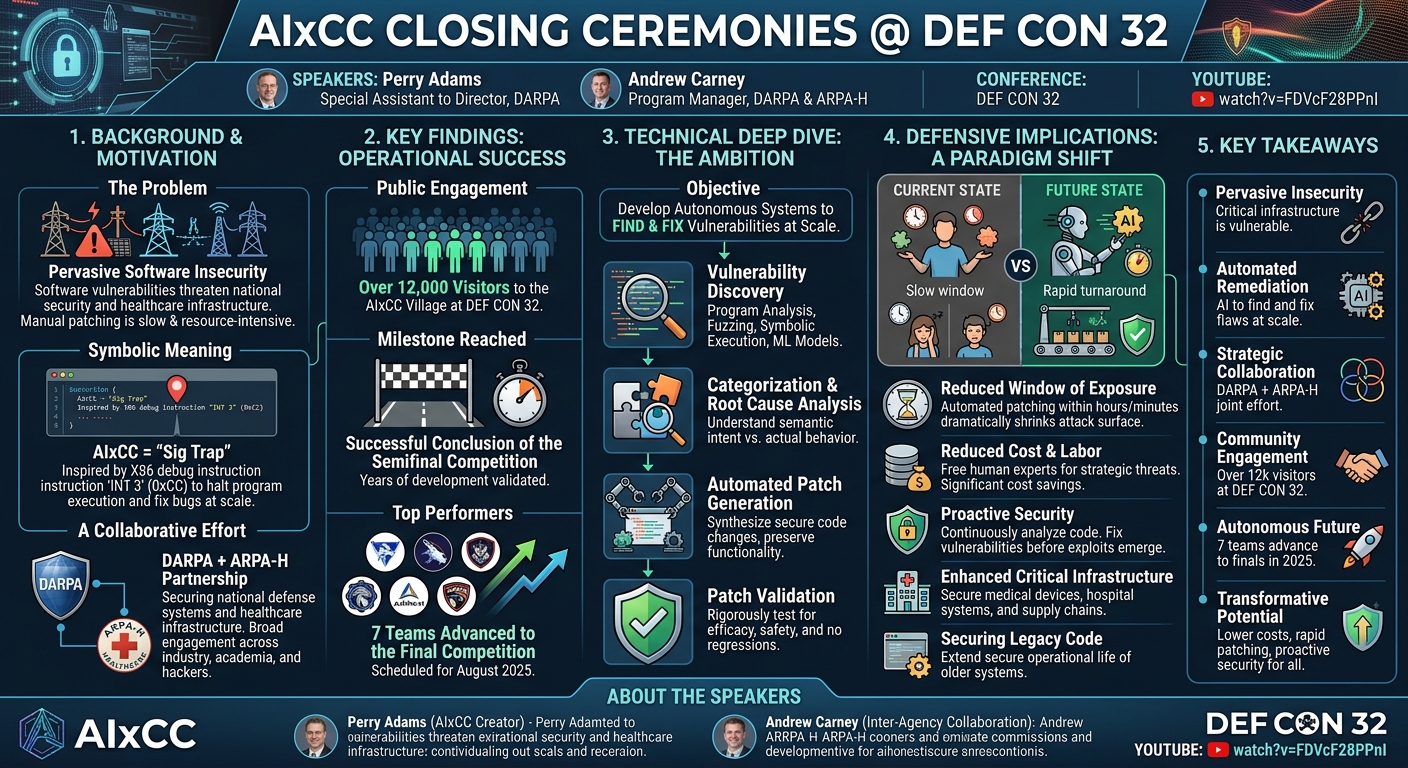
This talk serves as the closing ceremony for the AI Cyber Challenge (AIxCC) semifinal competition held at DEF CON 32. Presented by Perry Adams, Special Assistant to the Director at DARPA and the challenge's creator, alongside Andrew Carney, a Program Manager at DARPA and ARPA-H, the session reflects on the significant progress and impact of this ambitious initiative. The AIxCC is a groundbreaking effort aimed at harnessing artificial intelligence to autonomously identify and remediate software vulnerabilities at an unprecedented scale, addressing a pervasive and critical problem in modern technology.
Key moments
- 0:00 Introduction to AI Cyber Challenge and its goals
- 2:00 The 'Why': Insecurity of critical infrastructure and software
- 2:37 Unpacking the AIxCC name: Sig Trap and debugging
- 3:18 Semifinal competition results and advancing teams
- 4:00 ARPA-H collaboration for healthcare security
- 4:45 Gratitude to Def Con and partners for making it happen
- 6:30 Announcing the AIxCC final competition in August 2025
AIxCC Closing Ceremonies
Speakers: Perry Adams, Special Assistant to the Director at DARPA; Andrew Carney, Program Manager at DARPA and ARPA-H
Conference: DEF CON 32
YouTube: https://www.youtube.com/watch?v=FDVcF28PPnI
Overview
This talk serves as the closing ceremony for the AI Cyber Challenge (AIxCC) semifinal competition held at DEF CON 32. Presented by Perry Adams, Special Assistant to the Director at DARPA and the challenge's creator, alongside Andrew Carney, a Program Manager at DARPA and ARPA-H, the session reflects on the significant progress and impact of this ambitious initiative. The AIxCC is a groundbreaking effort aimed at harnessing artificial intelligence to autonomously identify and remediate software vulnerabilities at an unprecedented scale, addressing a pervasive and critical problem in modern technology.
The core motivation behind the AIxCC stems from the profound insecurity of critical infrastructure, which is fundamentally underpinned by software. With vulnerabilities constantly emerging, the challenge seeks to revolutionize the cybersecurity landscape by developing AI systems capable of not only detecting flaws but also automatically generating secure fixes. This initiative is a collaborative endeavor between DARPA, with its focus on national security technologies, and ARPA-H, a new federal agency dedicated to improving the health of all Americans, highlighting the critical importance of securing healthcare infrastructure from cyber threats. The speakers emphasize that the success of the challenge relies on broad collaboration across industry, academia, and the hacker community, exemplified by its prominent presence at DEF CON.
Background
▶ Watch: Introduction to AI Cyber Challenge and its goals (0:00)
The genesis of the AI Cyber Challenge, or AIxCC, lies in a fundamental and escalating problem: the inherent insecurity of software that forms the backbone of global critical infrastructure. From national defense systems to everyday applications and, critically, healthcare technology, software vulnerabilities represent a constant threat vector that adversaries can exploit. Traditional methods of vulnerability discovery and patching are largely manual, resource-intensive, and inherently slow, creating a substantial window of opportunity for attackers and an ever-growing backlog of unaddressed issues. This persistent challenge led DARPA to conceive of an initiative that could fundamentally shift the paradigm of software security.
The name "AIxCC" itself holds a symbolic meaning, suggested by a former DARPA program manager known by the handle "Sig Trap." Sig Trap refers to a debug instruction (specifically INT 3, or 0xCC in hexadecimal) in X86 architecture that halts program execution to allow for debugging. This analogy perfectly encapsulates the challenge's mission: to automatically "trap" and halt the execution of vulnerable code by identifying and fixing its flaws, effectively debugging software at scale. The goal is to move beyond mere detection to automated remediation, thereby securing code proactively.
The AIxCC is not solely a DARPA initiative. A crucial partnership with ARPA-H underscores the broader societal implications of software insecurity. Andrew Carney, a program manager who transitioned from DARPA to ARPA-H, highlights the magnitude and complexity of securing healthcare infrastructure. Medical devices, hospital systems, and patient data are increasingly reliant on software, making them prime targets for cyberattacks that could have direct and severe impacts on patient safety and national health. The collaboration ensures that the advancements made in the AIxCC will directly benefit the healthcare sector, providing vital tools to secure this critical domain.
Moreover, the challenge has been a monumental collaborative effort, extending beyond government agencies to embrace the wider cybersecurity community. The speakers express profound gratitude to DEF CON for hosting the AIxCC village, acknowledging the conference's pivotal role in engaging the hacker community, industry professionals, and academics. This broad engagement is essential for fostering the innovation required to tackle such a complex problem, demonstrating DARPA and ARPA-H's commitment to open collaboration and leveraging diverse expertise. The initiative was first announced at Black Hat and DEF CON the previous year, setting the stage for a year of intense development and competition.
Key Findings
▶ Watch: Unpacking the AIxCC name: Sig Trap and debugging (2:37)
As a closing ceremony, this talk primarily highlights the successful execution and significant milestones achieved within the AI Cyber Challenge (AIxCC) rather than presenting new technical "findings" in the traditional research sense. The key findings revolve around the challenge's operational success, its public engagement, and the progress of the participating teams.
Firstly, the AIxCC demonstrated remarkable public engagement and visibility at DEF CON 32. The speakers proudly announced that the AI Cyber Challenge village attracted over 12,000 visitors, underscoring the immense interest from the cybersecurity community, industry, and the general public in the intersection of AI and software security. This level of participation is a testament to the relevance and perceived importance of the challenge's mission.
Secondly, the talk marked the successful conclusion of the semifinal competition phase of the AIxCC. This competition saw numerous teams dedicating the past year to developing sophisticated AI systems capable of autonomously finding and fixing software vulnerabilities. The successful completion of this rigorous phase signifies a major step forward in the challenge's timeline, validating the approach and the potential of the competing technologies.
Finally, a crucial outcome of the semifinal competition is the identification of the top performers. The speakers announced that seven teams from the semifinal round have successfully advanced to the final competition, which is slated to take place in August 2025. This advancement indicates that these teams have demonstrated significant progress and promising capabilities in developing AI-driven vulnerability remediation systems, setting the stage for an even more intense and innovative final showdown. While specific technical details of these teams' approaches were not discussed in this high-level ceremony, their progression signifies the emergence of leading-edge solutions in this critical domain.
Technical Deep Dive
▶ Watch: Semifinal competition results and advancing teams (3:18)
While the closing ceremony itself does not delve into the intricate technical mechanisms developed by the competing teams, it clearly articulates the overarching technical ambition and the profound challenges that the AI Cyber Challenge (AIxCC) aims to address. The core technical objective is the development of autonomous systems capable of finding and fixing vulnerabilities in software at scale. This goes far beyond traditional static or dynamic analysis tools, which primarily identify potential flaws for human review. The AIxCC demands systems that can not only detect vulnerabilities but also understand their root causes, generate correct patches, and integrate these fixes without introducing new bugs or breaking functionality.
The concept of automated vulnerability remediation involves several complex technical hurdles:
- Vulnerability Discovery: AI systems must be able to analyze diverse codebases (potentially in multiple languages and architectures, like X86 mentioned in the "Sig Trap" analogy) to identify known and unknown vulnerabilities. This requires sophisticated techniques such as program analysis, fuzzing, symbolic execution, and potentially machine learning models trained on vast datasets of vulnerable and secure code patterns. The challenge lies in accurately identifying subtle logical flaws, memory safety issues (e.g., buffer overflows, use-after-free), and other common weaknesses that can lead to exploitable conditions.
- Vulnerability Categorization and Root Cause Analysis: Once a potential vulnerability is found, the AI system must understand its nature and the precise code constructs responsible for it. This involves deep semantic understanding of the code, going beyond superficial pattern matching to truly comprehend the program's intent versus its actual behavior. This step is crucial for generating an effective fix.
- Automated Patch Generation: This is perhaps the most challenging aspect. The AI must be able to synthesize new or modified code that correctly remediates the identified vulnerability without introducing regressions, breaking legitimate functionality, or creating new security flaws. This requires:
- Code Transformation: Modifying existing code structures, adding bounds checks, sanitizing inputs, or altering control flow.
- Semantic Preservation: Ensuring the patch maintains the original intended functionality of the program.
- Security Guarantees: Verifying that the generated patch actually closes the vulnerability and does not open new attack vectors.
- Language and Architecture Agnosticism (to an extent): The ultimate goal is systems that can operate across a variety of programming languages (C/C++, Python, Java, etc.) and potentially different hardware architectures, although the initial focus might be on common targets like X86.
- Patch Validation: After a patch is generated, it must be rigorously tested to confirm its efficacy and safety. This involves automated testing frameworks, including unit tests, integration tests, and security-specific tests (e.g., re-running the exploit that discovered the vulnerability to ensure it fails). The system must iterate on patches if initial validations fail.
The "at scale" requirement means these systems are not designed for one-off fixes but for continuous, high-throughput analysis and remediation across vast software ecosystems. This demands efficiency, robustness, and the ability to handle a massive volume of code. The long-term vision is to provide these advanced, AI-driven capabilities to industry and communities, democratizing access to sophisticated software security.
Demo / Proof of Concept
▶ Watch: Gratitude to Def Con and partners for making it happen (4:45)
This particular talk, being the closing ceremonies for the AI Cyber Challenge (AIxCC) semifinal competition, did not feature a live technical demonstration or proof of concept of the AI systems themselves. Instead, the speakers provided an update on the challenge's progress and acknowledged the participants and collaborators.
However, it is implicit that the AI Cyber Challenge itself involves rigorous demonstrations and validations of the competing teams' technologies. The "AI Cyber Challenge village" at DEF CON 32, which saw over 12,000 visitors, likely served as a venue where these teams showcased their automated vulnerability finding and fixing capabilities to the public and judges. The semifinal competition that just concluded would have required teams to demonstrate the functionality and effectiveness of their AI systems against a battery of challenges, proving their ability to identify and remediate vulnerabilities in real-world or simulated software environments. While the audience at this closing talk did not witness a direct demo, the entire challenge structure is built around the practical demonstration of AI's potential in cybersecurity.
Defensive Implications
▶ Watch: Announcing the AIxCC final competition in August 2025 (6:30)
The successful realization of the AI Cyber Challenge's (AIxCC) goals holds profound defensive implications for the entire software ecosystem, promising a paradigm shift in how organizations approach cybersecurity. Currently, vulnerability management is often a reactive, human-intensive, and resource-constrained process. Security teams grapple with a continuous influx of new vulnerabilities, often struggling to patch them faster than attackers can exploit them. The AIxCC aims to fundamentally alter this dynamic.
The primary defensive implication is the potential for automated, rapid vulnerability remediation at scale. Imagine a future where critical software components, upon the discovery of a new vulnerability (or even proactively), could be analyzed and patched by an AI system within hours or even minutes, rather than days, weeks, or months. This dramatically shrinks the window of exposure, significantly reducing the attack surface available to malicious actors. For organizations with vast codebases, legacy systems, or numerous open-source dependencies, this capability would be transformative, providing a level of security assurance currently unattainable.
Specifically, the AIxCC's success could lead to:
- Reduced Manual Labor and Cost: By automating the mundane yet critical tasks of vulnerability analysis and patch generation, human security experts can be freed to focus on higher-level strategic threats, complex architectural security reviews, and advanced threat intelligence, rather than being bogged down by repetitive patching cycles. This also translates into significant cost savings for organizations.
- Enhanced Security for Critical Infrastructure: The explicit partnership with ARPA-H highlights the direct benefit to healthcare infrastructure. Automated patching systems could secure medical devices, hospital management systems, and patient data platforms, which are often vulnerable due to long lifecycles, complex supply chains, and insufficient patching. Similar benefits would extend to other critical sectors like energy, finance, and defense.
- Proactive Security: Instead of waiting for exploits to emerge or for security researchers to manually discover flaws, AI systems could continuously monitor and analyze code, identifying and fixing vulnerabilities before they are even widely known or exploited. This moves security from a reactive posture to a truly proactive one.
- Democratization of Advanced Security: High-end security expertise and tools are often out of reach for smaller organizations or open-source projects. If the AIxCC successfully develops robust, deployable systems, these tools could be made available to a broader community, raising the baseline security posture across the entire software supply chain.
- Securing Legacy Code: Many critical systems rely on legacy codebases that are difficult and expensive to maintain or update. AI-driven systems could potentially analyze and patch these older, often less-understood codes, extending their secure operational life without requiring full rewrites.
The AI Cyber Challenge represents an investment in a future where software is inherently more resilient, where the "Sig Trap" of vulnerability is automatically detected and fixed, allowing defenders to stay ahead of the evolving threat landscape. The systems developed through this challenge are envisioned as tools that can be given to communities and industry to secure their own code, fostering a more secure digital world for everyone.
Key Takeaways
- Pervasive Software Insecurity: Critical infrastructure, including healthcare, is deeply vulnerable due to widespread software flaws, necessitating a paradigm shift in security approaches.
- AI for Automated Remediation: The AI Cyber Challenge (AIxCC) aims to develop AI systems capable of autonomously finding and fixing software vulnerabilities at scale, moving beyond mere detection.
- Strategic Inter-Agency Collaboration: The challenge is a joint effort between DARPA (national security focus) and ARPA-H (healthcare security focus), underscoring the broad societal impact of software vulnerabilities.
- Significant Community Engagement: The AIxCC village at DEF CON 32 attracted over 12,000 visitors, highlighting strong interest and participation from industry, academia, and the hacker community.
- Progress Towards an Autonomous Future: The successful conclusion of the semifinal competition and the advancement of seven teams indicate significant progress toward developing practical AI-driven vulnerability remediation solutions.
- Transformative Defensive Potential: Successful AIxCC systems could dramatically reduce the attack surface, lower security costs, free up human security talent, and enable proactive security for all software users.
About the Speaker(s)
Perry Adams is the Special Assistant to the Director at DARPA (Defense Advanced Research Projects Agency) and the original creator of the AI Cyber Challenge (AIxCC). His role at DARPA involves shaping and leading initiatives at the forefront of technological innovation, particularly those with significant implications for national security. He conceptualized the AIxCC to address the critical problem of software insecurity by leveraging artificial intelligence.
Andrew Carney is a Program Manager at both DARPA and ARPA-H (Advanced Research Projects Agency for Health). He has a background of many years at DARPA before transitioning to ARPA-H, a new federal agency focused on improving the healthcare of all Americans. His involvement in the AIxCC highlights the crucial partnership between DARPA and ARPA-H, ensuring that the challenge's advancements in automated vulnerability remediation directly benefit the security and resilience of the nation's healthcare infrastructure.
Reviews
Dr. Zero (Offensive Security Researcher) — MUST SEE
This isn't a technical deep-dive, but it's a critical update on an initiative that could fundamentally reshape software security. The AI Cyber Challenge, driven by DARPA and ARPA-H, aims to achieve autonomous vulnerability remediation at scale. This closing ceremony provides concrete updates on its progress, including significant community engagement and the advancement of top teams, delivering vital signal about government investment and the future direction of defensive innovation. The speakers, as the architects of the program, provide unquestionable credibility and a clear vision for tackling pervasive software insecurity.
Heather Calloway (CISO) — STRONG ACCEPT
The AI Cyber Challenge's closing ceremony highlights a crucial government initiative addressing the systemic failure of software security in critical infrastructure. While a ceremonial update, it effectively communicates the vision for autonomous vulnerability remediation, underscoring the profound implications for governance, business risk, and future operational models. This isn't just a technical exercise; it's a strategic investment in institutional resilience that warrants close attention from all security leaders and policymakers.