Changing Global Threat Landscape
Rob Joyce, The Dark Tangent
DEF CON 32 Main Stage · Day 1 · Main Stage
Overview
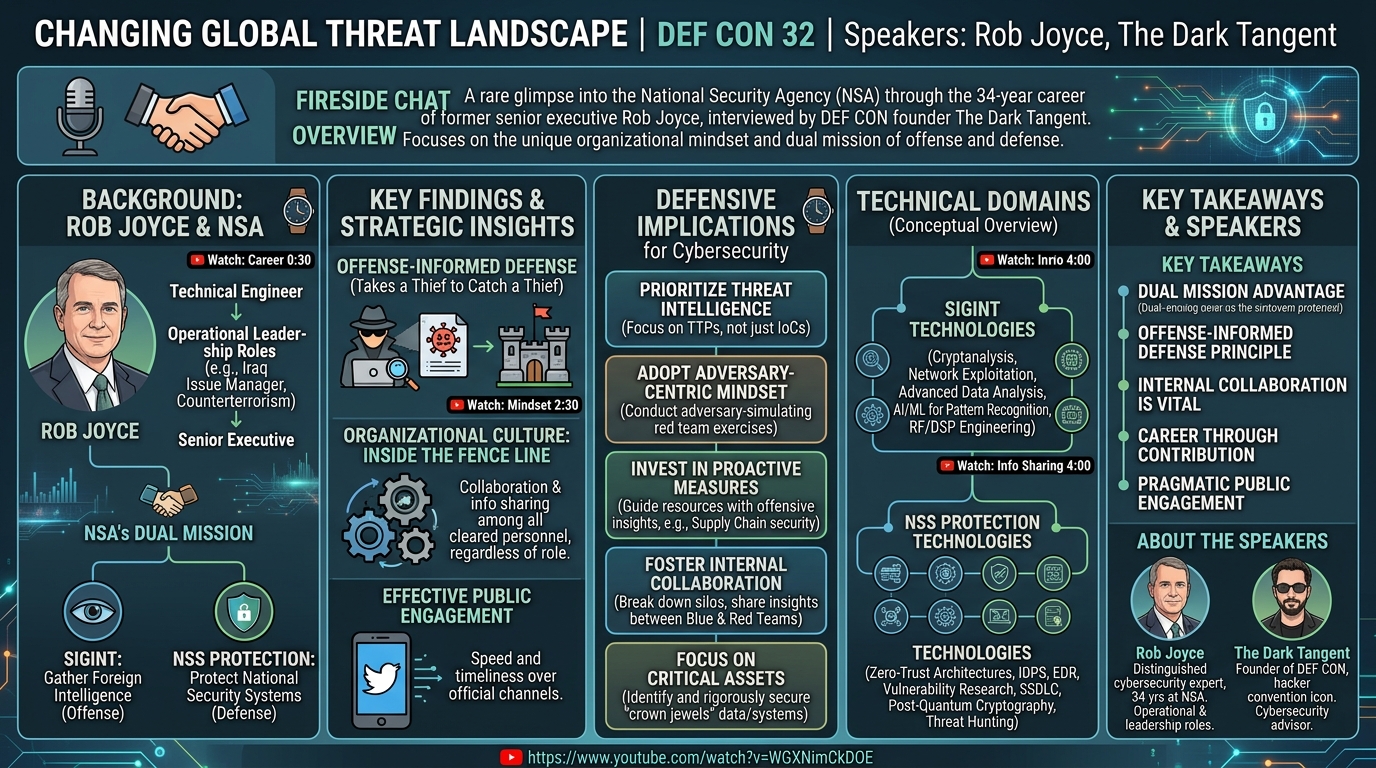
This talk, presented as a fireside chat at DEF CON 32, features Rob Joyce, a recently retired senior executive with 34 years of distinguished service at the National Security Agency (NSA), interviewed by DEF CON founder, The Dark Tangent. The discussion provides a rare glimpse into the inner workings, philosophical underpinnings, and career trajectory within one of the United States' most critical intelligence and cybersecurity organizations. While the talk's title, "Changing Global Threat Landscape," might suggest a detailed analysis of current geopolitical cyber threats, the conversation primarily centers on Joyce's personal journey, the unique dual mission of the NSA, and the mindset fostered by operating at the nexus of offensive intelligence and defensive cybersecurity.
Key moments
- 0:30 Rob Joyce introduces 34-year career at NSA
- 1:59 NSA's dual mission: signals intelligence (offense) and defense
- 2:30 Takes a thief to catch a thief - NSA's unique mindset
- 3:10 Rob Joyce's career survival philosophy at NSA
- 4:00 Internal information sharing and collaboration within NSA
- 5:00 Why Rob Joyce refused an official NSA Twitter handle
Changing Global Threat Landscape
Speakers: Rob Joyce, Former Senior Executive at National Security Agency; The Dark Tangent, Founder of DEF CON
Conference: DEF CON 32
YouTube: https://www.youtube.com/watch?v=WGXNimCkDOE
Overview
This talk, presented as a fireside chat at DEF CON 32, features Rob Joyce, a recently retired senior executive with 34 years of distinguished service at the National Security Agency (NSA), interviewed by DEF CON founder, The Dark Tangent. The discussion provides a rare glimpse into the inner workings, philosophical underpinnings, and career trajectory within one of the United States' most critical intelligence and cybersecurity organizations. While the talk's title, "Changing Global Threat Landscape," might suggest a detailed analysis of current geopolitical cyber threats, the conversation primarily centers on Joyce's personal journey, the unique dual mission of the NSA, and the mindset fostered by operating at the nexus of offensive intelligence and defensive cybersecurity.
The significance of this talk lies in its ability to humanize the often-opaque world of national security and intelligence. Joyce's insights illuminate how the NSA approaches its mandate to both gather foreign intelligence—known as signals intelligence (SIGINT)—and protect the nation's most sensitive national security systems. This dual role, he argues, cultivates a distinctive perspective, embodying the adage "it takes a thief to catch a thief," which is crucial for understanding and countering sophisticated nation-state adversaries. For the cybersecurity community, this conversation offers valuable lessons in organizational culture, information sharing within highly classified environments, and the strategic advantage gained from an offense-informed defense.
Background
▶ Watch: Rob Joyce introduces 34-year career at NSA (0:30)
Rob Joyce's career at the National Security Agency spanned 34 years, beginning as a technical engineer and evolving into high-level operational and leadership roles. His journey included critical assignments such as the Iraq issue manager during the Iraq War and extensive work in counterterrorism, demonstrating a breadth of experience across diverse national security challenges. This progression underscores the dynamic and multifaceted nature of work within the NSA, requiring not only deep technical acumen but also strategic thinking and operational leadership.
A central theme of the discussion is the NSA's unique dual mission. On one side, the agency is tasked with signals intelligence, which involves producing foreign intelligence to understand the plans, intentions, capabilities, and threats posed by adversaries. This traditional intelligence mission focuses on proactive data collection and analysis to inform national decision-makers and anticipate future challenges. On the other side, the NSA is responsible for protecting national security systems. These are the most sensitive networks of the United States government, designed to carry classified information, support warfighting capabilities, enable command and control, and facilitate intelligence operations. The integrity and resilience of these systems are paramount to national security.
Joyce emphasizes that this dual nature of playing both offense and defense imbues NSA personnel with a unique mindset. By actively engaging in offensive operations to understand adversary tactics and capabilities, the agency gains unparalleled insights into how nation-states would attempt to compromise critical systems. This direct experience informs and strengthens their defensive strategies. The "takes a thief to catch a thief" philosophy is not merely a metaphor but a practical approach where offensive knowledge directly enhances defensive posture. Furthermore, Joyce highlighted the internal culture of information sharing within the NSA, noting that "inside the fence line, there's a lot of sharing." Regardless of role—from janitorial staff to technical and language specialists—everyone holds a clearance, fostering a collaborative environment where knowledge and insights contribute to a unified "tapestry of a solution." This internal transparency, despite necessary compartmentation for specific accesses, is presented as vital for preventing redundant efforts and ensuring a comprehensive understanding of ongoing challenges. His time representing the NSA at the U.S. Embassy in London as a cryptologic representative further broadened his perspective, offering an international liaison dimension to his extensive career, though he noted the challenges posed by the COVID-19 pandemic during this period.
Key Findings
▶ Watch: Takes a thief to catch a thief - NSA's unique mindset (2:30)
As a fireside chat focused on a speaker's career and organizational philosophy rather than a research presentation, this talk does not present "findings" in the traditional sense of novel discoveries or empirical results. Instead, it offers profound insights and principles derived from Rob Joyce's extensive experience at the NSA.
The primary insight gleaned from the discussion is the strategic advantage of a dual offensive and defensive cybersecurity posture. Joyce repeatedly stresses that the NSA's unique capability to both conduct signals intelligence operations and protect national security systems provides an unparalleled understanding of the global threat landscape. This "takes a thief to catch a thief" approach allows the agency to anticipate adversary moves, understand their tradecraft, and develop more robust defenses based on real-world offensive knowledge. This is not merely theoretical; it is presented as a fundamental operational principle that shapes the NSA's entire approach to national security.
Another key insight concerns organizational culture and information flow within a highly classified environment. Joyce highlights that despite the inherent need for secrecy and compartmentation, a significant amount of information sharing occurs "inside the fence line" at the NSA. He explains that all personnel, regardless of their specific job function, possess a security clearance, enabling a broader, more integrated understanding of the agency's overarching mission. This collaborative environment is crucial for developing comprehensive solutions, ensuring that new ideas are not redundant and that collective knowledge is leveraged effectively to tackle complex challenges. The emphasis is on building a "tapestry of a solution" rather than siloed efforts.
Finally, Joyce subtly underscored the importance of effective public engagement and communication in the cybersecurity domain. His anecdote about maintaining a personal Twitter presence, which he found more effective for timely infosec interactions than official NSA channels, reveals a pragmatic understanding of how information disseminates and is received within the broader cybersecurity community. While not a direct "finding" about the threat landscape, it's a critical observation about bridging the gap between classified operations and public awareness, and the challenges of bureaucratic communication.
Technical Deep Dive
▶ Watch: Rob Joyce's career survival philosophy at NSA (3:10)
The transcript of this fireside chat, while rich in organizational philosophy and career insights, does not delve into specific technical details, code, protocols, or architectures. The discussion remains at a high conceptual level, focusing on the nature of the NSA's technical work rather than its granular implementation. Therefore, a traditional "technical deep dive" with specific tool names, CVE numbers, or version numbers is not applicable here.
However, we can infer the broad technical domains inherent in NSA's dual mission of signals intelligence and national security systems protection.
On the signals intelligence (SIGINT) side, the technical work would encompass a vast array of disciplines. This includes advanced cryptanalysis to break encrypted communications, network exploitation to gain access to adversary networks, and sophisticated data analysis techniques to process massive volumes of intercepted signals. Engineers and scientists in this domain would be involved in developing and deploying specialized hardware and software for signal collection, processing, and interpretation. This work requires deep expertise in areas such as radio frequency engineering, digital signal processing, computer forensics, reverse engineering of malware and adversary tools, and artificial intelligence/machine learning for pattern recognition and anomaly detection in vast datasets. The goal is to understand adversary capabilities, plans, and intentions by technically dissecting their communications and digital footprint. This involves understanding various communication protocols, network architectures, and encryption standards employed globally, and finding vulnerabilities or alternative means to access the intelligence contained within.
For the national security systems (NSS) protection mission, the technical focus shifts to defensive architecture, robust engineering, and incident response for the most sensitive government networks. This involves designing and implementing highly secure network infrastructures, often employing zero-trust architectures, advanced intrusion detection and prevention systems (IDPS), and endpoint detection and response (EDR) solutions. Technical personnel would be engaged in vulnerability research to identify and patch weaknesses before adversaries can exploit them, developing secure software development lifecycle (SSDLC) practices, and implementing stringent access control mechanisms. Cryptographic experts would design and deploy post-quantum cryptography solutions to protect classified data both in transit and at rest. Furthermore, the protection of NSS involves continuous threat hunting, incident response planning, and the development of resilient systems that can withstand sophisticated nation-state attacks, including those involving supply chain compromises or zero-day exploits. The technical challenge lies in creating an impenetrable "tapestry of a solution" across diverse and often legacy systems, ensuring the confidentiality, integrity, and availability of critical information and warfighting capabilities. The phrase "the special sauce of NSA is applied" suggests proprietary and highly advanced technical methodologies beyond what is publicly available or open source, particularly in how they leverage intelligence to inform and prioritize defensive technical measures.
Demo / Proof of Concept
▶ Watch: Internal information sharing and collaboration within NSA (4:00)
This fireside chat, being a high-level discussion about a distinguished career and organizational philosophy, did not include any live demonstrations or proofs of concept. The focus was entirely on sharing insights and experiences from Rob Joyce's tenure at the National Security Agency.
Defensive Implications
▶ Watch: Why Rob Joyce refused an official NSA Twitter handle (5:00)
The most significant defensive implication derived from Rob Joyce's discussion is the paramount importance of an offense-informed defense. His repeated emphasis on the NSA's dual mission—conducting signals intelligence (offense) and protecting national security systems (defense)—underscores a critical strategic principle: to effectively defend, one must deeply understand the adversary's offensive capabilities, methodologies, and motivations. This embodies the "takes a thief to catch a thief" adage, suggesting that defenders who possess insights into how offensive nation-state actors operate are far better equipped to build resilient and proactive defenses.
For organizations and cybersecurity professionals, this translates into several actionable areas:
- Prioritize Threat Intelligence: Defenders must actively seek and integrate high-quality, actionable threat intelligence into their security operations. This intelligence should not merely list indicators of compromise (IoCs) but provide a comprehensive understanding of adversary tactics, techniques, and procedures (TTPs). Understanding how a sophisticated actor (like a nation-state) would attempt to gain access, escalate privileges, maintain persistence, and exfiltrate data allows defenders to anticipate attacks and implement controls tailored to specific threats.
- Adopt an Adversary-Centric Mindset: Instead of simply patching vulnerabilities reactively, security teams should think like an attacker. This involves conducting red team exercises and penetration testing that simulate real-world nation-state attacks, not just compliance checks. Understanding potential attack paths and weaknesses from an offensive perspective enables the development of more robust, proactive defensive strategies.
- Invest in Proactive Security Measures: The insights from offensive operations can guide investments in defensive technologies and processes. For instance, if intelligence indicates a rise in supply chain attacks, defensive efforts should focus on supply chain security audits, software bill of materials (SBOM) analysis, and integrity verification. If certain zero-day exploits are anticipated, resources might be directed towards advanced endpoint protection, memory exploit mitigation, or behavioral analytics to detect novel attack patterns.
- Foster Internal Collaboration and Information Sharing: Joyce's point about widespread information sharing within the NSA, despite clearances, highlights the value of breaking down silos. In any organization, fostering collaboration between "red teams" and "blue teams," security architects, and incident responders ensures that offensive insights directly inform defensive improvements. Regular cross-functional communication helps create a holistic "tapestry of a solution."
- Focus on Critical Systems and Data: The NSA's mission to protect "national security systems" carrying classified information, warfighting, and command and control data emphasizes the importance of identifying and rigorously securing an organization's most critical assets. Defenders should employ a risk-based approach, dedicating the highest level of protection to systems and data whose compromise would have the most severe impact.
- Continuous Learning and Adaptation: The global threat landscape is constantly evolving. The NSA's long-standing dual mission implies a continuous cycle of learning from offensive operations and adapting defensive strategies. Defenders must embrace continuous education, stay abreast of emerging threats, and regularly update their security postures to counter new adversary techniques.
In essence, Joyce's career experience underscores that effective defense is not a static state but a dynamic process deeply informed by an intimate understanding of the offensive capabilities of sophisticated adversaries. By integrating this "thief's perspective," organizations can move beyond basic cybersecurity hygiene to build truly resilient and adaptive defenses against the most challenging threats.
Key Takeaways
- Dual Mission Advantage: The NSA's unique dual role in conducting signals intelligence (offense) and protecting national security systems (defense) provides an unparalleled strategic advantage in understanding and countering global cyber threats.
- Offense-Informed Defense: The philosophy of "it takes a thief to catch a thief" is a critical principle; understanding adversary tactics and capabilities through offensive operations directly informs and strengthens defensive strategies.
- Internal Collaboration is Key: Despite the need for compartmentation, robust internal information sharing among all cleared personnel within an organization like the NSA is vital for developing comprehensive, non-redundant security solutions.
- Career Growth Through Contribution: Rob Joyce's career philosophy emphasizes focusing on the current job, having good ideas, and actively contributing to efforts to unlock opportunities for new and bigger challenges.
- Pragmatic Public Engagement: The anecdote about Joyce's personal Twitter effectiveness highlights the challenges and importance of timely, practical information sharing in cybersecurity, even in sensitive domains, and the limitations of traditional bureaucratic communication channels.
About the Speaker(s)
Rob Joyce is a highly distinguished cybersecurity expert, having recently retired in March after 34 years of service at the National Security Agency (NSA). He began his extensive career as a technical engineer, progressively moving into significant operational roles, including serving as the Iraq issue manager during the Iraq War and working extensively in counterterrorism. Joyce's career at the NSA was characterized by his deep involvement in both signals intelligence—gathering foreign intelligence to understand adversary intentions and capabilities—and the critical mission of protecting national security systems, which safeguard classified information and warfighting capabilities. This dual experience provided him with a unique perspective on offensive and defensive cybersecurity strategies. Before his retirement, he also served as the cryptologic representative to the UK at the US Embassy in London.
The Dark Tangent (Jeff Moss) is a prominent figure in the information security community, best known as the founder and director of DEF CON, one of the world's largest and oldest hacker conventions. He also founded the Black Hat Briefings. Moss has served as an advisor on cybersecurity for various government bodies, including the Homeland Security Advisory Council. His role as the interviewer in this fireside chat underscores his continued influence and his ability to bring high-profile speakers like Rob Joyce to the DEF CON stage to share invaluable insights with the broader security community.
Reviews
Dr. Zero (Offensive Security Researcher) — STRONG ACCEPT
This fireside chat with former NSA executive Rob Joyce provided a rare and valuable insider's perspective on the NSA's unique dual mission of offensive intelligence and defensive cybersecurity. It articulated the critical "offense-informed defense" philosophy with exceptional clarity and authority, offering strategic insights into how a top-tier nation-state actor approaches the global threat landscape and builds resilience. This wasn't a technical deep-dive, but for its lane as an executive strategic talk, it delivered substantive signal and actionable strategic thinking.
Heather Calloway (CISO) — STRONG ACCEPT
This fireside chat, while misleadingly titled, offers a robust exploration of the National Security Agency's unique dual mission and the strategic advantage of an offense-informed defense. Rob Joyce's insights underscore the critical need for security leaders to deeply understand adversary tradecraft to build truly resilient programs. It's a valuable discussion on institutional strategy, internal collaboration, and the mindset required to lead security at scale, providing a strong framework for how CISOs should approach program design and risk prioritization, even if it lacks specific technical deep dives.