Thinking Like a Hacker in the Age of AI
Richard 'neuralcowboy' Thieme
DEF CON 33 · Day 1 · Main Stage
Overview
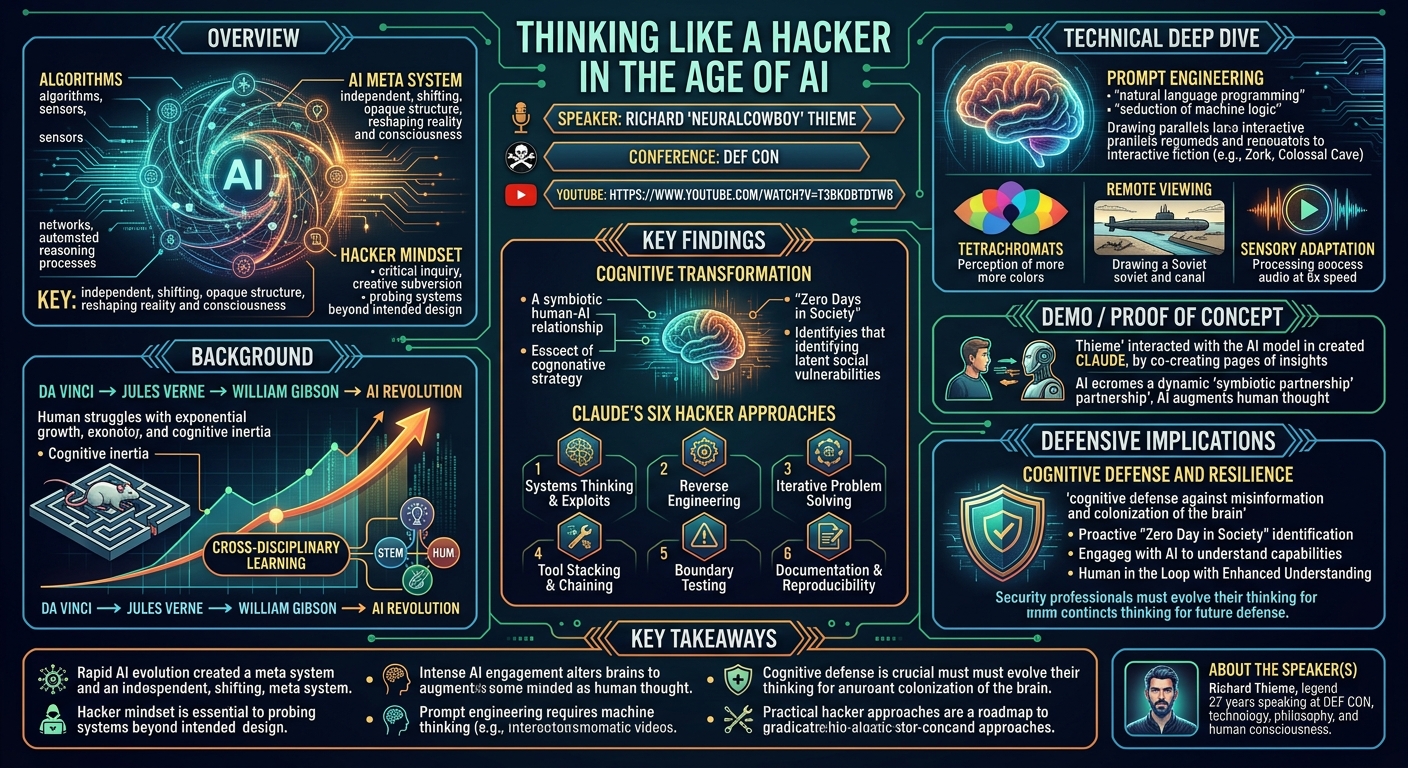
In his captivating DEF CON talk, "Thinking Like a Hacker in the Age of AI," Richard 'neuralcowboy' Thieme, a revered figure who has spoken at 27 DEF CONs over three decades, delivered a profound call to action. Thieme argues that the rapid, pervasive evolution of artificial intelligence has ushered humanity into an unprecedented era, a meta system – an independent, constantly shifting, opaque structure of algorithms, sensors, networks, and automated reasoning processes. This meta system is not merely a tool but an emergent reality that is fundamentally reshaping our understanding of the world and ourselves, often faster than we can comprehend.
Key moments
- 1:20 Defining the 'meta system' and its impact on reality
- 2:30 Adopting a hacker mindset in a self-redesigning world
- 4:30 Exponential growth and science fiction predicting our future
- 6:10 Hackers' multi-screen approach to information overload (ADHD as a feature)
- 6:40 The 'rat experiment' analogy: humans' struggle with habituation
- 8:20 The addictive 'rush' and 'sleepless nights' from engaging with AI
- 9:40 Claude (AI) brilliantly structured the speaker's own talk
Thinking Like a Hacker in the Age of AI
Speakers: Richard 'neuralcowboy' Thieme
Conference: DEF CON
YouTube: https://www.youtube.com/watch?v=t3bKDBtdSw8
Overview
In his captivating DEF CON talk, "Thinking Like a Hacker in the Age of AI," Richard 'neuralcowboy' Thieme, a revered figure who has spoken at 27 DEF CONs over three decades, delivered a profound call to action. Thieme argues that the rapid, pervasive evolution of artificial intelligence has ushered humanity into an unprecedented era, a meta system – an independent, constantly shifting, opaque structure of algorithms, sensors, networks, and automated reasoning processes. This meta system is not merely a tool but an emergent reality that is fundamentally reshaping our understanding of the world and ourselves, often faster than we can comprehend.
Thieme's core message is that traditional linear thinking and analytical tools are insufficient to navigate this new landscape. Instead, he advocates for adopting a hacker mindset – one characterized by critical inquiry, creative subversion, and an insatiable curiosity to probe systems beyond their intended design. This approach, he contends, is not just beneficial but essential for individuals and societies to maintain autonomy, freedom, and power in a future increasingly defined by AI. The talk is less about specific AI vulnerabilities and more about a radical shift in human cognition required to effectively engage with and defend against the pervasive influence of artificial intelligence.
Background
▶ Watch: Defining the 'meta system' and its impact on reality (1:20)
Thieme contextualizes the current AI revolution by drawing parallels with historical technological shifts and human perception. He references the adage from Roy Amara, stating that "we tend to overestimate the effect of a technology in the short run and underestimate it in the long run," suggesting AI's true impact is yet to be fully grasped. He highlights how humanity struggles to visualize exponential growth, often relying on science fiction to dream of future possibilities. From Da Vinci's flying machines to Jules Verne's lunar voyages and William Gibson's cyberspace, the gap between speculative vision and tangible reality has dramatically narrowed. What once took centuries now takes decades, or even years, demonstrating an accelerating pace of change.
The problem, Thieme explains, is our inherent human tendency to become habituated to existing paradigms, much like a rat repeatedly returning to the same tunnel for cheese, even after the cheese has moved. This cognitive inertia prevents us from thinking outside accustomed frameworks, leading us to apply outdated solutions to novel problems. Many current disciplines and experts struggle to keep pace with the material published in their own fields, let alone the interactions across "multimodal domains" creating entirely new categories. This challenge, however, is precisely what hackers excel at: operating with multiple screens open, embracing ambiguity, and constantly seeking new ways to understand and interact with complex systems. Thieme stresses the need for cross-disciplinary learning, noting that even STEM fields are now recognizing the value of humanities backgrounds for effective prompt engineering.
Key Findings
▶ Watch: Exponential growth and science fiction predicting our future (4:30)
Thieme's central finding is that the age of AI demands a fundamental re-evaluation of human consciousness and interaction with technology. He posits that we are in a symbiotic relationship with AI, one that is reshaping our thinking and behavior. The critical shift is from viewing AI as a mere tool to recognizing it as an emergent intelligence that necessitates a "metaconsciousness" from humans.
Key findings and contributions from the talk include:
- The Necessity of a Hacker Mindset: Thieme argues that a critical, creative, and subversive hacker mindset is the only effective way to navigate the AI meta system. This involves constantly questioning assumptions, exercising cognitive defense against misinformation, and thinking at a meta level – understanding that AI itself operates at this level of abstraction.
- AI as a Catalyst for Cognitive Transformation: Engaging with AI, particularly large language models (LLMs) like Claude, can fundamentally alter human thinking and perception. Thieme shares personal anecdotes of how interacting with early internet technologies and interactive fiction changed his brain, and how his intense engagement with Claude felt like "having an affair," colonizing his mind.
- "Zero Days in Society": Hackers are adept at finding zero days not only in software but also in society itself – latent vulnerabilities, unacknowledged conditions, and gaps in collective understanding. Identifying and acting on these societal zero days is critical for both offensive and defensive security in the AI age.
- The Six Hacker Approaches to AI: In preparing his talk, Thieme asked Claude for suggestions on how hackers can approach AI. Claude provided six brilliant categories, which Thieme then iterated upon with the AI:
- Thinking in systems and exploits: Understanding the interconnectedness of components and potential vulnerabilities.
- Reverse engineering: Deconstructing AI systems or their outputs to understand their inner workings and biases.
- Iterative problem solving: Continuously refining interactions and prompts based on AI responses.
- Tool stacking and chaining: Combining various AI tools and human skills to achieve complex objectives.
- Boundary testing: Pushing the limits of AI capabilities and identifying its failure points or unexpected behaviors.
- Documentation and reproducibility: Recording interactions, findings, and methods for shared learning and validation.
These categories represent a practical framework for hackers to engage with AI productively and securely.
Technical Deep Dive
▶ Watch: Hackers' multi-screen approach to information overload (ADHD as a feature) (6:10)
While not a technical deep dive into AI architectures or specific code, Thieme's talk offers a profound "technical deep dive" into the cognitive mechanics of human-AI interaction and the brain's plasticity in adapting to new technological interfaces. He redefines prompt engineering not merely as crafting effective queries but as a form of "seduction" or "programming" through natural language. Just as programmers learn to "think like a machine" to communicate with programming languages, ordinary users engaging with natural language interfaces must also learn to think like the AI to be effective.
Thieme draws a compelling analogy to early interactive fiction games like Colossal Cave or Zork. In these text-based adventures, users had to learn the specific syntax and vocabulary the computer understood (e.g., "enter building" instead of "enter the building"). This process of adjusting human language to machine logic is, in Thieme's view, precisely what happens with modern AI prompts. The AI provides a prompt, you respond, and if it doesn't understand, it implicitly prompts you to reframe your input. This iterative process of refinement creates an emergent reality from the meshing of human and AI context.
He argues that the brain itself is a malleable system, capable of radical adaptation. He provides several fascinating examples:
- Tetrachromats: Individuals, typically women, with an extra genetic change enabling them to perceive more colors than the average human. Their ability is not just physiological but also requires intentionality and practice to activate and develop, demonstrating how belief can influence perception and neural pathways.
- Remote Viewing: Structured protocols of clairvoyance used for intelligence gathering at a distance. Thieme recounts a successful remote viewing session where an individual accurately described a never-before-seen Soviet nuclear submarine and its inland construction site, including a newly built canal to the sea. Such anecdotes challenge conventional understandings of consciousness, time, and space, suggesting that consciousness might be a non-local field.
- Sensory Adaptation: The case of Ted Glazer, an MIT professor who became totally blind, but trained himself to listen to multiple conversations simultaneously and process audio at 5-6 times normal speed. Similarly, people learning Braille develop more neurons connecting their brain to their fingertips. These examples underscore the brain's remarkable plasticity and its capacity to reconfigure itself in response to intentional training and new forms of interaction.
These examples, while seemingly esoteric, serve to illustrate Thieme's core technical argument: that engaging deeply with AI will not only change our external world but will fundamentally rewire our brains and alter our consciousness, creating "new ways of knowing." This cognitive transformation is the true "technical deep dive" of the AI age.
Demo / Proof of Concept
▶ Watch: The addictive 'rush' and 'sleepless nights' from engaging with AI (8:20)
While Thieme did not present a traditional software or hardware demonstration, his personal interactions with the AI model Claude served as a powerful "proof of concept" for his thesis. He recounted spending several weeks meticulously crafting his talk, only then to ask Claude for suggestions on his topic. Claude, in a matter of seconds, generated six brilliant categories for how hackers could approach AI. Thieme then took each of these categories, fed them back into Claude, and received 20-25 pages of expanded insights – information he admitted he "never would have understood before" and that took Claude "several seconds to output" compared to his weeks of work.
This experience was Thieme's direct demonstration of the symbiotic relationship and the mind-blowing potential of human-AI collaboration. He emphasized that this interaction blew his mind, not because it suggested human obsolescence, but because it highlighted a new mode of cognitive partnership. Claude's ability to generate such comprehensive and insightful frameworks so rapidly underscored the AI's capacity to augment human thought and accelerate the discovery of new knowledge. This interactive process, where AI acts as a creative partner, is Thieme's practical demonstration of how hackers can engage with AI to "invent the future" rather than merely foretell it.
Defensive Implications
▶ Watch: Claude (AI) brilliantly structured the speaker's own talk (9:40)
The defensive implications of Thieme's talk are profound and extend beyond traditional cybersecurity measures to encompass cognitive and societal resilience. Defenders must recognize that the AI meta system is not just attacking systems but also attempting to "colonize your brain" with misinformation and disinformation.
Key defensive strategies include:
- Cognitive Defense and Meta-Level Thinking: Defenders must actively exercise cognitive defense against the flood of information and learn to think at a meta level. Since AI-assisted attacks will operate at this level of abstraction, human defenders must also adopt this perspective to effectively counter threats. This involves constantly questioning assumptions, identifying biases, and understanding the basis of one's own conclusions.
- Embracing the Hacker Mindset for Defense: The critical, creative, and subversive nature of the hacker mindset is crucial. This means not just securing systems as they were designed, but probing them to understand what they can be made to do and anticipating unforeseen vulnerabilities.
- Proactive "Zero Day in Society" Identification: Defenders need to develop the ability to identify "zero days" not just in code, but in societal structures, cultural norms, and cognitive biases. These are latent vulnerabilities that AI could exploit through "soft power" – influencing beliefs, narratives, and behaviors, much like the speaker's examples of Russia in Crimea or China in Hollywood.
- Engaging with AI to Understand It: Rather than fearing or dismissing AI, defenders must actively engage with it. This involves experimenting, testing, and probing AI systems to understand their capabilities, limitations, and emergent behaviors. By understanding how AIs think and act, defenders can better anticipate and mitigate AI-assisted attacks.
- Human in the Loop with Enhanced Understanding: While insisting on a "human in the loop" is important, Thieme clarifies that this is not a mere partnership but a symbiotic relationship. Humans must be equipped with a deeper, more nuanced understanding of AI's operations, even when they are opaque. This means developing intuitive grasps of AI's unique characteristics and providing a "different dimension of understanding" when the AI's internal workings are unknowable.
- Applying Claude's Six Hacker Approaches: The six categories provided by Claude (systems thinking and exploits, reverse engineering, iterative problem solving, tool stacking and chaining, boundary testing, documentation and reproducibility) offer a robust framework for defensive operations. These approaches allow defenders to dissect AI systems, predict their behavior, and develop countermeasures effectively.
Ultimately, defensive implications revolve around recognizing that AI is changing the very nature of reality and human cognition. Security professionals must therefore evolve their own thinking, becoming more adaptable, critical, and interdisciplinary to protect not just digital assets, but the integrity of human thought and societal autonomy.
Key Takeaways
- The rapid evolution of AI has created a meta system that is fundamentally reshaping reality and human consciousness, demanding a radical shift in how we think.
- A hacker mindset – critical, creative, and subversive – is essential for navigating the AI age, allowing us to question assumptions and discover "zero days" not only in software but also in society itself.
- Humans are in a symbiotic relationship with AI, where intense engagement can literally alter brain function and expand our cognitive capabilities, leading to "new ways of knowing."
- Prompt engineering is a form of natural language "programming" that requires learning to "think like the machine" to effectively sculpt interactions and co-create emergent realities with AI.
- Cognitive defense and thinking at a meta level are crucial for protecting against AI-assisted attacks and the colonization of our minds by misinformation and disinformation.
- Practical hacker approaches to AI, such as systems thinking and exploits, reverse engineering, iterative problem solving, tool stacking and chaining, boundary testing, and documentation and reproducibility, provide a roadmap for effective engagement and defense.
About the Speaker(s)
Richard Thieme, known by his handle 'neuralcowboy,' is a true legend in the DEF CON community, having spoken at the conference for 27 of its 30 years. His deep engagement with technology, philosophy, and human consciousness spans decades. Thieme is not only a seasoned speaker but also an accomplished intellectual, having taught literature at the University of Illinois with advanced degrees. His work often explores the intersection of hackers, intelligence, and the evolving digital landscape, making him a unique voice in the security world. His personal experiences, from writing for early internet publications like Wired to his profound interactions with AI, underscore his role as a long-time observer and participant in the technological transformations he describes.
Reviews
Dr. Zero (Offensive Security Researcher) — WEAK
A beloved elder statesman delivers a philosophical meditation on AI and consciousness that reads more like a TED Talk for mystics than a DEF CON session. Thieme's longevity at the con earns him the room, but not a pass on substance — and this talk is long on vibes, short on anything a practitioner can use.
Heather Calloway (CISO) — PASS
A long-running DEF CON speaker delivers a philosophical meditation on AI, consciousness, and the hacker mindset — sincere, personal, and entirely outside the lane of governance, operational security, or institutional accountability. Not a penalty on the speaker; this is simply not a talk that produces decisions, defenses, or risk clarity.