Whose Slide Is It Anyway?
Killer Grizz
DEF CON 33 · Day 1 · Main Stage
Overview
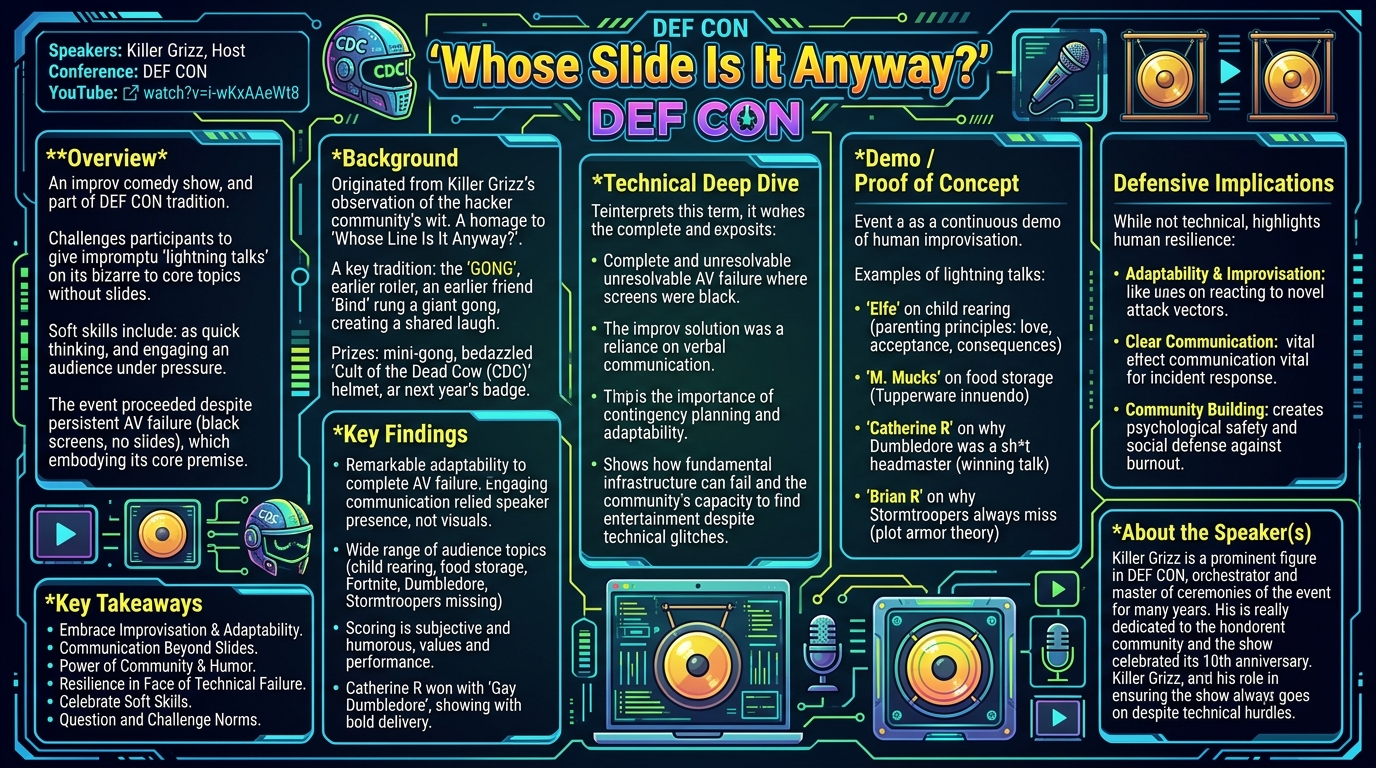
The DEF CON tradition of "Whose Slide Is It Anyway?" stands as a vibrant testament to the hacker community's capacity for humor, spontaneity, and resilience. Far from a conventional technical presentation, this event is an improv comedy show, challenging participants to deliver impromptu "lightning talks" on bizarre, audience-suggested topics without the aid of slides. Hosted by the inimitable Killer Grizz, the session at DEF CON was particularly memorable, unfolding against a backdrop of persistent audio-visual (AV) technical failures, which paradoxically amplified the core premise of the show: the absence of slides.
Key moments
- 0:00 Chaotic start & audience interaction
- 1:30 Mini gong necklace presentation and emotional backstory
- 3:40 Unveiling unique Defcon first place prizes
- 4:30 Heartfelt tribute to lost friend "Bind"
- 5:30 Adapting to AV issues: spontaneous lightning talks
- 6:15 First lightning talk: Elfe on child rearing
- 7:30 Elfe's key parenting principles: love, acceptance, consequences
Whose Slide Is It Anyway?
Speakers: Killer Grizz, Host
Conference: DEF CON
YouTube: https://www.youtube.com/watch?v=i-wKxAAeWt8
Overview
The DEF CON tradition of "Whose Slide Is It Anyway?" stands as a vibrant testament to the hacker community's capacity for humor, spontaneity, and resilience. Far from a conventional technical presentation, this event is an improv comedy show, challenging participants to deliver impromptu "lightning talks" on bizarre, audience-suggested topics without the aid of slides. Hosted by the inimitable Killer Grizz, the session at DEF CON was particularly memorable, unfolding against a backdrop of persistent audio-visual (AV) technical failures, which paradoxically amplified the core premise of the show: the absence of slides.
This unique event, celebrating its upcoming 10th anniversary, serves as a crucial counterpoint to the deep technical dives that characterize much of DEF CON. It underscores the importance of soft skills—quick thinking, public speaking, and engaging an audience under pressure—within the cybersecurity domain. More profoundly, it highlights the community's ability to pivot and find humor even when technology fails, transforming a potential "dumpster fire," as Killer Grizz affectionately put it, into a shared, unscripted experience that reinforces the bonds and unique culture of DEF CON.
The talk, or rather, the performance, matters because it encapsulates the spirit of hacking beyond code and exploits. It's about problem-solving in real-time, adapting to unexpected constraints, and fostering an environment where creativity and audaciousness are celebrated. In a world increasingly reliant on polished presentations, "Whose Slide Is It Anyway?" champions raw, unadulterated human connection and wit, proving that the most memorable moments at a security conference sometimes have nothing to do with security itself, but everything to do with the people who comprise its vibrant community.
Background
▶ Watch: Chaotic start & audience interaction (0:00)
"Whose Slide Is It Anyway?" emerged as a DEF CON staple, born from Killer Grizz's observation of the "ridiculous" and creative nature of the hacker community. The show, a clear homage to the popular improv television series "Whose Line Is It Anyway?", flips the script on traditional conference presentations by deliberately removing the crutch of visual aids. The core conceit is simple yet profoundly challenging: volunteer speakers are called to the stage and presented with a topic shouted out by the audience, often absurd or highly unconventional, and must immediately launch into a coherent, entertaining three-to-five-minute talk.
The origins of the show are rooted in a desire to foster informal interaction and showcase the quick wit inherent in the DEF CON crowd. Killer Grizz recounts the genesis of the event, explaining that it took him a year after his first DEF CON experience to grasp the unique ethos of the community before launching the contest. A significant element of the show's tradition is the gong, a physical manifestation of judgment and humor. Killer Grizz shared a poignant anecdote about the giant gong, which was first rung by his friend Bind in the hallway of the Flamingo hotel during an earlier DEF CON, creating a memorable, shared laugh that defined the show's spirit. This year, participants were awarded a smaller, mini-gong, carrying forward the tradition of playful recognition.
The event prizes further underscore its unique place within the conference. Beyond the coveted mini-gong, winners have received a bedazzled worker's helmet emblazoned with the Cult of the Dead Cow (CDC) logo, donated by Caitlyn aka Medusa, and even a badge for the following year's DEF CON. These prizes are not high-tech gadgets or professional certifications but rather quirky, community-specific tokens that resonate deeply with the hacker subculture, emphasizing shared identity over material gain. The show serves as a vital cultural anchor, providing a space for camaraderie, laughter, and a celebration of the human element that often gets overshadowed by the technical gravitas of the main conference tracks. This year's session, however, faced an unforeseen "problem": significant AV issues, which ironically aligned perfectly with the show's "no slides" premise, forcing an even greater reliance on pure verbal improvisation.
Key Findings
▶ Watch: Unveiling unique Defcon first place prizes (3:40)
Given the improvisational and non-technical nature of "Whose Slide Is It Anyway?", the "key findings" are not scientific discoveries or security vulnerabilities but rather profound observations about human performance, community dynamics, and the resilience of an event facing unexpected challenges. The primary finding was the remarkable adaptability of both the event host and the impromptu speakers in the face of a complete AV failure. Despite the screens being black and no slides ever appearing, the show not only continued but thrived, transforming a technical mishap into a core element of the experience. This underscored the fundamental truth that engaging communication relies more on the speaker's presence and wit than on visual aids.
Another significant finding was the sheer breadth and creativity of the audience-suggested topics, which ranged from the mundane to the absurd. Participants were challenged to speak on "child rearing," "food storage," "Fortnite," "why Dumbledore was a sh*t headmaster," and "why Stormtroopers always miss." These diverse topics highlighted the varied interests and intellectual nimbleness of the DEF CON attendees, demonstrating their ability to connect disparate concepts and deliver entertaining narratives on the fly. The judges' scoring, often subjective and humorous, further emphasized that the value lay in the performance and entertainment, not factual accuracy or technical depth.
The ultimate "winner" of the contest, Catherine R, delivering a talk on "Gay Dumbledore," exemplified the show's core tenets: bold delivery, passionate (and often irreverent) argumentation, and an ability to captivate an audience. Her performance, which garnered high scores and strong audience reaction, showcased the power of confident, unscripted communication. This event effectively "found" that the human element—wit, charisma, and the ability to connect—remains paramount, even in a conference dedicated to the cutting edge of technology. The show proved that the hacker community values not just technical prowess but also the soft skills that foster connection, humor, and shared experience, especially when the technology itself decides to take a break.
Technical Deep Dive
▶ Watch: Heartfelt tribute to lost friend "Bind" (4:30)
A traditional technical deep dive into code, protocols, or architectures is not applicable to "Whose Slide Is It Anyway?" as the event is fundamentally an improv comedy show and not a security talk. There were no exploits discussed, no vulnerabilities analyzed, and no new tools unveiled. However, a "meta" technical deep dive reveals insights into the resilience of live event production and the human element in overcoming technical failure within a highly technical community.
The most prominent "technical" aspect of this specific session was the complete and unresolvable AV failure that plagued the entire duration. From the outset, the host, Killer Grizz, acknowledged the issue, stating, "I don't know what the f*** happened to the AV. I really don't." This meant that the screens remained black, rendering any pre-prepared slides (had there been any for a "no slides" show) or even basic visual cues impossible. This unforeseen technical malfunction ironically reinforced the core premise of "Whose Slide Is It Anyway?" – the emphasis on pure, unadulterated verbal performance.
The improvised solution to this technical challenge was a complete reliance on verbal communication and the raw talent of the speakers. The host adapted by explicitly stating, "Anybody who was on the list who signed up, if you think you can do a 5-minute or three-minute lightning talk when the audience giving you suggestion, that's how we're going to do who slide today." This immediate pivot highlighted the importance of contingency planning and adaptability in live event management, even for a show designed to be spontaneous. The microphones, thankfully, remained operational, allowing the performances to proceed.
From a broader perspective, the incident serves as a stark reminder that even at a conference like DEF CON, where attendees are experts in dissecting and manipulating complex systems, fundamental technical infrastructure can still fail. The ability of the event to not only continue but to be embraced by the audience demonstrates a collective understanding and appreciation for the human element that transcends technological perfection. The "technical deep dive" here is not into a system, but into the dynamic interplay between human improvisation and the unpredictable nature of technology, ultimately revealing the community's capacity to find entertainment and connection despite, or perhaps because of, technical glitches.
Demo / Proof of Concept
▶ Watch: First lightning talk: Elfe on child rearing (6:15)
In the context of "Whose Slide Is It Anyway?", the entire event functions as a continuous demo and proof of concept for human improvisation, quick thinking, and engaging public speaking under pressure. Each lightning talk delivered by a volunteer from the audience serves as a standalone demonstration of these soft skills, performed live and unscripted. The "proof" is in the immediate, often uproarious, audience reaction and the subjective scoring by the panel of judges.
Several notable demonstrations occurred throughout the session. Elfe bravely tackled the topic of "child rearing," delivering a surprisingly personal and heartfelt talk about raising his twin boys, the challenges of honesty, and the "love and logic" approach to parenting. Despite the non-technical subject matter, his ability to craft a coherent narrative and connect with the audience on an emotional level was a powerful demonstration of impromptu storytelling.
Next, M. Mucks was challenged to speak on "food storage," which she masterfully transformed into an extended, innuendo-laden monologue about Tupperware. Her performance was a tour de force of comedic timing and double entendre, proving that any topic, no matter how mundane, can be elevated through creative delivery. M. Mucks's talk, filled with playful suggestive language and direct engagement with the judges, perfectly embodied the irreverent spirit of the show.
Catherine R then took the stage to argue "why Dumbledore was a sh*t headmaster," a topic that allowed her to showcase impressive analytical skills and a deep, albeit humorous, textual analysis of the Harry Potter series. Her arguments, ranging from Dumbledore's abandonment of Harry to his love of "fuzzy socks" and his identity as a "gay" character (as retroactively stated by JK Rowling), were delivered with such confidence and comedic flair that she ultimately won the entire contest. Her performance was a clear proof of concept for how structured argumentation can be spontaneously applied to even the most whimsical of topics.
Finally, Brian R offered his take on "why Stormtroopers always miss," skillfully weaving a narrative around plot armor and Darth Vader's secret paternity of Luke Skywalker. His ability to build a comedic conspiracy theory from pop culture lore demonstrated a different facet of improvisational skill: the construction of a humorous, albeit fictional, "insider" narrative.
These individual performances, punctuated by the host's commentary and the judges' often-comedic scoring, collectively demonstrated the core concept: that compelling communication and entertainment can arise organically from human wit, even without the crutch of prepared visuals or a pre-determined script, especially in an environment where technical failures necessitate a raw, human-centric approach. The physical mini-gong and the Cult of the Dead Cow helmet served as tangible artifacts of these successful "demos."
Defensive Implications
▶ Watch: Elfe's key parenting principles: love, acceptance, consequences (7:30)
While "Whose Slide Is It Anyway?" offers no direct technical defensive implications for cybersecurity professionals in terms of protecting systems or data, it provides invaluable lessons for personal and professional resilience within the broader security community. The event, especially this particular session marred by AV failure, became a powerful metaphor for operating effectively in unexpected and challenging environments.
Firstly, the show highlights the critical importance of adaptability and improvisation for security professionals. Just as the speakers had to pivot instantly to an unfamiliar topic without slides, defenders often face novel attack vectors, zero-day exploits, or unforeseen operational disruptions. The ability to think on one's feet, synthesize information rapidly, and communicate effectively under pressure—even when the "slides" (i.e., expected tools, data, or clear processes) are unavailable—is a crucial defensive skill. It's about developing cognitive resilience to maintain composure and effectiveness when plans go awry.
Secondly, the event underscores the value of clear and concise communication without relying solely on visual aids. In incident response, explaining complex technical issues to non-technical stakeholders (management, legal, PR) often requires distilling information to its essence and articulating it verbally. The improv speakers demonstrated how to engage an audience and convey a message purely through spoken word, a skill vital for security professionals presenting findings, explaining risks, or training colleagues. This builds a "defensive" capability against miscommunication and misunderstanding, which can be as damaging as any technical breach.
Furthermore, the communal aspect of "Whose Slide Is It Anyway?" fosters community building and psychological safety within the DEF CON environment. By celebrating humor, vulnerability, and shared experience, the event strengthens the social fabric of the hacker community. A strong, interconnected community is inherently more resilient; individuals are more likely to share information, collaborate on solutions, and support each other through professional challenges. This collective strength can be seen as a form of "social defense" against burnout, isolation, and the pressures of a demanding industry.
In essence, the "defensive implications" are not about protecting digital assets, but about cultivating the human assets within the cybersecurity field: fostering agile minds, effective communicators, and a supportive community capable of thriving even when the unexpected happens, much like Killer Grizz and his audience did when the AV screens went dark. It's about defending against rigidity and embracing the chaos with creativity and wit.
Key Takeaways
- Embrace Improvisation and Adaptability: The entire event, especially in the face of significant AV failure, underscored the critical importance of thinking on your feet and adapting to unexpected circumstances. This skill is invaluable for security professionals dealing with dynamic threats and unforeseen challenges.
- Communication Beyond Slides: The show powerfully demonstrated that engaging and effective communication can occur without any visual aids. Developing strong verbal articulation and storytelling abilities is crucial for conveying complex ideas, whether in a security briefing or an improv comedy setting.
- The Power of Community and Humor: "Whose Slide Is It Anyway?" highlights how humor, shared experiences, and informal events are vital for fostering a strong, resilient, and supportive community within the often-intense world of cybersecurity.
- Resilience in the Face of Technical Failure: The DEF CON audience and host's ability to pivot and find entertainment despite persistent technical glitches (black screens, no slides) serves as a potent reminder that human ingenuity and a positive attitude can overcome technological shortcomings.
- Celebrate Soft Skills: The event places a spotlight on the often-underappreciated "soft skills" like public speaking, quick wit, and the ability to connect with an audience, proving their immense value even in a highly technical field.
- Question and Challenge Norms: By subverting the traditional conference talk format, the show encourages a mindset of questioning established norms and finding creative, unconventional approaches—a core tenet of hacking itself.
About the Speaker(s)
The "Whose Slide Is It Anyway?" event is hosted by Killer Grizz, a prominent and beloved figure within the DEF CON community. While the transcript does not provide a formal title or company affiliation, Killer Grizz is clearly the long-standing orchestrator and master of ceremonies for this unique improv competition. He identifies this year as his "10-year anniversary here at Defcon," indicating a deep and sustained engagement with the conference culture. The show itself is slated to celebrate its own 10-year anniversary the following year, a testament to his dedication and the event's popularity.
Killer Grizz embodies the spirit of DEF CON, emphasizing the community's core values: "how we take care of each other and tell everybody else to f*** off." He is deeply connected to the traditions of the show, recalling the origin of the giant gong with his friend Bind, who has since passed. His role as host is characterized by a blend of irreverent humor, genuine affection for the community, and a steadfast commitment to ensuring the show goes on, even when faced with significant technical hurdles like the complete AV failure during this particular session. He is the driving force behind an event that celebrates the quick wit and camaraderie of the hacker world.
Reviews
Dr. Zero (Offensive Security Researcher) — SOLID
This isn't a security talk and shouldn't be judged as one — it's a DEF CON cultural institution, an improv comedy show that's been running a decade. Graded on what it actually is: a community event that delivers on its premise, holds the room without slides or working AV, and earns its place on the schedule as a pressure valve between the technical grind.
Heather Calloway (CISO) — PASS
This is a DEF CON improv comedy show. There is no security content, no governance angle, no defender value, and no institutional relevance. Scope judgment, not a critique.