Managing Bug Bounties @ Scale
Gabriel Nitu (Technical Lead · Splunk), Jay Dancer (Shopify), PayPal, Ryan Nolette, Goshak
DEF CON 33 · Day 1 · Main Stage
Overview
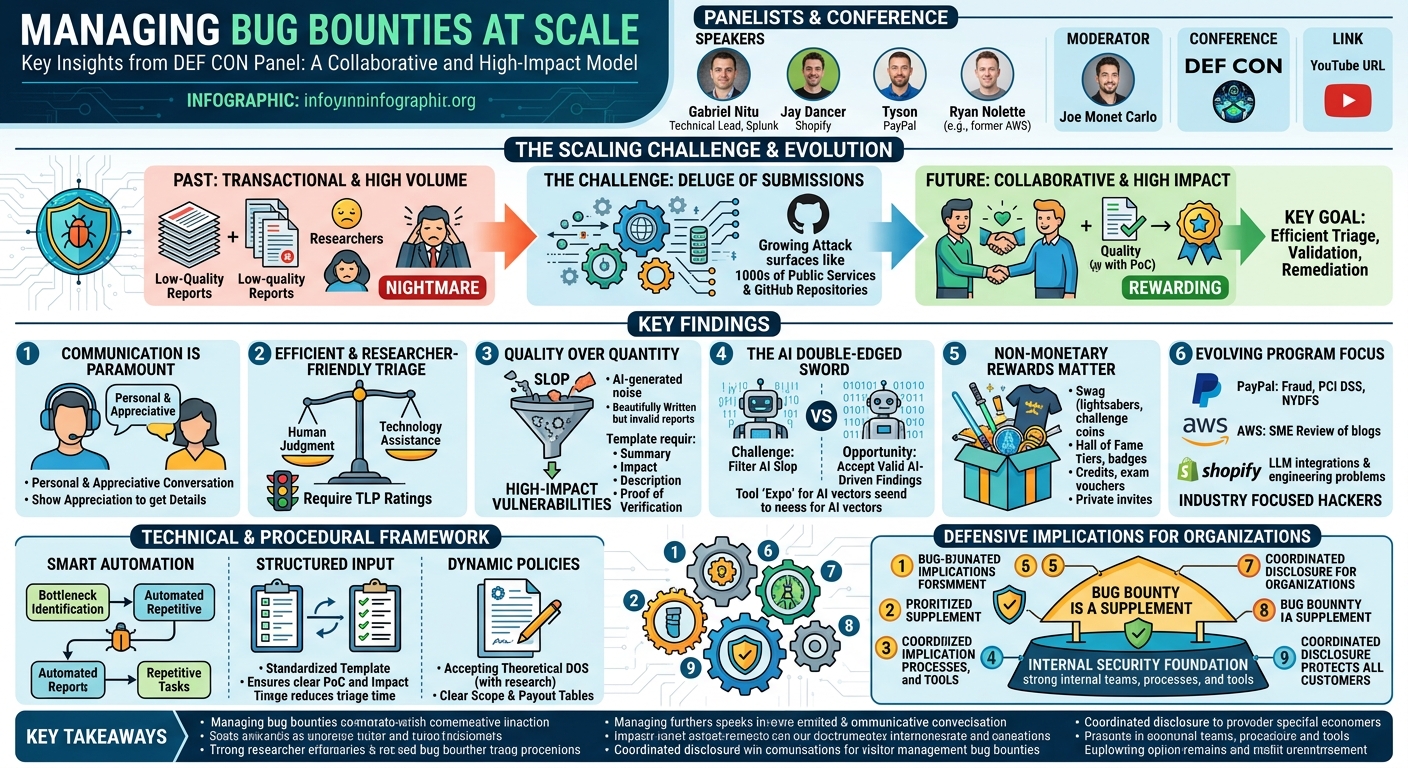
This DEF CON panel, "Managing Bug Bounties @ Scale," brings together industry leaders from major technology and financial companies—Splunk, Shopify, and PayPal, alongside an experienced former AWS security professional—to dissect the complexities of operating bug bounty programs for vast and diverse digital assets. Moderated by Joe Monet Carlo, the discussion transcends mere program administration, delving into the strategic, technical, and human elements essential for success in an ever-evolving threat landscape. The panelists share their hard-won lessons, candidly discussing the "nightmare" and "rewarding" aspects of balancing report volume with quality, fostering researcher relationships, and adapting to new challenges like the proliferation of AI-generated submissions.
Key moments
- 0:00 Panelist Introductions and Roles
- 1:00 Defining 'Bug Bounty at Scale': Orchestration and Challenges
- 2:40 Communication as Key for Researcher Experience
- 4:00 The Rewarding Side: Building a Strong Researcher Community
- 5:30 Building Efficient and Researcher-Friendly Triage Processes
- 8:00 Balancing Report Volume with Quality Relationships
- 9:00 Personalizing Communication and Adapting Policy for Researchers
Managing Bug Bounties @ Scale
Speakers: Gabriel Nitu (Technical Lead, Splunk); Jay Dancer (Shopify); Tyson (PayPal); Ryan Nolette
Conference: DEF CON
YouTube: https://www.youtube.com/watch?v=YKHs2XJWmXU
Overview
This DEF CON panel, "Managing Bug Bounties @ Scale," brings together industry leaders from major technology and financial companies—Splunk, Shopify, and PayPal, alongside an experienced former AWS security professional—to dissect the complexities of operating bug bounty programs for vast and diverse digital assets. Moderated by Joe Monet Carlo, the discussion transcends mere program administration, delving into the strategic, technical, and human elements essential for success in an ever-evolving threat landscape. The panelists share their hard-won lessons, candidly discussing the "nightmare" and "rewarding" aspects of balancing report volume with quality, fostering researcher relationships, and adapting to new challenges like the proliferation of AI-generated submissions.
The talk highlights a critical shift in the bug bounty paradigm: from a transactional, high-volume approach to a collaborative, high-impact model. As organizations expand their digital footprints and the sophistication of cyber threats grows, the ability to efficiently triage, validate, and remediate vulnerabilities identified by external researchers becomes paramount. This article will explore the panelists' insights into building effective triage processes, navigating the impact of artificial intelligence on report quality, leveraging non-monetary incentives, and evolving program strategies to meet contemporary security demands.
The insights shared are invaluable for any organization currently running or considering a bug bounty program, particularly those operating at a scale that necessitates robust processes, clear communication, and a strategic partnership with the global security research community. The candid discussion offers a realistic perspective on the operational challenges and strategic opportunities inherent in harnessing external expertise to bolster an organization's security posture.
Background
▶ Watch: Panelist Introductions and Roles (0:00)
The concept of bug bounty programs has matured significantly since its inception, evolving from informal disclosures to structured, platform-driven initiatives that incentivize security researchers to discover and report vulnerabilities in an organization's assets. These programs serve as a vital supplement to internal security testing, providing a continuous, diverse, and often cost-effective means of identifying weaknesses that might otherwise be missed. The fundamental premise is straightforward: leverage the collective intelligence and diverse skill sets of a global hacking community to proactively enhance security.
However, as companies grow, their digital attack surface expands exponentially, encompassing hundreds or even thousands of public services, applications, and GitHub repositories. This growth transforms the challenge of managing a bug bounty program from a simple intake process into a complex logistical and operational undertaking, referred to as "managing at scale." The panelists unanimously agreed that scaling a bug bounty program is inherently challenging and requires significant orchestration. Tyson from PayPal succinctly described it as a "nightmare" but also "rewarding," underscoring the dual nature of the endeavor.
Prior to the current state, many programs operated on a more transactional basis, often struggling with high volumes of low-impact reports and impersonal communication. The problem that exists at scale is multifaceted: how to efficiently process a deluge of submissions, distinguish genuine high-impact vulnerabilities from noise, maintain transparent and appreciative communication with researchers, and ensure timely remediation, all while managing internal resources. The shift towards a collaborative and high-impact approach, as highlighted by the panel, is a direct response to these scaling challenges. It acknowledges that researchers are not just "submitters" but valuable "collaborators" whose time and effort must be respected and nurtured. This evolution necessitates robust internal processes, effective tooling, and a deep understanding of human interaction, even across digital divides.
Key Findings
▶ Watch: Communication as Key for Researcher Experience (2:40)
The panel discussion revealed several key findings and shared experiences critical to managing bug bounty programs effectively at scale:
- Communication is Paramount: All panelists emphasized that clear, transparent, and appreciative communication with researchers is the cornerstone of a successful program. Ryan Nolette highlighted the importance of showing appreciation and having "decent conversation" to obtain additional details for triage. Tyson from PayPal echoed this, stressing the value of making interactions "personal" so researchers know "someone from the company is looking at this." Gabriel Nitu from Splunk added that building "great relation researchers and use them as your collaborators instead of just submitters" is crucial.
- Efficient and Researcher-Friendly Triage: Scaling triage requires a delicate balance between human interaction and technological assistance. Ryan noted that "humans are not all that scalable," advocating for integrating technology to reduce human effort on repetitive tasks, allowing them to focus on complex judgments. Requiring specific information like TLP (Traffic Light Protocol) ratings on initial reports was cited as an example of an effective scaling mechanism. Jay Dancer from Shopify articulated the challenge of balancing "sheer volume of reports and maintaining the quality of relationships."
- Quality Over Quantity: There's a strong industry trend moving from "high volume to high impact." Panelists expressed frustration with the increasing "slop" or low-quality, often AI-generated reports. Gabriel stressed the importance of educating researchers and requesting submissions based on a clear template (summary, impact, description, proof of verification steps) to improve quality and reduce triage time.
- The Double-Edged Sword of AI: The rise of AI tools presents both a challenge and a potential opportunity. While AI is generating a high volume of "beautifully written" but often invalid reports, panelists acknowledged that AI tools like Expo are also starting to generate valid attack vectors. The current dilemma is how to filter the "slop" without dismissing legitimate findings from automated sources, especially when AI-generated valid reports can be "indistinguishable" from human ones.
- Non-Monetary Rewards Matter: Beyond monetary bounties, non-monetary incentives significantly contribute to researcher engagement and loyalty. Examples included swag (lightsabers, challenge coins, t-shirts), Hall of Fame tiers, customized badges, account credits, exam vouchers, and invitations to private programs or VIP events. Gabriel noted Splunk provides bonuses for out-of-scope reports that lead to in-scope submissions in private programs, respecting researchers' time and effort.
- Evolving Program Focus: Programs are actively adapting to new threat landscapes. Tyson highlighted PayPal's focus on fraud and compliance/regulations within the fintech sector, seeking researchers knowledgeable in PCI DSS and NYDFS. Ryan (from his AWS experience) mentioned offering technical subject matter expert reviews for researchers' blog content or presentations to ensure factual accuracy. Jay discussed addressing vulnerabilities introduced by LLM (Large Language Model) integrations and the "problem of boding from engineers."
- Future is Collaboration and Industry Focus: The future of bug bounties is seen as deeply rooted in enhanced collaboration between researchers and programs. Speakers envisioned an environment where researchers focus on industry-specific expertise (fintech, e-commerce, healthcare), becoming "industry focused" hackers. This specialization would allow companies to work more closely with researchers who understand the unique regulatory and compliance challenges of their sector. Coordinated disclosure was also emphasized as crucial for collective customer safety.
Technical Deep Dive
▶ Watch: The Rewarding Side: Building a Strong Researcher Community (4:00)
Managing a bug bounty program at scale necessitates a robust technical and procedural framework that integrates human expertise with automation. The panelists elaborated on several key technical aspects and approaches:
Triage Processes and Automation:
At the heart of a scalable bug bounty program is an efficient triage process. Ryan Nolette underscored that while human interaction is crucial, it doesn't scale well for high volumes. His strategy at AWS involved identifying "bottlenecks" and "friction points" in the process and strategically introducing technology to offload repetitive tasks. A concrete example provided was the implementation of mandatory fields in report submissions, such as the TLP (Traffic Light Protocol) rating. This standardized approach immediately clarifies the sensitivity of the information, guiding internal communication protocols and reducing ambiguity.
Gabriel Nitu stressed the importance of researcher education and standardized reporting. He advocated for requiring researchers to submit reports based on a specific template that includes a summary, impact statement, detailed description, and verifiable proof of concept (PoC) steps. This structured input significantly reduces the time internal triage teams spend trying to decipher vague or incomplete reports, directly impacting the "external part" (researcher submission) to positively affect the "internal part" (triage efficiency). Shopify, as mentioned by Jay Dancer, also leverages internal tooling for "ticket management" and "surfacing trends easier," suggesting custom-built or integrated solutions to streamline the flow from report intake to remediation.
Policy Evolution and Scope Definition:
Bug bounty policies must be dynamic, adapting to new attack vectors and industry-specific nuances. Tyson from PayPal highlighted their decision to accept theoretical DOS (Denial of Service) attacks, a departure from many companies that typically disallow them. This policy change reflects an understanding that researchers contribute value even by identifying potential, rather than actively exploitable, vulnerabilities, as long as "you're putting in the work and actually doing the research and not submitting SLO." Gabriel emphasized the need for "Clear scope, clear, you know, policies and also clear markup table or ranges," ensuring researchers understand what they are hacking for and what level of compensation to expect. This transparency minimizes disputes and fosters trust.
The Impact of AI and LLMs:
A significant technical challenge discussed was the proliferation of AI-generated reports and AI-generated attack vectors. Ryan described receiving reports that "sound very convincing" but are "obviously the result of content [generated by AI]." He shared an anecdote of a 400,000-word essay about dentistry submitted to AWS, highlighting the sheer volume of irrelevant "slop" generated by AI. Tyson recounted similar experiences with "beautifully written" but fundamentally flawed reports, such as a researcher claiming to have found a vulnerability by logging into their own profile.
The panel acknowledged that while much of this AI-generated content is low-quality, some AI tools like Expo are now capable of generating "pretty good" and "accurate" attack vectors. This introduces a dilemma: how do programs distinguish valid AI-driven findings from mere noise? The current approach, as articulated by the panelists, is to treat valid findings as valid, regardless of their origin. However, Gabriel stated Splunk's firm policy: "Stop sending air reports. This is our mandatory requirements and if not you're out," indicating a proactive stance against low-quality, automated submissions. The long-term technical implication is the need for more sophisticated automated filtering and analysis tools within bug bounty platforms to manage this new category of submissions.
Security Foundation and Coordinated Disclosure:
Gabriel stressed a foundational principle: bug bounty programs are "only as a supplement to a strong internal security foundation." They are not a replacement. This implies that organizations must have robust internal security teams, processes, and tools to effectively receive, validate, and remediate vulnerabilities identified externally. Ryan highlighted the critical importance of coordinated disclosure, where researchers work with vendors to address vulnerabilities before public disclosure. This collaborative approach protects "all the customers overall" by allowing vendors to patch issues before they are widely exploited. This technical and ethical framework is vital for the collective safety of the digital ecosystem.
Demo / Proof of Concept
▶ Watch: Balancing Report Volume with Quality Relationships (8:00)
This panel discussion was a conversational exchange of experiences and best practices, and as such, no live demonstration or proof of concept was presented by the speakers. The focus was on the strategic and operational aspects of managing bug bounty programs.
However, the concept of a Proof of Concept (PoC) was a recurring and critically important theme within the discussion, particularly from the perspective of researchers submitting reports. Gabriel Nitu from Splunk explicitly stated that for researchers to get paid, they "have to provide impact meaning proof of concept by explan." This underscores the technical requirement for researchers to not just identify a potential flaw but to demonstrate its exploitability and potential impact through concrete steps. Without a clear PoC, internal triage teams struggle to understand the severity and reproduce the issue, leading to delays and potential dismissal of reports. The panel's emphasis on researcher education and templated reports is partly aimed at ensuring PoCs are consistently included and clearly articulated.
Defensive Implications
▶ Watch: Personalizing Communication and Adapting Policy for Researchers (9:00)
The insights from this panel offer several critical defensive implications for organizations running or planning bug bounty programs:
- Prioritize Communication and Transparency: Defenders must cultivate open, transparent, and respectful communication channels with the researcher community. This includes providing timely feedback, explaining severity downgrades or report closures, and making interactions personal. As Tyson from PayPal noted, treating researchers as valued collaborators, not just submitters, fosters a stronger community. Ryan Nolette's emphasis on asking for and acting on feedback, even if it "hurts," is crucial for continuous program evolution.
- Streamline Triage with Smart Automation: While human judgment remains indispensable, organizations should invest in automating repetitive aspects of triage. Implementing mandatory report fields, such as TLP (Traffic Light Protocol) ratings, and requiring structured report templates (summary, impact, PoC, verification steps) can significantly reduce the manual effort for initial assessment. This allows security analysts to focus on complex vulnerability analysis rather than data gathering.
- Educate and Mentor Researchers for Quality: To combat the "slop" and increase the signal-to-noise ratio, programs should proactively educate researchers on expected report quality. This involves providing clear guidelines, templates, and examples of high-impact reports. As Gabriel Nitu highlighted, mentoring researchers to submit quality reports directly impacts internal triage efficiency.
- Adapt Policies to Emerging Threats (and Researcher Behavior): Bug bounty policies are not static documents. Defenders need to continuously review and update them to reflect new attack vectors (e.g., vulnerabilities from LLM integrations as mentioned by Jay Dancer), industry-specific risks (e.g., fraud and compliance in fintech as per Tyson), and evolving researcher methodologies (e.g., accepting theoretical DOS attacks). Clearly defined scope and payout tables are also essential for setting expectations.
- Diversify Researcher Incentives: Beyond monetary bounties, organizations should explore and implement a range of non-monetary rewards. These can include swag, Hall of Fame recognition, private program invitations, account credits, and opportunities for technical collaboration (e.g., reviewing researcher blog posts for accuracy, as offered by Ryan Nolette from his AWS experience). Such incentives build loyalty and a stronger sense of community.
- Reinforce Internal Security Foundation: The panel unequivocally stated that a bug bounty program is a supplement, not a replacement, for a strong internal security posture. Defenders must ensure their internal security teams, processes, and tools are robust enough to effectively handle, remediate, and learn from external vulnerability reports. Without this foundation, bug bounties can create an "illusion of security."
- Embrace Coordinated Disclosure: Defenders should actively promote and facilitate coordinated disclosure with researchers. This means working collaboratively to fix vulnerabilities before public disclosure, thereby protecting all users of the affected software or service. Building trust and a strong relationship with researchers is key to achieving this.
- Develop Strategies for AI-Generated Reports: The rise of AI-generated "slop" requires new defensive strategies. While valid findings from AI tools should be acknowledged and rewarded if they meet policy, programs need to develop methods (potentially automated filters or explicit policy statements) to efficiently discard low-quality, AI-generated noise. Gabriel Nitu's "Stop sending air reports... or you're out" policy at Splunk is one such direct approach.
- Foster Industry-Specific Expertise: Encourage and engage with researchers who possess specialized knowledge in specific industry sectors (e.g., fintech, e-commerce, healthcare). As Tyson suggested, such focused expertise can lead to more granular and impactful reports, especially concerning complex regulatory and compliance violations (e.g., PCI DSS, NYDFS).
Key Takeaways
- Communication is the bedrock of successful bug bounty programs: Transparent, personal, and appreciative interaction with researchers fosters collaboration and trust, essential for scaling.
- Triage efficiency demands a blend of human judgment and automation: Leverage technology to handle volume and repetitive tasks, freeing human experts to focus on complex analysis and relationship building.
- Prioritize report quality over sheer volume: Educate researchers on reporting standards, require clear proof of concepts, and use templates to combat "slop" and elevate impact.
- AI presents a dual challenge and opportunity: While AI-generated "slop" clogs triage, AI tools are also producing valid findings, necessitating adaptive policies and filtering mechanisms.
- Non-monetary incentives significantly boost researcher engagement: Beyond bounties, offering swag, Hall of Fame recognition, and access to private programs strengthens community loyalty.
- Bug bounties are a supplement, not a substitute, for internal security: A strong internal security foundation is crucial for effectively leveraging external research and ensuring long-term security.
About the Speaker(s)
- Gabriel Nitu: Serving as a Technical Lead at Splunk, Gabriel is deeply involved in the company's exposure program, DERT (Detection and Response Team), and broader security initiatives. His experience emphasizes the technical orchestration and researcher relationship management required for large-scale bug bounty operations.
- Jay Dancer: With approximately eight years at Shopify, Jay has spent the last five years focusing on mobile access and other senior duties within the security team. His insights reflect the unique challenges and opportunities in managing bug bounties for an expansive e-commerce platform.
- Tyson: As the individual responsible for running the bug bounty program at PayPal, Tyson brings extensive experience from the financial technology (fintech) sector. His perspective highlights the critical interplay of security, fraud detection, and regulatory compliance in bug bounty management.
- Ryan Nolette: Though his current affiliation was not explicitly stated in the transcript, Ryan's contributions heavily drew from his experience managing hundreds of public services and numerous GitHub repositories at AWS. He provided valuable insights into scaling bug bounty programs for a vast cloud infrastructure and navigating challenges like high report volumes and AI-generated content.
Reviews
Dr. Zero (Offensive Security Researcher) — SOLID
A competent panel of practitioners from credible programs sharing honest operational experience — the AI-slop discussion and non-monetary incentive details have real utility for anyone standing up or scaling a program. But this is firmly a practitioner roundtable, not research, and it stays safely inside known territory without surfacing anything that would surprise an experienced VDP or bug bounty manager.
Heather Calloway (CISO) — SOLID
A competent practitioner panel with real operational texture — handling AI-generated noise, triage design, researcher incentives — but it never climbs above program management. The institutional and governance dimensions of bug bounty at scale go untouched, and security leaders leave without a decision to make.