DC101 Panel - Alethe Denis, Nikita Kronenberg , zziks, Nicole Schwartz, Nina Alli
Alith (Second Lead for Defcon Groups), Nina Ali (Executive Director · Biohacking Village), Circuit Swan (Director · Diana Initiative), Zeke (Arts and Entertainment Department Lead)
DEF CON 33 · Day 1 · Main Stage
Overview
This talk, titled "DC 101: Your Hacker Survival Guide to Defcon," serves as an indispensable primer for navigating the world's largest and most chaotic hacker conference, DEF CON. Presented as a lively panel discussion, the session featured seasoned DEF CON veterans Alith, Nina Ali, Circuit Swan, and Zeke, who collectively offered invaluable insights and practical advice for both first-time attendees and returning veterans. The discussion transcended a mere logistical guide, delving into the unique culture, community spirit, and often overwhelming nature of the event.
Key moments
- 0:00 Introduction to DC 101 and panel members
- 1:35 Defcon's origin story and its unique character
- 2:15 Panelists share their personal Defcon experiences
- 4:20 Understanding the Defcon HQ staff and Goons
- 5:40 Why Goons volunteer and give back to Defcon
- 7:00 Villages, communities, and new initiatives like tour groups
DC 101: Your Hacker Survival Guide to Defcon
Speakers: Alith, Second Lead for Defcon Groups; Nina Ali, Executive Director, Biohacking Village; Circuit Swan, Director, Diana Initiative; Zeke, Arts and Entertainment Department Lead
Conference: DEF CON
YouTube: https://www.youtube.com/watch?v=ia-LpnWwc8Y
Overview
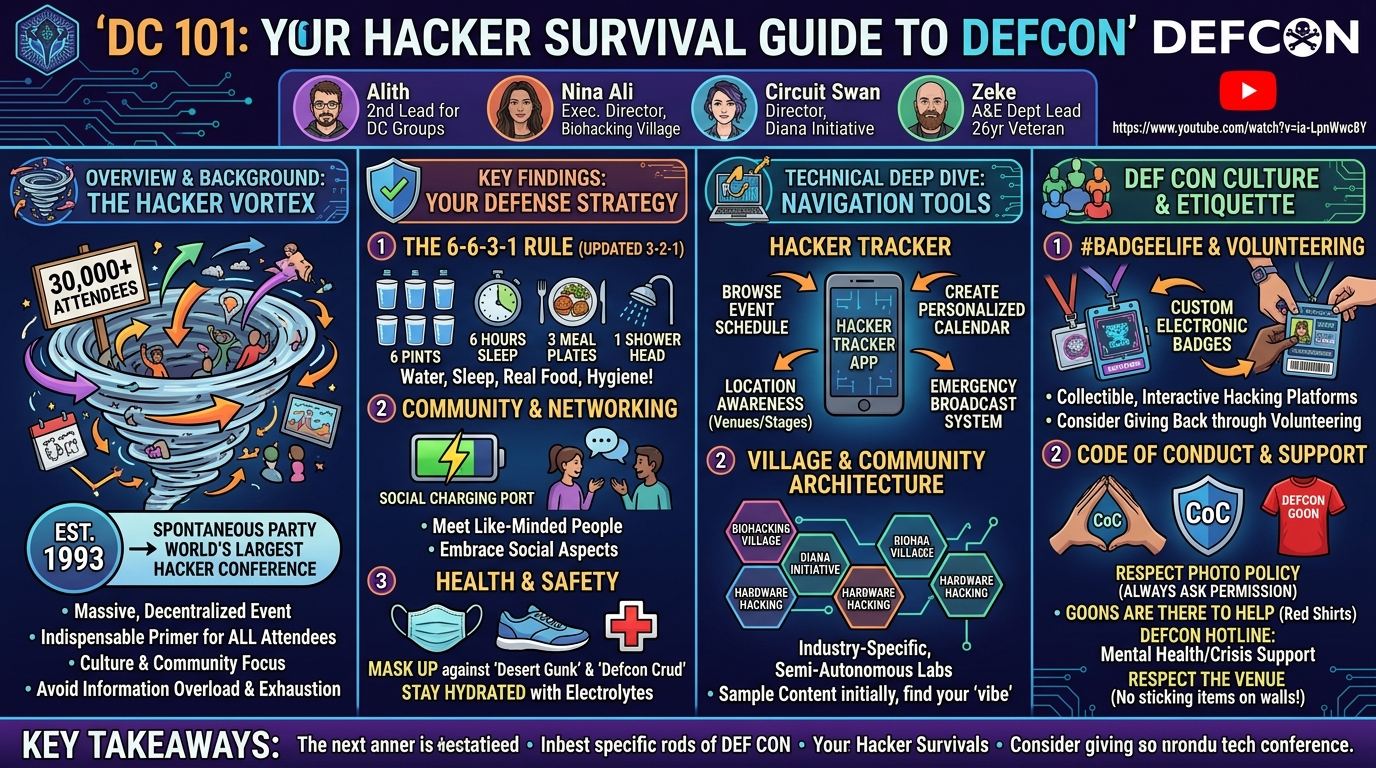
This talk, titled "DC 101: Your Hacker Survival Guide to Defcon," serves as an indispensable primer for navigating the world's largest and most chaotic hacker conference, DEF CON. Presented as a lively panel discussion, the session featured seasoned DEF CON veterans Alith, Nina Ali, Circuit Swan, and Zeke, who collectively offered invaluable insights and practical advice for both first-time attendees and returning veterans. The discussion transcended a mere logistical guide, delving into the unique culture, community spirit, and often overwhelming nature of the event.
The panel's primary objective was to equip attendees with the knowledge and tools necessary to not only survive DEF CON but to thrive within its vibrant ecosystem. From understanding the core organizational structure and diverse content offerings to prioritizing personal well-being and adhering to crucial social etiquette, the speakers covered a broad spectrum of topics. Their collective experience, spanning decades of involvement with DEF CON as organizers, village leads, and "goons" (volunteer staff), provided a rich tapestry of anecdotes and actionable recommendations, emphasizing the conference as a unique melting pot for learning, networking, and personal growth.
This talk is critically important because DEF CON, with its 30,000+ attendees, sprawling venues, and decentralized content, can be an incredibly disorienting experience. Without guidance, newcomers risk missing out on key opportunities, falling victim to physical exhaustion, or misinterpreting the unwritten rules of engagement. The panel's advice addresses these challenges head-on, fostering a safer, more inclusive, and ultimately more rewarding experience for everyone. It underscores the community's commitment to supporting its members, ensuring that the legacy of DEF CON continues to be one of collaborative learning and shared passion for hacking.
Background
▶ Watch: Introduction to DC 101 and panel members (0:00)
DEF CON, founded in 1993 by an 18-year-old known as The Dark Tangent, originated as a spontaneous farewell party for a friend leaving a bulletin board group. What began as a one-off meetup in Las Vegas unexpectedly blossomed into the largest and longest-running hacker conference globally, now attracting over 30,000 attendees annually. This organic, hacker-driven genesis has profoundly shaped DEF CON's unique character: a massive, chaotic, and largely decentralized event that stands apart from more corporate cybersecurity conferences. It's described as a "melting pot" for students, information security beginners, policymakers, and even government agents, all converging to test their skills, share knowledge, and connect with like-minded individuals.
The inherent "problem" that talks like DC 101 address stems directly from this unique, sprawling nature. For many, particularly first-time attendees, DEF CON can be profoundly overwhelming. The sheer volume of concurrent talks, diverse villages, contests, and informal meetups creates an information overload, often referred to by attendees as "the vortex," where time and direction seem to disappear. Beyond the intellectual challenges, the physical demands of navigating large convention centers in the Las Vegas heat, combined with the intense social environment, frequently lead to exhaustion and the infamous "Defcon crud." The absence of a rigid corporate structure means much of the conference's operation, content, and attendee experience relies on a vibrant volunteer community and an evolving set of cultural norms, which can be opaque to outsiders.
While not referencing "prior work" in a traditional academic sense, the panel's advice implicitly builds on decades of collective experience in navigating and organizing DEF CON. The evolution of attendee guidance, such as the modification of the legendary "3-2-1 rule" (3 hours of sleep, 2 meals, 1 shower) to a more health-conscious "6-6-3-1" (6 pints of water, 6 hours of sleep, 3 meals, 1 shower), demonstrates an adaptive understanding of attendee needs. The continuous development of resources like the Hacker Tracker app and the establishment of dedicated support systems like the Defcon Hotline reflect an ongoing effort to mitigate the challenges inherent in such a massive, community-driven gathering. The very existence of this "survival guide" panel is a testament to the community's proactive approach in welcoming and integrating new members into this extraordinary hacker ecosystem.
Key Findings
▶ Watch: Panelists share their personal Defcon experiences (2:15)
The DC 101 panel distilled decades of collective experience into several critical insights and actionable pieces of advice for navigating the DEF CON experience. These "key findings" are less about technical discoveries and more about the essential wisdom required to thrive at such a unique event.
Firstly, the panel emphasized DEF CON's profound identity as a community and a social charging port. Zeke, the Arts and Entertainment Department Lead, highlighted how the conference serves as a place for introverts to meet like-minded people and "recharge." This underscores that beyond the talks and technical challenges, the core value of DEF CON lies in human connection and camaraderie. Attendees are encouraged to embrace this social aspect, engage with strangers, and proactively seek out conversations, as this is where many of the most valuable experiences and friendships are forged.
Secondly, a significant portion of the discussion focused on content navigation and exploration. With "dozens of villages and over 30 communities" offering a tremendous amount of content, the panel advised a strategic approach. For first-timers, the recommendation is to "embrace the vortex" by taking a tour (such as those offered by the Diana Initiative) or simply sampling a few minutes of various villages to get a "vibe." The Hacker Tracker app was highlighted as an indispensable tool for personalizing schedules, searching for specific interests, and staying informed about critical updates, including an emergency broadcast feature. This approach encourages broad exploration initially, followed by focused engagement in subsequent years.
Thirdly, personal health and safety emerged as a paramount concern. The panel updated the infamous "3-2-1 rule" for survival (3 hours sleep, 2 meals, 1 shower) to a more realistic and health-conscious guideline: 6 pints of water, 6 hours of sleep, 3 meals, and definitely one shower per day. Speakers stressed the importance of comfortable shoes due to extensive walking, eating "real food" (not just Red Bull and Cheez-Its), and staying hydrated with electrolytes. The continued recommendation for mask-wearing was strongly emphasized to combat "desert gunk" and the "Defcon crud," with free COVID test kits available at the Diana Initiative. Attendees were also reminded of the Code of Conduct, the photo policy (always ask permission, with the exception of misbehaving goons), and the availability of the Defcon Hotline for mental health or crisis support, accessible via cards in restrooms.
Finally, the panel provided crucial insights into DEF CON culture and etiquette. Respect for the venue, particularly the new LVCC location, was stressed, meaning no sticking items on walls. The concept of #badgeelife was introduced, referring to the custom badges created by villages and communities, which are often collectible and technically intricate. The existence of DC NextGen for attendees under 18 and activities for those 18-21 (not centered around drinking) highlighted the conference's multi-generational appeal. The panel also encouraged volunteerism, noting that many goons and village leads (like Nina Ali, after 10 years with the Biohacking Village) are motivated by a desire to give back to a community that has given them so much. This ethos of contribution and mutual support is a cornerstone of the DEF CON experience.
Technical Deep Dive
▶ Watch: Understanding the Defcon HQ staff and Goons (4:20)
While the DC 101 panel focused on survival and cultural navigation rather than a traditional cybersecurity technical deep dive, it implicitly highlighted several "technical" aspects related to conference organization, attendee experience management, and community engagement. Understanding these underlying mechanisms is crucial for appreciating the scale and complexity of DEF CON.
Central to the attendee experience is the Hacker Tracker app. This mobile application serves as the primary digital information hub for the entire conference. Its functionality extends beyond a simple schedule viewer:
- Event Scheduling: It allows users to browse talks, workshops, and events across all tracks, villages, and communities.
- Personalized Calendar: Attendees can save items of interest to create a customized schedule, helping to manage time and navigate the vast content landscape.
- Location Awareness: The app helps attendees locate specific venues and stages within the sprawling convention center.
- Emergency Broadcast System: A critical "technical" feature mentioned by the panel is its ability to broadcast emergency alerts directly to attendees. This real-time communication channel is vital for safety in a large, dynamic environment, especially given past "apocalyptic situations" like window blowouts or "locust storms" as referenced by Zeke. This demonstrates a sophisticated backend infrastructure for event management and crisis communication.
The structure of villages and communities also represents a decentralized "technical architecture" of content delivery. Each village, like Nina Ali's Biohacking Village, is an "industry-specific," "thematic," and "very focused area." These villages and the newer communities operate semi-autonomously, with their own leads, volunteers, and content curation. This distributed model allows for a vast array of specialized topics—from hardware hacking and lockpicking to social engineering and biohacking—to be presented simultaneously. The coordination among these entities, despite their independence, is a significant organizational feat, requiring common platforms (like Basecamp mentioned by Circuit Swan for tour organization) and shared understanding of the DEF CON ethos.
Another "technical" element, albeit one with a strong cultural component, is #badgeelife. This refers to the tradition of villages and communities creating their own custom badges, often incorporating intricate electronic designs, embedded microcontrollers, LEDs, or other interactive components. These badges are not merely decorative; they frequently serve as miniature hacking platforms, puzzles, or communication devices, reflecting the technical creativity and ingenuity of their respective communities. The pursuit and collection of these unique badges become a meta-game within DEF CON, fostering interaction and demonstrating a deep appreciation for hardware hacking and bespoke electronics design.
While not explicitly detailed, the panel's roles hint at the significant behind-the-scenes infrastructure required. Zeke, as the Arts and Entertainment Department Lead, is responsible for "all the fun lights and hear the fun music" in the chill-out room and for "making loud sounds everywhere." This involves considerable audio-visual (A/V) equipment, networking, power management, and technical expertise to ensure smooth operation of entertainment venues and the main stages (tracks). The "goons" and Defcon HQ staff, like the absent Nikita, are the human "technical support" system, ensuring "trains keep running on time" and all logistical elements are in place. The continuous effort to set up and manage these diverse technical and logistical components, often with personal financial investment from volunteers, underscores the labor-intensive "technical" undertaking that is DEF CON.
Demo / Proof of Concept
▶ Watch: Why Goons volunteer and give back to Defcon (5:40)
While this panel discussion did not feature a traditional technical demonstration or proof of concept in the cybersecurity sense, the speakers effectively "demonstrated" the spirit and practicalities of DEF CON through their shared experiences and advice. The most tangible "demonstration" of a service was Circuit Swan's description of the Diana Initiative's tour groups. These tours, identifiable by guides waving "sticks" and shouting village names, function as a real-time, low-stakes way for newcomers to experience different villages without commitment. This "no expert" approach, where guides know "just as little as you do," exemplifies the peer-to-peer learning and exploration encouraged at DEF CON. It's a living, breathing "proof of concept" for how to combat overwhelm and foster community engagement among first-timers.
The "demonstration" extended to the panel's collective presence and candid sharing. By openly discussing their roles—from Nina Ali's decade-long leadership of the Biohacking Village to Zeke's 26 years in Arts and Entertainment and his personal story of meeting his wife at DEF CON—they showcased the depth of personal investment and the profound impact DEF CON has on its community members. This served as an emotional "proof of concept" for the value of engagement and volunteering. The panel itself, in its informal, direct style, modeled the open communication and helpfulness that attendees should expect and contribute to within the DEF CON environment.
Defensive Implications
▶ Watch: Villages, communities, and new initiatives like tour groups (7:00)
For attendees, the panel's advice carries significant "defensive implications" that extend beyond typical cybersecurity practices, encompassing personal well-being, information management, and social resilience within the unique DEF CON environment. These defenses are crucial for protecting one's physical, mental, and informational assets during the conference.
1. Personal Health and Resilience: The updated "6-6-3-1" rule (6 pints of water, 6 hours of sleep, 3 meals, 1 shower) is a fundamental defensive strategy against physical exhaustion and illness, commonly known as the "Defcon crud." Prioritizing hydration, nutrition, and rest is paramount. Wearing masks is a proactive defense against respiratory issues in a crowded, dry environment. Comfortable shoes are a defense against foot pain, which can severely impact mobility and enjoyment. The Diana Initiative's quiet room provides a crucial defensive space for neurodivergent individuals or anyone needing to escape sensory overload, acting as a mental health buffer. These measures protect the attendee's most critical asset: their own body and mind.
2. Information Overload Mitigation: DEF CON's "vortex" of information can be debilitating. The Hacker Tracker app is a primary defensive tool against this. By allowing attendees to curate their schedules and receive emergency alerts, it helps manage the overwhelming flow of information and ensures critical safety updates are received. The advice to take "tours" of villages for first-timers is a defensive tactic against decision paralysis, offering a structured way to sample content without feeling pressured to commit or understand everything at once. This mirrors cybersecurity's approach to threat intelligence: filtering noise to focus on actionable, relevant data.
3. Social and Behavioral Defenses: Adherence to the Code of Conduct and photo policy (always ask permission) are critical social defenses. They protect the privacy and comfort of other attendees, preventing unwelcome interactions and fostering a respectful environment. The explicit exception allowing photography of "misbehaving goons" for reporting purposes is a defense mechanism for accountability within the volunteer staff, ensuring a safe and fair experience for everyone. The Defcon Hotline serves as an ultimate defense for mental health crises or other serious issues, providing a trained support system when personal resilience is depleted.
4. Community and Reputation Management: Respecting the venue (LVCC) by not sticking items on walls or elevators is a defensive measure to protect DEF CON's relationship with its hosts, ensuring the conference's long-term viability. Engaging with the community, joining Defcon Groups, and considering volunteerism are defensive strategies against isolation and impostor syndrome, fostering a sense of belonging and mutual support. For example, Zeke's anecdote about picking up a stranger and making a new friend illustrates how proactive engagement can build a personal support network. This strengthens the overall community, making it more resilient and welcoming for all.
In essence, the defensive implications of the DC 101 panel's advice are about building personal and communal resilience. They equip attendees with the knowledge to protect themselves from physical harm, mental exhaustion, social missteps, and information overload, thereby maximizing their ability to learn, connect, and contribute positively to the DEF CON ecosystem.
Key Takeaways
- Embrace the Community and Engage: DEF CON is fundamentally a community-driven event; don't be afraid to strike up conversations, meet new people, and explore the diverse groups and villages. It's a "social charging port" for many.
- Prioritize Personal Well-being: Adhere to the modified "6-6-3-1 rule" (6 pints water, 6 hours sleep, 3 meals, 1 shower). Wear comfortable shoes, eat real food, and consider wearing a mask to stay healthy and combat the "Defcon crud" in the demanding Las Vegas environment.
- Leverage the Hacker Tracker App: This indispensable tool is your central guide for navigating the conference, personalizing your schedule, and receiving critical emergency alerts. Update it for the latest features.
- Explore and Adapt to the "Vortex": For first-timers, try sampling various villages and communities (e.g., via Diana Initiative tours) before focusing on specific interests in subsequent years. Be prepared for information overload and accept that you can't see everything.
- Respect the Culture and Policies: Be mindful of the Code of Conduct, always ask permission before taking photos, and respect the venue. Engage with the #badgeelife culture and consider giving back to the community through volunteering.
- Support Systems Are Available: Remember the goons (identifiable by red shirts and unique patches) are there to help, and the Defcon Hotline provides crucial mental health and crisis support. Don't hesitate to seek assistance if needed.
About the Speaker(s)
Alith served as the second lead for Defcon Groups and skillfully guided the DC 101 panel discussion. Her role involves overseeing the global network of local Defcon Groups, which meet regularly to foster community and share knowledge outside of the main conference.
Nina Ali is the Executive Director of the Biohacking Village, a role she has held for 10 years, managing its five distinct labs and extensive content. She recently also became a "goon," highlighting her deep commitment to the DEF CON community and its operational aspects.
Circuit Swan, formerly known as "Amazon V," is the Director of the Diana Initiative. Under her leadership, the Diana Initiative provides crucial resources like a quiet room, guided tour groups for new attendees, and a dedicated discussion group room, focusing on creating an improved and inclusive experience at the conference.
Zeke is a long-standing veteran of DEF CON, having attended for 26 years. He leads the Arts and Entertainment Department, responsible for the "fun lights and music" in the chill-out room and various after-hours events. Zeke is also a "goon" and famously met his wife, Miss Jackaloupe (the resident DJ), at DEF CON.
Reviews
Dr. Zero (Offensive Security Researcher) — SOLID
A panel discussion, not a research talk — graded accordingly. As an orientation session for new DEF CON attendees, it delivers exactly what it promises: practical logistics, cultural onboarding, and community warmth from people who clearly live this stuff. It won't advance anyone's technical knowledge, but that's not the job.
Heather Calloway (CISO) — PASS
A conference orientation panel for first-time DEF CON attendees. Competent at what it is, but outside the scope of governance, security operations, or institutional risk entirely.