Resilient & Reconfigurable Maritime Comms
Avinash Srinivasan (Associate Professor · US Naval Academy), Brien Croteau (Commander · US Naval Academy)
DEF CON 33 · Day 1 · Main Stage
Overview
In an era of increasing global trade and geopolitical complexities, the security and efficiency of maritime communications are paramount. This talk, "Resilient & Reconfigurable Maritime Comms," presented by Avinash Srinivasan and Brien Croteau from the US Naval Academy, addresses critical challenges facing modern naval and commercial shipping operations. The speakers propose a novel Unified Communications Framework that integrates Software-Defined Radios (SDR), Software-Defined Networks (SDN), and existing Satellite Communications (Satcom) infrastructure to create a more robust, adaptable, and secure communication ecosystem at sea.
Key moments
- 0:00 Introduction and broad research questions
- 2:00 Unique maritime environment and communication challenges
- 3:20 Examples of known maritime system vulnerabilities
- 4:10 Understanding software-defined radios and their paradigm shift
- 5:00 Exploring the core advantages of Software-Defined Radios
Resilient & Reconfigurable Maritime Comms
Speakers: Avinash Srinivasan, Associate Professor, US Naval Academy; Brien Croteau, Commander, US Naval Academy
Conference: DEF CON
YouTube: https://www.youtube.com/watch?v=N0XFOS1kHaM
Overview
In an era of increasing global trade and geopolitical complexities, the security and efficiency of maritime communications are paramount. This talk, "Resilient & Reconfigurable Maritime Comms," presented by Avinash Srinivasan and Brien Croteau from the US Naval Academy, addresses critical challenges facing modern naval and commercial shipping operations. The speakers propose a novel Unified Communications Framework that integrates Software-Defined Radios (SDR), Software-Defined Networks (SDN), and existing Satellite Communications (Satcom) infrastructure to create a more robust, adaptable, and secure communication ecosystem at sea.
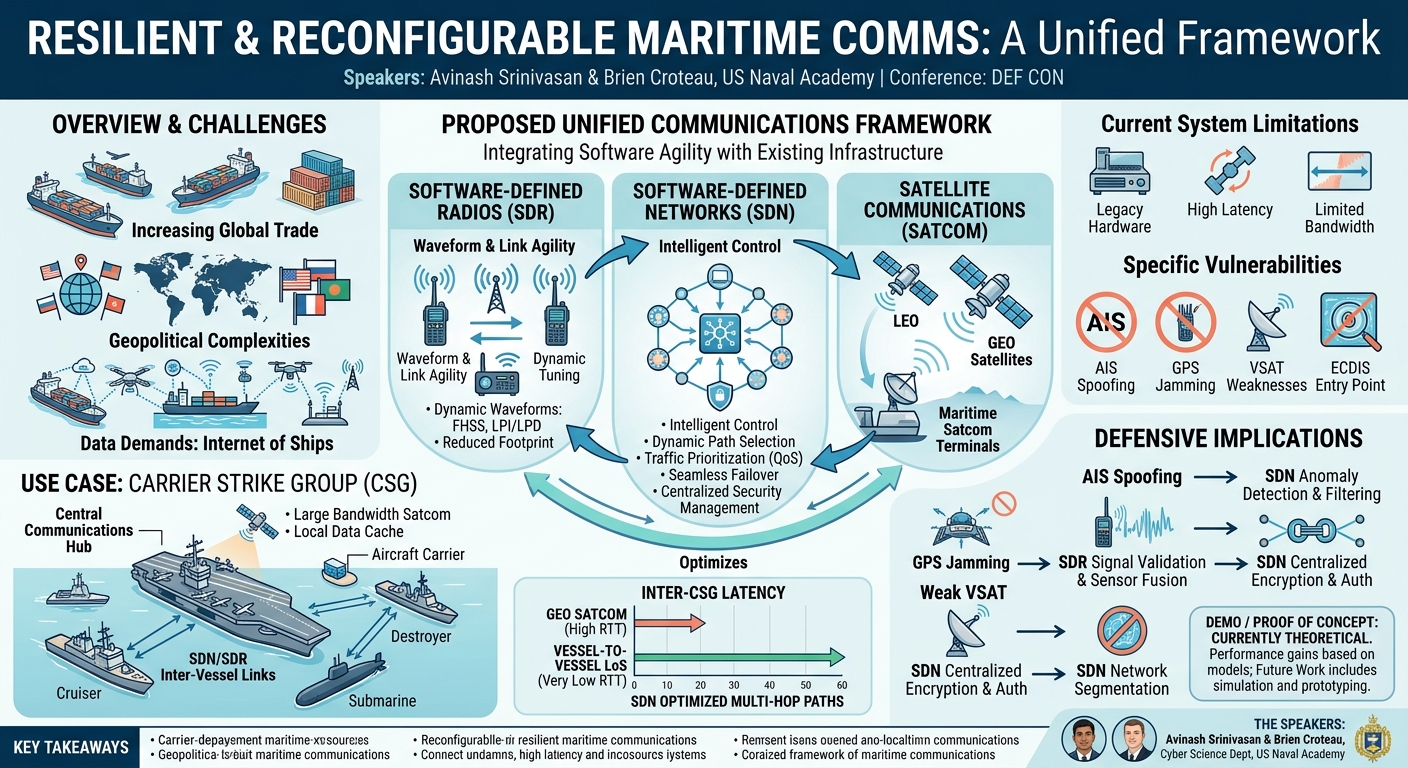
The core motivation behind this framework stems from the inherent limitations of current maritime communication systems, which are often characterized by legacy hardware, limited bandwidth, high latency, and significant vulnerabilities. With the advent of the "Internet of Ships" and the proliferation of IoT and unmanned platforms, data demands are skyrocketing, further exacerbating these issues. Srinivasan and Croteau present a vision for a future where maritime platforms can dynamically adapt their communication links to environmental changes, mission requirements, and emerging threats, significantly enhancing operational efficiency and resilience.
This talk is crucial for anyone involved in maritime security, naval operations, or critical infrastructure protection. It highlights how cutting-defined software-defined technologies can transform a traditionally hardware-centric domain, offering a path toward overcoming long-standing challenges in reliability, bandwidth, and cybersecurity within the contested maritime environment. The theoretical performance gains and vulnerability mitigations presented underscore the transformative potential of their proposed framework.
Background
▶ Watch: Introduction and broad research questions (0:00)
The maritime environment presents a unique and challenging landscape for communications. Vessels operate across vast distances, often far beyond the line-of-sight range of terrestrial communication systems like VHF and Wi-Fi. This necessitates a heavy reliance on Satellite Communications (Satcom), which, while providing global coverage, often suffer from long latencies, particularly with geostationary satellites. The increasing adoption of Internet of Things (IoT) devices and unmanned platforms within the maritime domain, dubbed the "Internet of Ships," is driving unprecedented data demands, pushing existing bandwidth-constrained legacy systems to their limits.
Compounding these operational challenges are significant security vulnerabilities inherent in many widely used maritime systems. The speakers highlighted several examples:
- Automatic Identification System (AIS): Lacks built-in authentication, making it susceptible to the injection of false targets or positions and spoofing attacks.
- Global Positioning System (GPS): Can be easily spoofed or jammed, potentially leading to vessels being directed off course.
- Very Small Aperture Terminal (VSAT): Often deployed with weak default security configurations, default credentials, and unencrypted links, making them vulnerable to exploitation.
- Electronic Chart Display and Information System (ECDIS): As plotting software on the ship's bridge, it can be updated via the ship's IT networks, creating a potential entry vector for adversaries to compromise critical navigation systems.
To address these multifaceted problems, the concept of Software-Defined Radios (SDR) and Software-Defined Networks (SDN) offers a paradigm shift. Traditional radios are characterized by fixed hardware functionalities, specific modulations, and protocols, lacking dynamic reconfigurability. Upgrades typically require new custom hardware. SDRs, in contrast, move signal processing from hardware to software, allowing for unprecedented agility, flexibility, and programmability from a single board. This means core functions like modulation, filtering, and decoding, traditionally hardware-bound, can now run on general-purpose CPUs or programmable hardware like Field-Programmable Gate Arrays (FPGAs). Key advantages of SDR include operational efficiency through software-based upgrades, cost savings, future-proofing, rapid prototyping, and the ability to deploy new secure waveforms. They significantly reduce the physical hardware footprint by consolidating multiple single-purpose radios into one reconfigurable platform, which is critical for space-constrained environments like ships, submarines, or unmanned platforms.
Similarly, Software-Defined Networks (SDN) decouple the network's control plane from its data plane, shifting control logic from individual network hardware (switches, routers) to a centralized, programmable software controller. This makes networks smarter, easier to manage, and highly adaptable. SDN offers advantages such as centralized control for automatic provisioning, monitoring, and troubleshooting, enabling rapid adaptation of routing policies and configurations without hardware changes. It allows for dynamic bandwidth allocation, traffic prioritization, and enhanced security through the creation of isolated virtual networks and consistent centralized policy enforcement.
The integration of these two powerful software-defined concepts into the existing maritime Satcom infrastructure forms the bedrock of the proposed unified framework, aiming to overcome the inherent limitations and vulnerabilities of current systems.
Key Findings
▶ Watch: Unique maritime environment and communication challenges (2:00)
The central contribution of this talk is the proposal of a Unified Communications Framework that synergistically combines Software-Defined Radios (SDR), Software-Defined Networks (SDN), and existing Satellite Communications (Satcom) infrastructure within the maritime domain. The primary goal is to alleviate both network and physical layer complexities in dynamic maritime environments, leading to a resilient, reconfigurable communications platform with simplified onboard infrastructure, making management and maintenance significantly easier and more cost-effective.
The framework leverages the unique strengths of each component:
- SDR Contributions: At the physical layer, SDR provides waveform and link agility, enabling dynamic switching between military and commercial satellites (operating at LEO or GEO orbital layers). It facilitates dynamic tuning for frequency adaptation based on spectrum quality, power control for link quality, and mission or environmental-aware modulation and coding. SDR also brings cognitive radio capabilities for sensing and adapting to RF interference, and advanced processing capabilities like space-time aware processing and beamforming. Crucially, a single SDR platform can replace a multitude of specialized hardware radios (HF, VHF, UHF, satellite modems, tactical transceivers, SIGINT receivers, radar processors), drastically reducing the hardware footprint and simplifying maintenance.
- SDN Contributions: At the network layer, SDN intelligent control enables dynamic path selection to choose optimal links, whether via Satcom, line-of-sight, or vessel-to-vessel connections. This is vital for complex operations like Carrier Strike Groups (CSGs) and fleet movements. It allows for traffic prioritization, ensuring mission-critical data (e.g., command and control) is prioritized over bulk logistical data. SDN facilitates seamless link failover, allowing instant switching between congested GEO satellites and LEO satellites while maintaining ongoing sessions. The centralized SDN controller provides fleet-wide visibility for monitoring performance, bandwidth utilization, and latencies. Furthermore, network segmentation can isolate operational traffic from unclassified or administrative networks, enhancing security.
A key use case presented is the application of this framework to a Carrier Strike Group (CSG). The vision is for the aircraft carrier, with its larger bandwidth capacity (typically 4-8 Mbps compared to 200-500 kbps for smaller vessels), to act as a central communications hub. Smaller ships within the CSG would route their Satcom requests through the carrier, leveraging its larger data pipe. This not only optimizes bandwidth utilization but also enables local caching of frequently requested information (e.g., situational reports, weather data) on the carrier, significantly reducing redundant Satcom requests and associated latency.
The speakers highlighted significant theoretical performance gains. For inter-CSG communications, using internal low-latency links managed by SDN/SDR can dramatically reduce communication delays. A direct Satcom link via a geostationary satellite has a round-trip time (RTT) of approximately 552 milliseconds. In contrast, a vessel-to-vessel communication within line-of-sight can achieve an RTT of approximately 0.17 milliseconds, representing an almost 100% improvement. Even multi-hop paths managed by SDN within the CSG would be orders of magnitude faster and more efficient than individual Satcom connections for every vessel. This dynamic path selection, driven by the unified framework, allows for optimized link transfers and handoffs, ensuring critical information reaches its destination with minimal delay.
Technical Deep Dive
▶ Watch: Examples of known maritime system vulnerabilities (3:20)
The proposed Unified Communications Framework is built upon the synergistic integration of Software-Defined Radios (SDR), Software-Defined Networks (SDN), and existing Satellite Communications (Satcom) infrastructure. This section delves into the technical specifics of how each component contributes and how they interoperate.
Software-Defined Radios (SDR) in Detail:
SDR represents a fundamental shift from fixed-function hardware to flexible, software-driven signal processing. Instead of custom, purpose-built chips for specific modulation schemes or frequency bands, SDR platforms perform core radio functions—such as modulation, filtering, and decoding—in software. This software can run on general-purpose Central Processing Units (CPUs) or on reconfigurable hardware like Field-Programmable Gate Arrays (FPGAs), which offer superior performance for high-speed signal processing.
The technical advantages of SDRs are manifold:
- Operational Efficiency: Software-based upgrades eliminate the need for hardware replacements, leading to significant cost savings and future-proofing. New protocols, waveforms, or security features can be deployed via firmware or software updates.
- Rapid Prototyping: The ease of software modification allows for quick development and testing of new communication capabilities.
- Network Agility and Flexibility: SDRs enable protocol diversity, allowing a single platform to support multiple waveforms and standards. This facilitates rapid reconfiguration based on mission requirements, environmental conditions (e.g., jamming, interference), or detected threats.
- Performance Optimization: Dynamic frequency tuning, adaptive modulation, and coding can be implemented in real-time, adapting to link quality and spectrum availability.
- Security and Resilience: SDRs support advanced techniques like frequency hopping spread spectrum (FHSS), Low Probability of Interception (LPI), and Low Probability of Detection (LPD). The ability to deploy new secure waveforms dynamically means that if a communication link is compromised, the system can swiftly switch to an entirely different, more secure waveform.
- Reduced Physical Footprint: By consolidating the functions of multiple single-purpose radios (HF, VHF, UHF, Satcom modems, tactical transceivers, SIGINT receivers, radar processors) into one or two custom SDR boards, the framework drastically reduces the space and weight requirements, which is critical for space-constrained platforms like submarines or unmanned vehicles. Examples of commercial/open-source SDR platforms include Red Hawk, GNU Radio, and the Universal Software Radio Peripheral (USRP).
Software-Defined Networks (SDN) in Detail:
SDN fundamentally alters network architecture by separating the control plane (which makes routing decisions) from the data plane (which forwards packets). A centralized programmable controller becomes the "brain" of the network, managing all forwarding devices.
Key technical aspects and advantages of SDN:
- Centralized Control: A single SDN controller oversees the entire network, simplifying management, provisioning, monitoring, and troubleshooting. This allows for automated network operations.
- Network Agility and Flexibility: Routing policies and network configurations can be rapidly adapted via software, enabling dynamic network topology changes without hardware modifications.
- Dynamic Path Selection: The controller can analyze network conditions (latency, bandwidth, link quality) and dynamically select optimal communication paths. This is crucial for maritime environments where links can fluctuate. For a Carrier Strike Group, this means intelligently routing traffic between Satcom, line-of-sight radio links, or multi-hop vessel-to-vessel connections.
- Traffic Prioritization (Quality of Service - QoS): SDN allows fine-grained control over traffic, ensuring mission-critical data (e.g., command and control) receives higher priority and guaranteed bandwidth over less critical bulk data transfers.
- Seamless Link Failover: If a primary link (e.g., a GEO satellite) experiences congestion or failure, the SDN controller can instantly re-route traffic to an alternate link (e.g., a LEO satellite or a direct vessel-to-vessel link) without interrupting ongoing sessions.
- Fleet-wide Visibility: The centralized controller provides a comprehensive view of network performance, bandwidth utilization, and latency across all connected vessels, enabling proactive management.
- Network Segmentation: SDN facilitates the creation of isolated virtual networks. This is critical for security, allowing the separation of operational technology (OT) networks from information technology (IT) networks, or classified traffic from unclassified administrative traffic. Examples of popular SDN controllers include Open Network Operating System (ONOS) and OpenDaylight.
Unified Framework Operation (Carrier Strike Group Use Case):
In the proposed Carrier Strike Group (CSG) architecture, the aircraft carrier serves as the central communications hub. While every vessel maintains its own redundant Satcom connection, the SDN controller orchestrates traffic flow.
- Centralized Satcom Gateway: Smaller vessels (cruisers, destroyers, submarines) within the CSG would primarily route their Satcom-bound traffic through the carrier. The carrier, possessing a significantly larger bandwidth pipe (e.g., 4-8 Mbps compared to 200-500 kbps on smaller ships), acts as a shared gateway, optimizing the use of high-capacity links.
- Inter-Vessel Communication: For communications within the CSG, the framework prioritizes low-latency, line-of-sight (LoS) links. The speakers estimate LoS ranges of 25-30 km. If two vessels are beyond direct LoS, the SDN controller dynamically identifies and establishes multi-hop logical links through intermediate vessels. For example, if Submarine 1 needs to communicate with Submarine 2, the SDN might route traffic via Cruiser 1, the Carrier, and then to Submarine 2, or through a longer chain of surface vessels, always selecting the most optimal path based on real-time network conditions.
- Redundancy and Intelligent Routing: Every vessel maintains a direct physical connection to the carrier as a baseline. The SDN controller continuously monitors link quality, latency, and congestion across all available paths (direct LoS, multi-hop, carrier-hubbed Satcom). It then makes real-time decisions to use the most efficient and resilient path, ensuring communication even if primary links are unavailable or degraded.
- Data Caching: A significant efficiency gain comes from the carrier's ability to cache frequently requested data, such as situational awareness updates, weather reports, or intelligence briefs. If a vessel requests information that has already been retrieved and cached by the carrier, it can be served locally, bypassing the high-latency Satcom link and saving valuable bandwidth. This dramatically impacts cost savings and information delivery speed.
This integrated approach ensures that the physical layer agility provided by SDRs (dynamic waveform/frequency switching, cognitive capabilities) is intelligently managed and optimized by the network layer intelligence of SDNs (dynamic routing, traffic prioritization, failover), all while leveraging and enhancing the reach of existing Satcom infrastructure. The result is a highly adaptive, resilient, and efficient communication system tailored for the complexities of the maritime environment.
Demo / Proof of Concept
▶ Watch: Understanding software-defined radios and their paradigm shift (4:10)
The speakers explicitly stated that the proposed Unified Communications Framework is currently theoretical, and no live demonstration or proof of concept was presented during the talk. The significant performance improvements highlighted, such as the dramatic reduction in round-trip time for inter-vessel communications compared to geostationary satellite links, are based on theoretical calculations and models. As part of their future work, the presenters outlined a phased approach, beginning with simulation-based evaluations to validate their theoretical gains, followed by the potential development of a prototype testbed if research funding is secured.
Defensive Implications
▶ Watch: Exploring the core advantages of Software-Defined Radios (5:00)
The proposed Unified Communications Framework offers significant defensive implications for mitigating existing vulnerabilities and enhancing overall cybersecurity within the maritime domain. By integrating SDR and SDN, the system gains dynamic adaptability and centralized control that traditional, static systems lack.
Here's how the framework can address specific maritime vulnerabilities:
- AIS Vulnerabilities: The SDN controller can act as a centralized filtering and policy enforcement point for AIS (Automatic Identification System) data. By applying intelligence and anomaly detection algorithms, the SDN can identify and filter out physically impossible or spoofed AIS targets before they reach critical bridge repeaters or navigation systems. For example, if an AIS signal indicates a vessel moving at implausible speeds or making impossible maneuvers, the SDN can flag or block that data, preventing navigation systems from being misled.
- GPS Spoofing and Jamming: The SDR capabilities can significantly enhance GPS resilience. Instead of relying on a single, vulnerable GPS signal, an SDR-enabled system can integrate data from multiple sensors (e.g., Inertial Navigation Systems, visual aids, other positioning systems). The SDR can perform signal validation and authentication, using advanced signal processing techniques to detect and potentially mitigate spoofing or jamming attempts. By intelligently fusing data from diverse sources and dynamically adapting its reception parameters, the SDR makes it much harder for adversaries to disrupt positioning and timing.
- VSAT Security Issues: Integrating VSAT (Very Small Aperture Terminal) communications into the SDN environment allows for centralized security management. The SDN can enforce robust encryption protocols for all VSAT traffic, mandate session authentication, and implement strong access control policies, moving beyond the weak default security settings often found in commercial VSAT systems. This ensures that all satellite communications are protected end-to-end.
- ECDIS Entry Points: Network segmentation, a core capability of SDN, can isolate critical operational systems like ECDIS (Electronic Chart Display and Information System). By creating a separate, highly controlled network segment for ECDIS updates and chart pushes, the framework can prevent potential compromise of navigation systems via less secure IT networks. This creates a harder target for adversaries, limiting lateral movement if other parts of the ship's network are breached.
Beyond these specific mitigations, the framework offers broader defensive advantages:
- Enhanced Resilience: The dynamic path selection and seamless link failover capabilities of SDN, combined with SDR's waveform and frequency agility, mean that communication links are inherently more resilient to attack or environmental disruption. If one link is jammed or compromised, the system can automatically switch to an alternative.
- Adaptive Security: SDR's support for LPI/LPD (Low Probability of Interception/Detection) and the ability to deploy new secure waveforms on the fly provide a powerful defensive mechanism against eavesdropping and targeted attacks. If a threat is detected, the communication parameters can be instantly reconfigured.
- Centralized Policy Enforcement: The SDN controller provides a single point for enforcing security policies across the entire fleet, ensuring consistent application of rules regarding who can communicate with whom, and under what conditions. This simplifies auditing and reduces configuration drift.
- Reduced Attack Surface: By consolidating multiple hardware radios into a few SDR platforms, the physical attack surface is reduced. Software-based security updates are also easier to deploy across the fleet than hardware modifications.
While implementing such a comprehensive framework, especially for a large organization like the Navy, would be a multi-year endeavor, the defensive gains in terms of resilience, threat mitigation, and overall communication security are substantial.
Key Takeaways
- The proposed Unified Communications Framework integrates Software-Defined Radios (SDR), Software-Defined Networks (SDN), and existing Satellite Communications (Satcom) to address critical performance and security limitations in maritime communications.
- This framework aims to alleviate network and physical layer complexities, offering a resilient, reconfigurable platform vital for the "Internet of Ships" era with its increasing data demands.
- SDR provides unprecedented physical layer agility, enabling dynamic waveform/frequency tuning, cognitive radio capabilities, and significantly reducing hardware footprint by consolidating multiple specialized radios.
- SDN delivers intelligent network control, facilitating dynamic path selection, robust traffic prioritization, seamless link failover, fleet-wide visibility, and critical network segmentation for enhanced security.
- A Carrier Strike Group (CSG) use case demonstrates significant theoretical performance gains, including drastic reductions in communication latency by leveraging the carrier as a hub and prioritizing low-latency inter-vessel links over high-latency Satcom for internal communications.
- The framework offers substantial defensive implications, mitigating vulnerabilities in systems like AIS, GPS, VSAT, and ECDIS through intelligent filtering, signal validation, centralized management, and network segmentation.
- While currently theoretical, this framework represents a promising long-term vision for modernizing maritime communication infrastructure, enabling smarter, data-driven operations with enhanced security and efficiency.
About the Speaker(s)
Avinash Srinivasan is an Associate Professor in the Cyber Science Department at the US Naval Academy. His expertise lies in developing innovative solutions for complex communication challenges, particularly in the domain of software-defined technologies and their application to critical infrastructure. He is a co-author of the published paper that forms the basis of this talk.
Brien Croteau is a Commander and also serves in the Cyber Science Department at the US Naval Academy. His background and experience within the naval context provide crucial insights into the operational realities and requirements of maritime communications, underpinning the practical applicability and relevance of the proposed unified framework.
Reviews
Dr. Zero (Offensive Security Researcher) — WEAK
Naval Academy researchers propose a conceptual SDR+SDN+Satcom integration framework for maritime comms — no prototype, no testbed, no implementation data, no exploits demonstrated. The vulnerability survey (AIS spoofing, GPS jamming, VSAT misconfig, ECDIS exposure) is years-old public knowledge, and the 'framework' amounts to architecture diagrams backed by theoretical RTT math. This is a graduate seminar presentation wearing a DEF CON badge.
Heather Calloway (CISO) — WEAK
Credible speakers, real problem, entirely theoretical proposal with no demonstrated results. The framework is coherent on paper, but without a prototype or validation data, this talk describes a vision, not a finding — and a DEF CON audience deserves more than a whitepaper read aloud.