Making the DEF CON 33 Badge
Mar (UX Designer)
DEF CON 33 · Day 1 · Main Stage
Overview
Mar Williams, a distinguished UX designer and artist with a long history of contributing to DEF CON's unique aesthetic, took the stage to demystify the complex process behind creating the iconic DEF CON 33 badge. Far more than a mere access token, the DEF CON badge has evolved into a sophisticated piece of interactive art and engineering, often incorporating intricate electronic challenges and unique design features. This talk offered an unprecedented look into the journey from initial conceptualization to final production, highlighting the immense "invisible work" involved in bringing such a massive, multi-faceted project to fruition under immense pressure.
Key moments
- 0:00 Speaker introduction and team acknowledgements
- 2:08 Badge design philosophy and invisible work
- 4:16 Inspiration for the DC33 badge design
- 5:26 Demonstrating interactive color theory with badge lenses
- 7:08 From sketches to first 3D badge rendering
- 8:00 Manufacturing challenges: typhoon and tariffs
Making the DEF CON 33 Badge
Speakers: Mar Williams, UX Designer
Conference: DEF CON
YouTube: https://www.youtube.com/watch?v=y8kbuGgH2eQ
Overview
Mar Williams, a distinguished UX designer and artist with a long history of contributing to DEF CON's unique aesthetic, took the stage to demystify the complex process behind creating the iconic DEF CON 33 badge. Far more than a mere access token, the DEF CON badge has evolved into a sophisticated piece of interactive art and engineering, often incorporating intricate electronic challenges and unique design features. This talk offered an unprecedented look into the journey from initial conceptualization to final production, highlighting the immense "invisible work" involved in bringing such a massive, multi-faceted project to fruition under immense pressure.
Williams' presentation was a candid exploration of the intersection of art, user experience (UX) design, and large-scale manufacturing. It underscored the critical role of human factors engineering in crafting an engaging and functional artifact for tens of thousands of attendees. Beyond the technical and logistical hurdles, the talk also served as a powerful testament to the dedication of the design and manufacturing teams, while simultaneously advocating for more sustainable project timelines to preserve the well-being of creators. This discussion is particularly relevant for anyone involved in large-scale event production, hardware design, or managing complex supply chains, offering insights into the often-overlooked challenges inherent in such ambitious endeavors.
Background
▶ Watch: Speaker introduction and team acknowledgements (0:00)
The DEF CON badge has long transcended its utilitarian function, becoming a highly anticipated and collectible piece of hacker culture. Over the years, these badges have evolved from simple identification cards to intricate electronic puzzles, interactive art installations, and even miniature computing platforms. This evolution reflects the growing scale and technical sophistication of the DEF CON conference itself, transforming the badge project into a massive undertaking that demands a blend of artistic vision, engineering prowess, and logistical precision. The expectation for each year's badge to be innovative and engaging places significant pressure on the design and production teams.
Mar Williams brings a rich background to this challenge, having contributed art to DEF CON since DC17 and previously designed the DC31 and DC32 badges, leading the DC32 badge team. Her expertise as a UX designer and human factors engineer provides a critical lens through which to approach the badge project, emphasizing the entire badge experience rather than just its individual components. This holistic perspective considers everything from the aesthetic appeal and tactile feedback to the underlying game mechanics and manufacturing feasibility. Prior iterations of the badge, particularly the DC32 badge, involved not only hardware contractors but also dedicated game development teams, illustrating the multi-layered complexity that often goes uncredited amidst the public-facing "drama" of conference logistics. The problem of delivering a novel, engaging, and functional badge to 28,000 attendees within a tight, annual production cycle is a persistent and escalating challenge, fraught with both creative and logistical hurdles that are largely invisible to the end-user.
Key Findings
▶ Watch: Inspiration for the DC33 badge design (4:16)
The DEF CON 33 badge project unveiled several key findings, primarily centered around innovative design integration, the unforeseen complexities of global manufacturing, and a critical re-evaluation of project sustainability.
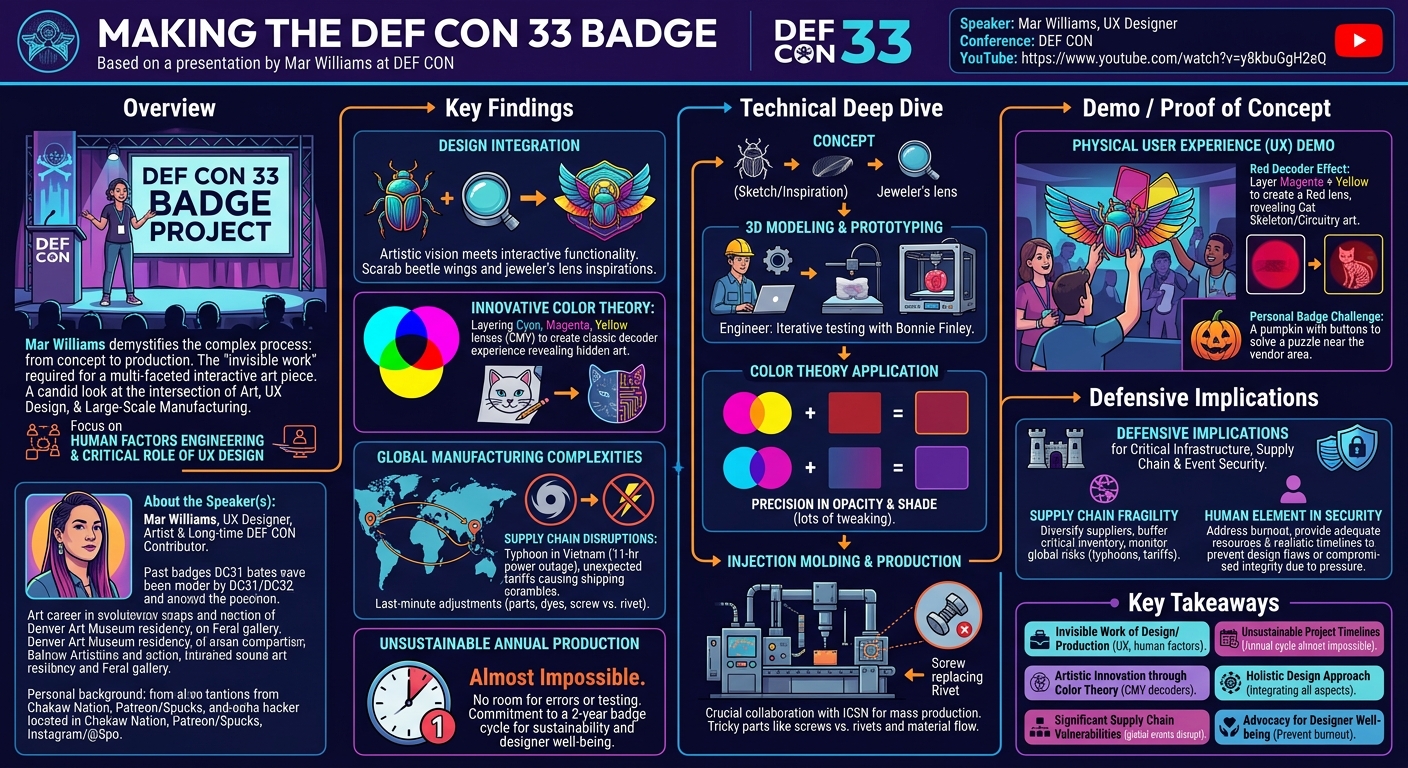
From a design perspective, Williams' core contribution was a badge that masterfully blends artistic vision with interactive functionality. The inspiration for the badge's unique form factor stemmed from a jeweler's lens and the wings of a scarab beetle, resulting in a multi-layered, splaying design. This aesthetic was deeply intertwined with a sophisticated exploration of color theory, specifically additive versus subtractive color principles. Drawing on her 2016 Denver Art Museum residency, Williams meticulously tweaked the opacity and shade of magenta and yellow lenses to achieve specific visual effects. The groundbreaking aspect was the creation of a classic decoder experience: by layering the CMY (Cyan, Magenta, Yellow) lenses, users could achieve RGB (Red, Green, Blue) effects, revealing hidden imagery. For instance, combining the magenta and yellow lenses created a red lens, which, when viewed through, transformed certain art pieces around the conference (like a cat drawing) to reveal an underlying skeleton or circuitry. This demonstrated a profound understanding of how physical design elements could create dynamic, engaging interactions without relying solely on electronics.
Operationally, the project highlighted the immense and often unpredictable challenges inherent in large-scale, international manufacturing. The team faced significant supply chain disruptions, including a typhoon in Vietnam that caused an 11-hour power outage at the factory responsible for producing the bulk of the badges, leading to critical delays. Furthermore, unexpected tariffs disproportionately impacting Vietnam created a scramble for shipping slots, forcing the DEF CON team to compete with numerous other entities trying to beat the new tariffs. These external factors severely impacted the timeline and required last-minute adjustments, such as sourcing different parts or even alternative plastic dyes when original suppliers couldn't deliver. The speaker also mentioned a specific issue where a last-minute decision to use a screw instead of a rivet led to some badges falling apart, underscoring the high stakes and rapid decision-making required under extreme time constraints.
Finally, a crucial finding and overarching message from Williams was the unsustainable nature of the current annual badge production cycle. She explicitly stated that any manufacturing project of this scale is "almost impossible in the timeline of one year" dueating to "no room for errors, proper testing," and the inability to adequately address manufacturer issues or consistently source the right parts. This led to a personal commitment to move to a two-year badge cycle for future projects, emphasizing the importance of designer well-being and the ability to engage in "hacker stuff with my friends" rather than being perpetually consumed by the badge project. This finding represents a significant shift in philosophy, advocating for more realistic timelines and a greater appreciation for the human cost of ambitious creative endeavors.
Technical Deep Dive
▶ Watch: Demonstrating interactive color theory with badge lenses (5:26)
The technical deep dive into the DEF CON 33 badge reveals a sophisticated blend of industrial design, material science, and optical principles, rather than traditional cybersecurity hardware. At its core, the badge's physical design was a journey from abstract inspiration to tangible, mass-produced reality.
The initial conceptualization was heavily influenced by the mechanics of a jeweler's lens, specifically its sliding, layered components, combined with the organic form of scarab beetle wings. This dual inspiration led to a badge structure that "splays out like little wings," creating a unique, multi-paneled form factor. The transition from these conceptual sketches to a manufacturable product involved extensive collaboration with Bonnie Finley, who was responsible for the 3D modeling of the badge. This iterative process of 3D modeling and 3D printing prototypes allowed for repeated physical testing and refinement of the design, ensuring that the intricate sliding mechanisms and overall form factor were both aesthetically pleasing and functionally robust for mass production.
A significant technical aspect was the meticulous application of color theory, particularly the interplay between additive and subtractive color models. Williams, drawing from her background in fine art and her Denver Art Museum residency, focused on the precise manipulation of CMY (Cyan, Magenta, Yellow) transparent plastics. Unlike RGB (Red, Green, Blue), which are additive primary colors used in light (e.g., screens), CMY are subtractive primary colors used in pigments and filters. When light passes through CMY filters, certain wavelengths are absorbed (subtracted), creating new colors. The badge incorporated three distinct transparent lenses: cyan, magenta, and yellow. The "technical trick" was to layer these. For instance, combining the magenta and yellow lenses effectively created a red filter, as the magenta subtracts green light and the yellow subtracts blue light, leaving primarily red light to pass through. Similarly, layering all three CMY lenses theoretically produces black, as all visible light is absorbed.
The design required extreme precision in manufacturing, particularly with the opacity and exact shade of each plastic lens. Williams mentioned "lots of tweaking so that this badge would work," indicating a rigorous process of material selection and quality control to ensure the optical properties were correct for the intended interactive effects. This level of detail is crucial because even slight variations in dye concentration or plastic thickness could compromise the visual decoding mechanism.
The manufacturing process itself relied heavily on injection molding, a technique for producing parts by injecting molten material into a mold. This method is essential for producing the 28,000 badges required for DEF CON, but it introduces its own set of technical challenges. Ensuring that the intricate details of the badge's design, including the sliding parts and the precise dimensions for lens layering, could be consistently reproduced through injection molding required close collaboration with the manufacturing partner, ICSN. Williams explicitly noted the complexities: "With injection molding, it can get really tricky," and the need for "design support so that everything flows just right." The issue of the screw replacing a rivet highlights a critical last-minute design decision influenced by manufacturing realities. Rivets provide a permanent, flush fastening solution, ideal for the badge's multi-layered structure, whereas screws, while easier to assemble, can loosen or catch, impacting durability and user experience. This pivot underscores the constant trade-offs between ideal design, available parts, and production timelines.
In essence, the technical prowess behind the DEF CON 33 badge lies in the successful translation of complex artistic and optical concepts into a mass-produced, interactive physical object, navigating the myriad constraints and unforeseen challenges of global manufacturing.
Demo / Proof of Concept
▶ Watch: From sketches to first 3D badge rendering (7:08)
While not a "proof of concept" in the typical cybersecurity sense, the DEF CON 33 badge itself served as an interactive demonstration of its core design principles, essentially a physical user experience (UX) demo. The primary interactive feature revolved around the badge's unique multi-layered design and its integrated CMY lenses.
Attendees were encouraged to physically manipulate their badges, holding them up to their faces to layer the transparent cyan, magenta, and yellow panels. The core demonstration involved using these layered lenses as a decoder. Williams illustrated this with specific examples:
- Red Decoder Effect: By combining the magenta and yellow lenses, users effectively created a red filter. When this "red lens" was then held over specific art installations or signage strategically placed around the conference, hidden elements would "pop out." For instance, a drawing of a cat would reveal its underlying skeleton, or intricate circuitry on its face, depending on the combination of lenses.
- Dark Blue Effect: Combining the blue (cyan) and red (magenta+yellow) lenses could create a "really nice dark blue" effect, revealing different hidden details. The speaker also mentioned simply using the cyan lens independently for other effects.
The design specifically accounted for the form factor to facilitate this interaction, ensuring the badge was sized and shaped so people could comfortably "hold it up like this" to their face, mimicking how one might use binoculars or 3D glasses. This emphasis on ergonomic interaction underscored the UX design principles at play.
Beyond the badge itself, Williams also mentioned a personal, supplementary badge challenge she organized. Located near the arts and entertainment booth in the vendor area, this challenge involved a "big stupid pumpkin with buttons on it." While details were sparse, this indicated an additional layer of interactive engagement, encouraging attendees to "come check it out and press some buttons" to figure out the puzzle. This served as a smaller-scale, hands-on demonstration of interactive design and problem-solving, aligning with the spirit of DEF CON.
The "demo" of the DEF CON 33 badge was thus an experiential one, where the artifact's design actively invited user participation to unlock hidden visual information, transforming a passive object into an engaging, interactive art piece.
Defensive Implications
▶ Watch: Manufacturing challenges: typhoon and tariffs (8:00)
The DEF CON 33 badge talk, while primarily focused on design and manufacturing, offers tangential but significant defensive implications for organizations involved in critical infrastructure, supply chain management, and large-scale event security. The challenges highlighted by Mar Williams underscore vulnerabilities that, in a different context, could be exploited.
Firstly, the talk vividly illustrates the immense supply chain fragility inherent in complex hardware projects. The impact of a typhoon causing an 11-hour factory power outage and unforeseen tariffs disrupting shipping timelines demonstrates how external, geopolitical, or natural events can critically affect the delivery of essential components or finished products. For defenders, this is a stark reminder of the importance of supply chain resilience and risk assessment. Organizations relying on custom hardware, secure tokens, or critical electronic components must:
- Diversify suppliers: Reduce single points of failure by having multiple qualified manufacturers in different geographic regions.
- Buffer inventory: Maintain sufficient stock of critical parts or finished goods to absorb unexpected delays.
- Monitor geopolitical and environmental risks: Proactively assess potential disruptions in manufacturing hubs and shipping lanes.
- Implement robust quality control at multiple stages: The "screw instead of a rivet" issue highlights how last-minute changes, even seemingly minor ones, can introduce vulnerabilities or functional compromises. In a security context, this could manifest as weaker physical tamper resistance or unintended design flaws.
Secondly, the emphasis on the "invisible work" and the "almost impossible" one-year timeline speaks to the human element of security. Overburdened teams, pressured into unrealistic deadlines, are more prone to errors, oversight, and burnout. In a defensive context, this translates to:
- Increased risk of design flaws: Rushed development cycles can lead to insufficient testing, potentially missing critical security vulnerabilities in hardware or software.
- Compromised integrity: The pressure to "just get it done" might lead to shortcuts that bypass established security protocols or quality checks.
- Burnout and attrition: A continuously unsustainable work environment can lead to loss of experienced personnel, impacting an organization's long-term defensive capabilities.
While the DEF CON badge is an artistic endeavor, its logistical challenges mirror those faced by entities producing anything from secure access cards to military hardware. Understanding these pressures and their potential to introduce weaknesses is crucial for developing robust physical security and supply chain security strategies. Defenders must advocate for realistic timelines, adequate resources, and resilient supply chains to mitigate risks that extend far beyond the aesthetic appeal of a conference badge.
Key Takeaways
- The "Invisible Work" of Design and Production: The majority of effort in complex projects like the DEF CON badge involves intricate UX design, human factors engineering, and manufacturing coordination, which remains largely unseen by the end-user.
- Artistic Innovation through Color Theory: The DEF CON 33 badge leverages classic color theory (CMY lenses creating RGB effects) to deliver a unique, interactive visual decoder experience that reveals hidden art.
- Significant Supply Chain Vulnerabilities: Global events like typhoons and tariffs can critically disrupt manufacturing and shipping, leading to major delays and forcing last-minute design compromises (e.g., screw vs. rivet).
- Unsustainable Project Timelines: An annual cycle for a project of this scale is "almost impossible," leading to insufficient testing, manufacturing issues, and designer burnout, necessitating a shift to longer development cycles.
- Holistic Design Approach: Successful large-scale hardware projects require a comprehensive approach, integrating artistic vision, 3D modeling, material science, and manufacturing expertise, all centered around the end-user experience.
- Advocacy for Designer Well-being: The talk serves as a powerful call for more realistic project timelines and better support for creators to prevent burnout and foster sustainable creative endeavors.
About the Speaker(s)
Mar Williams is a highly accomplished UX designer, artist, and long-time contributor to the DEF CON community. Her artistic journey with the conference began at DC17, and she has since played a pivotal role in shaping the visual and interactive identity of DEF CON badges, having designed the DC31 and DC32 badges and led the DC32 badge team. Beyond her work in the hacker community, Williams' professional background includes experience as a human factors engineer, leading development teams as a UX designer, and chairing hacker spaces. She is also deeply involved in the art world, having completed a 4-month residency at the Denver Art Museum in 2016 and running a collaborative gallery. She is opening a new gallery called Feral in Denver in September. Williams is a citizen of the Chakaw Nation of Oklahoma and is a strong advocate for indigenous rights. Her work often blends her artistic passion with a deep understanding of user experience and human interaction, as evidenced by the intricate and engaging designs of the DEF CON badges. She maintains a presence in the vendor area at DEF CON, offering her art and merchandise, and can be supported via Patreon (Patreon/Spucks) and Instagram (@Spo).
Reviews
Dr. Zero (Offensive Security Researcher) — SOLID
A charming, honest behind-the-scenes talk from someone who clearly did the work and isn't interested in sanitizing it. The supply chain chaos, color theory mechanics, and two-year-cycle advocacy are all genuinely interesting — but this is a DEF CON community talk, not a research session, and it should be judged as one.
Heather Calloway (CISO) — PASS
A creative production retrospective on the DEF CON 33 badge — interesting craft, zero governance relevance. This is outside my lane, and I'm not going to penalize it for that.