Firmware Decryption: For, and By, the Cryptographically Illiterate
Craig Heffner (Netrise)
DEF CON 33 · Day 1 · Main Stage
Overview
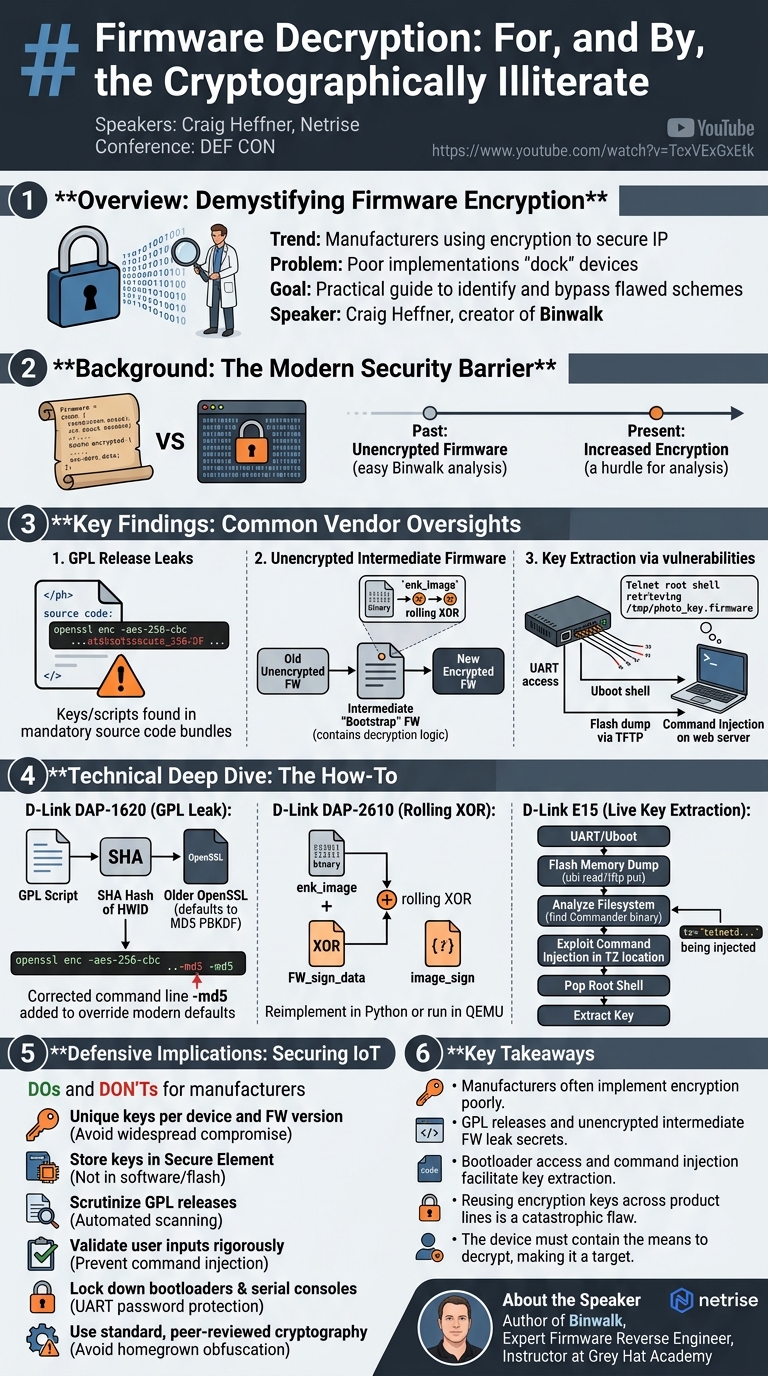
In this insightful DEF CON talk, Craig Heffner, renowned for developing the Binwalk firmware analysis tool, delves into the increasingly common practice of firmware encryption by device manufacturers. While encryption is intended to secure intellectual property and prevent tampering, Heffner demonstrates how many vendors, particularly in the consumer and small business sectors, implement these security measures poorly. The talk serves as a practical guide for security researchers, reverse engineers, and even "cryptographically illiterate" individuals on how to identify and bypass these flawed encryption schemes to gain access to device firmware.
Key moments
- 0:00 Introduction: The problem of encrypted firmware
- 2:00 DLink 1620: Encryption key found in GPL release
- 3:50 DLink 2610: Decrypting using unencrypted older firmware
- 6:40 DLink E15: Accessing UART and Uboot bootloader shell
- 7:50 Modifying Uboot kernel arguments to get a shell
Firmware Decryption: For, and By, the Cryptographically Illiterate
Speakers: Craig Heffner, Netrise
Conference: DEF CON
YouTube: https://www.youtube.com/watch?v=TcxVExGxEtk
Overview
In this insightful DEF CON talk, Craig Heffner, renowned for developing the Binwalk firmware analysis tool, delves into the increasingly common practice of firmware encryption by device manufacturers. While encryption is intended to secure intellectual property and prevent tampering, Heffner demonstrates how many vendors, particularly in the consumer and small business sectors, implement these security measures poorly. The talk serves as a practical guide for security researchers, reverse engineers, and even "cryptographically illiterate" individuals on how to identify and bypass these flawed encryption schemes to gain access to device firmware.
Heffner’s presentation highlights that despite the apparent complexity, many firmware encryption methods can be defeated through careful observation, leveraging publicly available information, and exploiting common development oversights. By walking through real-world examples from D-Link devices, he illustrates how vendors inadvertently "dock themselves" by leaving critical decryption information—such as keys, algorithms, or even decryption binaries—exposed in their software releases or on the devices themselves. This talk is crucial for anyone interested in embedded device security, offering actionable strategies to demystify encrypted firmware and underscore the importance of robust cryptographic engineering in IoT and network devices.
Background
▶ Watch: Introduction: The problem of encrypted firmware (0:00)
Historically, firmware, especially for consumer-grade devices, was largely unencrypted. Reverse engineers and security researchers could readily inspect its contents using tools like Binwalk or even a simple hex editor, enabling them to understand device functionality, identify vulnerabilities, or customize behavior. However, the landscape has shifted significantly. In recent years, an increasing number of manufacturers, even for seemingly "small insignificant products," have begun encrypting their firmware. This trend, while ostensibly aimed at enhancing security and protecting proprietary code, presents a significant hurdle for those seeking to analyze, modify, or simply understand what's running on their devices.
Craig Heffner, whose work in firmware reverse engineering is "near and dear to his heart," identifies this as a pervasive problem. He notes that while the intent might be good, the execution is often flawed. Many vendors lack deep cryptographic expertise, leading to implementations that are easily bypassed. The core problem lies in what Heffner terms the "Achilles heel" of hardware encryption: if a device uses encrypted firmware and is sold to a user, that user effectively possesses a decryption device. The challenge then becomes how easily one can leverage that device to perform the decryption. This talk explores common pitfalls in vendor encryption practices and provides a methodology to overcome them, emphasizing that with sufficient time, effort, and resources, virtually any such scheme can be broken.
Key Findings
▶ Watch: DLink 1620: Encryption key found in GPL release (2:00)
Craig Heffner presented three distinct case studies involving D-Link devices, each revealing a common, yet critical, vendor oversight that allowed for firmware decryption. These findings collectively demonstrate that many firmware encryption schemes are vulnerable due to improper implementation rather than inherent cryptographic weaknesses.
- GPL Release Leaks: The first major finding, exemplified by the D-Link DAP-1620 Wi-Fi access point, showed that vendors often inadvertently expose their encryption keys or methodologies through their GPL (General Public License) compliance efforts. Because Linux-based firmware must release its source code, manufacturers sometimes include build scripts that contain the exact OpenSSL commands used for encryption and decryption. In the DAP-1620's case, the build script revealed that the firmware was encrypted using AES-256-CBC with a passphrase derived from a SHA hash of the device's hardware ID and model name. A crucial detail for successful decryption was recognizing that D-Link's older OpenSSL version defaulted to MD5 for key derivation, not SHA-256, a common pitfall when dealing with legacy systems.
- Unencrypted Intermediate Firmware: The second finding, based on the D-Link DAP-2610, highlighted the vulnerability of devices that were not originally designed to handle encrypted firmware. To transition to encrypted updates, manufacturers often release an intermediate, unencrypted firmware version that contains the logic to decrypt future firmware images. This "bootstrap" firmware essentially defeats the purpose of encryption by exposing the decryption mechanism. Heffner discovered an
enk_imagebinary within the unencrypted firmware that performed AES encryption. This binary generated the encryption key and Initialization Vector (IV) by applying a rolling XOR operation to two hardcoded strings,FW_sign_dataandimage_sign, which were readily available within the binary itself and the firmware header. This allowed for easy reimplementation of the decryption logic or even running theenk_imagebinary directly within QEMU.
- Easily Accessible Keys on Live Devices via Command Injection: The most sophisticated and scalable finding involved the D-Link E15 access point, representative of D-Link's current consumer product line. Even without GPL leaks or intermediate firmware, physical access combined with bootloader interaction and a software vulnerability allowed for key extraction. Heffner leveraged a labeled UART header to access the Uboot bootloader shell. From Uboot, he used commands like
ubi readto dump flash memory (specifically the unencrypted SquashFS file system) andtftp putto exfiltrate it. Analysis of binaries within the extracted file system, such as theCommanderbinary, revealed that the device stored the firmware encryption key in a predictable location:/tmp/photo_key.firmware. To access this live system file, Heffner exploited a command injection vulnerability in the device's web server, specifically within theTZ locationparameter handled by a custom binary namedFOD. This allowed him to spawn a root shell via Telnet and retrieve the key. Crucially, this key was found to be consistent across all firmware versions for that device and, more significantly, across D-Link's entire product line using the same base firmware, enabling widespread decryption capabilities.
Technical Deep Dive
▶ Watch: DLink 2610: Decrypting using unencrypted older firmware (3:50)
The technical strategies employed by Craig Heffner to decrypt D-Link firmware highlight common weaknesses in embedded device security, ranging from improper cryptographic implementation to fundamental software vulnerabilities.
D-Link DAP-1620: The GPL Leak and OpenSSL Quirks
The first case involved the D-Link DAP-1620, a small Wi-Fi access point. Initial inspection of the encrypted firmware revealed a header containing salted__ followed by eight bytes of random data. This pattern is a strong indicator of OpenSSL encryption using a passphrase-based key derivation function (PBKDF).
Heffner's breakthrough came from examining the GPL release for the device. Many manufacturers, to comply with the GPL for their Linux-based firmware, release build scripts alongside the source code. In this instance, the build script contained the precise OpenSSL command used for encryption: openssl enc -aes-256-cbc -pass pass:$(KEY) -salt. The $(KEY) variable was defined as a SHA-1 hash of the device's hardware ID and model name.
A critical detail emerged when attempting to decrypt the firmware with a modern OpenSSL client. While the passphrase and salt were known, direct decryption failed. This was due to a change in OpenSSL's default key derivation function. Older versions, likely used by D-Link, defaulted to MD5 for key derivation when a passphrase was provided. Modern OpenSSL defaults to SHA-256. Therefore, to successfully decrypt, the specific -md5 flag had to be explicitly added to the OpenSSL command, overriding the modern default: openssl enc -d -aes-256-cbc -pass pass:$(SHA1_OF_HWID_MODEL) -salt -md5. This underscores the importance of understanding the evolution of cryptographic tools and their default behaviors.
D-Link DAP-2610: Intermediate Firmware and Rolling XOR
The D-Link DAP-2610, a higher-end access point, presented a different challenge. While its most recent firmware was heavily encrypted (high entropy), Heffner observed that the very first firmware release for the device was entirely unencrypted, containing a standard SquashFS file system. This revealed a common pattern: devices not initially designed for encrypted firmware need an unencrypted "bootstrap" firmware to handle future encrypted updates.
Within this unencrypted firmware, a new binary named enk_image was found. This binary was responsible for decrypting subsequent firmware images. Reverse engineering enk_image revealed that it used AES encryption (likely AES-256-CBC, though not explicitly stated, it's a common choice). The key and Initialization Vector (IV) for this AES operation were derived using a rolling XOR algorithm applied to two hardcoded strings: FW_sign_data and image_sign. Both of these strings were embedded directly within the enk_image binary and also present in the firmware header.
Reimplementing the rolling XOR logic in Python was described as "maybe 15 lines of Python code," demonstrating its relative simplicity. Alternatively, for those less inclined to reverse engineer the algorithm, Heffner pointed out that the enk_image binary itself could be run within an emulator like QEMU. By feeding the encrypted firmware file as input to the emulated enk_image binary, it would perform the decryption, essentially acting as a "decryption oracle" provided by the vendor.
D-Link E15: Live System Key Extraction via Bootloader and Command Injection
The most sophisticated and generalizable technique was demonstrated on the D-Link E15, a representative of D-Link's current product line. This device's firmware was OpenSSL encrypted, but no GPL release was available, and all available firmware versions were encrypted.
Heffner began with physical access to the device. He identified a four-pin header on the board, clearly labeled for UART (Transmit, Receive, Ground), indicating a serial port. Connecting to this revealed a boot log. During boot, the device used Uboot, a common bootloader. By hitting any key during the "Hit any key to stop auto boot" prompt, Heffner gained access to the Uboot shell.
An initial attempt to force a shell by setting the kernel argument init=/bin/sh failed, as the serial console became unresponsive after the kernel booted. Returning to Uboot, Heffner explored its powerful features. He discovered two crucial commands compiled into this version of Uboot:
ubi read <address> <offset> <size>: This command allowed reading specific sections of the flash memory into RAM. By consulting Uboot's flash layout definitions, Heffner identified the address and size of the file system partition.tftp put <address> <filename> <size>: This command enabled exfiltrating data from RAM over TFTP to a remote server (e.g., Heffner's laptop).
Using these commands, Heffner successfully dumped the entire file system partition, which turned out to be an unencrypted SquashFS image. This provided full access to the device's binaries and configuration.
Analyzing the extracted SquashFS image, Heffner used tools like strings and internal firmware analysis tools to examine binaries. He focused on a binary named Commander which, despite being compiled, seemed to be written by a "bash script person" due to its frequent shelling out to other commands. By grepping for terms like "firmware" or "key," he discovered commands indicating that the firmware key was read from a flash partition (with obfuscated offsets) and then written to /tmp/photo_key.firmware.
The final step was to retrieve this key from the live system. Heffner identified a command injection vulnerability in the device's web server. A custom binary called FOD processed various arguments, including TZ location (timezone). While normally a dropdown menu, this parameter was susceptible to injection. By setting the TZ location to a crafted string like ` telnetd -p 2323 -l /bin/sh ` (using backticks for command substitution), Heffner successfully launched a Telnet server on the device, providing a root shell. From this shell, a simple cat /tmp/photo_key.firmware` command yielded the encryption key.
This key was found to be universal, working for all firmware versions of that specific device and, critically, across all D-Link devices running the same underlying firmware. This demonstrated a severe lack of unique keying.
Demo / Proof of Concept
▶ Watch: DLink E15: Accessing UART and Uboot bootloader shell (6:40)
While the talk itself served as an extended demonstration of the methodologies, Craig Heffner also showcased practical implementations and the scalability of his findings. The decryption techniques were not merely theoretical but were actively used to gain access to D-Link firmware.
The speaker's approach to the D-Link E15 case study, involving the acquisition of multiple devices from Amazon, was a tangible "proof of concept" for the widespread applicability of his findings. He described buying "every single one I could get off of Amazon, plugged it in, popped a shell, pulled the key, packaged it back up, sent it back to Amazon." This strategy effectively demonstrated that once the base vulnerability and key derivation method for a particular platform or product line were understood, the process could be replicated across numerous devices, yielding a repository of decryption keys.
To make these capabilities accessible to the broader security community, Heffner developed a dedicated tool named Dlink (spelled D L I N K) specifically for decrypting D-Link firmware. Furthermore, this decryption functionality has been integrated directly into the latest version of Binwalk, his popular firmware analysis tool. This integration means that users can now run Binwalk on supported D-Link firmware images, and the tool will automatically detect the encryption, apply the appropriate key, and extract the contents without manual intervention. This automation significantly lowers the barrier for researchers and greatly enhances the efficiency of firmware analysis for these devices.
Defensive Implications
▶ Watch: Modifying Uboot kernel arguments to get a shell (7:50)
The case studies presented by Craig Heffner offer critical lessons for manufacturers aiming to secure their embedded devices. The recurring theme is that weak implementation, rather than the absence of encryption, is the primary vulnerability.
- Avoid Hardcoded Keys and Predictable Key Derivation: Storing encryption keys directly within firmware binaries, in easily accessible
/tmpdirectories, or deriving them from predictable static values (like hardware IDs or fixed strings via simple XOR) is a fundamental security flaw. Keys should be unique per device, generated securely, and stored in tamper-resistant hardware (e.g., a Hardware Secure Module (HSM) or a dedicated Secure Element), not in a way that can be extracted from the software image or a running system.
- Scrutinize GPL Releases: Manufacturers must exercise extreme caution when preparing GPL releases. Build scripts, configuration files, and even comments can inadvertently contain sensitive information, including encryption keys, passphrases, or the exact commands used for cryptographic operations. Automated tools should scan GPL bundles for such leaks.
- Secure Intermediate Firmware: If a device must transition from unencrypted to encrypted firmware, the intermediate firmware responsible for decryption must be robustly secured. Its decryption logic, keys, and any associated binaries become prime targets for reverse engineering. Ideally, the entire boot chain should be secured from the outset, eliminating the need for such vulnerable transitions.
- Implement Robust Input Validation: Command injection vulnerabilities, as seen with the
TZ locationparameter, are critical flaws that can lead to full system compromise. All user-supplied input, whether from web interfaces, configuration files, or network protocols, must be rigorously validated and sanitized to prevent the execution of arbitrary commands.
- Secure the Bootloader: Bootloaders like Uboot are powerful and offer extensive control over the device. Access to the bootloader shell should be severely restricted, ideally requiring strong authentication (e.g., password protection) or being entirely disabled in production devices. UART/serial consoles should be disabled or made read-only in deployed products.
- Unique Keys per Device and Firmware Version: Reusing the same encryption key across an entire product line or even for different firmware versions of the same device is a catastrophic mistake. As demonstrated, compromising one device or one firmware version then compromises all others. Each device should ideally have a unique, cryptographically strong key, and firmware updates should be signed with keys that are not easily extractable.
- Avoid Homegrown Cryptography: While Heffner noted that "homegrown encryption... is not cryptographically secure, but a huge pain in the ass to reverse engineer," manufacturers should avoid custom cryptographic algorithms or implementations. Instead, they should rely on well-established, peer-reviewed cryptographic primitives (e.g., AES-256, SHA-3) and battle-tested libraries (e.g., OpenSSL, provided they are used correctly and kept up-to-date).
- Leverage Entropy Analysis: During development and quality assurance, performing entropy analysis on firmware images can help detect issues. High entropy generally indicates proper encryption or strong compression. If a supposedly encrypted section exhibits low entropy, it might suggest a faulty encryption process or simple obfuscation, which is not true security.
In essence, manufacturers must adopt a "defense in depth" approach, understanding that relying solely on encryption without securing the entire key management and software delivery pipeline is an illusion of security. The device itself should not become the easiest path to its own compromise.
Key Takeaways
- Many embedded device manufacturers implement firmware encryption poorly, often "docking themselves" by exposing keys or decryption methods.
- GPL releases can inadvertently leak critical encryption details, including build scripts with OpenSSL commands and key derivation logic.
- Devices transitioning to encrypted firmware often rely on unencrypted "intermediate" firmware that contains the full decryption mechanism, making it vulnerable to analysis.
- Physical access via UART and leveraging powerful bootloaders like Uboot can facilitate dumping unencrypted file systems and extracting secrets.
- Common software vulnerabilities, such as command injection in web interfaces, can provide root shells for live system key extraction.
- Reusing the same encryption key across an entire product line or multiple firmware versions is a severe security flaw that allows for widespread compromise once a single key is found.
- The "Achilles heel" of device encryption is that the device itself, by necessity, must contain the means to decrypt its firmware, making it a target for reverse engineering.
- Understanding the specific historical behaviors of tools like OpenSSL (e.g., default key derivation functions like MD5 vs. SHA-256) is crucial for successful decryption.
About the Speaker(s)
Craig Heffner is a prominent figure in the field of firmware reverse engineering and security analysis. He is widely recognized as the original author of Binwalk, a fast, easy-to-use tool for analyzing, reverse engineering, and extracting firmware images. Currently, Craig works for Netrise, where he focuses on advanced firmware security analysis. Additionally, he shares his extensive knowledge and experience by teaching firmware reverse engineering courses at Grey Hat Academy, demonstrating his passion for the subject. Heffner also mentioned the interesting history of Binwalk, noting it's technically owned by Microsoft (due to a past acquisition of a company he worked for), though he remains its sole maintainer. His work consistently highlights critical vulnerabilities in embedded systems and provides practical methodologies for their discovery and remediation.
Reviews
Dr. Zero (Offensive Security Researcher) — STRONG ACCEPT
Heffner brings exactly the right credentials to this talk — he built the tooling the community relies on, and he's done the actual work on these devices. Three concrete case studies, each with a distinct attack path, real keys, and tooling shipped at the end. This is practitioner content that earns its slot.
Heather Calloway (CISO) — WEAK
Technically competent and well-executed research that exposes real, systemic failures in D-Link's firmware security posture. But the talk stops at the device layer and never reaches the institutional, procurement, or governance dimensions where these failures actually have organizational consequence.