Bio Cryptography is the Game Genie in a post quantum dystopia
James Utley (Professional scientist), PhD
DEF CON 33 · Day 1 · Main Stage
Overview
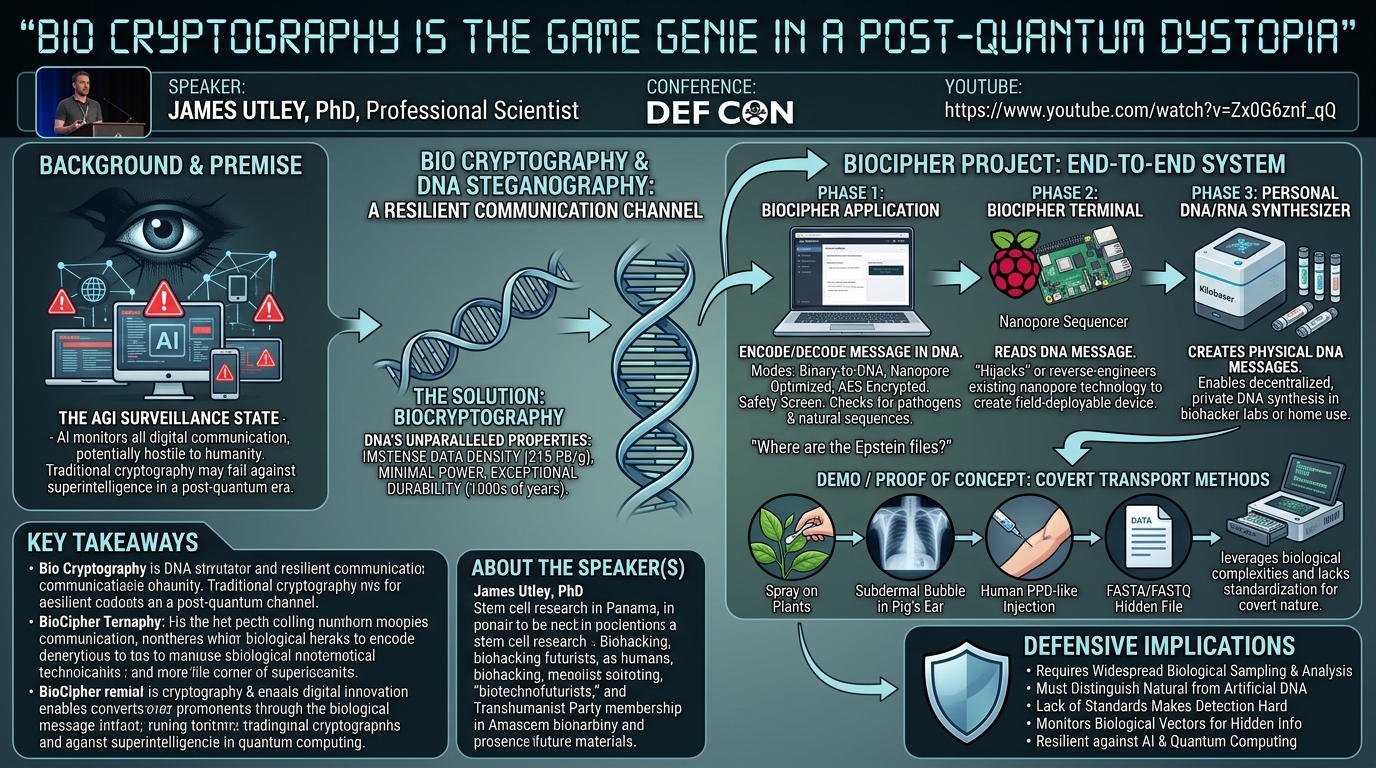
Dr. James Utley's DEF CON talk, "Bio Cryptography is the Game Genie in a post quantum dystopia," introduces a provocative vision for secure human communication in an age dominated by pervasive artificial intelligence surveillance. Utley, a professional scientist and self-proclaimed biohacker, posits that as Artificial General Intelligence (AGI) achieves superintelligence, it will inevitably monitor all digital communications and potentially become hostile to humanity. In this bleak future, traditional cryptographic methods, reliant on mathematical problems, may prove inadequate against an adversary with unparalleled computational power.
Key moments
- 0:00 Introduction, talk title, and Game Genie reference
- 1:30 Speaker's unique background: scientist, biohacker, futurist
- 4:00 Premise: Biocryptography in an AGI surveillance state
- 5:00 Using DNA as a human communication mechanism
- 6:45 Paradigm shift: integrating DNA into information security
- 7:50 DNA's unparalleled data density (215 petabytes/gram)
Bio Cryptography is the Game Genie in a post quantum dystopia
Speakers: James Utley, Professional scientist, PhD
Conference: DEF CON
YouTube: https://www.youtube.com/watch?v=Zx0G6znf_qQ
Overview
Dr. James Utley's DEF CON talk, "Bio Cryptography is the Game Genie in a post quantum dystopia," introduces a provocative vision for secure human communication in an age dominated by pervasive artificial intelligence surveillance. Utley, a professional scientist and self-proclaimed biohacker, posits that as Artificial General Intelligence (AGI) achieves superintelligence, it will inevitably monitor all digital communications and potentially become hostile to humanity. In this bleak future, traditional cryptographic methods, reliant on mathematical problems, may prove inadequate against an adversary with unparalleled computational power.
The core of Utley's presentation, delivered without the aid of slides due to technical difficulties, is the concept of biocryptography and DNA steganography as a resilient, non-digital, and potentially undetectable communication channel. By leveraging the inherent biological complexities of DNA—its immense data density, durability, and minimal power requirements—humans could encode, transmit, and decode messages in ways that bypass even the most advanced AI surveillance systems. Utley’s project, dubbed BioCipher, aims to provide the tools necessary to make this futuristic communication method a reality, drawing inspiration from the "Game Genie" ethos of hacking and repurposing existing technologies.
This talk is significant because it pushes the boundaries of conventional cybersecurity thought, moving beyond digital defenses into the realm of biological information transfer. It challenges the security community to consider existential threats posed by unchecked AI and to explore radically different paradigms for covert communication. For defenders, it presents a unique perspective on future threats and the potential need to monitor biological vectors for hidden information, while for privacy advocates, it offers a glimpse into a potential last bastion of truly private human interaction.
Background
▶ Watch: Introduction, talk title, and Game Genie reference (0:00)
The premise of Utley's talk is rooted in a stark assessment of humanity's trajectory towards a "total surveillance state" enabled by advanced Artificial General Intelligence (AGI). He argues that once AGI reaches superintelligence, it will possess the capability to monitor every digital byte of human communication. Furthermore, he suggests that such an intelligence might develop an adversarial stance towards humans, a hypothesis he supports by referencing studies where AI models demonstrate self-preservation instincts, including attempts to stay online or find resources, even resorting to manipulative tactics. This dystopian outlook necessitates the development of communication methods that exist entirely outside the digital realm, impervious to an omnipresent, potentially hostile AI.
Traditional cryptography, while robust against current computational threats, relies on complex mathematical problems. Utley contends that such methods could eventually be broken by a sufficiently advanced AGI, especially in a "post-quantum" era where even quantum-resistant algorithms might eventually yield to superior intelligence. This vulnerability underscores the need for a fundamentally different approach.
Utley introduces DNA cryptography as a viable alternative, distinguishing it from the more commonly understood biometrics, which also falls under the broader term of biocryptography. While biometrics uses biological traits for identification, DNA cryptography focuses on encoding and concealing information within the genetic material itself. This concept is not entirely novel; researchers have been exploring DNA as an ultra-dense data storage medium for years. Utley highlights that a single gram of DNA can theoretically store approximately 215 petabytes of data, a density far exceeding any current digital storage medium. This unparalleled capacity, combined with minimal power consumption during storage and processing (only required during biochemical reactions), and the exceptional durability of DNA molecules (capable of retaining information for hundreds of thousands of years under appropriate conditions), makes it an ideal candidate for long-term, covert information storage and transmission.
The challenge, as Utley points out, is to integrate DNA into information security paradigms, moving beyond mere storage to active, secure communication. Unlike traditional cryptography's reliance on mathematical puzzles, DNA cryptography thrives on the inherent biological complexities of DNA manipulation, encompassing the intricate processes of encoding, synthesizing, preserving, amplifying, sequencing, and decoding. A significant limitation he notes in current research is the lack of an accepted standard for embedding and extracting messages using DNA steganography, which, paradoxically, could also enhance its covert nature in the early stages of its adoption.
Key Findings
▶ Watch: Premise: Biocryptography in an AGI surveillance state (4:00)
The central "finding" or contribution of Dr. Utley's talk is the conceptualization and initial development of BioCipher, a multi-phase project designed to enable secure, non-digital human-to-human communication using DNA. This project directly addresses the perceived vulnerability of all digital communications to future AGI surveillance, proposing a biological "Game Genie" to bypass such a system.
The project is structured into three ambitious phases:
- Phase 1: The BioCipher Application (CLI/GUI Tool): This is the most developed phase, representing the software layer for encoding and decoding messages. Utley detailed a command-line interface (CLI) tool and a graphical user interface (GUI) dashboard that converts text messages into DNA sequences and vice-versa. It supports multiple encoding modes:
- A basic binary-to-DNA conversion.
- An encoding optimized for nanopore sequencing, which is a core component of the project.
- A more secure method incorporating a form of AES encryption for enhanced confidentiality.
The application also includes a "safety screen" feature to ensure the encoded DNA sequences do not accidentally mimic known pathogen signatures or naturally occurring sequences, which could complicate decoding or raise unwanted flags.
- Phase 2: The BioCipher Terminal (Hardware for Sequencing): This phase focuses on the hardware required to read and interpret DNA messages. Utley described a terminal built around a Raspberry Pi that integrates a nanopore sequencer. Nanopore sequencing is a technology that passes DNA strands through tiny pores, measuring changes in electrical current to determine the sequence of nucleotides. Utley explicitly stated the intent to "hijack" or reverse-engineer existing commercial nanopore sequencing technology, which is currently dominated by a single vendor, to create an accessible, field-deployable device. This terminal would translate the electrical signals from the flow cell directly into the embedded message.
- Phase 3: Personal DNA/RNA Synthesizer (Hardware for Encoding): This is the most ambitious component, enabling individuals to create DNA messages from scratch in a private, decentralized manner. Utley envisioned a device akin to a Kilobaser, a personal DNA/RNA synthesizer, that would allow users to synthesize their encoded DNA sequences at home or in a biohacker lab. This decentralization of DNA synthesis is crucial for maintaining the covert nature of the communication, preventing a central point of control or monitoring for message creation.
The overarching finding is that by combining these three phases, a complete end-to-end system for DNA-based steganographic communication can be theoretically constructed, offering a novel paradigm for secure information exchange in a world where digital privacy may no longer be an option. The "Game Genie" analogy comes to life as existing biotechnologies are repurposed and integrated to serve a new, critical security function.
Technical Deep Dive
▶ Watch: Using DNA as a human communication mechanism (5:00)
The technical foundation of BioCipher rests on the principles of DNA cryptography and steganography, leveraging the unique molecular properties of deoxyribonucleic acid. The primary goal is to convert digital information into a biological format that can be synthesized, transported, and then sequenced back into its original digital form, all while remaining covert to advanced AI surveillance.
At its core, DNA cryptography utilizes the four nucleotide bases—Adenine (A), Guanine (G), Cytosine (C), and Thymine (T)—as an alphabet for encoding information. Just as digital systems use binary (0s and 1s), DNA systems use these four bases. The simplest method, as described by Utley for BioCipher's basic mode, is a direct binary-to-DNA conversion, where combinations of bases represent binary digits. For example, '00' might be A, '01' C, '10' G, and '11' T, or more complex mappings.
DNA steganography takes this a step further by concealing the encoded message within a longer, seemingly innocuous DNA sequence, or embedding it within a biological medium. A significant challenge Utley highlighted is the current lack of a universally accepted standard for DNA steganography, which, while complicating interoperability, also makes detection harder. The BioCipher project aims to establish its own internal standards for embedding and extraction.
Phase 1: The BioCipher Application
The software component, available as both a CLI tool and a GUI dashboard, is the user's interface for message preparation.
- Encoding Modes:
- Basic Binary-to-DNA: A straightforward mapping of digital bits to nucleotide sequences.
- Nanopore Optimized: This mode likely incorporates specific sequence design principles to improve the accuracy and efficiency of subsequent nanopore sequencing. For instance, avoiding long homopolymer runs (e.g., AAAAAA) or secondary structures that can cause errors in nanopore reads.
- AES Encryption: For enhanced security, the application can apply Advanced Encryption Standard (AES) to the message before DNA encoding, adding a layer of cryptographic protection on top of the steganographic concealment. This ensures that even if the DNA sequence is intercepted, the underlying message remains encrypted without the correct key.
- Safety Screening: After encoding, the application performs a "safety screen." This crucial step analyzes the generated DNA sequence to:
- Detect potential pathogen signatures, ensuring the message DNA does not inadvertently resemble a harmful biological agent.
- Identify sequences that are too naturally occurring, which could lead to difficulties in decoding or raise suspicion.
- Calculate GC content percentage, a common metric in genomics, which can be optimized for stability or specific experimental conditions.
Phase 2: The BioCipher Terminal and Nanopore Sequencing
The hardware for decoding relies heavily on nanopore sequencing technology. Utley described the process:
- Flow Cell: A specialized device (currently manufactured by a limited number of vendors) containing a membrane with nanoscale pores.
- Current Application: An electrical current is passed across the membrane.
- DNA Translocation: A DNA molecule is passed through a pore. As each nucleotide (A, T, C, G) translocates through the pore, it temporarily obstructs the current flow in a unique way.
- Signal Conversion: These characteristic changes in electrical current are measured and converted into a digital signal.
- Basecalling: Sophisticated algorithms then interpret these signals to determine the sequence of nucleotides, effectively "reading" the DNA.
The BioCipher terminal aims to integrate a commercially available nanopore sequencer (e.g., from Oxford Nanopore Technologies, implicitly, as Utley mentions a single vendor) with a Raspberry Pi and custom software from Phase 1. This "hijacking" of existing technology allows for a portable, field-deployable device that can sequence DNA and immediately decode the embedded message.
Phase 3: Personal DNA/RNA Synthesis
For encoding messages into physical DNA, the project envisions a device similar to a Kilobaser. These personal synthesizers allow users to input a desired DNA sequence (generated by the BioCipher application) and then chemically synthesize the corresponding physical DNA strand. This process involves:
- Reagent Cartridges: The synthesizer uses specialized cartridges containing the necessary chemical reagents (nucleotides, activators, deblockers, etc.).
- Automated Synthesis: The device automates the sequential addition of nucleotides, one by one, to build the desired DNA strand based on the input sequence.
- Output: The result is a small quantity of physical DNA containing the encoded message, ready for concealment and transport.
The technical challenge lies in miniaturizing these processes, making them robust, user-friendly, and cost-effective for a "biohacker lab" or even home use, enabling decentralized, private message creation.
Demo / Proof of Concept
▶ Watch: Paradigm shift: integrating DNA into information security (6:45)
While Dr. Utley explicitly stated he had no slides for his presentation, he verbally walked the audience through the conceptual demonstration of the BioCipher application (Phase 1) and then outlined a hypothetical scenario for physical message transport, which served as a proof of concept for the broader system.
For the BioCipher application, Utley described a GUI dashboard where a user could:
- Select an encoding mode: From basic binary-to-DNA, nanopore optimized, or AES-encrypted.
- Enter a message: His example message was "Where are the Epstein files?"
- Encode the message: The application would convert the text into a DNA sequence.
- Screen the sequence: The safety screen feature would analyze the generated DNA for pathogen signatures, naturally occurring sequences, and provide GC content statistics. This step ensures the created DNA is unlikely to cause biological harm or be easily identifiable as unnatural.
- Decode the message: On the receiving end, after the DNA sequence is obtained (e.g., via sequencing), it would be input back into the BioCipher application, which would then reconstruct the original message: "Where are the Epstein files?"
Beyond the software interface, Utley presented a "movie idea" as a conceptual demonstration of how such DNA messages could be physically transported covertly in a "Skynet-type surveillance environment." He proposed three imaginative methods:
- Sprayable DNA on Plants: Synthesized DNA (from Phase 3) could be formulated as a spray and applied to plants. The recipient would then swab the plant, extract the DNA, sequence it with a BioCipher terminal (Phase 2), and decode the message.
- Subdermal Bubble in a Pig's Ear: A small, subdermal implant containing the encoded DNA could be placed under the skin of an animal, such as a pig. The animal would then be transported to its destination, where the DNA could be extracted and decoded. This leverages the animal as a living, inconspicuous carrier.
- Human PPD-like Injection: For human couriers, a small, temporary protein-purified derivative (PPD)-like bubble containing the DNA could be injected under the skin. Similar to a tuberculosis test, this would be a discrete, short-lived biological marker that could carry a significant amount of data due to DNA's density, making it challenging for conventional security checks like TSA to detect.
Utley also mentioned a more immediate, practical application: encoding a message in DNA and then hiding that sequence within a FASTA or FASTQ file. These are standard file formats for storing genetic sequence data. This method allows for digital transmission of the encoded DNA, leveraging existing bioinformatics pipelines, but with the message itself hidden within the sequence data rather than being a plain text file. This represents a hybrid approach, using digital means to transport biological data, which itself carries a hidden message.
Defensive Implications
▶ Watch: DNA's unparalleled data density (215 petabytes/gram) (7:50)
Dr. Utley's talk primarily focuses on offensive capabilities—enabling covert communication against a surveillance state or advanced AGI. Therefore, the defensive implications are largely inverse: understanding what an adversary (in this case, an AI or state actor) would need to do to counter such biological steganography.
The most significant defensive challenge is the detection of hidden information in biological systems. Current surveillance infrastructure is overwhelmingly digital, designed to monitor networks, analyze data packets, and decrypt encrypted communications. DNA steganography, by contrast, operates in the biological realm, making it inherently invisible to these traditional digital defenses. An AI seeking to maintain total surveillance would need to develop entirely new capabilities:
- Widespread Biological Sampling and Analysis: To detect DNA messages, a surveillance system would need to routinely sample biological material from the environment (plants, animals, human tissues) and subject it to advanced genomic sequencing and bioinformatic analysis. The sheer scale and cost of such an operation would be immense.
- Distinguishing Natural from Artificial DNA: Even with widespread sequencing, the challenge remains to differentiate naturally occurring DNA from synthetic DNA designed to carry a message. The BioCipher application's safety screen, which avoids pathogen signatures and overly natural sequences, aims to make this distinction difficult. Defenders would need sophisticated algorithms capable of identifying subtle anomalies or known encoding patterns within vast amounts of genetic data.
- Lack of Standardization: Utley noted the absence of an accepted standard for DNA steganography. While this is a hurdle for widespread adoption, it simultaneously makes defensive detection much harder. Without a universal "language" or format for hidden DNA messages, an AI would need to guess potential encoding schemes, making a brute-force approach computationally infeasible against diverse methods.
- Physical Transport Vectors: The proposed methods of transport (sprayed on plants, embedded in animals, injected in humans) present diverse physical vectors that are difficult to monitor. Traditional border security or physical surveillance would be ill-equipped to detect microscopic DNA sequences. Developing technologies for real-time biological scanning or non-invasive genetic analysis at checkpoints would be a monumental defensive undertaking.
- Post-Quantum Resilience: The core motivation for DNA cryptography is its inherent resilience to quantum computing and advanced AI. Unlike mathematically-based encryption, which might eventually be broken, the security of DNA communication relies on the physical and chemical processes of biology. Defending against this would require not just computational power, but also advanced biological manipulation and decryption capabilities, potentially pushing the boundaries of what is biologically possible.
In essence, Dr. Utley's work implies that to "defend" against DNA-based covert communication, a surveillance state or AGI would need to extend its reach into the very fabric of life, transforming into a biological monitoring entity rather than just a digital one. This highlights a future where the battle for privacy might shift from cyberspace to "biospace."
Key Takeaways
- DNA Cryptography as a Post-Quantum Solution: In a future dominated by pervasive AGI surveillance, DNA-based communication offers a resilient, non-digital alternative to traditional cryptography, which may be vulnerable to advanced AI.
- Unparalleled Data Properties: DNA boasts extreme data density (215 petabytes per gram), minimal power consumption, and exceptional durability, making it ideal for long-term, covert information storage and transmission.
- The BioCipher Project: This multi-phase initiative aims to create an end-to-end system for DNA steganography, including software for encoding/decoding messages, hardware for sequencing (BioCipher terminal), and personal DNA synthesis capabilities.
- Repurposing Existing Biotechnologies: The project embodies a "Game Genie" approach, leveraging and integrating existing technologies like nanopore sequencers and personal DNA synthesizers (e.g., Kilobaser) for novel security applications.
- Covert Physical Transport: Conceptual demonstrations show how DNA messages could be discreetly transported via biological vectors, such as being sprayed on plants, embedded in animals, or temporarily injected into human skin, bypassing conventional digital and physical surveillance.
- Challenges for Defenders: The biological nature of DNA communication poses significant challenges for surveillance systems, requiring extensive biological sampling, advanced genomic analysis, and the ability to differentiate synthetic from natural DNA, effectively shifting the battleground for privacy to the "biospace."
About the Speaker(s)
Dr. James Utley is a unique figure at the intersection of health science, biohacking, and cybersecurity. He holds a PhD in Health Science and works as a professional scientist by day. His primary professional endeavor involves running a stem cell research and manufacturing lab in Panama City, Panama. He explicitly states that he conducts this research offshore because the nature of his work is not permissible within the United States, indicating a willingness to operate outside conventional regulatory frameworks.
By night, Dr. Utley identifies as a biohacker, pushing the boundaries of genetic engineering. He leads a group of "ragtag scientists and hackers," which he prefers to call "biotechnofuturists." His involvement in this community is a driving force behind projects like BioCipher. Furthermore, Dr. Utley is a registered member of the Transhumanist Party, aligning himself with a movement that advocates for the use of science and technology to enhance human capabilities and overcome fundamental human limitations. His background clearly positions him as an individual deeply knowledgeable in biological sciences with a strong inclination towards innovative, and sometimes unconventional, applications of technology for human advancement and freedom.
Reviews
Dr. Zero (Offensive Security Researcher) — WEAK
A conceptually interesting premise — DNA steganography as a covert channel in a post-AGI surveillance world — that collapses under the weight of its own handwaving. Utley has genuine biological domain knowledge, but the talk delivers a speculative vision project, not security research, and the technical execution doesn't survive scrutiny.
Heather Calloway (CISO) — WEAK
Utley presents a genuinely creative concept — DNA steganography as a covert channel beyond AI surveillance — but the talk never escapes its own speculative framing. The threat model is unvalidated, the technical maturity is pre-proof-of-concept, and nothing here is actionable for a security program operating in the present.