Back to Basics: Building Resilient Cyber Defenses
Yael Grauer (Program Manager · Consumer Reports)
DEF CON 33 · Day 1 · Main Stage
Overview
In "Back to Basics: Building Resilient Cyber Defenses," Yael Grauer, a Program Manager overseeing cybersecurity research at Consumer Reports and an investigative tech reporter, challenges the conventional approach to digital security advice. Grauer introduces an innovative framework that leverages gardening analogies instead of the prevalent military metaphors, aiming to make complex cybersecurity concepts more accessible and relatable to a broader audience. The core of her talk revolves around providing a structured method for evaluating the deluge of security advice available today, distinguishing between "viral" recommendations that often lack context and "tried-and-tested" best practices.
Key moments
- 0:00 Introduction: Cyber security with gardening analogies
- 2:00 Attack surface explained using garden plots analogy
- 3:00 Layered defense explained with soil layers metaphor
- 4:20 Walled Garden vs. Open Garden analogy
- 6:00 Preventing threats with mulch and landscape fabric
- 6:20 Threat models as plant hardiness zones: tailoring advice
Back to Basics: Building Resilient Cyber Defenses
Speakers: Yael Grauer, Program Manager, Consumer Reports
Conference: DEF CON
YouTube: https://www.youtube.com/watch?v=Y4ziT89VmAk
Overview
In "Back to Basics: Building Resilient Cyber Defenses," Yael Grauer, a Program Manager overseeing cybersecurity research at Consumer Reports and an investigative tech reporter, challenges the conventional approach to digital security advice. Grauer introduces an innovative framework that leverages gardening analogies instead of the prevalent military metaphors, aiming to make complex cybersecurity concepts more accessible and relatable to a broader audience. The core of her talk revolves around providing a structured method for evaluating the deluge of security advice available today, distinguishing between "viral" recommendations that often lack context and "tried-and-tested" best practices.
Grauer's work is particularly pertinent in an era where misinformation and oversimplified solutions proliferate online, often leading individuals to adopt ineffective or even counterproductive security measures. By advocating for a contextual understanding of threats and defenses, she empowers individuals to tailor their digital security strategies to their unique circumstances, or "hardiness zones," rather than blindly applying generic advice. This talk provides a critical lens through which to assess the applicability and efficacy of security recommendations, underscoring the importance of understanding the underlying "why" behind any given piece of advice.
The talk matters because it addresses a fundamental gap in cybersecurity education: the lack of accessible, nuanced guidance for the average user. Grauer’s approach encourages a shift from a reactive, fear-driven response to security incidents towards a proactive, informed, and personalized defense posture. Her insights are invaluable for anyone seeking to build more resilient digital defenses, whether they are individuals navigating personal privacy concerns or organizations managing complex security infrastructures.
Background
▶ Watch: Introduction: Cyber security with gardening analogies (0:00)
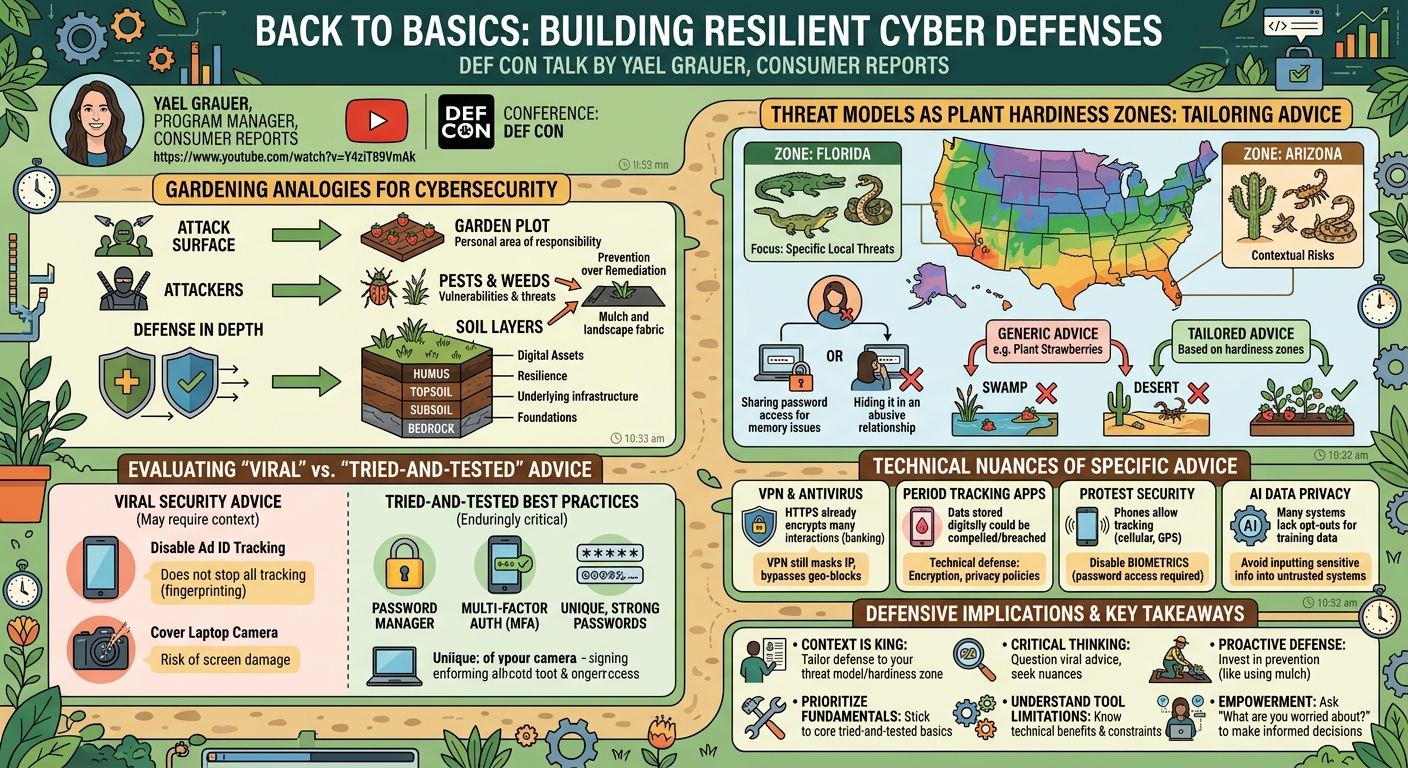
Traditional cybersecurity discourse is heavily steeped in militaristic language, employing terms like "attack surface," "attackers," "attack vectors," and "layered defense" or "defense in depth." While these metaphors serve a purpose in professional security circles, Yael Grauer argues that they can be intimidating and less accessible for many, particularly those new to digital security. Grauer proposes a refreshing alternative: drawing parallels from the world of gardening to demystify and humanize cybersecurity concepts. This innovative approach forms the bedrock of her framework for evaluating digital security advice.
Grauer introduces several gardening analogies to illustrate key security principles. The attack surface, for instance, is reimagined as a garden plot – a personal area of responsibility that can expand with the introduction of new vulnerabilities, much like an issue in one plot could affect an entire community garden. Layered defense is likened to soil layers, where the health of plants (digital assets) depends on unseen, deeper layers (bedrock, subsoil, topsoil, humus) that govern drainage, nutrition, and overall resilience. This highlights that effective security involves more than just visible, surface-level protections. The concept of sun, water, and nutrients translates to the essential elements for thriving online communities, such as robust trust and safety mechanisms, effective moderation, and, critically, privacy and security by design.
A particularly insightful analogy is the distinction between a walled garden and an open garden. The "walled garden" concept, already prevalent in tech discussions, describes closed ecosystems like those managed for device fleets, where control and security might be prioritized over transparency and openness. Conversely, an "open garden" represents systems that value transparency, diversity, and cost-effectiveness, but might grapple with fragmentation and complexity. Grauer acknowledges that each approach has its merits and drawbacks, depending on the specific context. Furthermore, she uses mulch and landscape fabric to represent proactive measures against weed infestations (vulnerabilities), emphasizing that prevention is far more effective and less arduous than remediation.
However, the most critical analogy Grauer introduces is threat models as plant hardiness zones. Just as a gardener would never plant strawberries without considering their local climate, temperature, and rainfall, digital security advice must be customized to an individual's specific environment and needs. Generic advice, such as "plant strawberries," might be utterly inappropriate for a "swamp" or a "desert." This underscores the problem with much of the "viral security advice" circulating online: it often fails to account for individual contexts. Grauer highlights diverse threat landscapes, contrasting the concerns of someone in Arizona (jumping cholla cactus, scorpions, rattlesnakes) with those in Florida (alligators, cottonmouth snakes). This personalization is crucial, as advice for someone with memory issues might involve sharing password manager access, while someone in an abusive relationship would never share such credentials. This contextual framework is essential for understanding when and why certain security advice applies, preparing for specific events (like frost preparation for protests), and critically evaluating the source of expert advice, ensuring it's not just a repetition of information without true understanding.
Key Findings
▶ Watch: Layered defense explained with soil layers metaphor (3:00)
Yael Grauer's presentation culminates in several key findings that challenge the prevailing, often uncritical, consumption of cybersecurity advice. Her central contribution is the articulation of a robust framework for evaluating digital security recommendations, predicated on understanding one's individual hardiness zone or threat model. This framework directly counters the pervasive issue of "viral security advice" which, while sometimes well-intentioned, frequently lacks the necessary context to be truly effective for everyone.
A significant finding is that "tried-and-tested" advice itself can evolve or become partially obsolete. Grauer points out that while foundational practices like using a password manager, setting up multi-factor authentication (MFA), and maintaining unique passwords remain universally critical, other once-ubiquitous recommendations, such as using a Virtual Private Network (VPN) for all internet activity, have changed in their applicability. With the widespread adoption of HTTPS, many common online activities, like banking, now inherently benefit from encryption that a VPN used to primarily provide, rendering its general utility less critical for these specific scenarios.
Grauer also highlights the inherent bias in the spread of information, noting that negative or sensationalized claims often propagate faster and more widely than accurate, positive information. She cites the recurring, often unfounded, critiques of secure communication platforms like Signal as a prime example. This phenomenon contributes to the confusion and distrust surrounding effective security tools.
Perhaps the most crucial finding is the necessity of a nuanced, "it depends" approach to security. Grauer demonstrates that blindly following advice can have unintended, negative consequences. For instance, covering a laptop camera without proper knowledge can damage the screen, and abandoning essential tools like period tracking apps based on generalized fears can hinder personal decision-making without actually addressing the most significant threat vectors. The talk reveals that effective digital defense is not about a checklist of universal actions, but a dynamic process of assessing specific risks, understanding the limitations of tools, and tailoring strategies to individual circumstances and goals. This requires a critical mindset, a willingness to ask "what are you trying to do?" and "what are you worried about?", and the ability to discern truly applicable advice from generalized noise.
Technical Deep Dive
▶ Watch: Walled Garden vs. Open Garden analogy (4:20)
Grauer delves into several specific pieces of security advice, dissecting their technical underpinnings, actual efficacy, and contextual applicability. This detailed examination provides the technical substance for her "hardiness zone" framework.
One common piece of "viral" advice is to disable Ad ID tracking on your phone. Grauer explains that this action is indeed beneficial for privacy-minded individuals, as it makes it harder for data brokers and advertisers to build comprehensive profiles of user locations and behaviors. It aims to reduce the volume of data collected by companies and subsequently sold to third parties. However, Grauer clarifies a crucial technical limitation: disabling Ad ID tracking does not stop all forms of tracking. Advanced techniques like digital fingerprinting can still identify users across different platforms and services, even without a unique advertising identifier. Furthermore, for individuals facing threats from personal stalkers or abusers, disabling Ad ID tracking is largely ineffective. These threats often stem from shared accounts (e.g., Google Maps), direct location sharing, or social engineering within personal networks, which are outside the scope of Ad ID functionality. The technical defense against such personal threats requires securing shared access and being judicious about who has access to real-time location data.
Grauer then addresses the perennial "stop using Signal" narrative. Technically, Signal provides robust end-to-end encryption for messages, ensuring that only the sender and intended recipient can read the content. The "viral" critiques often revolve around Signal's funding structure, executive salaries, or false claims about metadata storage. Grauer debunks these by highlighting that industry-standard salaries do not compromise cryptographic security, and Signal's architecture is designed to minimize metadata collection. Critically, she contrasts Signal with less secure alternatives often recommended by those critiquing Signal, such as Telegram, which does not offer end-to-end encryption by default for all chats and stores user data on its servers. From a cryptographic and security architecture standpoint, Signal remains a tried-and-tested recommendation for secure communication.
The advice to use a VPN or antivirus software also receives a technical re-evaluation. Grauer explains that while VPNs were historically crucial for encrypting internet traffic and protecting against eavesdropping on insecure public Wi-Fi networks, the widespread adoption of HTTPS has significantly changed the landscape. Most sensitive web interactions, such as online banking, are now encrypted directly between the user's browser and the server, making a VPN redundant for that specific layer of protection. Technically, a VPN still routes traffic through an intermediary server, masking the user's IP address and potentially bypassing geo-restrictions or censorship. However, it does not prevent ad tracking through cookies, browser fingerprinting, or other client-side techniques. Grauer emphasizes that the type of VPN matters, especially for censorship circumvention, and users must understand why they are using one and its specific technical benefits and limitations. Antivirus, while generally a good baseline defense, wasn't explored in deep technical detail but is acknowledged as a foundational tool.
For individuals attending protests, the advice to leave your phone at home is analyzed for its technical implications. While it technically prevents digital tracking via cellular triangulation, GPS, or app data, Grauer highlights the significant practical drawbacks. Phones provide critical navigation, emergency communication, and access to real-time information. A more technically nuanced approach, if a phone must be carried, involves disabling biometrics (e.g., fingerprint, facial recognition). Legally, law enforcement in many jurisdictions can compel biometric access to a device, but typically requires a warrant or explicit consent for a password. Therefore, switching to a strong password offers a stronger technical defense against compelled access. The concept of burner phones also introduces technical complexities, such as the risk of carrying both a burner and primary device, which could negate the privacy benefits if not managed meticulously.
Regarding period tracking apps, the technical concern is the potential for sensitive health data to be accessed by law enforcement, particularly post-Roe v. Wade. While some apps may have weaker data security or privacy policies, Grauer points out that there's currently no widespread evidence of police investigations relying on this app data at scale. The primary technical threat for criminalization, she suggests, remains traditional forms of evidence and reporting by individuals. The technical defense here involves choosing apps with robust encryption, clear privacy policies, and minimizing data sharing. However, the broader technical landscape involves understanding that any data stored digitally could theoretically be compelled or breached.
Finally, Grauer touches on advice to use special settings to prevent AI training on user data and to cover laptop cameras/disable microphones. For AI training, she notes the technical challenge that many companies lack meaningful and verifiable opt-out mechanisms. Technically, if data is input into a system, it's difficult to guarantee its exclusion from training sets without explicit, auditable controls. Her practical advice is to avoid inputting sensitive information into such systems in the first place, favoring secure channels like Signal. Regarding camera covers, she mentions the technical risk of damaging laptop screens or brightness sensors. As for disabling microphones, Grauer questions the technical efficacy if an attacker has achieved root access to a system. An attacker with root privileges could likely re-enable a disabled microphone or switch default audio inputs, rendering such a defense largely symbolic against a sophisticated adversary. These examples underscore the need to evaluate technical advice based on actual threat capabilities and system vulnerabilities, rather than perceived or superficial protections.
Demo / Proof of Concept
▶ Watch: Preventing threats with mulch and landscape fabric (6:00)
This talk was primarily conceptual and analytical, focusing on a framework for evaluating cybersecurity advice through analogies and critical discussion of common recommendations. As such, there was no live demonstration or technical proof of concept presented by Yael Grauer during the session. The content centered on theoretical understanding and practical application of critical thinking to security advice rather than showcasing specific tools or exploits.
Defensive Implications
▶ Watch: Threat models as plant hardiness zones: tailoring advice (6:20)
Yael Grauer's "Back to Basics" talk offers profound defensive implications, urging a paradigm shift from a generic, one-size-fits-all approach to cybersecurity towards a highly contextualized and informed strategy. Defenders, whether individuals or organizations, must adopt a mindset that critically evaluates advice based on their unique threat models or "hardiness zones."
Firstly, the most critical defensive implication is the need for contextual risk assessment. Before implementing any security measure, individuals and organizations must clearly define "what are you trying to do?" and "what are you worried about?" This means understanding the specific adversaries, their capabilities, and the assets being protected. For instance, defending against corporate data collection requires different strategies than defending against a state-sponsored actor or a personal stalker. Generic advice, while easy to disseminate, is often inefficient or even counterproductive if misapplied.
Secondly, defenders should prioritize foundational, tried-and-tested security basics. Grauer implicitly reinforces the enduring importance of measures like password managers, multi-factor authentication (MFA), and the use of unique, strong passwords for every account. These remain the bedrock of digital security, akin to preparing the "soil layers" for resilient growth. While some advice changes over time, these core practices offer fundamental protection against common attack vectors.
Thirdly, cultivate a skeptical and analytical approach to "viral" security advice. Defenders should question the source, context, and technical underpinnings of any new recommendation, especially those that spread rapidly online or promise simplistic solutions. Understand that negative information often spreads faster, and that "it depends" is often the most accurate, though least viral, answer in cybersecurity. This involves discerning between genuine vulnerabilities and sensationalized claims, as seen in the discussions around Signal.
Fourthly, proactive defense is paramount. Grauer’s analogy of mulch and landscape fabric to prevent weed infestations highlights that investing in preventative measures is far more effective and less resource-intensive than reacting to breaches or vulnerabilities after they occur. This translates to regular security audits, patching systems, educating users, and designing systems with privacy and security by design from the outset.
Finally, defenders must stay informed about the evolving technical landscape and the nuances of various security tools. Understand the limitations of technologies like VPNs (e.g., they don't stop all ad tracking or digital fingerprinting) and the implications of system access levels (e.g., root access rendering simple mic disabling ineffective). For specific situations, like protests, defenders should be aware of legal nuances, such as the distinction between compelling biometric access versus passwords, and adjust their security posture accordingly (e.g., disabling biometrics on phones). Rather than blindly following advice, the goal is to build a comprehensive understanding that allows for adaptive and resilient digital defense strategies.
Key Takeaways
- Context is King for Cybersecurity: Effective digital defense requires a personalized approach based on individual threat models or "hardiness zones." Generic advice, while easy to share, is often ineffective or even counterproductive without understanding specific circumstances and risks.
- Evaluate Advice Critically: Distinguish between "viral" and "tried-and-tested" security advice. Be skeptical of oversimplified solutions and sensationalized claims, recognizing that even established recommendations can evolve in their applicability (e.g., the changing role of VPNs post-HTTPS).
- Prioritize Foundational Practices: Core security measures like using password managers, setting up multi-factor authentication (MFA), and maintaining unique, strong passwords for every account remain indispensable for building resilient digital defenses.
- Understand Technical Nuances and Limitations: Recognize that security tools and practices have specific technical benefits and limitations. For instance, disabling Ad ID tracking helps against advertisers but not personal stalkers, and simple mic disabling is ineffective against an attacker with root access.
- Proactive Measures Over Reactive Fixes: Investing in preventative security strategies, much like using mulch to prevent weeds, is more efficient and effective than reacting to security incidents after they occur. This includes designing for privacy and security from the start.
- Empowerment Through Informed Decision-Making: Instead of blindly following recommendations, individuals and organizations should be empowered to ask "what are you trying to do?" and "what are you worried about?" to make informed decisions that align with their specific security goals and risk profiles.
About the Speaker(s)
Yael Grauer is a prominent figure in the cybersecurity and privacy landscape, serving as a Program Manager for cybersecurity research at Consumer Reports. In this role, she contributes to crucial work that helps consumers navigate the complexities of digital safety. Beyond her work at Consumer Reports, Grauer is an accomplished investigative tech reporter, known for her deep dives into technology-related issues. She also actively champions individual privacy by running a data broker opt-out list, assisting people in removing their personal information from people search sites. With a long-standing commitment to helping individuals stay safe online, Yael Grauer brings a wealth of practical experience and analytical insight to her discussions on digital security. Her hobbies, many of which are nature-based, including gardening (despite self-identifying as a "serial plant killer" who has successfully grown vegetables), informed the accessible and engaging analogies used in her DEF CON talk.
Reviews
Dr. Zero (Offensive Security Researcher) — SOLID
Grauer delivers a competent, accessible framework for consumer-facing security advice using gardening analogies as a teaching device. It's well-intentioned and reasonably well-executed for its lane — consumer education at a technical conference — but the content is largely a repackaging of existing guidance rather than novel research or insider signal.
Heather Calloway (CISO) — SOLID
Grauer delivers a coherent, accessible framework for consumer-facing security advice, and the threat modeling lens is genuinely useful for the audience she's addressing. But this is a DEF CON talk aimed at individual users, not a governance or operational contribution — and it doesn't pretend to be otherwise.