Off Grid Datarunning in Oppresive Regimes: Sneakernet and Pirate Box
Robert Menes (Linux system administrator · Hacker Town)
DEF CON 33 · Day 1 · Main Stage
Overview
In an era of increasing digital fragility and pervasive censorship, Robert Menes of Hacker Town delivered a compelling talk at DEF CON, advocating for the revival and modernization of off-grid data running techniques. Titled "Off Grid Datarunning in Oppressive Regimes: Sneakernet and Pirate Box," his presentation explored how tools like the now-defunct Pirate Box project and the age-old concept of Sneakernet can be re-engineered to circumvent information control, preserve knowledge, and deliver critical data to marginalized communities.
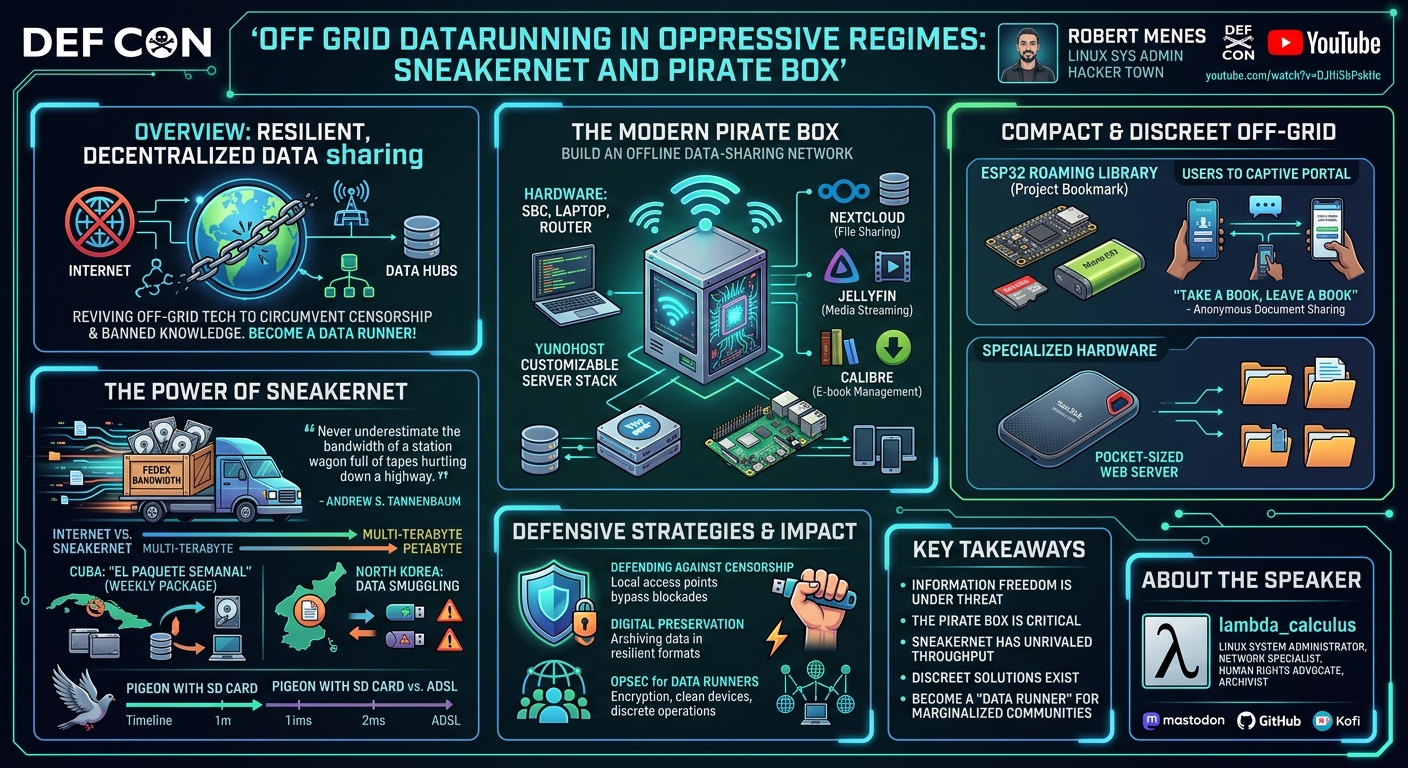
Key moments
- 0:00 Introduction to off-grid data running and speaker
- 1:20 Understanding the original Pirate Box project concept
- 2:08 Building a modern Pirate Box with new hardware
- 4:09 Using YunoHost for a customizable Pirate Box
- 6:00 Why the Pirate Box concept is still vital
- 6:54 Project Bookmark: The tiny ESP32 roaming library
- 7:40 How the Roaming Library shares documents off-grid
Off Grid Datarunning in Oppressive Regimes: Sneakernet and Pirate Box
Speakers: Robert Menes, Linux system administrator, Hacker Town
Conference: DEF CON
YouTube: https://www.youtube.com/watch?v=DJHiSbPskHc
Overview
In an era of increasing digital fragility and pervasive censorship, Robert Menes of Hacker Town delivered a compelling talk at DEF CON, advocating for the revival and modernization of off-grid data running techniques. Titled "Off Grid Datarunning in Oppressive Regimes: Sneakernet and Pirate Box," his presentation explored how tools like the now-defunct Pirate Box project and the age-old concept of Sneakernet can be re-engineered to circumvent information control, preserve knowledge, and deliver critical data to marginalized communities.
Menes highlighted the urgent need for resilient, decentralized information distribution systems, especially in the face of rising book bannings, website takedowns, and state-sponsored censorship. The talk served as a call to action for hackers, advocates, and concerned citizens to become "data runners," leveraging readily available hardware and open-source software to ensure information freedom. By combining the local access point capabilities of a Pirate Box with the high-bandwidth physical transfer of Sneakernet, individuals can create powerful, censorship-resistant channels for sharing media, educational materials, and vital community resources.
This article delves into the technical underpinnings, practical implementations, and broader implications of Menes' vision. It examines how modern interpretations of the Pirate Box, specialized hardware like the SanDisk Wireless USB, and innovative projects like the Roaming Library are empowering individuals to build localized, resilient networks. Furthermore, it explores how the seemingly archaic practice of Sneakernet remains an unparalleled method for high-volume data transfer, offering critical lessons from countries with limited internet infrastructure.
Background
▶ Watch: Introduction to off-grid data running and speaker (0:00)
The concept of off-grid data sharing has roots in a fundamental desire for information freedom, particularly in contexts where traditional internet access is restricted, unreliable, or surveilled. The Pirate Box project, which ran until 2019, emerged as a pioneering solution in this space. It leveraged readily available hardware, typically a single-board computer (SBC) like a Raspberry Pi, an old laptop, or even a pocket travel router, to create a standalone wireless access point (AP). This AP hosted a local server stack, providing a landing page for users to download files, access a media server, or participate in a small, private forum. The ability to scrub the forum hourly, for instance, offered a degree of ephemeral privacy, crucial for sensitive discussions. The project's original aim was to facilitate anonymous, offline file sharing, independent of internet connectivity, fostering local communities and information exchange.
However, the original Pirate Box project eventually ceased activity in 2019. Menes attributed its demise, in part, to the increasing difficulty of "hacking" and reverse-engineering modern routers. Manufacturers began locking down devices, making it challenging to install custom firmware like DD-WRT, which was often a prerequisite for the original Pirate Box setup. Despite its closure, Menes passionately argued that the spirit and concept of the Pirate Box are more critical than ever in the current global climate.
The speaker underscored the growing fragility of online information and the accelerating pace of censorship. He cited concerns like Project 2025, widespread book bannings, and the arbitrary takedown of websites and videos due to content disputes or copyright strikes. The Internet Archive, a cornerstone of digital preservation, suffered a massive DDoS attack in 2024, highlighting the vulnerability of even robust online archives. This environment creates a critical need for alternative, resilient methods of information dissemination, especially for marginalized communities that may lack reliable internet access or face heightened risks of digital surveillance and suppression. Menes' talk positioned the modern Pirate Box and Sneakernet as essential tools in this ongoing fight for information freedom and digital resilience.
Key Findings
▶ Watch: Building a modern Pirate Box with new hardware (2:08)
Menes' presentation unveiled several key findings and contributions, primarily centered on the resurgence and re-imagination of off-grid data sharing methods for contemporary challenges. The core findings can be summarized as:
- The Enduring Relevance of the Pirate Box Concept: Despite the original Pirate Box project's cessation in 2019, its underlying principle—creating an offline, local data-sharing network—remains profoundly important. Menes argued that modern hardware and software can easily revive and improve upon this concept, addressing the "critical need" for decentralized information access in an age of fragility and censorship.
- Modernizing the Pirate Box with YunoHost: A significant contribution is the identification and promotion of YunoHost as an ideal modern software stack for building a Pirate Box. YunoHost, a customizable server stack, simplifies the deployment of various services (Nextcloud, Jellyfin, Calibre, torrent servers) on low-cost hardware like a Raspberry Pi, offering a robust and easily administrable solution that is both light on system resources and highly versatile.
- Specialized Hardware for Impromptu Web Servers: The talk highlighted the utility of specific hardware, such as the now-discontinued SanDisk Wireless USB flash drive, as a pocket-sized, self-contained web server. This device, with its onboard Wi-Fi and lighttpd web server, demonstrates the potential for highly portable, discreet information carriers.
- The Roaming Library (Project Bookmark): Menes introduced a novel, low-cost (under $20) project by "Slug Noodle" called the Roaming Library. This ESP32/ESP8266-based board with a micro SD card reader acts as a portable, battery-powered library, generating a captive portal for anonymous document sharing ("take a book, leave a book"). This exemplifies a highly discreet and accessible form of off-grid information exchange.
- Sneakernet's Unrivaled Bandwidth and Practicality: The talk forcefully reaffirmed Sneakernet as a superior method for high-volume data transfer compared to current internet infrastructure. Through historical anecdotes, a famous quote from Andrew S. Tannenbaum, and contemporary examples from Cuba and North Korea, Menes demonstrated that physical data transport remains unmatched in terms of throughput, especially when dealing with multi-terabyte or petabyte-scale datasets. He compellingly argued that "FedEx bandwidth" will likely not be matched by internet speeds until at least 2040.
- Real-World Application in Oppressive Regimes: Menes provided concrete examples of how these off-grid methods are actively used to bypass censorship and deliver vital information in countries like Cuba (el paquete semanal) and North Korea (smuggled Western media). These case studies underscore the practical efficacy and socio-political importance of off-grid data running.
Technical Deep Dive
▶ Watch: Using YunoHost for a customizable Pirate Box (4:09)
The core of Menes' talk lay in detailing the technical evolution and practical application of off-grid data sharing, moving from the historical Pirate Box to modern, highly adaptable solutions.
The original Pirate Box project, operational until 2019, was predicated on using inexpensive hardware to create a localized, internet-free network. Typically, this involved a single-board computer (SBC) like a Raspberry Pi, an old laptop, or even a pocket travel router. The essential components were:
- Hardware: A device capable of hosting a Wi-Fi access point and running a lightweight Linux distribution.
- Software Stack: A custom software bundle that, once installed, configured the hardware to broadcast a Wi-Fi SSID. When users connected to this SSID, they were redirected to a captive portal or landing page.
- Services: This landing page provided access to various services, including a file server for downloading pre-loaded content (media, documents), a media server (e.g., for streaming audio/video), and sometimes a small, private web forum that could be configured to scrub its contents periodically (e.g., hourly) for enhanced privacy.
Menes emphasized that while the original project is dormant, the concept is easily revived with modern tools. His primary recommendation for a modern Pirate Box is to utilize YunoHost. YunoHost is a comprehensive, customizable server stack designed for easy installation and administration on Debian-based Linux distributions. It can be deployed on a Raspberry Pi or similar SBC by either installing it on an existing Linux distribution or flashing a pre-built YunoHost image directly onto an SD card.
Once YunoHost is set up, it provides a user-friendly web interface for installing a wide array of server applications, which can form the backbone of a modern Pirate Box:
- Nextcloud: For file sharing, synchronization, and collaborative document editing.
- Jellyfin: A powerful media server for streaming audio and video content locally.
- Calibre: An e-book management system, ideal for sharing digital books and documents.
- Torrent Server: To enable local sharing of torrent files or even acting as a seedbox for specific content.
Menes highlighted that YunoHost's "very light system usage" makes it ideal for resource-constrained SBCs, ensuring efficient operation. The administrative interface allows for full control over the services, making it a robust and flexible platform for creating a self-contained information hub.
Beyond the full-fledged Pirate Box, Menes introduced a more compact and discreet option: the SanDisk Wireless USB flash drive. Produced around 2012-2013, these devices offered a unique combination of features:
- Onboard Wi-Fi: Supporting BGN standards, allowing it to act as a localized access point.
- Micro SD Card Slot: For storage, meaning the capacity was limited only by the size of the user's micro SD card, not internal storage.
- Built-in Battery: Making it fully portable and self-sufficient.
- Lighttpd Web Server: A lightweight web server pre-installed, enabling it to host static web pages directly from the SD card.
The speaker demonstrated how one could load a website onto the SD card, configure the Wi-Fi, and then simply tell users to navigate to a static IP address (e.g., 10.0.0.1/default.html) to access content. This essentially creates an "impromptu web server you can literally carry around in your pocket."
Another innovative project highlighted was "Slug Noodle's" Roaming Library, also known as Project Bookmark. This project utilizes an ESP32 or ESP8266-based board – microcontrollers with integrated Wi-Fi capabilities.
- Hardware: A tiny board with onboard Wi-Fi and a micro SD card reader, costing less than $20 for the components. It supports micro SD cards up to 32GB.
- Software: A custom software stack creates a small web server and a captive portal.
- Functionality: The device generates an SSID like "bookmark" followed by a random number. Users connecting to this SSID are directed to a captive portal where they can "take a book and leave a book." This allows for anonymous, peer-to-peer sharing of documents, PDFs, text files, and even comic book archives (CBZ/CBR).
- Power: The device is powered by a battery via a USB-C port, making it highly portable and discrete.
Finally, Menes delved into Sneakernet, the physical transport of data. This seemingly anachronistic method remains incredibly powerful for throughput. He quoted Andrew S. Tannenbaum: "Never underestimate the bandwidth of a station wagon full of tapes hurtling down a highway," underscoring the fundamental principle that physical transport often vastly outstrips network bandwidth for large datasets.
He provided a modern illustration: filling a shoebox with 8 terabyte NVMe SSDs. Such a box could easily contain "multi-petabyte" data, transferable in minutes by walking it across a room or driving it across town. This "FedEx bandwidth" is projected to remain superior to typical internet speeds until at least 2040.
Real-world examples of Sneakernet were crucial:
- Cuba's "el paquete semanal" (the weekly package): Approximately one terabyte of media, books, movies, TV shows, music, information, and zines is compiled onto a hard drive, placed in an enclosure, and physically circulated around Havana. Individuals with poor internet access can connect their laptops or USB sticks to copy desired content.
- North Korea's data smuggling: Due to the country's highly restricted internet (only government-approved sites), Western movies, music, and media are smuggled across borders (from South Korea or China) on hard drives and then copied onto thumb drives and passed hand-to-hand. This example also highlighted the Operational Security (OPSEC) challenges, as North Korea's Red Star OS marks files that pass through it, necessitating careful handling on non-Red Star systems.
- South Africa's pigeon vs. ADSL race: A telecom company famously pitted a homing pigeon carrying a 4 GB micro SD card against its ADSL service over 37 miles. The pigeon delivered the data in 2 hours and 6 minutes, while the ADSL connection had only reached 4% completion and dropped twice in the same timeframe. This stark comparison vividly illustrated the raw efficiency of physical data transfer.
Collectively, these technical details paint a picture of a diverse and adaptable toolkit for information dissemination outside conventional internet infrastructure, emphasizing both local wireless sharing and high-volume physical transport.
Demo / Proof of Concept
▶ Watch: Project Bookmark: The tiny ESP32 roaming library (6:54)
While Robert Menes' talk did not feature a live, on-stage coding or hardware build demonstration, he effectively presented several tangible "proofs of concept" and highlighted opportunities for hands-on engagement:
- SanDisk Wireless USB Drives: Menes explicitly stated, "I'm going to have some at Hackerstown tomorrow if you want to come and pick some up." This indicates he brought physical examples of these devices, allowing attendees to see and potentially interact with a functional, pocket-sized impromptu web server. This served as a direct demonstration of a discreet, portable Pirate Box alternative.
- The Roaming Library (Project Bookmark): Although the creator, "Slug Noodle," was not present, Menes detailed the Roaming Library as a fully realized project. He described its hardware (ESP32/ESP8266, micro SD, battery power via USB-C) and its software functionality (Wi-Fi SSID, captive portal, "take a book, leave a book" interface for documents). The detailed description of its low cost (under $20 for hardware) and specific features clearly presented it as a working proof of concept for a highly accessible, discreet, and portable library.
- Conceptual Demonstrations via Real-World Examples: Menes used compelling real-world scenarios—Cuba's "el paquete semanal," North Korea's data smuggling, and the South African pigeon race—as powerful demonstrations of Sneakernet's efficacy. These were not theoretical discussions but concrete examples of how these data running principles are applied in practice, proving their viability and impact in challenging environments.
The talk itself, by explaining how to build and deploy these systems using modern software like YunoHost on Raspberry Pis, implicitly served as a guide and proof of concept for attendees eager to replicate the methods. His invitation for attendees to visit Hackertown further underscored the practical, hands-on nature of the movement he advocates.
Defensive Implications
▶ Watch: How the Roaming Library shares documents off-grid (7:40)
In the context of Robert Menes' talk, "defensive implications" are primarily framed around defending against information suppression and censorship rather than traditional cybersecurity threats like network intrusion. The tools and methodologies discussed are themselves a form of defense for individuals and communities operating under oppressive regimes or in environments with fragile information infrastructure.
Here's how defenders can leverage or consider the information presented:
- Counter-Censorship and Information Resilience: The most direct defensive implication is the ability to bypass state-sponsored censorship and internet shutdowns. By creating off-grid Pirate Boxes or Roaming Libraries, activists, journalists, and educators can ensure continued access to vital information, educational materials, and independent media, effectively defending against information blackouts. This acts as a critical lifeline for communities whose access to the open internet is compromised.
- Preservation of Knowledge and Cultural Heritage: In an age where online content can be arbitrarily removed or lost (as evidenced by the Internet Archive DDoS attack), these off-grid solutions offer a decentralized defense mechanism for digital preservation. By circulating "the tapes" (digital files) via Sneakernet or local Pirate Boxes, valuable information, cultural artifacts, and historical records can be archived and distributed, making them resilient to centralized takedowns.
- Operational Security (OPSEC) for Data Runners: While promoting open information, the talk implicitly highlights the need for robust OPSEC for those acting as "data runners." The North Korean example, where Red Star OS marks transferred files, underscores the significant risks involved. Defenders (or data runners) must be acutely aware of:
- Steganography and Encryption: Encrypting sensitive data transferred via Sneakernet or Pirate Boxes is paramount.
- Device Hygiene: Using "clean" devices or air-gapped systems to handle sensitive data to prevent malware infection or forensic tracing.
- Physical Security: Ensuring the physical security of hard drives, USB sticks, and Pirate Box devices to prevent seizure or tampering.
- Discreet Operation: The Roaming Library's design for discretion (small, battery-powered, random SSID) is a defensive feature in itself, reducing detectability.
- Community Empowerment and Skill Building: By encouraging individuals to build their own Pirate Boxes, Menes advocates for a form of grassroots defense. Learning about networking, Linux administration, and hardware configuration empowers communities to create their own resilient information infrastructures, reducing reliance on vulnerable, centralized systems. This decentralization inherently makes the network more difficult for adversaries to disrupt entirely.
- Preparation for Infrastructure Collapse: The emphasis on off-grid solutions also serves as a defensive strategy against potential internet infrastructure collapse due to natural disasters, cyberattacks, or large-scale geopolitical conflicts. Having pre-existing knowledge and tools for localized data sharing ensures that critical information can still flow when traditional networks fail.
In essence, the defensive implications of Menes' talk revolve around proactive measures to safeguard information access and freedom, building resilient channels that can withstand and circumvent the growing threats of censorship and digital fragility.
Key Takeaways
- Information Freedom is Under Threat: Rising censorship, book bannings, and the fragility of online data necessitate resilient, decentralized methods for information dissemination.
- The Pirate Box Concept is More Relevant Than Ever: Modern hardware (Raspberry Pi, ESP32) and software (YunoHost) can revive the Pirate Box to create powerful, off-grid local data-sharing networks.
- Sneakernet Offers Unrivaled Bandwidth: Physical data transport remains the fastest and most efficient method for moving large volumes of data (multi-terabyte, petabyte-scale), often surpassing internet speeds.
- Low-Cost, Discreet Solutions are Available: Projects like the Roaming Library (under $20 hardware) and devices like the SanDisk Wireless USB offer highly portable and discreet ways to share information locally.
- Become a "Data Runner": Individuals are encouraged to build and utilize these tools to circulate information, preserve knowledge, and support marginalized communities, fighting the good fight for information access.
- Learn and Adapt: Engaging with these technologies offers valuable learning opportunities in networking, Linux, and hardware, empowering individuals to build resilient information infrastructures.
About the Speaker(s)
Robert Menes, known online as lambda calculus at hackers.Ttown, is a dedicated Linux system administrator and network specialist with a strong background in security. Beyond his technical expertise, Menes is a passionate advocate for human rights, a teacher, and self-identifies as a "filthy seafaring pirate" who deeply believes in the importance of archiving, preservation, and circulating information. Based in New Jersey, he is a familiar face at DEF CON, where this was his third time speaking. He has previously given talks on topics such as Red Star OS, North Korea's customized Linux distribution. Menes is an active member of Hacker Town and can be found on Mastodon at masto.hackers.ttown/@lambda_calculus, GitHub as lambdacalculus37, and also maintains a Kofi page.
Reviews
Dr. Zero (Offensive Security Researcher) — SOLID
Menes is clearly passionate and has done real fieldwork on this topic, and the real-world case studies — el paquete semanal, North Korean thumb drive networks, the South African pigeon race — are genuinely illustrative. But the talk is more advocacy and survey than novel research; the core content (Sneakernet good, Pirate Box lives, YunoHost exists) is well-trodden ground for a DEF CON audience, and the technical depth stays at the 'here's what to Google' level rather than pushing into anything that required original work.
Heather Calloway (CISO) — WEAK
Menes clearly cares about information freedom and knows his tools, but this talk operates entirely outside the governance and institutional security frame. It is advocacy and tinkering — valuable in its own right — but it offers nothing for the security leader, the board, or the organization trying to manage risk at scale.