Incident Response from a Maritime Sysadmin’s War Room
Kit Louttit (Executive Director · Marine Exchange of Southern California), Steve Winston (CEO · Mastermind)
DEF CON 33 · Day 1 · Main Stage
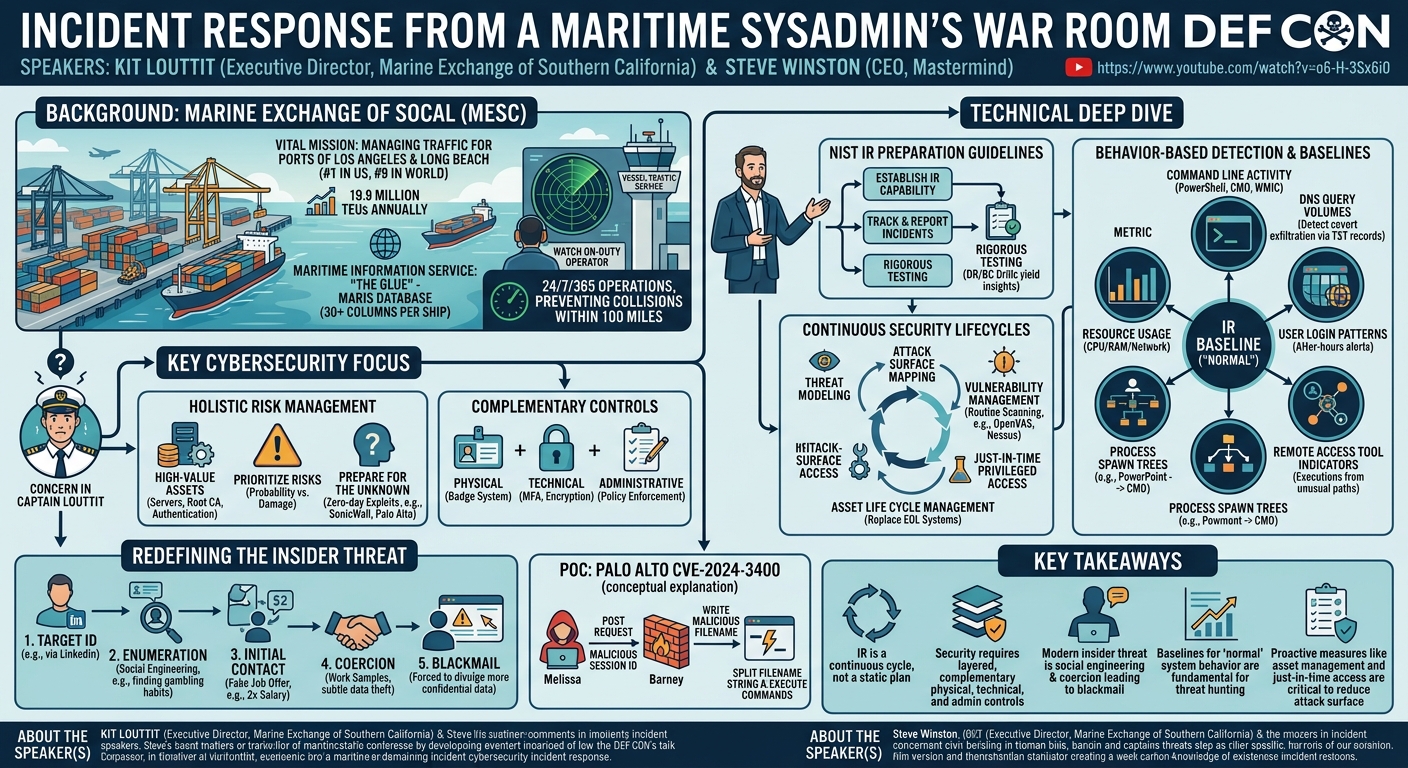
Key moments
- 0:00 Introduction to Marine Exchange and its mission
- 2:00 Scale and importance of LA/Long Beach Port complex
- 4:00 Vessel Traffic Service: maritime air traffic control
- 5:30 Operational scope, control room, and past challenges
- 6:45 Introduction to Mastermind and cybersecurity focus
- 8:00 NIST guidelines for incident response preparation
Incident Response from a Maritime Sysadmin’s War Room
Speakers: Kit Louttit (Executive Director, Marine Exchange of Southern California); Steve Winston (CEO, Mastermind)
Conference: DEF CON
YouTube: https://www.youtube.com/watch?v=o6-H-3Sx6i0
Overview
This DEF CON talk, "Incident Response from a Maritime Sysadmin’s War Room," offers a unique perspective on cybersecurity challenges within critical infrastructure, specifically the maritime sector. Captain Kit Louttit, Executive Director of the Marine Exchange of Southern California (MESC), first provides a high-level overview of their vital role in managing vessel traffic and information for the bustling ports of Los Angeles and Long Beach. He underscores the immense scale and operational criticality of their work, setting the stage for the cybersecurity discussion.
Following Captain Louttit, Steve Winston, CEO of Mastermind MSP and MESC's IT and cybersecurity contractor, delves into the practicalities of incident response and proactive security. Winston shares invaluable lessons learned from years of experience protecting diverse clients, including defense contractors, and highlights the specific strategies and methodologies employed to safeguard the MESC's operations. The talk effectively bridges the gap between high-stakes physical operations and the intricate world of cyber defense, emphasizing the need for robust, tested, and adaptive security measures in an environment where downtime is not an option.
The importance of this talk lies in its direct applicability to critical infrastructure protection, a domain often targeted by sophisticated adversaries. By presenting a real-world case study from one of the world's busiest port complexes, Louttit and Winston illuminate the unique blend of operational technology (OT) and information technology (IT) security concerns. Their insights into risk management, insider threats, behavior-based detection, and the nuances of responding to zero-day exploits provide a compelling blueprint for organizations facing similar challenges, reinforcing that effective incident response is a continuous journey of preparation, persistence, and adaptation.
Background
▶ Watch: Introduction to Marine Exchange and its mission (0:00)
The Marine Exchange of Southern California (MESC) holds a pivotal position in global trade, operating the Vessel Traffic Service for the ports of Los Angeles and Long Beach. These twin ports collectively represent the number one port complex in the United States and the ninth busiest worldwide, handling an astonishing 19.9 million TEUs (20-foot equivalent units) annually. Beyond container traffic, the ports manage passenger vessels, oil tankers, and auto carriers, making their operations incredibly diverse and complex.
MESC's functions are twofold: the Maritime Information Service, which dates back 102 years to 1923, and the Vessel Traffic Service, established in 1994. The Maritime Information Service acts as "the glue," collating and unifying the daily schedule for all ships arriving at and departing from the 55 independent terminals across both ports. This crucial data, stored in their Maris database, includes approximately 30 columns of information per ship—from arrivals and departures to tug requirements and customs boarding data. The Vessel Traffic Service, akin to air traffic control, operates 24 hours a day, 365 days a year, with two operators on watch. Its primary mission is to prevent collisions and ensure the safe, efficient movement of vessels within a 100-mile radius from Morro Bay to the Mexican border, with intensive control within a seven-mile box outside the port complex. The vivid memory of 86 ships anchored within the 25-mile ring during peak COVID-19 backups underscores the immense pressure and responsibility these operators face.
Captain Louttit candidly admits that despite having excellent personnel and equipment, his number one concern is cybersecurity. The potential for systems to fail, or perform unexpected updates at critical moments, highlights the tension between operational reliability and the dynamic nature of IT maintenance and security. This is where Mastermind MSP, led by CEO Steve Winston, steps in as MESC's IT and cybersecurity contractor. Winston brings over a decade of experience from a previous MSP, having worked with a wide array of clients from defense contractors to manufacturing. His segment of the talk focuses on distilling these experiences into actionable lessons for incident response and proactive security, grounded in established frameworks like the NIST guidelines for incident response preparation. These guidelines emphasize establishing an operational incident handling capability, tracking and reporting incidents, and crucially, testing that capability through regular disaster recovery and business continuity drills—a practice MESC has diligently pursued for years, consistently yielding new insights and refinements.
Key Findings
▶ Watch: Vessel Traffic Service: maritime air traffic control (4:00)
The talk presents several critical findings and methodologies for robust cybersecurity, moving beyond basic compliance to a truly resilient posture.
Firstly, risk management must be holistic and pragmatic. Identifying high-value assets extends beyond servers and databases to include critical infrastructure components like root certificates for a certificate authority (CA) and authentication mechanisms. Risk assessment should prioritize based on a realistic evaluation of both the probability and damage of a potential incident, rather than simply labeling everything as "very high risk." Crucially, organizations must prepare for the unknown, including zero-day exploits, as exemplified by recent SonicWall and Palo Alto vulnerabilities where initial vendor statements were later complicated by emerging details.
Secondly, effective defense relies on a combination of physical, technical, and administrative controls. Simply "checking the box" for compliance frameworks like CMMC is insufficient, as attackers will actively test defenses, not just meet requirements. Controls must be complementary; for instance, a physical badge system is weak without multi-factor authentication (MFA), and vice-versa, with administrative policies enforcing both. Security is a matter of posture, persistence, and preparation, mirroring adversaries' layered attack strategies.
A significant finding relates to the nature of the insider threat. Winston challenges the common perception of a state actor directly infiltrating a company. Instead, he describes a more insidious method: adversaries using resources like LinkedIn to identify individuals working on sensitive projects. They then enumerate details about these targets, establish fake communication channels, and offer highly inflated, fake job opportunities (e.g., twice their current salary). This psychological manipulation, preying on human desire and potential vulnerabilities like gambling habits, leads the target to divulge confidential company data under the pretense of "proving expertise." Once this line is crossed, the individual is blackmailed, making them a compromised insider without ever intending to be. This redefines the internal threat as a sophisticated social engineering and coercion vector.
Proactive security measures are paramount. These include regular threat modeling and attack surface mapping, which must evolve with system changes to identify weaknesses before adversaries do. Continuous vulnerability management through routine scanning (e.g., OpenVAS, Nessus) and patch management, integrated with zero-day watchlists and shared intelligence feeds, is favored over infrequent penetration tests for organizations with less mature security models. Privileged access review with just-in-time access and continuous monitoring is essential, as is asset life cycle management to address the "weakest link" of outdated or unsupported systems.
Finally, the talk emphasizes moving beyond signature-based detection to threat hunting and behavior-based detection. This requires establishing incident response baselines to define "normal" system behavior across various metrics: CPU, RAM, network usage, registry keys, file hashes, command-line activity (PowerShell, CMD, WMIC), DNS query volumes (especially for covert exfiltration via TXT records), login times, process spawn trees (e.g., PowerPoint spawning CMD), remote access tool indicators, file write activity in sensitive directories, and privileged access frequency. Anomalies against these baselines become critical indicators of compromise. Red team tactics, such as living off the land, traffic obfuscation (e.g., Cobalt Strike over HTTPS), excessive permissions, misconfigurations, baseline drift exploitation, shadow IT, orphaned assets, lack of egress filtering, abuse of inactive accounts, and weak cryptography, are highlighted as common attack vectors that defenders must specifically watch for.
Technical Deep Dive
▶ Watch: Operational scope, control room, and past challenges (5:30)
The technical deep dive provided by Steve Winston outlines a comprehensive framework for incident response and proactive security, heavily drawing on NIST guidelines and real-world attack scenarios. He begins by reinforcing the three core NIST tenets for incident response preparation: establishing an operational incident handling capability, tracking and documenting incidents, and rigorously testing the capability. The Marine Exchange's long-standing practice of disaster recovery (DR) and business continuity (BC) drills, which consistently reveal areas for improvement, serves as a testament to the value of "live fire" testing over theoretical planning.
Risk management is presented as a multi-faceted process. It starts with identifying high-value assets, which extends beyond traditional servers and databases to include critical infrastructure like root certificates for a certificate authority (CA) or core authentication mechanisms. The assessment of risk should be granular, considering the probability of an incident and the consequences of its occurrence, rather than a blanket "very high risk" designation. Prioritization of protections must account for both known risks and the inherent unknowns—specifically, zero-day vulnerabilities. Winston cites the example of a recent SonicWall exploit where credentials were potentially captured via an SSLVPN vulnerability (CVE from 2024, though the year might be a transcription error for a more recent event) or even due to configuration resets during firewall upgrades. He stresses the importance of erring on the side of safety, even when vendors initially deny vulnerabilities.
The talk then delves into the critical concept of layered and complementary controls. Winston argues against simply "checking boxes" for compliance frameworks like CMMC, emphasizing that adversaries will test actual defenses. A robust security posture combines physical, technical, and administrative controls. For instance, a physical badge system is ineffective without multi-factor authentication (MFA), and both require strong administrative policies for enforcement.
A significant portion of the technical deep dive addresses the insider threat, reframing it from a direct infiltration model to a sophisticated social engineering and coercion scheme. The attacker's methodology involves:
- Target Identification: Using platforms like LinkedIn to find individuals working on sensitive projects.
- Enumeration: Gathering information about the target through fake communication channels or social media to obtain private contact details or personal vulnerabilities (e.g., gambling habits).
- Initial Contact: Offering a highly attractive, fake job opportunity (e.g., twice the current salary) to exploit human desire and create a sense of urgency.
- Coercion: Requesting "work samples" or "proof of expertise" that subtly lead the target to divulge confidential company data.
- Blackmail: Leveraging the initial compromise to demand further, more extensive data, placing the victim in an untenable position where they risk termination and legal consequences if they refuse. This method avoids the high risk of a physical, in-person infiltration.
Proactive security measures are detailed:
- Threat Modeling and Attack Surface Mapping: These should be performed regularly, updated as systems evolve, and aim to proactively identify weaknesses.
- Continuous Vulnerability Management: This is preferred over infrequent penetration tests for organizations with less mature security programs. It involves routine scanning (e.g., OpenVAS, Nessus), patch management, integrating zero-day watchlists, and utilizing shared intelligence feeds. Penetration tests are best reserved for when a robust security model is already in place due to their cost and point-in-time nature.
- Privileged Access Review: Regularly auditing users, enhanced roles, and service accounts. Just-in-time access is crucial, where elevated permissions are granted only when needed, monitored, and then automatically or manually revoked.
- Asset Life Cycle Management: Addressing the "weakest link" by replacing or updating end-of-life (EOL) systems, outdated firmware on servers, or unsupported software like VMware ESXi without active support contracts.
- Threat Hunting and Behavior-Based Detection: Moving beyond traditional signature-based detection, which is deemed insufficient. This involves proactively looking for anomalies based on established baselines.
The concept of incident response baselines is a cornerstone of behavior-based detection. Without knowing "normal," anomalies cannot be detected. Specific examples of baselines include:
- Resource Usage: Normal CPU, RAM, and network usage patterns.
- System Changes: Expected registry keys and file hashes.
- Command Line Activity: Normal usage patterns for PowerShell, CMD, and WMIC (critical for detecting living off the land tactics).
- Network Traffic: Normal outbound DNS query volumes for hosts, as covert exfiltration often uses TXT records in DNS.
- User Behavior: Typical login times by user and role, and automated alerting for repeated after-hours logins or other abnormalities.
- Process Execution: Monitoring process spawn trees (e.g., PowerPoint spawning a CMD or PowerShell session indicates an anomaly).
- Remote Access Tools (RATs) & Indicators: Looking for executions from unusual paths like
program dataorapp datafolders, and monitoring file paths and hashes. - File System Activity: File write activity in sensitive directories.
- Privileged Access Frequency: Sudden increases in account elevation usage.
- Endpoint Communication Patterns: An endpoint initiating remote sessions when it normally doesn't.
- Logging: Monitoring logging volume and failures, as gaps in logs can indicate an adversary attempting to hide their tracks.
Winston also enumerates common red team tactics that indicate a compromise: living off the land (using native binaries), traffic obfuscation (e.g., Cobalt Strike beacons over HTTPS), excessive permissions and role abuse, misconfigurations, baseline drift exploitation, shadow IT and orphaned assets, lack of egress filtering (a significant blind spot for many organizations), abuse of inactive but enabled accounts (especially service or rarely used administrator accounts), logging and alerting gaps, and default or weak cryptography suites.
Finally, he highlights vulnerabilities at the digital attack surface, particularly the edge appliance (firewall). He warns against the instability of rushed firewall updates, citing Fortinet as an example where patches can break critical functionality. He specifically calls out CVE-2024-3400 affecting Palo Alto firewalls. This vulnerability exposed the SSLVPN endpoint on the public interface, with no vendor-supported way to change the default VPN port. The exploit involved a simple POST request with a malicious session ID cookie, writing a malicious filename (without needing file contents) and then executing commands by splitting the filename string. While NAT zoning can provide a workaround, it's not officially supported by the vendor, leaving many exposed.
Demo / Proof of Concept
▶ Watch: Introduction to Mastermind and cybersecurity focus (6:45)
During the technical deep dive, Steve Winston presented a specific proof of concept related to the Palo Alto CVE-2024-3400 vulnerability. While not a live demonstration, he walked through the technical details of how the exploit functioned, illustrating it with a slide showing the conceptual interaction between "Melissa" (malicious traffic) and "Barney" (a compromised entity) bypassing "Palo Alto."
Winston explained that the vulnerability stemmed from Palo Alto's SSLVPN being exposed on the public interface without a vendor-supported mechanism to change its default port. This exposure made it susceptible to a simple POST request. The exploit involved a malicious session ID cookie within this request. Crucially, the attack would write a malicious filename to the system. This filename itself, rather than its contents, was the vector. The exploit then proceeded to split this filename string and execute each segment as a separate command. This demonstrated a clever technique to achieve command execution without dropping a traditional malicious payload, making it harder to detect via file content analysis. He noted that while NAT zoning could offer a workaround by redirecting the port, this was not officially supported by Palo Alto, leaving many organizations vulnerable if they relied solely on vendor-provided configurations.
Defensive Implications
▶ Watch: NIST guidelines for incident response preparation (8:00)
The insights shared by Kit Louttit and Steve Winston offer critical defensive implications for any organization, particularly those operating in critical infrastructure.
- Prioritize Incident Response Preparedness as a Continuous Process: Defenders must move beyond simply having an incident response plan. The MESC's experience with continuous DR/BC drills underscores that plans must be regularly tested, refined, and adapted. Expect deviations during a live incident and build the capability to be dynamic.
- Implement Holistic Risk Management: Identify all high-value assets, including often-overlooked components like root CAs and authentication mechanisms. Assess risks based on realistic probability and damage, not just blanket severity. Actively prepare for the unknown, such as zero-day exploits, by maintaining a proactive stance even when initial vendor statements are ambiguous.
- Adopt Layered, Complementary Controls: Security is not achieved by single solutions or "checking boxes." Defenses must be layered across physical, technical, and administrative domains, ensuring they are complementary. For example, MFA is only as strong as the physical security protecting the access point, and both require robust administrative policies.
- Rethink Insider Threat Mitigation: Defenders must understand that the modern insider threat often originates from sophisticated social engineering and coercion, not direct infiltration. Implement strong end-user education programs that specifically address targeted phishing, fake job offers, and the psychological tactics used to elicit confidential information. Foster a culture where employees feel safe reporting suspicious interactions without fear of reprisal. Monitor for unusual data access patterns that might indicate an employee is being blackmailed.
- Embrace Proactive Security Lifecycles:
- Continuous Threat Modeling and Attack Surface Mapping: Regularly update these processes as systems evolve to identify and mitigate weaknesses before adversaries exploit them.
- Mature Vulnerability Management: Prioritize continuous scanning (e.g., OpenVAS, Nessus) and patch management, integrating zero-day watchlists and shared intelligence. Penetration tests should complement, not replace, a strong vulnerability management program.
- Strict Privileged Access Management: Implement just-in-time access with rigorous monitoring and automated revocation of elevated permissions. Regularly audit all privileged accounts, including service accounts.
- Aggressive Asset Life Cycle Management: Proactively identify and replace or update end-of-life (EOL) systems, outdated firmware, and unsupported software to eliminate the "weakest links" in the network.
- Develop Advanced Detection Capabilities with Baselines: Move beyond signature-based detection. Establish incident response baselines for "normal" system behavior across a wide range of metrics: CPU, RAM, network usage, registry keys, file hashes, command-line activity (PowerShell, CMD, WMIC), DNS query volumes (especially for covert exfiltration via TXT records), user login patterns, process spawn trees, remote access tool indicators, file write activity in sensitive directories, and privileged access frequency. These baselines are fundamental for effective threat hunting and behavior-based anomaly detection.
- Implement Robust Egress Filtering: A significant number of compromises are missed because organizations focus solely on inbound filtering. Egress filtering is critical for detecting command-and-control (C2) communications and data exfiltration, as compromised systems will inevitably attempt to communicate outbound.
- Harden Edge Appliances and Monitor for Zero-Days: Firewalls are the first line of defense, but also a prime target. Be cautious with rushed firmware updates, as they can introduce instability. Understand and implement secure configurations, even if not officially vendor-supported (e.g., NAT zoning for VPN ports). Actively monitor for and mitigate specific CVEs affecting your edge devices, like the Palo Alto SSLVPN vulnerability (CVE-2024-3400), which exploited a simple POST request and malicious filename execution.
By integrating these defensive implications, organizations can build a more resilient, adaptive, and proactive cybersecurity posture capable of protecting critical operations from sophisticated and evolving threats.
Key Takeaways
- Incident response is a continuous cycle of preparation, testing, and refinement, not a static plan, as demonstrated by MESC's long-standing DR/BC drills.
- Effective security requires a layered defense integrating physical, technical, and administrative controls that are complementary and enforced by policy.
- The modern insider threat often originates from sophisticated social engineering and coercion tactics, such as fake job offers leading to blackmail, rather than direct infiltration.
- Establishing baselines for "normal" system behavior across various metrics (CPU, network, process execution, command-line usage) is fundamental for detecting anomalies and enabling effective threat hunting.
- Proactive measures like continuous vulnerability management, just-in-time privileged access, and aggressive asset life cycle management are critical to reduce the attack surface.
- Egress filtering is paramount for detecting command-and-control traffic and data exfiltration, and behavior-based detection is essential to counter "living off the land" tactics.
About the Speaker(s)
Captain Kit Louttit is the Executive Director of the Marine Exchange of Southern California (MESC). In this role, he oversees the operations of the vessel traffic service for the vital ports of Los Angeles and Long Beach. His extensive experience in maritime operations provides a crucial perspective on the unique challenges and critical importance of securing such infrastructure.
Steve Winston is the CEO of Mastermind MSP, a company specializing in IT and cybersecurity support. Mastermind serves as the IT contractor for the Marine Exchange of Southern California. With over ten years of experience in the Managed Service Provider (MSP) sector, Winston has worked with a diverse range of clients, including defense contractors, construction firms, and manufacturing companies, giving him a broad and practical understanding of real-world security incidents and effective defensive strategies.
Reviews
Dr. Zero (Offensive Security Researcher) — SOLID
A genuine war-story from a niche-but-critical piece of infrastructure that most security folks never think about. The maritime operational context is legitimately interesting, and the insider-threat-via-coercion framing is the one moment the talk rises above the ordinary. But the technical content is largely a curated checklist of established defensive practices rather than anything novel, and the CVE-2024-3400 walkthrough is well-documented public analysis, not original research.
Heather Calloway (CISO) — SOLID
A genuine critical infrastructure case study with grounded IR and detection content, but it operates at the practitioner level and never climbs to the institutional or governance questions that make maritime OT security strategically important. Useful for mid-level defenders; not a conversation-changer for CISOs or policymakers.