Hard Hat Brigade Creations Q&A
MrBill, M0nkeyDrag0n, CoD_Segfault
DEF CON 33 · Day 1 · Main Stage
Overview
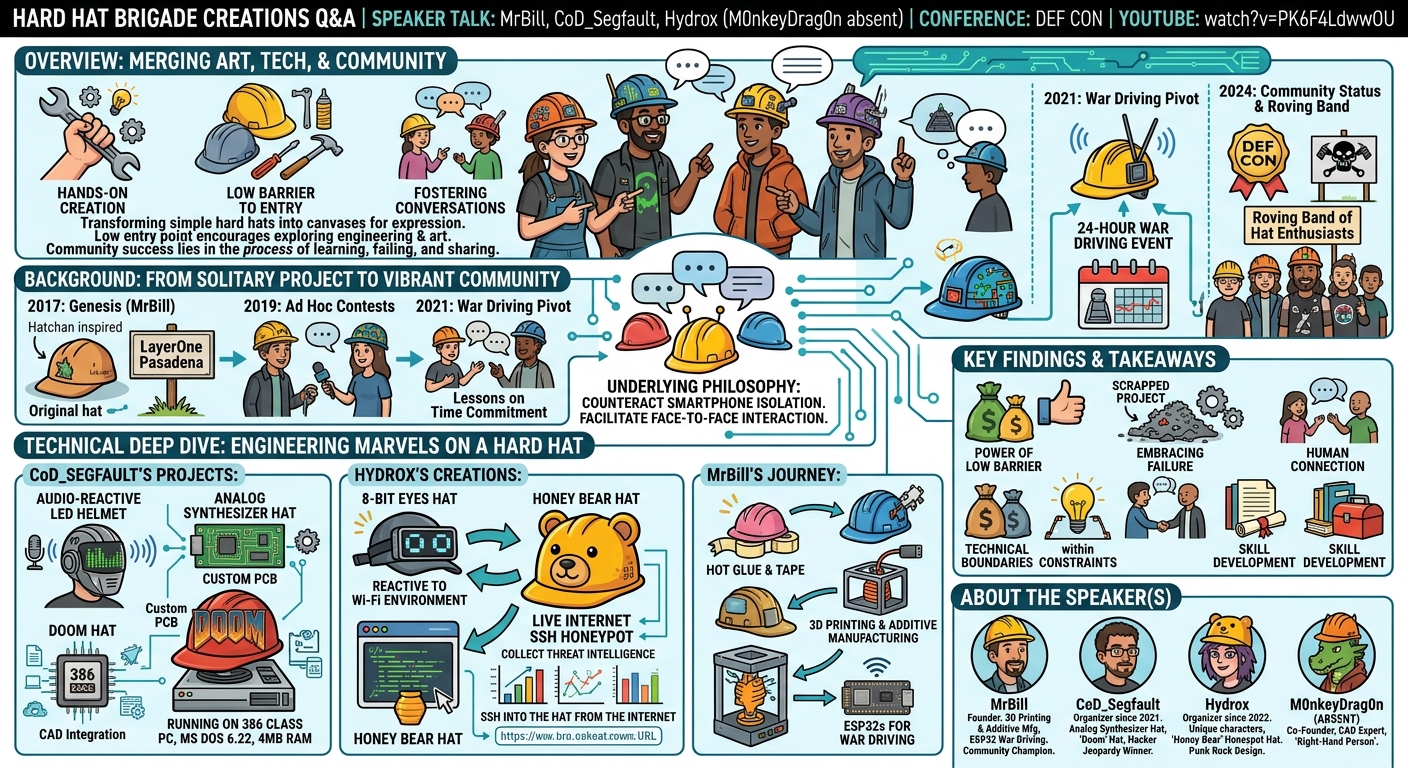
The "Hard Hat Brigade Creations Q&A" talk at DEF CON provided a fascinating deep dive into a burgeoning subculture that merges art, technology, and community engagement through the medium of custom-built, often elaborate, headwear. Presented by MrBill, the founder, alongside CoDSegfault and Hydrox, two key organizers (with M0nkeyDrag0n notably absent but acknowledged), the session chronicled the journey of the Hard Hat Brigade from a solitary personal project to a vibrant, recognized community within the larger DEF CON ecosystem. More than just a showcase of quirky hats, this talk illuminated the profound impact of hands-on creation, collaborative learning, and the deliberate fostering of in-person conversations in an increasingly digital world.
Key moments
- 0:00 Welcome and Hard Hat Brigade introduction
- 1:10 The origin of the first hard hat
- 2:09 Hard hats foster real-world conversations
- 3:03 Holding the first unofficial contest (2019)
- 4:00 Initiating the 24-hour war driving event
- 6:00 Achieving DEF CON community status (2024)
- 7:00 The core mission: bringing people together
- 8:00 Philosophy: pushing people out of comfort zones
Hard Hat Brigade Creations Q&A
Speakers: MrBill, M0nkeyDrag0n, CoD_Segfault
Conference: DEF CON
YouTube: https://www.youtube.com/watch?v=PK6F4LdwwOU
Overview
The "Hard Hat Brigade Creations Q&A" talk at DEF CON provided a fascinating deep dive into a burgeoning subculture that merges art, technology, and community engagement through the medium of custom-built, often elaborate, headwear. Presented by MrBill, the founder, alongside CoD_Segfault and Hydrox, two key organizers (with M0nkeyDrag0n notably absent but acknowledged), the session chronicled the journey of the Hard Hat Brigade from a solitary personal project to a vibrant, recognized community within the larger DEF CON ecosystem. More than just a showcase of quirky hats, this talk illuminated the profound impact of hands-on creation, collaborative learning, and the deliberate fostering of in-person conversations in an increasingly digital world.
At its core, the Hard Hat Brigade is an initiative designed to lower the barrier to entry for technical creation and encourage individuals to step outside their comfort zones. By transforming simple, inexpensive hard hats into canvases for technological expression, participants are prompted to explore additive manufacturing, microcontroller programming, 3D modeling, and various other engineering and artistic disciplines. The speakers emphasized that the project's success lies not just in the impressive final products, but in the process of learning, failing, and sharing insights with a supportive community.
The talk serves as both an origin story and an inspirational call to action, highlighting how a seemingly whimsical idea can organically grow into a significant force for community building and skill development. It underscores the value of tangible, physical projects in sparking curiosity and facilitating genuine human interaction, making it a compelling case study for anyone interested in fostering technical creativity and engagement at conferences or within broader maker communities.
Background
▶ Watch: Welcome and Hard Hat Brigade introduction (0:00)
The genesis of the Hard Hat Brigade traces back to 2017 when MrBill, inspired by the "Hatchan project," conceived the idea of using a hard hat as a novel way to engage people at conferences. His initial prototype, an 8-year-old hat still in use today, was first worn at a LayerOne conference in Pasadena. Despite initial self-consciousness, the hat proved to be a remarkable conversation starter, leading to numerous interactions and a growing collection of stickers that visually documented its journey. The positive reception at DEF CON 2018 solidified the concept, and soon, other attendees began crafting their own unique headwear, marking the organic birth of the Hard Hat Brigade.
The movement gained momentum through unofficial contests. In 2019, the brigade hosted its first ad hoc competition, documenting over 20 entries and learning valuable lessons about the time commitment required for interviewing participants. The challenges of the 2020 pandemic prompted an innovative pivot in 2021, with the brigade hosting a 24-hour war driving event—a natural overlap given the use of technology on hats. This event, held annually in October, continues to engage both hat enthusiasts and general war drivers. By 2023, DEF CON organizers began to take notice, leading to the Hard Hat Brigade achieving "community status" in 2024. This recognition initially provided a dedicated floor space, which, while beneficial for engagement, proved somewhat restrictive. Consequently, for the current year, the brigade embraced a "roving band of hat enthusiasts" model, receiving free badges from DEF CON to facilitate broader interaction across the conference floor.
The underlying philosophy of the Hard Hat Brigade is to create a low-barrier entry point for creative expression. Hard hats are cheap, readily available, and serve as an accessible canvas. The act of wearing a distinctive hat, especially at a large event like DEF CON, serves a deliberate purpose: to counteract the isolating effects of smartphones and encourage face-to-face conversations. It's a physical embodiment of the maker spirit, fostering a subculture akin to badge life or specialized groups like red teamers and blue teamers, but with a unique emphasis on wearable technology and personal interaction. The brigade’s evolution reflects a continuous effort to engage, inspire, and build a vibrant community around the shared passion for making and exploring technology.
Key Findings
▶ Watch: Hard hats foster real-world conversations (2:09)
The Hard Hat Brigade's journey has yielded several significant insights and contributions, primarily centered around community building, personal growth, and the innovative application of technology. One of the foremost findings is the immense power of a low barrier to entry to foster widespread participation. By selecting an inexpensive and readily available item like a hard hat, the brigade successfully democratized technical art, encouraging individuals from diverse backgrounds and skill levels to engage in hands-on creation. This accessibility directly translates into a thriving, self-sustaining community where everyone, from seasoned engineers to curious newcomers, feels welcome to contribute and learn.
Another key finding is the profound impact of stepping outside one's comfort zone. As MrBill and CoD_Segfault articulated, simply wearing a modified hard hat in a public setting like DEF CON can be a significant personal challenge for many tech professionals. This deliberate act of vulnerability, however, often leads to unexpected social interactions, skill development, and a deeper sense of belonging. The hats act as catalysts for conversation, breaking down social barriers and facilitating genuine human connection in an environment that can sometimes feel overwhelming.
Technically, the brigade has demonstrated the incredible versatility and potential for innovation within constraints. Speakers highlighted how limitations—such as memory, power, weight, and the physical form factor of a hard hat—often drive more creative and interesting solutions. This "puzzle-solving" approach has led to the development of highly unique projects, from period-correct computing systems to live internet honeypots. Furthermore, the emphasis on learning from failure is a critical contribution. The speakers openly shared stories of scrapped projects, design flaws, and last-minute pivots, normalizing the iterative process of making and encouraging others to share their struggles as much as their successes. This culture of transparency and mutual support is instrumental in accelerating collective learning and pushing the boundaries of what can be achieved with wearable technology.
Technical Deep Dive
▶ Watch: Initiating the 24-hour war driving event (4:00)
The Hard Hat Brigade showcases a remarkable breadth of technical ingenuity, transforming simple headwear into complex, interactive, and often whimsical technological marvels. The speakers provided detailed insights into the engineering challenges and solutions behind their creations.
CoD_Segfault's journey began with a motorcycle helmet adorned with LEDs reactive to audio. This early project incorporated microphones and an audio jack, allowing the lights to respond dynamically to sound inputs from a phone or synthesizer. The subsequent ambition to mount a 3D printer on a hard hat highlighted a crucial design constraint: weight. The project, though technically feasible in its individual components, proved too heavy to be practically wearable, forcing a last-minute pivot.
This pivot led to the creation of an analog synthesizer hard hat. This intricate build featured a Printed Circuit Board (PCB) mounted on the back, with meticulously routed wires connecting to switches and knobs positioned on the inside of the hat. This design choice ensured a clean, aesthetically pleasing exterior while maintaining full functionality, demonstrating a thoughtful balance between form and function.
Perhaps CoD_Segfault's most ambitious project is the Doom hat. Eschewing modern microcontrollers or single-board computers, this hat runs the classic game on an actual 386 class PC with MS DOS 6.22 and only 4 megabytes of RAM. The deliberate choice of period-correct hardware presented significant challenges in terms of miniaturization, power management, and mounting. The speaker noted a steep learning curve in CAD (Computer-Aided Design) to effectively integrate and secure the components onto the hard hat, showcasing a dedication to authentic, constraint-driven engineering.
Hydrox also shared a progression of hats, each with a unique technical twist. His initial efforts involved components "bolted on and screwed in," reflecting an early stage of fabrication. A later hat featured 8-bit eyes designed to react to the surrounding Wi-Fi environment. This project likely involved a Wi-Fi scanning module (e.g., an ESP32) to detect network traffic or specific SSIDs, with the data then translated into emotional expressions displayed on the LED eyes, such as "crying," "laughing," or "looking confused." This demonstrated real-time data interpretation and display on a wearable platform.
Hydrox's current creation, the Honey Bear hat, is a sophisticated live internet SSH honeypot. This involves running custom-written honeypot software directly on the hard hat, accessible via a public web address. The speaker explained that existing open-source honeypot solutions were not suitable due to the specific memory constraints and unique requirements of a hard hat deployment, necessitating a from-scratch implementation. The hat collects and displays login attempts and other interactions from the internet in real-time, effectively turning a wearable art piece into a distributed threat intelligence gathering node. The construction also involved advanced 3D modeling to custom-fit components directly to the hat's contours.
MrBill, the brigade's founder, described his early hats as "very rough" and "fragile," often held together with hot glue and double-sided tape, with stickers cleverly covering misaligned holes. His journey has involved significant learning in 3D printing and additive manufacturing, as well as extensive use of a Dremel for modifications. More recently, his focus has shifted towards microcontroller-based projects, specifically utilizing ESP32s for war driving. This involves programming these versatile chips to perform Wi-Fi scanning, GPS tracking, and data logging, pushing him into the realm of programming despite initial disinclination. He also recounted a carbon fiber black hat with exposed brass wire and multiple ESP32s that, despite not fully working at DEF CON, still sparked engaging conversations and collaborative troubleshooting.
Across all these projects, common technical threads emerge: the necessity of robust power management for wearable devices, careful consideration of weight distribution for comfort and safety, and innovative approaches to component mounting and wiring management within the confined and curved space of a hat. The emphasis on practical, hands-on learning, often through trial and error, underpins the entire technical philosophy of the Hard Hat Brigade.
Demo / Proof of Concept
▶ Watch: Achieving DEF CON community status (2024) (6:00)
The core of the Hard Hat Brigade's presentation and existence is the hats themselves, which serve as ongoing demonstrations and proofs of concept of wearable technology and artistic expression. While the talk itself was a panel discussion rather than a live, interactive demo of each hat, the speakers vividly described the functionality and impact of their creations.
CoD_Segfault's analog synthesizer hat was presented as a fully functional piece, where "everything worked," implying its capability to generate sounds through its on-board PCB, switches, and knobs. This demonstrated the successful integration of complex electronic circuits into a wearable form factor, allowing for real-time sound manipulation. His Doom hat, an actual 386 PC running MS DOS 6.22, stood as a tangible proof of concept for running vintage software on period-correct hardware in a highly constrained, portable environment. Although not explicitly shown playing Doom during the talk, its existence as a working system on a hard hat is a powerful testament to bespoke hardware integration.
Hydrox's 8-bit eyes hat provided a dynamic visual demonstration by reacting to the surrounding Wi-Fi environment. This concept effectively turned invisible radio signals into visible emotional cues, showcasing real-time data visualization on a wearable. His current Honey Bear hat offers a live, interactive demonstration of a honeypot in action. By providing a web address, Hydrox invites attendees (and anyone online) to SSH directly into the hard hat from the internet. The hat then displays the messages and login attempts it receives, effectively turning a cute, fuzzy accessory into a real-time threat intelligence collector. This is a direct, public-facing proof of concept for a distributed, wearable security sensor.
MrBill's early hats, while simpler, served as proof of concept for the power of visual engagement. Even a hat with "pie parts" and flashing lights successfully initiated conversations. His more recent work with ESP32s for war driving demonstrates the practical application of microcontrollers for environmental sensing and data collection in a mobile context. Though his carbon fiber hat "didn't work" at one point, its physical presence and the subsequent discussions it sparked still served as a powerful demonstration of the community's willingness to engage with and troubleshoot technical challenges collectively.
In essence, each hat discussed or displayed in the presentation acts as a mini-demonstration of what's possible when technical skills are combined with creativity and a willingness to share. The collective body of work within the Hard Hat Brigade represents an ongoing, distributed proof-of-concept for the viability and impact of wearable tech art.
Defensive Implications
▶ Watch: Philosophy: pushing people out of comfort zones (8:00)
While the Hard Hat Brigade primarily focuses on creative expression and community building, the technical endeavors undertaken by its members have several subtle yet significant defensive implications for the cybersecurity community.
Firstly, the very act of building and understanding systems from the ground up is a foundational skill for cybersecurity defenders. When individuals like CoD_Segfault delve into the intricacies of integrating a 386 PC or an analog synthesizer, or Hydrox writes a custom honeypot from scratch, they gain a deep, practical understanding of hardware, software, and networking principles. This hands-on knowledge is invaluable for identifying vulnerabilities, designing secure architectures, and effectively responding to incidents. Knowing how something is built provides critical insight into how it can be broken or defended.
Secondly, Hydrox's SSH honeypot Honey Bear hat offers a direct defensive application. By deploying a live honeypot on a public network (via the internet), the hat actively collects threat intelligence. The messages and login attempts displayed provide real-time insights into common attack vectors, botnet activity, and attacker methodologies. This distributed, wearable honeypot network, if scaled, could contribute to a broader understanding of global attack trends, offering valuable data for defensive strategies and security research. It demonstrates a creative approach to deception technology and threat hunting in an unconventional form factor.
Thirdly, the brigade's engagement with war driving using ESP32s, as mentioned by MrBill, has implications for understanding wireless network security. By actively scanning and mapping Wi-Fi environments, participants gain practical experience with network reconnaissance techniques, which can be leveraged to identify insecure access points, rogue devices, or anomalous network behavior in real-world settings. This type of hands-on exploration directly informs defensive postures against wireless attacks.
Finally, the emphasis on physical security and the challenges of deploying technology in exposed environments are implicitly explored. While not explicitly discussed as a defensive measure, the process of securing components, managing power, and ensuring durability on a hard hat touches upon aspects of tamper resistance and ruggedization that are relevant in various defensive contexts, especially for Industrial Control Systems (ICS) or Internet of Things (IoT) deployments in challenging environments. The shared failures and troubleshooting discussions within the community also foster a culture of resilience and practical problem-solving, which are critical attributes for any defender facing complex security challenges.
Key Takeaways
- Community-Driven Innovation: The Hard Hat Brigade demonstrates how an accessible, low-barrier entry point (a hard hat) can foster a vibrant community focused on creative technical expression and organic growth.
- Embracing Failure as a Learning Tool: Speakers openly shared stories of technical challenges, scrapped projects, and last-minute pivots, normalizing the iterative process of making and emphasizing that failures are crucial for learning and improvement.
- Catalyst for Human Connection: The unique wearable technology serves as a deliberate conversation starter, encouraging face-to-face interactions and fostering genuine community engagement in an increasingly digital world.
- Pushing Technical Boundaries within Constraints: Projects like the "Doom hat" with period-correct hardware or the custom-written SSH honeypot highlight how creative limitations (weight, memory, power) often drive more innovative and interesting engineering solutions.
- Skill Development and Interdisciplinary Learning: Participation encourages hands-on learning in diverse areas such as 3D modeling, additive manufacturing, microcontroller programming (ESP32s), PCB design, and even custom software development.
- Evolution of a Subculture: What began as a personal project has evolved into a recognized subculture at DEF CON, demonstrating the power of grassroots initiatives to create lasting impact and inspire a broader community.
About the Speaker(s)
MrBill is the founder of the Hard Hat Brigade, initiating the project in 2017 with the goal of engaging people through wearable technology. His personal journey with hard hats has involved learning 3D printing, additive manufacturing, and microcontroller programming, particularly with ESP32s for war driving, often pushing past his initial discomfort with coding. He champions the idea of fostering hands-on creation and community support, believing that even failed projects can lead to valuable learning and engagement.
CoD_Segfault has been an active organizer with the Hard Hat Brigade since 2021. His background includes creating an audio-reactive LED motorcycle helmet and ambitious projects like an attempted 3D printer on a hat. He successfully built an analog synthesizer hat and famously created the "Doom hat," an actual 386 class PC running MS DOS 6.22 on a hard hat, demonstrating a deep commitment to period-correct hardware and intricate engineering. He is also a notable Hacker Jeopardy winner, reflecting his broader engagement in the hacker community.
Hydrox joined the Hard Hat Brigade in 2022 and quickly became an organizer, known for infusing his hats with unique backstories and characters. His creations include a hat with 8-bit eyes that react to Wi-Fi environments, and his current project, a "Honey Bear" hard hat that functions as a live internet SSH honeypot. He emphasizes the creative power of working within project constraints and embraces a "punk rock" approach to design, often seeking to create something entirely different from prevailing trends.
M0nkeyDrag0n (not present at the talk) is recognized as a co-founder and a key organizer of the Hard Hat Brigade. MrBill referred to him as his "right-hand person" and acknowledged his significant contributions, particularly in assisting with CAD work, indicating his expertise in design and fabrication.
Reviews
Dr. Zero (Offensive Security Researcher) — SOLID
This is a community/culture talk, not a research session — judge it accordingly. It's a warm, honest origin story about a maker subculture that genuinely fosters hands-on skill development and human connection at DEF CON. Charming for what it is, but it won't teach you anything you couldn't absorb in a five-minute hallway conversation with someone wearing a ridiculous hat.
Heather Calloway (CISO) — PASS
A community showcase about decorative hard hats at DEF CON. Charming maker culture content with no governance, defender, or institutional relevance. Entirely outside my lane.