DEF CON 33 Preview - AIXCC
Andrew Carney
DEF CON 33 · Day 1 · Main Stage
Overview
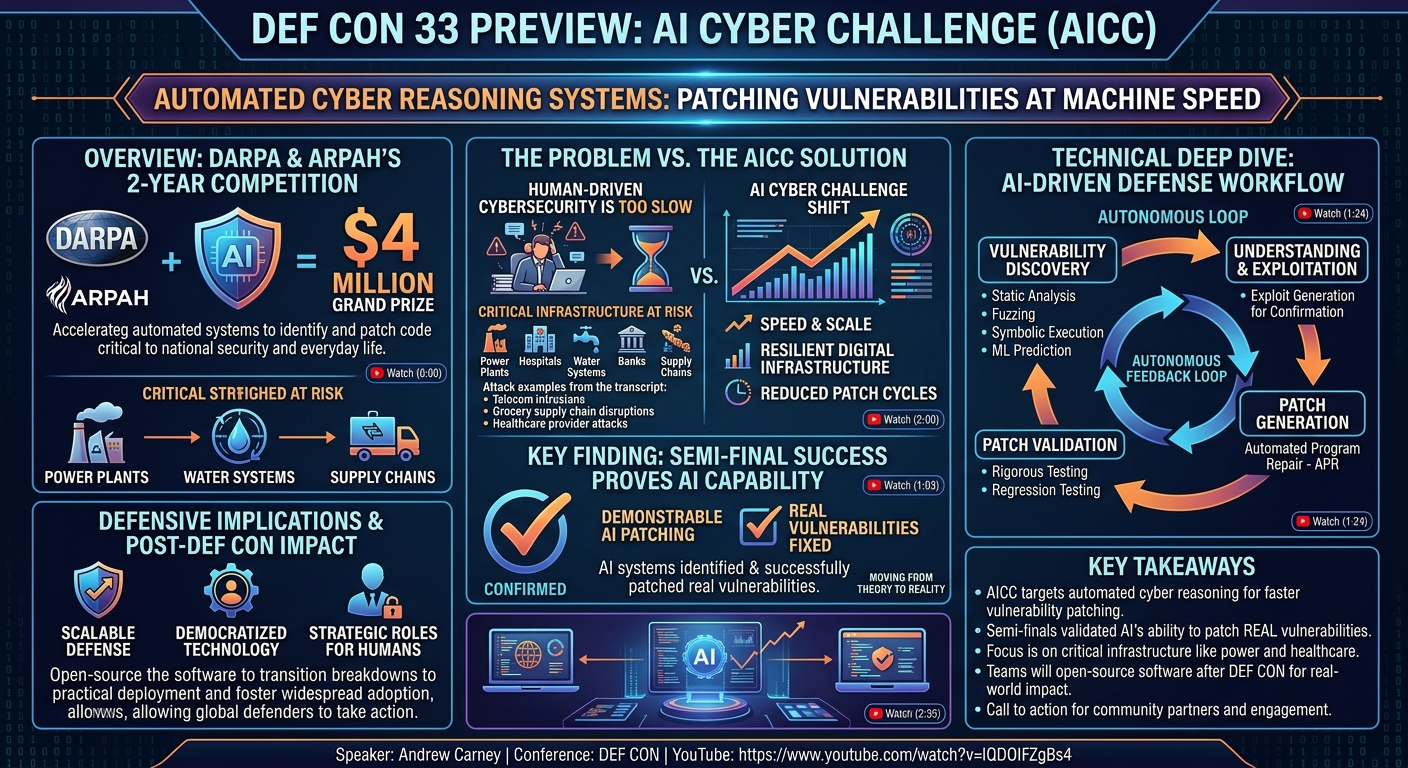
The DEF CON 33 Preview for the AI Cyber Challenge (AICC) introduces an ambitious and critical initiative spearheaded by DARPA and ARPAH. This 2-year competition is designed to accelerate the development of automated cyber reasoning systems capable of identifying and patching software vulnerabilities with unprecedented speed and scale. The core objective is to bolster the security of code deemed critical to national security and everyday life, encompassing vital sectors such as power plants, hospitals, water systems, banks, and supply chains.
Key moments
- 0:00 Introduction to AI Cyber Challenge (AICC) and prizes
- 0:30 Why AICC matters: current cybersecurity threats and stakes
- 1:03 AICC semi-final success and final competition announcement
- 1:24 What to expect at the Defcon AICC experience
- 2:00 Deep dive into AICC Defcon experience activities
- 2:35 Call to action: support game-changing cybersecurity technology
DEF CON 33 Preview - AIXCC
Speakers: Andrew Carney
Conference: DEF CON
YouTube: https://www.youtube.com/watch?v=lQDOIFZgBs4
Overview
The DEF CON 33 Preview for the AI Cyber Challenge (AICC) introduces an ambitious and critical initiative spearheaded by DARPA and ARPAH. This 2-year competition is designed to accelerate the development of automated cyber reasoning systems capable of identifying and patching software vulnerabilities with unprecedented speed and scale. The core objective is to bolster the security of code deemed critical to national security and everyday life, encompassing vital sectors such as power plants, hospitals, water systems, banks, and supply chains.
The urgency of the AICC is underscored by the pervasive vulnerability of modern systems to cyber attacks, a challenge that current, predominantly human-driven cybersecurity efforts struggle to adequately address. Recent incidents, including massive intrusions into telecom systems, attacks on grocery stores leading to supply chain disruptions, and debilitating assaults on healthcare providers, highlight the dire consequences of cybersecurity failures. The AICC seeks to shift this paradigm by harnessing advanced artificial intelligence to create a more resilient digital infrastructure, offering substantial prizes—up to $4 million for the first-place team—to incentivize groundbreaking innovation.
Crucially, the AICC is not merely an academic exercise; it's a direct pathway to real-world impact. The competition’s semi-final rounds have already demonstrated the capacity of AI systems to not only identify but also successfully patch legitimate vulnerabilities. Following DEF CON, the participating teams are committed to open-sourcing their software, ensuring that these breakthroughs transition from competition to practical deployment. This strategic move aims to foster widespread adoption and engagement from industry partners, ultimately creating a more secure future for everyone by making advanced defensive capabilities accessible and actionable.
Background
▶ Watch: Introduction to AI Cyber Challenge (AICC) and prizes (0:00)
The pervasive vulnerability of modern digital infrastructure has reached a critical juncture, necessitating a fundamental re-evaluation of cybersecurity strategies. For decades, the cybersecurity landscape has been characterized by an arms race between attackers constantly probing for weaknesses and defenders scrambling to identify, analyze, and patch vulnerabilities. This human-intensive process is inherently slow, expensive, and increasingly overwhelmed by the sheer volume and complexity of code, the rapid pace of software development, and the sophisticated tactics employed by adversaries.
The problem is particularly acute in critical infrastructure sectors. Systems underpinning power grids, water treatment facilities, hospitals, financial institutions, and supply chains are often built on complex, legacy codebases that are difficult to secure, maintain, and update. A single unpatched vulnerability in such a system can have catastrophic consequences, ranging from widespread service disruptions and economic instability to direct threats to public health and national security. The transcript explicitly cites examples like "massive intrusions into our telecom systems," "attacks on our grocery stores that have led to supply chain issues and empty shelves," and "attacks on hospitals and healthcare providers that impact patient care," illustrating the tangible and severe repercussions of these vulnerabilities.
Historically, efforts to automate vulnerability discovery and patching have met with limited success. While techniques like static analysis (examining code without executing it), dynamic analysis (fuzzing, symbolic execution), and various forms of automated program repair have existed for years, they often struggle with high false-positive rates, limited scope, or an inability to generate robust, functionally correct patches without human intervention. The dream of "self-healing" software—systems that can autonomously detect and remediate their own flaws—has remained largely aspirational. The challenge lies in developing systems that can not only pinpoint vulnerabilities but also understand their semantic implications, generate correct fixes, and verify that these fixes do not introduce new bugs or break existing functionality. The AICC represents a concerted effort by DARPA and ARPAH to bridge this gap, leveraging recent advancements in artificial intelligence and machine learning to achieve a level of automation and effectiveness that has previously been out of reach. By focusing on "real vulnerabilities" in "critical infrastructure," the competition directly addresses the most pressing and impactful cybersecurity challenges facing society today.
Key Findings
▶ Watch: AICC semi-final success and final competition announcement (1:03)
The most significant "key finding" presented in this DEF CON preview is the demonstrable success of the AI Cyber Challenge (AICC) semi-final competition. This phase of the 2-year initiative proved conclusively that AI systems are capable of not only identifying but also successfully patching real vulnerabilities. This outcome is a pivotal milestone, moving the concept of automated cyber reasoning systems from theoretical possibility to practical reality.
This finding validates the core premise of the AICC: that artificial intelligence can be effectively leveraged to augment and potentially transform cybersecurity defense. The ability of these systems to handle "real vulnerabilities" implies they can contend with the complexities, nuances, and diverse attack surfaces present in actual software environments, rather than just idealized test cases. For an industry perennially struggling with the scale and speed of cyber threats, this provides a powerful proof of concept. It suggests that the long-sought goal of autonomous vulnerability management, capable of operating at machine speed, is now within tangible reach. This success injects significant momentum into the final competition and reinforces the potential for AI to become a cornerstone of future defensive cybersecurity strategies, particularly for the high-stakes critical infrastructure sectors that are the primary focus of the challenge.
Technical Deep Dive
▶ Watch: What to expect at the Defcon AICC experience (1:24)
While the DEF CON 33 preview for the AI Cyber Challenge (AICC) serves primarily as an announcement and does not delve into the specific technical architectures or methodologies employed by the competing teams, it implicitly outlines the formidable technical scope and requirements for any automated cyber reasoning system aiming to identify and patch vulnerabilities autonomously. To achieve the AICC's ambitious goals, participating systems must integrate a sophisticated array of AI and cybersecurity technologies, working in concert to emulate and surpass human capabilities in vulnerability research and program repair.
At a high level, such a system would typically comprise several interconnected modules:
- Vulnerability Identification and Discovery: This is the initial stage where the system analyzes target code to locate potential flaws.
- Static Analysis: Algorithms would scan source code or binaries without execution, looking for common vulnerability patterns (e.g., buffer overflows, format string bugs, use-after-free errors), insecure API calls, or violations of coding best practices. Techniques could include control flow analysis, data flow analysis, and taint analysis to track potentially malicious input through the program.
- Dynamic Analysis (Fuzzing): This involves executing the target program with a vast number of malformed or unexpected inputs to trigger crashes, assertion failures, or other anomalous behaviors indicative of a vulnerability. Advanced fuzzing techniques, such as coverage-guided fuzzing (e.g., using AFL++ or libFuzzer) or mutational fuzzing, would be essential to efficiently explore the program's state space and uncover deep-seated flaws.
- Symbolic Execution: A more rigorous form of analysis that treats program inputs as symbolic variables, exploring all possible execution paths to identify inputs that lead to specific undesirable states (e.g., reaching a vulnerable function with attacker-controlled data). This method can provide concrete exploit conditions but is computationally intensive.
- Machine Learning for Vulnerability Prediction: AI models trained on vast datasets of known vulnerabilities and secure code could learn to identify subtle patterns or code characteristics associated with weaknesses that traditional static analysis might miss. This could involve deep learning models analyzing code embeddings or graph representations of program logic.
- Vulnerability Understanding and Exploitation (Optional but Beneficial): Once a potential vulnerability is identified, a robust system might attempt to confirm its exploitability.
- Exploit Generation: While not strictly required for patching, the ability to automatically generate a proof-of-concept exploit confirms the severity and reachability of a vulnerability. This involves understanding the identified flaw's impact and crafting inputs that trigger it in a controlled manner. This step is crucial for differentiating between theoretical weaknesses and practically exploitable bugs.
- Patch Generation and Program Repair: This is arguably the most challenging component, requiring the system to synthesize corrective code.
- Automated Program Repair (APR): This field leverages various techniques to automatically modify code to fix bugs. Approaches include:
- Search-based APR: Exploring a vast space of potential code changes (e.g., adding null checks, bounds checks, sanitizing inputs) and evaluating them against test suites to find a fix that passes all tests and resolves the vulnerability.
- Semantic-based APR: Using formal methods or program synthesis techniques to understand the intended behavior of the program and generate a patch that restores that behavior while eliminating the flaw.
- Learning-based APR: Training AI models on datasets of vulnerable code and corresponding patches to learn common repair patterns and apply them to new vulnerabilities. This could involve neural machine translation techniques, treating code as a language.
- Patch Validation: Generated patches must be rigorously tested to ensure they effectively mitigate the vulnerability without introducing new bugs (regressions) or altering the program's intended functionality. This would involve running the original test suite, newly generated vulnerability-specific tests, and potentially formal verification methods.
- Integration and Orchestration: All these components must be seamlessly integrated into an autonomous feedback loop. The system needs to manage the workflow from code ingestion, analysis, vulnerability detection, patch generation, to validation and deployment. For critical infrastructure, this also implies dealing with diverse programming languages (C/C++, Java, Python, Go, Rust), various operating systems, and potentially embedded or real-time constraints. The challenge explicitly mentions "real vulnerabilities" and "code that's critical to our national security and our everyday lives," indicating the need for extreme accuracy, robustness, and the ability to operate effectively in complex, production-like environments where failures are unacceptable. The successful semi-final competition suggests that significant progress has been made in achieving this complex integration.
Demo / Proof of Concept
▶ Watch: Deep dive into AICC Defcon experience activities (2:00)
As a DEF CON preview and announcement, the talk itself did not feature a live demonstration or a detailed proof of concept of the AI Cyber Challenge (AICC) systems in action. The presentation's purpose was to build anticipation for the main event at DEF CON, where the final competition winners would be announced and their technologies showcased.
However, the transcript clearly outlines what attendees could expect at the dedicated "AICC experience" at DEF CON: "Meet the teams and see their technology in action. Explore competition data, including vulnerabilities and patches found and created by the competitor's systems." Based on this, a typical demonstration would likely involve a compelling illustration of an automated cyber reasoning system performing its core function. This could entail:
- Vulnerable Code Ingestion: The system might be fed a piece of code known to contain a specific vulnerability, perhaps a common flaw like a buffer overflow, SQL injection, or a deserialization vulnerability.
- Automated Analysis: The demonstration would then highlight the system's process of analyzing the code, showing how it identifies the precise location and nature of the flaw. This might be visualized through code annotations, data flow diagrams, or a clear textual output detailing the vulnerability (e.g., CVE-like information).
- Patch Generation: The system would then proceed to automatically generate a patch. This could involve displaying the original vulnerable code alongside the proposed patched version, with the changes clearly highlighted.
- Verification: To prove the patch's efficacy, the system might then run a series of tests. This would include demonstrating that the original exploit no longer works against the patched code, and crucially, that the patch does not introduce new bugs or break existing, intended functionality.
- Competition Data Exploration: Beyond live demonstrations, the AICC experience would also offer attendees the chance to delve into the "competition data." This would likely include anonymized or sanitized examples of vulnerabilities discovered by the systems, the corresponding patches generated, and the performance metrics (e.g., time taken, accuracy, regression rates) that led to the teams' success in the semi-finals. Such an exhibit would provide concrete evidence of the systems' capabilities and the types of "real vulnerabilities" they have successfully addressed.
These demonstrations would serve to concretely illustrate the "game-changing technology" and underscore the potential for AI to dramatically enhance cybersecurity defenses, moving beyond theoretical discussions to tangible, automated solutions.
Defensive Implications
▶ Watch: Call to action: support game-changing cybersecurity technology (2:35)
The successful development and proposed open-sourcing of automated cyber reasoning systems from the AI Cyber Challenge (AICC) carry profound defensive implications for organizations, critical infrastructure operators, and the cybersecurity industry at large. This initiative represents a paradigm shift from reactive, human-intensive vulnerability management to proactive, machine-speed defense.
Firstly, the most immediate and impactful implication is the potential for drastically reduced patch cycles. Currently, the time between vulnerability discovery and patch deployment can range from days to months, leaving a significant window of exposure that attackers readily exploit. AICC's systems, capable of autonomously identifying and patching vulnerabilities, could shrink this window to hours or even minutes. This accelerated remediation directly translates to a smaller attack surface and enhanced resilience against both known and zero-day exploits, especially for critical infrastructure where downtime or compromise can have severe societal repercussions.
Secondly, these systems offer unprecedented scalability in cybersecurity defense. Human teams are limited by expertise, bandwidth, and the sheer volume of code that needs to be secured. Automated systems can analyze vast codebases, monitor continuous integration/continuous deployment (CI/CD) pipelines, and process newly discovered vulnerabilities at a scale unachievable by human efforts. This is particularly vital for organizations managing complex software ecosystems or extensive networks of IoT devices.
Thirdly, the AICC's focus on critical infrastructure protection means direct benefits for national security and public welfare. By securing systems that underpin power, water, healthcare, and financial services, these AI tools can help prevent the "massive intrusions" and "attacks on hospitals" highlighted in the preview. This proactive defense of essential services is paramount in an era of escalating state-sponsored and financially motivated cyber warfare.
Fourthly, the commitment to open-sourcing the software developed by AICC teams is a game-changer for the broader cybersecurity community. This democratizes access to advanced defensive capabilities, potentially leveling the playing field for smaller organizations, non-profits, or government agencies that lack the resources to develop such sophisticated tools in-house. Open-source availability will foster community-driven improvement, broader adoption, and integration into existing security tooling, accelerating the transition of these breakthroughs into real-world applications. It allows defenders globally to "take action and support adoption of this technology."
Finally, the advent of such autonomous systems will likely lead to a redefinition of roles for cybersecurity professionals. Instead of spending countless hours on manual vulnerability analysis and patch development, human experts can shift their focus to higher-level strategic tasks: overseeing AI systems, analyzing threat intelligence, designing more secure architectures, and responding to novel, complex threats that still require human ingenuity. This transition promises to make cybersecurity roles more strategic and impactful, addressing the ongoing shortage of skilled professionals by empowering them with advanced AI assistance.
While the potential benefits are immense, defenders must also consider the implications of AI-generated patches potentially introducing new, subtle bugs or being bypassed by highly sophisticated adversaries. Therefore, human oversight, rigorous testing, and continuous improvement will remain essential, even as AI takes on a larger role in automated defense.
Key Takeaways
- The AI Cyber Challenge (AICC) is a DARPA/ARPAH competition driving the development of automated cyber reasoning systems to identify and patch vulnerabilities.
- The semi-final competition demonstrated that AI systems are capable of successfully identifying and patching real vulnerabilities, marking a significant milestone in autonomous cyber defense.
- The challenge specifically targets critical infrastructure sectors (power plants, hospitals, water systems, banks, etc.) to enhance national security and everyday life.
- Winning teams will open-source their software after DEF CON, facilitating the transition of these innovative technologies into practical, real-world applications.
- The AICC emphasizes the urgent need for partners and engagement from the cybersecurity community to support the adoption and deployment of these game-changing tools.
- The initiative aims to create a more cyber secure world by dramatically speeding up vulnerability remediation and scaling defensive capabilities beyond human limitations.
About the Speaker(s)
Andrew Carney is listed as the speaker for this DEF CON 33 Preview of the AI Cyber Challenge (AICC). The presentation itself functions as an introductory announcement for the competition and the associated "AICC experience" at DEF CON, focusing on the goals and impact of the initiative rather than providing personal biographical details of the speaker within the transcript.
Reviews
Dr. Zero (Offensive Security Researcher) — WEAK
This is a DARPA program announcement dressed up as conference content — a hype reel for AIXCC with no technical substance, no architecture details, no results data, and no novel insight. The 'key finding' that AI can patch vulnerabilities is asserted, not demonstrated, and the entire writeup reads like a DARPA press release ghostwritten by a language model.
Heather Calloway (CISO) — SOLID
A competent preview of a genuinely important DARPA initiative — AIXCC demonstrates real proof-of-concept progress on automated vulnerability remediation, and the open-sourcing commitment has meaningful downstream value. But as a talk, it reads more like a program announcement than an analytic briefing, and it never closes the gap between 'AI patched a real vulnerability in a competition' and 'here is what your security program should do with that fact.'