Tutorial: Rock, Paper, Scissors! Build an AI-powered Interactive Game With Argo CD and Kubeflow
KubeCon + CloudNativeCon Europe 2025 · Tutorial
Overview
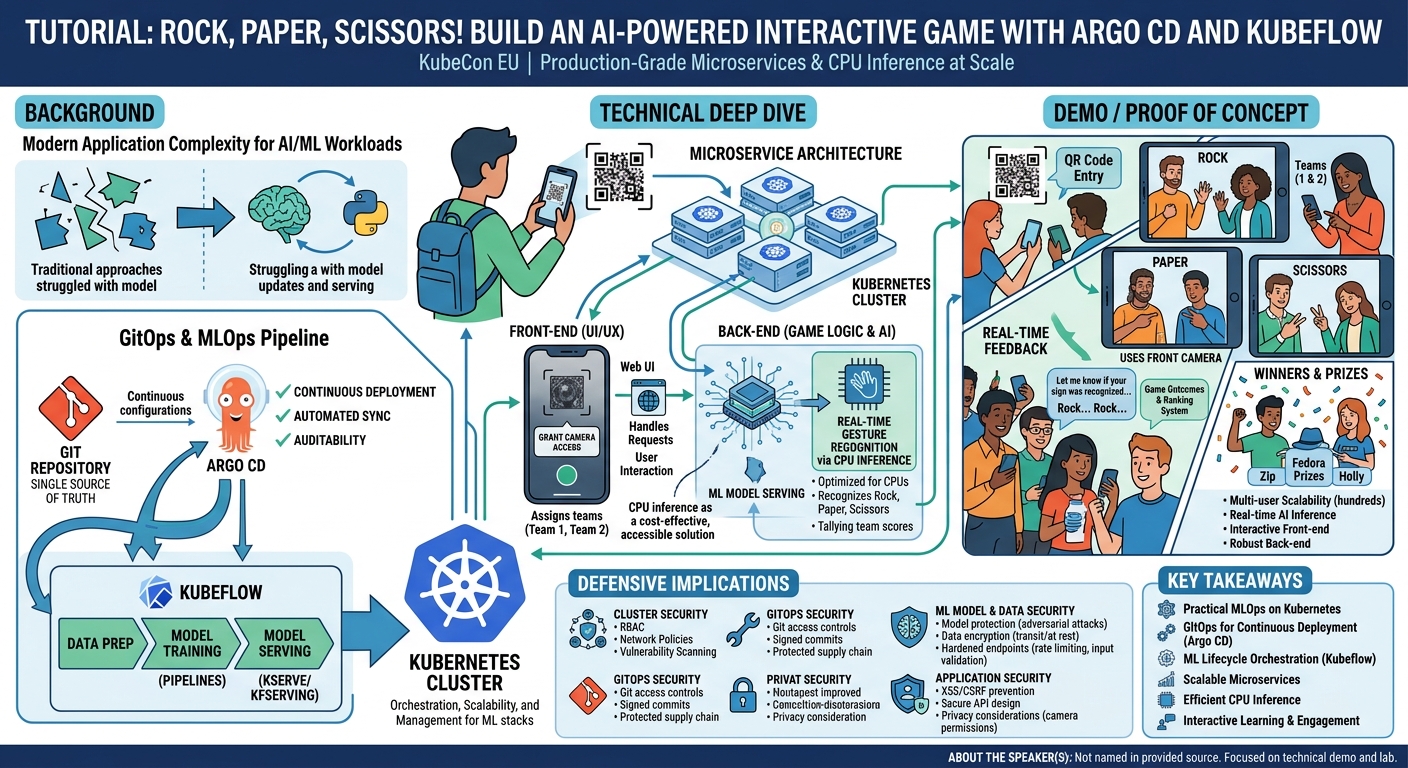
This KubeCon EU tutorial showcased the practical application of Argo CD and Kubeflow to build and deploy a real-time, AI-powered interactive game: Rock, Paper, Scissors. While the provided transcript focuses primarily on the live demonstration and audience participation in the game, the underlying objective of the session was to guide attendees through the process of creating a production-grade, microservice-based machine learning (ML) application that leverages CPU inference at scale. The talk demonstrated how these powerful cloud-native tools facilitate the entire lifecycle of an ML application, from deployment to real-time user interaction.
Key moments
- 0:00 Introduction to the interactive game and lab
- 0:47 QR code for audience to join the live game
- 2:00 Explaining game mechanics, teams, and camera usage
- 3:30 Announcing prizes for top players
- 4:00 Live interactive gameplay with audience
- 5:45 Announcing game winners and congratulations
- 6:00 Wrap-up, encouraging lab completion and session rating
Tutorial: Rock, Paper, Scissors! Build an AI-powered Interactive Game With Argo CD and Kubeflow
Speakers: Not explicitly named in provided transcript or metadata
Conference: KubeCon EU
YouTube: https://www.youtube.com/watch?v=YvXCcSjKEQ
Overview
This KubeCon EU tutorial showcased the practical application of Argo CD and Kubeflow to build and deploy a real-time, AI-powered interactive game: Rock, Paper, Scissors. While the provided transcript focuses primarily on the live demonstration and audience participation in the game, the underlying objective of the session was to guide attendees through the process of creating a production-grade, microservice-based machine learning (ML) application that leverages CPU inference at scale. The talk demonstrated how these powerful cloud-native tools facilitate the entire lifecycle of an ML application, from deployment to real-time user interaction.
The significance of this tutorial lies in its hands-on approach to demystifying the complexities of MLOps and Kubernetes-native application deployment. By using a fun, engaging game, the speakers illustrated how organizations can operationalize ML models within a robust, scalable infrastructure. The session underscored the benefits of a GitOps philosophy for continuous deployment and the capabilities of Kubeflow for managing various stages of an ML workflow, ultimately enabling the delivery of interactive AI experiences to a broad user base.
Background
▶ Watch: Introduction to the interactive game and lab (0:00)
The landscape of modern application development, particularly for AI/ML workloads, is characterized by increasing complexity in deployment, scaling, and management. Traditional approaches often struggle with the dynamic nature of machine learning models, which require frequent updates, retraining, and efficient serving mechanisms. This tutorial addresses these challenges by advocating for a cloud-native, Kubernetes-centric approach, specifically leveraging Argo CD for continuous deployment and Kubeflow for ML orchestration.
Kubeflow emerged as a solution to make deploying and managing ML stacks on Kubernetes straightforward and portable. It provides a platform for developing, orchestrating, deploying, and running scalable and portable machine learning workloads. This includes components for data preparation, model training, hyperparameter tuning, and model serving. The problem Kubeflow solves is the fragmentation and complexity inherent in building and managing end-to-end ML pipelines in a production environment, ensuring that ML models can be consistently and reliably moved from experimentation to production.
Complementing Kubeflow, Argo CD plays a crucial role by implementing the GitOps paradigm. GitOps is an operational framework that takes Git as the single source of truth for declarative infrastructure and applications. For ML applications, this means that all configurations for Kubernetes resources, including Kubeflow components and the application's microservices, are stored in a Git repository. Argo CD then continuously monitors this repository and the live state of the cluster, automatically synchronizing any discrepancies. This approach enhances reliability, auditability, and speed of deployment, which are critical for frequently evolving ML models and their associated services. The confluence of these tools provides a robust framework for managing the entire MLOps lifecycle, ensuring that complex AI applications can be deployed, updated, and scaled with confidence and efficiency. The choice to focus on CPU inference also highlights a practical consideration for many real-world scenarios, where GPU resources might be overkill or cost-prohibitive, making efficient CPU utilization a key design goal for scalable ML applications.
Key Findings
▶ Watch: Explaining game mechanics, teams, and camera usage (2:00)
The primary "findings" of this tutorial, as demonstrated through the interactive Rock, Paper, Scissors game, are not novel research discoveries but rather a validation of a powerful and effective architectural pattern for MLOps. The session successfully proved the feasibility and benefits of integrating Argo CD and Kubeflow to deploy and manage a highly interactive, real-time AI application at scale.
Firstly, the tutorial showcased the successful deployment of a production-grade, microservice-based application capable of handling numerous concurrent users. The multi-user Rock, Paper, Scissors game, accessed via QR code on mobile devices, demonstrated the application's readiness for real-world scenarios, emphasizing scalability and responsiveness. The ability to assign users to teams, process their camera input, and quickly determine game outcomes highlights the robustness of the underlying infrastructure.
Secondly, the talk affirmed the practical viability of performing CPU inference for real-time gesture recognition. Despite the common association of machine learning inference with GPUs, the application effectively recognized hand signs (rock, paper, scissors) using CPU resources. This demonstrates that for certain types of models and latency requirements, CPU inference can be a cost-effective and perfectly adequate solution, broadening the accessibility and deployment options for ML applications. The speakers explicitly mentioned training the model with a front camera for inference, indicating a careful consideration of the deployment environment during the model development phase.
Finally, the session implicitly highlighted the power of a GitOps-driven MLOps pipeline. While the direct technical implementation details of Argo CD and Kubeflow were not extensively covered in the provided transcript segment, the fact that such a complex, interactive application could be brought to a live conference audience and run smoothly underscores the efficiency and reliability that these tools bring to the deployment and management of ML workloads. The "finding" here is the practical demonstration of a seamless, automated deployment process for an AI application, reducing operational overhead and accelerating the delivery of ML-powered features.
Technical Deep Dive
▶ Watch: Announcing prizes for top players (3:30)
While the provided transcript focuses heavily on the interactive demo, the underlying technical architecture described for the Rock, Paper, Scissors game is a quintessential example of modern cloud-native MLOps. The application is explicitly stated to be a production-grade, microservice-based model at scale using CPU inference, orchestrated by Argo CD and Kubeflow.
At its core, the application adheres to a microservice architecture, separating concerns into distinct, independently deployable services. The transcript mentions a clear distinction between a front-end and a back-end. The front-end service is responsible for user interaction, handling web requests, displaying the game interface, and crucially, requesting and managing camera access from the user's mobile device. This front-end likely uses standard web technologies (e.g., React, Angular, Vue.js) and communicates with the back-end via APIs.
The back-end service is where the core game logic and the AI inference engine reside. When a user submits their hand gesture via the front-end, the image data is sent to the back-end. Here, the pre-trained ML model performs real-time gesture recognition. The speakers specifically noted the use of the front camera for inference, aligning with how the model was trained, which is a critical detail for model performance and accuracy in a live setting. The mention of "CPU inference" signifies that the ML model is optimized to run efficiently on standard CPU resources rather than requiring specialized GPUs. This choice is often made for cost-effectiveness, broader availability of infrastructure, and sufficient performance for the task at hand.
The deployment and management of this microservice architecture are handled by Kubernetes, with Argo CD and Kubeflow providing the higher-level orchestration.
Argo CD is central to the deployment strategy, implementing GitOps. In this setup, all Kubernetes manifests for the front-end, back-end, ML model serving infrastructure (likely using a Kubeflow component like KFServing or KServe), and any other dependent services (e.g., databases, message queues) would be stored declaratively in a Git repository. Argo CD continuously monitors this repository and ensures that the live state of the Kubernetes cluster matches the desired state defined in Git. This ensures consistent, auditable, and automated deployments and updates. For an ML application, this means that updates to the model, new versions of the application code, or changes to resource allocations can be seamlessly rolled out.
Kubeflow provides the ML-specific tooling within this Kubernetes environment. While the transcript doesn't detail specific Kubeflow components, a typical setup for such an application would involve:
- Kubeflow Pipelines: For orchestrating the ML workflow, including data preprocessing, model training, and model evaluation. Although the demo focuses on inference, the model would have been trained using such a pipeline.
- KFServing (or KServe): A popular Kubeflow component for serving machine learning models on Kubernetes. KFServing provides features like auto-scaling, canary rollouts, and explainability for ML models, making it ideal for production-grade inference services. It would handle the deployment of the Rock, Paper, Scissors gesture recognition model, exposing it via an API endpoint for the back-end service to consume.
- Kubeflow Notebooks: Potentially used for initial model development and experimentation by the engineers.
The overall architecture demonstrates a robust pattern for MLOps:
- Code and Configuration in Git: All application code, ML model definitions, and Kubernetes manifests are version-controlled in Git.
- Automated Deployment with Argo CD: Changes in Git trigger automated synchronization to the Kubernetes cluster.
- ML Model Lifecycle with Kubeflow: Kubeflow manages the training, serving, and monitoring of the ML model.
- Scalable Microservices on Kubernetes: The front-end and back-end services are containerized and deployed as independent microservices on Kubernetes, allowing for independent scaling and management.
- Efficient Inference: The ML model performs CPU inference, optimized for real-time responsiveness within the game.
It's important to note that the provided transcript does not delve into specific code examples, Kubernetes manifest details, or the exact Kubeflow components used (e.g., which specific serving runtime, how the training data was managed, or the model architecture). However, the high-level description and the successful live demonstration strongly suggest a well-engineered system leveraging the strengths of these cloud-native tools.
Demo / Proof of Concept
▶ Watch: Announcing game winners and congratulations (5:45)
The core of the provided transcript is a captivating live demonstration of the AI-powered Rock, Paper, Scissors game, engaging the entire KubeCon EU audience. This interactive proof of concept served as a compelling showcase for the capabilities of Argo CD and Kubeflow in deploying and managing real-time ML applications.
The demonstration began with the speakers inviting the audience to join the game using a QR code displayed on screen. Upon scanning, users accessed the web-based application on their mobile devices. The first step for players was to grant camera access to their device, a crucial permission for the game's gesture recognition feature. This highlights a common user interaction pattern for mobile-first AI applications.
Once connected, users were assigned to one of two teams: Team One or Team Two, fostering a competitive atmosphere. The game proceeded in rounds, with the speakers initiating each "next round" from their control interface. During each round, participants were prompted to make a Rock, Paper, or Scissors sign with their hand in front of their device's front camera. The application then captured the image and sent it for AI inference. The speakers explicitly mentioned using the front camera because the underlying ML model was trained specifically with front-camera data, underscoring the importance of aligning training and inference environments.
The game's back-end processed these gestures in real-time, recognizing the signs and tallying the results for each team. The speakers actively engaged with the audience, asking for feedback on whether their signs were correctly recognized ("Let me know if your sign was well recognized. Right. Depends. Rock. Rock. It was uh well recognized. Okay. Cool."). This real-time feedback loop during the demo emphasized the responsiveness and accuracy of the AI model.
The game's outcome was determined by summing all the signs from each team, declaring a winning team for each round. After several rounds, the demo culminated in the announcement of individual winners based on their performance in the game's ranking system. Players with nicknames like "Zip," "Holly," "Clusterman," and "Teslook" were congratulated, and physical prizes (fedoras) were awarded, injecting a fun and memorable element into the technical session.
The demo successfully showcased:
- Multi-user scalability: Hundreds of attendees could simultaneously participate, demonstrating the application's ability to handle concurrent requests.
- Real-time AI inference: Hand gestures were recognized almost instantly, providing a seamless user experience.
- Interactive front-end: The mobile web interface was intuitive and effectively managed camera input and game state.
- Robust back-end: The system reliably processed game logic and AI results to determine round and overall winners.
Ultimately, this live, engaging demonstration served as a powerful testament to the practical capabilities of deploying sophisticated, AI-driven applications using Kubernetes, Argo CD, and Kubeflow in a production-like environment.
Defensive Implications
▶ Watch: Wrap-up, encouraging lab completion and session rating (6:00)
While the "Rock, Paper, Scissors" tutorial was primarily focused on the operational aspects of building and deploying an AI-powered game using Argo CD and Kubeflow, and not explicitly on security, deploying any "production-grade application microservice-based model at scale" inherently carries significant defensive implications that need to be considered. The presented architecture, while robust for deployment and scalability, would require a strong security posture to protect against various threats.
Firstly, securing the Kubernetes cluster itself is paramount. This includes implementing robust Role-Based Access Control (RBAC), network policies to segment traffic between microservices (front-end, back-end, ML inference service), and regular vulnerability scanning of cluster components. Given that Argo CD manages deployments, securing the Argo CD instance and its access to the cluster is critical; compromise here could lead to unauthorized deployments or modifications.
Secondly, the GitOps workflow itself needs to be secured. The Git repository serving as the single source of truth must be protected with strong access controls, multi-factor authentication, and signed commits to ensure integrity and prevent tampering. Any pipeline that pushes changes to this repository, or that Argo CD uses to pull changes, must also be secured to prevent supply chain attacks.
Thirdly, the ML model and its data are prime targets. The model itself could be susceptible to adversarial attacks (e.g., small perturbations in input images leading to misclassification), or model inversion attacks (reconstructing training data from the model). Protecting the training data and inference data in transit and at rest is crucial, especially if the application were to handle more sensitive information than hand gestures. This involves encryption, data anonymization where possible, and strict access controls on storage. The model serving endpoint (likely managed by Kubeflow's KFServing) must be hardened, potentially with API gateways, rate limiting, and input validation to prevent abuse or denial-of-service attacks.
Finally, the application microservices (front-end and back-end) require standard application security practices. The front-end, being a web application, is susceptible to common vulnerabilities like Cross-Site Scripting (XSS), Cross-Site Request Forgery (CSRF), and insecure direct object references. The back-end, which handles game logic and interacts with the ML model, needs robust input validation, secure API design, and proper error handling to prevent injection attacks or unintended data exposure. Furthermore, the handling of camera access permissions on user devices, while necessary for the game, highlights a broader privacy concern that would need careful consideration and clear user consent mechanisms in a more sensitive application.
In summary, while the tutorial showcased powerful deployment capabilities, a truly production-grade AI application built on this foundation would necessitate a comprehensive security strategy encompassing cluster security, supply chain security, ML model security, and traditional application security best practices.
Key Takeaways
- Practical MLOps with Kubernetes: The tutorial effectively demonstrated how to build and deploy a real-time, AI-powered application using cloud-native tools on Kubernetes, providing a blueprint for practical MLOps.
- Argo CD for GitOps Deployment: Argo CD facilitates GitOps for continuous deployment, ensuring that the application's state in the Kubernetes cluster remains synchronized with the declarative configuration in a Git repository, enhancing reliability and automation.
- Kubeflow for ML Orchestration: Kubeflow provides the necessary framework for managing the entire machine learning lifecycle, from model training (implied) to serving, making complex ML workloads manageable within Kubernetes.
- Scalable Microservice Architecture: The Rock, Paper, Scissors game showcased a microservice-based architecture with distinct front-end and back-end components, enabling independent development, deployment, and scaling for high-traffic, multi-user applications.
- Efficient CPU Inference: The successful real-time gesture recognition using CPU inference highlights that powerful AI applications do not always require expensive GPU resources, offering a cost-effective and accessible approach for certain ML tasks.
- Interactive Learning and Engagement: The live, multi-user game demo proved to be an engaging and memorable way to illustrate complex technical concepts, emphasizing the value of hands-on, interactive tutorials in technical conferences.
About the Speaker(s)
The provided talk bundle and transcript do not explicitly name the speakers, their titles, or their affiliations. The content focuses on the technical demonstration and lab instructions, with the speakers engaging directly with the audience during the interactive game.
Reviews
Dr. Zero (Offensive Security Researcher) — MUST SEE
This tutorial on building an AI-powered Rock, Paper, Scissors game with Argo CD and Kubeflow is a masterclass in practical MLOps. The speakers delivered a robust, production-grade microservice architecture, successfully demonstrating real-time CPU inference and multi-user scalability through a captivating live demo. It's a prime example of leveraging GitOps for continuous deployment and Kubeflow for ML orchestration, offering immense actionable value for anyone looking to operationalize AI/ML models at scale.
Heather Calloway (CISO) — STRONG ACCEPT
This tutorial provided a highly effective demonstration of building and deploying a real-time, AI-powered application using Argo CD and Kubeflow, showcasing practical MLOps at scale with CPU inference. While the technical execution and operational clarity for developers were exceptional, it notably omitted any discussion of security governance, risk ownership, or institutional accountability, which are critical for any truly 'production-grade' system. It serves as an excellent blueprint for what security leaders must understand their teams are building, but leaves the vital questions of how to secure it and who owns that risk unanswered.