Automating Kubernetes Cluster Updates: Achieving Z... Haitao Zhang, Ling Ling, Wei Jiang & Baofa Fan
Haitao Zhang, Ling Ling, Wei Jiang, Baofa Fan
KubeCon + CloudNativeCon Europe 2025 · Session
Overview
Keeping Kubernetes clusters updated is a foundational yet often challenging aspect of cloud-native operations. This KubeCon EU talk, presented by Haitao Zhang, Ling Ling, Wei Jiang, and Baofa Fan, dives deep into the complexities of Kubernetes data plane updates and introduces Karpenter as a powerful tool for automating this critical process with the goal of achieving zero downtime. The speakers illuminate the inherent risks associated with manual or poorly managed updates—ranging from inconsistent node configurations and service disruptions to compatibility issues and difficult rollbacks—and propose a robust, automated solution.
Key moments
- 0:00 Introduction: The headache of Kubernetes updates
- 0:45 Why updating Kubernetes data plane is critical
- 2:00 Key challenges and risks of data plane updates
- 3:30 Automating Kubernetes updates the right way with Kipanda
- 4:00 Node upgrade strategies: Rolling Update explained
- 6:30 Kipanda's core mechanism for automated node replacement
- 8:30 Understanding Kipanda's key constructs: Node Pool, Class, Claim
- 10:45 Leveraging Pod Disruption Budgets for stable updates
Automating Kubernetes Cluster Updates: Achieving Zero Downtime
Speakers: Haitao Zhang, Ling Ling, Wei Jiang, Baofa Fan
Conference: KubeCon EU
YouTube: https://www.youtube.com/watch?v=rAIcQvKBuZA
Overview
Keeping Kubernetes clusters updated is a foundational yet often challenging aspect of cloud-native operations. This KubeCon EU talk, presented by Haitao Zhang, Ling Ling, Wei Jiang, and Baofa Fan, dives deep into the complexities of Kubernetes data plane updates and introduces Karpenter as a powerful tool for automating this critical process with the goal of achieving zero downtime. The speakers illuminate the inherent risks associated with manual or poorly managed updates—ranging from inconsistent node configurations and service disruptions to compatibility issues and difficult rollbacks—and propose a robust, automated solution.
The presentation outlines how Karpenter, an open-source node provisioning project, can intelligently manage the lifecycle of Kubernetes nodes, ensuring that updates are performed efficiently and with minimal impact on running applications. It highlights Karpenter's unique approach to node replacement, which prioritizes continuous service availability over traditional, more disruptive rolling update methodologies. Furthermore, the talk explores advanced extensions developed by Cloud AI/Palai, demonstrating how machine learning can enhance Karpenter's capabilities for intelligent node selection and predictive spot instance management, pushing the boundaries of cost-efficiency and reliability in cloud environments.
This article provides a comprehensive breakdown of the talk, dissecting the technical mechanisms behind Karpenter-driven updates, discussing its limitations, and detailing the innovative features introduced by Cloud AI/Palai. It aims to equip readers with a deeper understanding of how to leverage automation to maintain secure, performant, and continuously available Kubernetes clusters, even in the face of rapid version evolution and dynamic cloud infrastructure.
Background
▶ Watch: Introduction: The headache of Kubernetes updates (0:00)
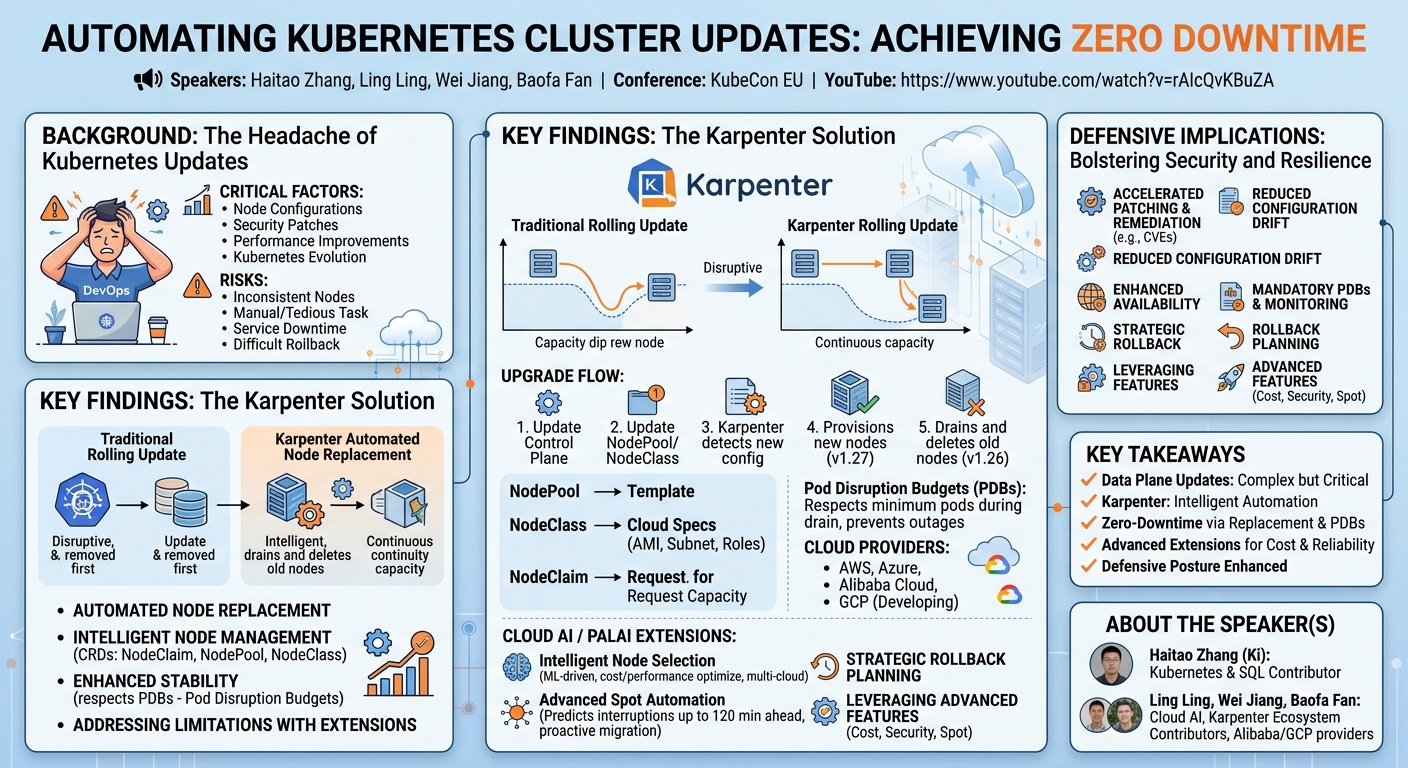
The necessity of regularly updating the Kubernetes data plane, which encompasses the worker nodes running applications, is undeniable. These updates are driven by several critical factors: the need to modify node configurations (such as tweaking kubelet startup parameters or upgrading the underlying operating system), the imperative to apply security patches and benefit from performance improvements introduced in new kubelet versions, and the continuous evolution of Kubernetes itself. Neglecting these updates can lead to severe consequences, including unpatched vulnerabilities, degraded cluster reliability, and significant compatibility issues as the control plane outpaces the data plane.
However, the process of updating the data plane is fraught with challenges. One major risk is inconsistent node configurations or kubelet versions across the cluster, which can lead to unpredictable application behavior and failures. For organizations managing multiple Kubernetes clusters, manual updates become a tedious, resource-intensive task, consuming valuable engineering hours and delaying deployments. Crucially, there's a constant risk of service downtime if workloads are not properly drained and rescheduled during updates, directly impacting service availability. Finally, if something goes wrong mid-update, rolling back the changes can be exceptionally difficult, potentially leading to extended outages without a solid recovery strategy. These complexities underscore the need for a sophisticated, automated approach to Kubernetes data plane management.
Key Findings
▶ Watch: Key challenges and risks of data plane updates (2:00)
The talk's central finding is that Karpenter provides a robust and intelligent solution for automating Kubernetes node updates, significantly mitigating the risks associated with manual processes and traditional update strategies. By adopting Karpenter, organizations can achieve near-zero downtime during data plane upgrades, ensuring continuous application availability.
Key findings include:
- Automated, Disruption-Minimized Node Replacement: Karpenter introduces a "replace" strategy for node updates, which involves provisioning new nodes with the desired configuration before gracefully draining and deleting old nodes. This contrasts with traditional rolling updates that may temporarily reduce cluster capacity and increase disruption risks.
- Intelligent Node Management via Custom Resources: Karpenter leverages Kubernetes Custom Resource Definitions (CRDs) like NodeClaim, NodePool, and NodeClass to abstract and automate the lifecycle management of nodes, allowing it to provision, update, and de-provision instances dynamically based on workload requirements and infrastructure specifications.
- Enhanced Application Stability with Pod Disruption Budgets (PDBs): Karpenter integrates seamlessly with Kubernetes Pod Disruption Budgets (PDBs), respecting application-defined availability constraints during node drains. This ensures that critical applications maintain a minimum number of running pods, preventing service outages during updates.
- Addressing Karpenter's Limitations with Advanced Features: While powerful, Karpenter has limitations such as a lack of gradual update control and built-in rollback mechanisms. The talk highlights how extensions, specifically those developed by Cloud AI/Palai, can overcome these by introducing features like intelligent node selection (optimizing cost and performance across multi-cloud environments using machine learning) and advanced spot instance automation with predictive interruption capabilities.
- Multi-Cloud Agnostic Approach: Karpenter's design supports various cloud providers (AWS, Azure, Alibaba Cloud, GCP in development), making it a versatile tool for diverse cloud environments.
Technical Deep Dive
▶ Watch: Node upgrade strategies: Rolling Update explained (4:00)
The process of upgrading a Kubernetes cluster fundamentally involves two main components: the control plane (master nodes) and the data plane (worker nodes). The control plane must be updated first, followed by the worker nodes. This talk primarily focuses on the intricate process of updating the data plane, where applications reside.
Traditionally, one common method for node updates is a rolling update. In this strategy, nodes are updated one by one:
- A node is cordoned and drained, meaning no new pods are scheduled on it, and existing pods are evicted.
- The old node is deleted.
- A new node with the updated Kubernetes version (e.g., from v1.26 to v1.27) is created and brought online.
- Once the new node is ready, the process repeats for the next node.
While straightforward, rolling updates have several drawbacks. They can lead to a temporary reduction in cluster capacity, as one node is removed before its replacement is fully operational. If evicted pods cannot be rescheduled due to insufficient resources on remaining nodes, or if they have specific requirements that aren't met, this can cause significant disruption to applications. Scaling up the node pool temporarily can mitigate capacity issues, but this adds manual complexity.
Karpenter's Automated Node Replacement Strategy
Karpenter, often mispronounced as "Kipanda" in the talk, offers a more sophisticated "replace" strategy designed to minimize disruption. Instead of immediately deleting an old node, Karpenter first adds a new node running the desired Kubernetes version (e.g., v1.27) to the cluster. This maintains cluster capacity throughout the update process. Once the new node is ready, Karpenter then proceeds to gracefully drain one of the old nodes (v1.26), moving its pods to the newly provisioned node or other existing nodes in the cluster, based on the Kubernetes scheduler's decisions. After the old node is completely drained, it is deleted. This cycle repeats until all nodes in the cluster have been updated.
Karpenter achieves this automation through a set of custom resources:
- NodePool: This is a construct that defines a group of nodes with specific characteristics, such as instance types, disk sizes, and labels, where pods can run. It acts as a template for provisioning nodes.
- NodeClass: This resource defines the cloud-provider-specific infrastructure attributes for nodes. This includes details like the Amazon Machine Image (AMI), subnet, security groups, and IAM roles that the nodes will use. It separates the infrastructure definition from the workload-specific node configuration.
- NodeClaim: This is Karpenter's central mechanism for requesting capacity from the cloud provider. When Karpenter needs to create a node (either for scaling up or for replacement during an update), it creates a NodeClaim. In response, Karpenter interacts with the cloud provider (e.g., AWS EC2, Azure VMs) to provision an instance. Once the instance is created, Karpenter registers it as a Kubernetes node, links it to the NodeClaim, and waits for it to become ready. If a NodeClaim is deleted, Karpenter handles the de-provisioning of the associated cloud instance and the eviction of any pods running on that node.
A crucial aspect of Karpenter's intelligent handling of disruptions is its integration with Pod Disruption Budgets (PDBs). A PDB is a Kubernetes resource that specifies the minimum number or percentage of pods that must remain available during a voluntary disruption (like a node drain). Before draining a node, Karpenter checks if any pods on that node are protected by PDBs. If a node contains pods that cannot be disrupted without violating a PDB, Karpenter will postpone draining that node until the PDB can be satisfied or the problematic pod is removed. This prevents uncontrolled application outages during updates. Karpenter's ability to take a "snapshot" of the cluster to understand the relationships between nodes and pods further enhances its intelligent placement and eviction decisions.
The talk highlights that Karpenter specifically avoids a simplistic rolling update approach due to certain limitations, such as scenarios involving volumes that cannot be simultaneously attached to different nodes, which would cause significant disruption if not handled carefully.
Karpenter's Cloud Provider Support and Current Limitations
Karpenter was initially developed by AWS and donated to the Cloud Native Computing Foundation (CNCF) in 2023, fostering an active community. It supports multiple cloud providers, including AWS, Azure, and Alibaba Cloud (contributed by Cloud Palai), with GCP support actively under development.
Despite its capabilities, Karpenter has some acknowledged limitations:
- No gradual update control: Node updates happen without intermediate state checks or fine-grained controls, meaning an update cannot be paused in progress. This can lead to unintended disruptions if issues arise.
- No built-in fallback strategy: If an update goes wrong (e.g., due to an AMI incompatibility causing service crashes), Karpenter does not offer an automated rollback mechanism, making recovery more challenging and time-consuming.
- Migration-sensitive applications: For applications requiring precise timing for migrations (e.g., real-time gaming), Karpenter's default scaling-down logic might not account for optimal timing, potentially disrupting services.
Cloud AI/Palai's Extensions to Karpenter
To address these limitations and enhance Karpenter's capabilities, Cloud AI (referred to as Cloud Palai in parts of the transcript) offers a managed Karpenter cloud service with intelligent features:
- Intelligent Node Selection: Beyond basic provisioning, Cloud AI analyzes workload characteristics, cost data, and CPU architectures across multiple cloud providers (AWS, Azure, Google Cloud). This machine learning-driven approach ensures that the most cost-effective instances are provisioned while balancing performance and stability, optimizing resource utilization and spend.
- Spot Automation with Advanced Interruption Prediction: Spot instances are highly cost-effective but come with the risk of sudden termination, often with only a few minutes' notice. Cloud AI leverages machine learning, trained on historical patterns, to predict spot instance interruptions up to 120 minutes in advance. This predictive capability is paired with automated migration strategies, allowing workloads to be gracefully moved off an instance before it is reclaimed by the cloud provider. This enables organizations to confidently utilize spot instances for significant cost savings without compromising reliability.
These extensions demonstrate how Karpenter's open architecture can be enhanced to provide smarter scaling, better management, and greater cost savings, ensuring that not just any resources are provisioned, but the right resources at the right time.
Demo / Proof of Concept
▶ Watch: Kipanda's core mechanism for automated node replacement (6:30)
The talk effectively described the intricate mechanisms and benefits of using Karpenter for automated Kubernetes cluster updates, alongside the advanced features offered by Cloud AI/Palai. While the presentation included diagrams and conceptual flows illustrating how Karpenter operates and how Cloud AI enhances its capabilities, it did not feature a live, interactive demonstration or a pre-recorded proof of concept. The speakers focused on explaining the architectural design, the operational flow, and the impact of these solutions on cluster management.
Defensive Implications
▶ Watch: Leveraging Pod Disruption Budgets for stable updates (10:45)
Automating Kubernetes data plane updates with tools like Karpenter has profound defensive implications, significantly bolstering the security posture and operational resilience of cloud-native environments.
- Accelerated Patching and Vulnerability Remediation: The primary defensive benefit is the ability to rapidly deploy security patches and update
kubeletversions. Manual updates are slow and prone to error, leaving clusters vulnerable for longer. Karpenter's automation enables organizations to quickly roll out updates across their node fleet, reducing the window of exposure to newly discovered vulnerabilities (e.g., CVEs impactingkubeletor underlying OS). This is crucial for maintaining a strong security posture in a rapidly evolving threat landscape. - Reduced Configuration Drift and Inconsistency: Inconsistent
kubeletversions or OS configurations across nodes can introduce subtle vulnerabilities or unpredictable behavior that attackers might exploit. Karpenter ensures that all new nodes conform to a definedNodeClassandNodePoolspecification, enforcing consistency and reducing configuration drift. This minimizes the attack surface by eliminating discrepancies that could be leveraged. - Enhanced Availability and Resiliency: By minimizing downtime during updates through its intelligent replacement strategy and PDB awareness, Karpenter inherently improves the availability of critical applications. A highly available system is more resilient to denial-of-service attacks and operational disruptions, ensuring business continuity. Defenders can rely on the underlying infrastructure to remain stable even during necessary maintenance.
- Mandatory Pod Disruption Budgets (PDBs): Defenders must actively implement and enforce Pod Disruption Budgets (PDBs) for all critical applications. While Karpenter respects PDBs, it's the responsibility of the application owner or security team to define them correctly. Properly configured PDBs ensure that even during automated node drains, a minimum number of replicas remain available, preventing service outages that could be exploited or mistaken for an attack.
- Robust Monitoring and Alerting: Even with automation, comprehensive monitoring of the update process is essential. Defenders should implement robust observability solutions to track node lifecycle events, pod evictions, resource utilization, and application health during Karpenter-driven updates. Alerts should be configured for any unexpected failures, prolonged drains, or PDB violations, allowing for rapid response to potential issues or malicious activity.
- Strategic Rollback Planning: Acknowledging Karpenter's current lack of a built-in automated rollback strategy, organizations must develop and test their own manual or custom rollback procedures. This ensures that in the event of a critical failure during an update (e.g., an incompatible AMI or
kubeletversion), the cluster can be quickly reverted to a stable state, minimizing the impact of a failed deployment. - Leveraging Advanced Features for Cost and Security: Solutions like Cloud AI's intelligent node selection and predictive spot instance automation offer additional defensive benefits. By optimizing resource allocation, organizations can reduce unnecessary infrastructure sprawl, which often correlates with a larger attack surface. Predictive spot instance management allows for the safe utilization of cheaper, ephemeral resources, reducing overall operational costs without sacrificing security or availability, thereby freeing up resources for other security initiatives.
- Regular Testing in Staging Environments: Before deploying updates to production, organizations should rigorously test Karpenter's update process in dedicated staging environments. This allows for the identification and resolution of potential compatibility issues, performance regressions, or security misconfigurations in a controlled setting, preventing production incidents.
- Staying Current with Karpenter and Kubernetes: Defenders should commit to staying updated with the latest versions of Karpenter and Kubernetes itself. New releases often include security enhancements, bug fixes, and improved features that contribute to a more secure and stable operating environment.
By proactively adopting Karpenter and integrating it with other defensive strategies, organizations can transform Kubernetes node updates from a high-risk operational burden into a streamlined, secure, and highly automated process.
Key Takeaways
- Kubernetes Data Plane Updates are Critical but Complex: Regular updates are essential for security, performance, and compatibility, but manual processes are prone to errors, downtime, and difficult rollbacks.
- Karpenter Automates Node Lifecycle Management for Safer Updates: Karpenter provides an intelligent, automated solution for provisioning, updating, and de-provisioning Kubernetes nodes, significantly reducing manual effort and operational risk.
- Zero-Downtime Updates via Intelligent Replacement Strategy: Karpenter's approach of adding new nodes before draining old ones, combined with Pod Disruption Budgets (PDBs), enables near-zero downtime updates, maintaining application availability during node upgrades.
- Karpenter's Limitations Drive Innovation: While powerful, Karpenter lacks gradual update control and built-in rollback. This has led to advanced extensions, such as Cloud AI's managed service, offering intelligent node selection and predictive spot instance management.
- Advanced Features Optimize Cost and Reliability: Solutions leveraging machine learning for intelligent node selection across multi-cloud environments and predictive spot instance interruption (up to 120 minutes in advance) significantly enhance cost-efficiency and reliability.
- Defensive Posture is Enhanced by Automation and PDBs: Adopting Karpenter facilitates faster security patching and reduces configuration drift. Implementing robust PDBs is crucial to protect applications during automated disruptions, ensuring continuous service availability.
About the Speaker(s)
Haitao Zhang, known by his GitHub name "Ki," is a key contributor with a primary focus on the Kubernetes project and SQL storage solutions. His expertise lies in the foundational aspects of Kubernetes, particularly around node management and data persistence.
Ling Ling, Wei Jiang, and Baofa Fan are associated with Cloud AI (also referred to as Cloud Palai in the talk), a company focused on enhancing cloud management services. They have made significant contributions to the Karpenter ecosystem, notably by developing and contributing the Alibaba Cloud provider for Karpenter. Their team is also actively working on adding support for Google Cloud Platform (GCP), demonstrating their commitment to expanding Karpenter's multi-cloud capabilities and addressing its inherent limitations through intelligent, managed services. Their work aims to deliver smarter scaling, better management, and greater cost savings for Kubernetes users.
Reviews
Dr. Zero (Offensive Security Researcher) — STRONG ACCEPT
This talk presents a solid operational deep-dive into automating Kubernetes data plane updates using Karpenter, focusing on its 'replace' strategy for minimizing disruption. While Karpenter itself is a known quantity, the presentation effectively details its mechanisms and integration with PDBs. The real value, and what elevates this from 'competent' to 'strong accept,' lies in the discussion of Cloud AI/Palai's extensions, particularly the machine learning-driven intelligent node selection and the genuinely impressive 120-minute predictive spot instance interruption capabilities. This goes beyond basic automation, offering tangible improvements in cost-efficiency and reliability for…
Heather Calloway (CISO) — STRONG ACCEPT
This talk presents Karpenter as a robust, automated solution for managing Kubernetes data plane updates, directly addressing critical challenges around security patching, configuration consistency, and service availability. It offers a clear path to achieving near-zero downtime during upgrades, significantly reducing operational risk and enhancing an organization's resilience. The discussion of Karpenter's limitations and how extensions can overcome them provides a balanced, actionable perspective for security leaders and cloud operations teams.