Why Allyship Matters and Your Role in Creating a More Diverse Cloud Native Community
KubeCon + CloudNativeCon Europe 2025 · Session
Overview
This panel discussion, moderated by Katherine Paganini, delves into the critical importance of allyship in fostering a more diverse and inclusive cloud-native community, with a specific focus on the experiences of deaf and hard of hearing (DHH) individuals. The talk, featuring panelists Anastasia Gupska, Sandeep Parashar, Rob Cotch, and Milad—all prominent members of the CNCF Deaf and Hard of Hearing Working Group—highlights how proactive support from allies can dramatically transform career trajectories and community engagement for underrepresented groups. It underscores that while minorities are by definition a small segment, the collective power of allies can amplify their voices and drive significant, lasting change.
Key moments
- 0:00 Introduction: Why allyship is crucial for community inclusion
- 1:40 Meet the panelists: Diverse backgrounds and DHH involvement
- 3:30 Anastasia's story: How captions opened the door to Kubernetes
- 5:20 Shand on allyship's impact: Amplifying voices and career growth
- 6:40 Shand's career breakthrough: Manager's belief despite hearing impairment
Why Allyship Matters and Your Role in Creating a More Diverse Cloud Native Community
Speakers: Katherine Paganini, Director of Marketing at Buoyant, Co-chair of TAG Contributor Strategy; Anastasia Gupska, SRE/DevOps Engineer at BT British Telecom, CNCF Ambassador; Sandeep Parashar, Lead Software Engineer at Jen, Co-chair of CNCF Deaf and Hard of Hearing Working Group; Rob Cotch, Principal Data Engineer at Slalom, Co-chair of CNCF Deaf and Hard of Hearing Working Group, AWS Data Hero; Milad, Software Engineer at EPAM, Founder of DeFeek YouTube channel
Conference: KubeCon EU
YouTube: https://www.youtube.com/watch?v=1rgZPi2dTvE
Overview
This panel discussion, moderated by Katherine Paganini, delves into the critical importance of allyship in fostering a more diverse and inclusive cloud-native community, with a specific focus on the experiences of deaf and hard of hearing (DHH) individuals. The talk, featuring panelists Anastasia Gupska, Sandeep Parashar, Rob Cotch, and Milad—all prominent members of the CNCF Deaf and Hard of Hearing Working Group—highlights how proactive support from allies can dramatically transform career trajectories and community engagement for underrepresented groups. It underscores that while minorities are by definition a small segment, the collective power of allies can amplify their voices and drive significant, lasting change.
The discussion emphasizes that real progress in Diversity, Equity, and Inclusion (DEI) initiatives often hinges on allies leveraging their privilege and influence to advocate for accessibility. The panelists share compelling personal anecdotes, illustrating how seemingly small acts of allyship have had profound impacts on their professional lives, enabling them to access opportunities, contribute to open-source projects, and ascend in their careers within the highly technical cloud-native ecosystem. This talk serves as a powerful call to action, equipping attendees with actionable strategies to become effective allies and contribute to a more welcoming and equitable environment for everyone in tech.
Background
▶ Watch: Introduction: Why allyship is crucial for community inclusion (0:00)
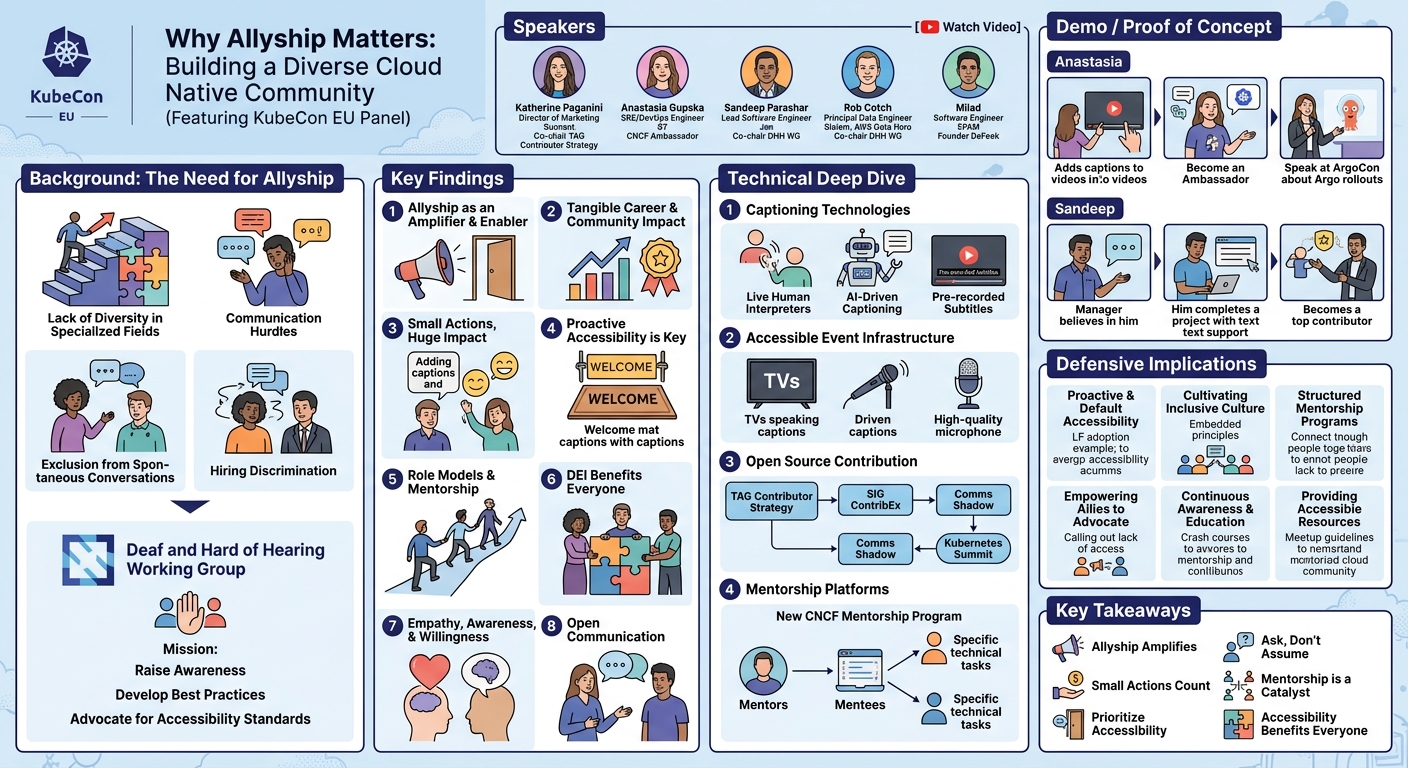
The technology industry, despite numerous DEI initiatives, continues to struggle with a significant lack of diversity, particularly in highly specialized fields like cloud native. Underrepresented groups, including those who are deaf or hard of hearing (DHH), often face systemic barriers that hinder their entry, progression, and full participation in the community. These challenges range from communication breakdowns and lack of accessible resources to unconscious biases and a prevailing assumption that accommodations are unnecessary if DHH individuals are not immediately visible.
Historically, DHH professionals have encountered substantial hurdles, such as difficulty accessing educational materials without captions or sign language interpreters, exclusion from spontaneous conversations, and even outright discrimination in hiring processes due as highlighted by Sandeep's early career struggles. The rapid pace and often auditory-centric nature of technical communication—from conference talks and online tutorials to team meetings and client interactions—exacerbate these issues, creating an environment where DHH individuals must constantly advocate for their basic needs or risk being left behind.
The CNCF Deaf and Hard of Hearing Working Group was established to address these systemic issues directly within the cloud-native landscape. Its mission is to raise awareness, develop best practices, and advocate for accessibility standards across CNCF projects, events, and the broader community. The working group operates under the TAG Contributor Strategy, emphasizing that inclusivity is not merely a social nicety but a strategic imperative for the health and innovation of the entire ecosystem. By creating a dedicated forum for DHH voices and their allies, the group aims to dismantle barriers and ensure that talent and expertise are never overlooked due to a lack of accessibility.
Key Findings
▶ Watch: Meet the panelists: Diverse backgrounds and DHH involvement (1:40)
The panel discussion illuminated several key findings regarding the impact of allyship and the persistent challenges faced by DHH individuals in the tech community:
- Allyship as an Amplifier and Enabler: The most significant finding is that allies serve as crucial amplifiers of DHH voices and enablers of their success. As Anastasia eloquently put it, an ally is "a person who does something very small that becomes a big impact." This amplification helps spread awareness about accessibility needs and ensures that DHH perspectives are not easily ignored.
- Tangible Career and Community Impact: Allyship has a direct, measurable impact on career progression and community involvement. Sandeep's journey from struggling to find a job due to hearing impairment to becoming a top contributor and receiving a CNCF award, directly enabled by a manager's faith and an ally's simple question about captions, exemplifies this. Anastasia's ability to learn Kubernetes and Argo rollouts and subsequently present at ArgoCon was a direct result of an ally adding captions to training videos.
- Small Actions, Huge Impact: The panelists consistently highlighted that allyship doesn't require grand gestures. Simple acts, like adding captions to a video, asking "are the captions working for you?", or proactively considering accommodations before a meeting, can have transformative effects. Katherine emphasized that "just little little steps make a huge have a huge impact."
- Proactive Accessibility is Key: A critical insight is the need for accessibility by default, rather than as an afterthought. The panelists stressed that often, DHH individuals are absent from events or communities precisely because they lack accessibility. As Katherine noted, "There are no deaf people here so we don't need captions. Well, guess why? There are no deaf people because there are no captions." Making events and resources accessible upfront attracts and includes DHH talent.
- Role Models and Mentorship Pave the Way: Having role models and mentors, both DHH and hearing allies, significantly smooths the path for underrepresented groups. Rob's role as a role model for Milad, and the announcement of the CNCF mentorship program, underscore the importance of structured support and guidance in navigating professional challenges and accessing opportunities.
- DEI Benefits Everyone: Rob emphasized that DEI initiatives, when properly integrated into a company's culture, are a "two-way street" that benefits the entire organization. Inclusive environments lead to better products and services, as diverse perspectives inform development and outreach strategies.
- Empathy, Awareness, and Willingness are Core: Sandeep articulated that accessibility is "not rocket science" and doesn't require immense resources. Instead, it primarily needs "a little bit of empathy and of awareness and lots of willingness." Allyship is about internalizing this mindset rather than just performing actions.
- Open Communication is Essential: The panelists encouraged allies to "ask and don't assume" about specific needs and preferences. They stressed that DHH individuals are generally open to discussing their communication requirements and appreciate direct, respectful inquiry over hesitant avoidance.
These findings collectively paint a picture of allyship as an indispensable force for creating truly inclusive and equitable technical communities, demonstrating its power to overcome significant barriers and unlock the full potential of diverse talent.
Technical Deep Dive
▶ Watch: Anastasia's story: How captions opened the door to Kubernetes (3:30)
While this talk is centered on social dynamics and inclusivity, the discussion extensively covers the technical mechanisms and strategic implementations required to achieve accessibility within the cloud-native and broader tech communities. The "technical deep dive" here focuses on how technology and structured approaches are leveraged to bridge communication gaps and facilitate participation for DHH individuals.
1. Captioning Technologies and Services:
The most frequently discussed technical accommodation is captioning. The panel highlighted various forms and their importance:
- Live Human Captioning/Interpreters: The panel itself utilized both British Sign Language (BSL) and American Sign Language (ASL) interpreters on stage, demonstrating a high level of accommodation for a diverse DHH audience. Anastasia, who also uses Ukrainian Sign Language, underscored the complexity of language situations for DHH individuals from different regions.
- AI-Driven Captioning: For smaller meetups or virtual events, the use of AI-powered captioning tools was recommended. Sandeep specifically mentioned a tool called V BY, which he uses for virtual meetups, noting its in-built captioning capabilities. This highlights the increasing reliance on machine learning for real-time transcription, though the accuracy and reliability of such systems can vary.
- Pre-recorded Video Subtitles: Anastasia's breakthrough in learning Kubernetes and Argo rollouts came from an ally, Kostas, who manually added subtitles to his training videos. This emphasizes that even for asynchronous content, quality captions are paramount for technical education and skill development. The effort involved in creating accurate subtitles for complex technical topics is non-trivial but incredibly impactful.
2. Accessible Event and Meeting Infrastructure:
The panelists provided specific technical guidelines for making events accessible, which are also available on the CNCF DHH working group website:
- Physical Setup for Captions: For local meetups, recommendations include bringing a TV screen and hooking it up for live caption display. This simple setup, often combined with an AI captioning app, can significantly improve accessibility.
- Microphone Usage: In both physical and virtual settings, clear audio input is crucial for effective captioning. Sandeep mentioned that good microphones can be a small but impactful investment for smooth communication, especially in small group discussions or virtual interviews.
- Proactive Accommodation Planning: Milad stressed the importance of asking about accommodation needs before meetings. This implies a technical and logistical preparedness to integrate sign language interpreters, captioning services, or other assistive technologies into the meeting infrastructure from the outset, rather than reactively.
3. Open Source Contribution and Mentorship Platforms:
The discussion touched upon the technical pathways for DHH individuals to contribute to open-source projects:
- CNCF Landscape Navigation: Sandeep’s journey through the TAG Contributor Strategy meeting, the SIG ContribEx group, and ultimately becoming a Comms Shadow for the Kubernetes Contributor Summit, illustrates a structured path within the CNCF ecosystem. Allyship here involved ensuring he could follow these technical discussions and contribute effectively, leading to his understanding of the steering committee and technical oversight committee.
- Mentorship Programs: Katherine announced a new CNCF mentorship program specifically designed to connect underrepresented groups with mentors. This program provides a formal structure for knowledge transfer, career guidance, and technical skill development. Mentors can choose to help with specific tasks like teaming up for a talk, career advice, or contributing to open source, tailoring the technical engagement to individual needs. This is a critical technical infrastructure for talent development.
4. Communication Strategies and Tools:
Beyond formal accommodations, the panelists discussed pragmatic technical and non-technical communication strategies:
- Text-Based Communication: For situations where interpreters or captions are unavailable, basic tools like texting on phones or even pen and paper serve as fallback communication methods. This underscores the need for flexibility and adaptability in communication.
- Visual Communication: Milad, as the founder of DeFeek, a YouTube channel focused on deafness and technology, leverages video as a primary medium to share technical knowledge, often with visual aids and captions, directly addressing the needs of the DHH community.
- Presentation Design: Sandeep mentioned that he prepares his presentations using "minimal images" to make them accessible for visually challenged individuals, demonstrating a broader technical consideration for universal design in content creation.
In essence, the "technical deep dive" reveals that allyship in the cloud-native community is deeply intertwined with the thoughtful implementation and strategic use of various technologies and structured programs to ensure that DHH individuals can fully engage with, contribute to, and lead in this highly technical domain.
Demo / Proof of Concept
▶ Watch: Shand on allyship's impact: Amplifying voices and career growth (5:20)
While this panel discussion did not feature a traditional technical "demo" of a security exploit or a new software feature, it served as a powerful proof of concept for the profound impact of allyship in fostering inclusion and enabling career advancement within the cloud-native community. The panelists' personal stories and achievements functioned as living demonstrations of allyship's tangible value.
1. Anastasia Gupska's Journey to CNCF Ambassadorship and ArgoCon Speaker:
Anastasia presented a compelling proof of concept for how a simple act of allyship can unlock significant technical opportunities. When she moved to the UK and needed to upskill in Kubernetes, she encountered online workshops lacking captions. Her request to the content creator, an ally, resulted in him "absolutely no problem" adding captions to his training videos. This single act enabled Anastasia to "access the world of Kubernetes." The direct result? She became a CNCF Ambassador and presented at ArgoCon, demonstrating her deep technical understanding of Argo rollouts. This scenario directly proved that providing accessible learning materials can transform a learner into a recognized expert and community leader. Furthermore, her mentor, Kostas, created subtitled videos explaining complex Argo concepts, enabling her to justify automatic deployments and the business case for Argo rollouts within her organization, showcasing a direct link between allyship and organizational technical efficiency.
2. Sandeep Parashar's Rise to Top Contributor and CNCF Awardee:
Sandeep's narrative provided another strong proof of concept. Faced with initial hiring discrimination ("no one was willing to hire a person who cannot listen over the phone"), an ally—his first manager—chose to "believe in me." This foundational allyship allowed him to start his career in a "wonderfully inclusive company" where he rose to become the "top contributor." A specific demonstration of allyship's power occurred during a client deployment. Confronted with a client whose thick beard made lip-reading impossible, his manager texted him, "You just focus on your work. Don't worry about anything else." This support enabled Sandeep to complete a complex project ahead of schedule, proving that with the right support, disability does not hinder excellence. His subsequent journey to becoming a Comms Shadow for the Kubernetes Contributor Summit and receiving a CNCF award within six months of starting his open-source journey, was a direct testament to the "numerous allies who empowered" him.
3. Milad's Advocacy and Rob Cotch's Mentorship:
Milad, born deaf, demonstrated the power of self-advocacy and community building through his DeFeek YouTube channel, which produces videos "regarding deafness and technology and improving the work conditions for people who are deaf and heart of hearing." This initiative serves as a proof of concept for leveraging platforms to share knowledge and best practices for DHH individuals in tech. Rob Cotch, an AWS Data Hero and co-chair of the DHH working group, was cited by Milad as a "tremendous role model," demonstrating how visible DHH leaders can inspire and mentor others, expanding "the road wider for us to get into more places we weren't able to get into before." This highlights the "proof" that representation and mentorship directly facilitate access and growth.
In essence, the "demo" of this talk was the collective success and impactful contributions of the panelists themselves, directly attributed to the power of allyship. Their stories provided concrete, real-world evidence that inclusive practices, driven by empathetic allies, lead to tangible, positive outcomes for individuals and the broader technical community.
Defensive Implications
▶ Watch: Shand's career breakthrough: Manager's belief despite hearing impairment (6:40)
In the context of this discussion, "defensive implications" refers to the strategies and actions the cloud-native community and organizations can adopt to defend against exclusion, build a more resilient and inclusive environment, and proactively mitigate barriers for underrepresented groups, particularly DHH individuals. These implications are crucial for fostering a robust and diverse talent pool that can collectively innovate and solve complex technical challenges.
1. Proactive and Default Accessibility:
The most significant defensive implication is the need to shift from reactive accommodations to proactive, default accessibility. As Katherine emphasized, the absence of DHH individuals often stems from the lack of accessibility, not a lack of interest. Organizations and event organizers must implement accessibility features, such as captions and sign language interpreters, as standard practice for all events, videos, and online meetings. This "accessibility by default" approach defends against the silent exclusion of potential contributors and attendees. The Linux Foundation's rapid adoption of best practices after being approached by the DHH working group serves as a powerful example of how quickly positive change can be enacted when organizations commit.
2. Cultivating an Inclusive Organizational Culture:
Rob Cotch highlighted that when allyship is "built into a company's culture," it significantly eases support for underrepresented groups. This means integrating DEI principles beyond mere initiatives, making them "second nature." A truly inclusive culture defends against unconscious biases, promotes equitable opportunities, and ensures that diverse perspectives are valued in decision-making and product development. This cultural shift creates an environment where DHH employees feel empowered to contribute their best work, rather than constantly battling for basic accommodations.
3. Structured Mentorship and Support Programs:
The announcement of the CNCF mentorship program is a direct defensive measure against career stagnation and lack of access for underrepresented groups. By formally connecting experienced professionals with mentees from marginalized communities, the program defends against the informal networks and biases that often limit opportunities. Mentorship helps DHH individuals navigate career paths, gain technical skills, and develop self-advocacy, as Milad noted, impacting "future generations of people in tech." This structured support system builds individual resilience and collective strength.
4. Empowering Allies to Advocate and "Call Out":
Allies play a critical defensive role by actively advocating for accessibility and "calling out" instances of non-compliance. Anastasia encouraged allies to "call out lack of accessibility" in organizations and events. This means using their privilege and influence to challenge the status quo, ensuring that organizers are held accountable for creating inclusive environments. Such advocacy defends against complacency and forces organizations to improve their accessibility standards, thereby expanding the reach and impact of the community.
5. Continuous Awareness and Education:
The DHH working group's activities, such as the sign language crash course and open discussions, serve as defensive mechanisms against ignorance and misunderstanding. By raising awareness about DHH experiences and communication needs, these initiatives equip allies with the knowledge and empathy required to act effectively. Understanding that accessibility "is not really rocket science" but requires "a little bit of empathy and of awareness and lots of willingness" is fundamental. This continuous education helps to internalize allyship, making it an inherent part of community interaction.
6. Providing Accessible Resources and Guidelines:
The existence of detailed instruction sheets and guidelines on the CNCF DHH working group website for hosting accessible meetups and conferences is a practical defensive tool. These resources empower event organizers, even those with limited budgets or experience, to implement basic to advanced accommodations. By providing clear, actionable steps (e.g., using a TV screen with AI captioning, recommended microphone setups), the community defends against the excuse of "not knowing where to start."
In summary, the defensive implications from this talk are about proactively building a resilient, inclusive cloud-native community that actively champions accessibility, nurtures diverse talent, and systematically dismantles the barriers that have historically excluded DHH individuals. This collective effort strengthens the community as a whole, making it more innovative, equitable, and sustainable.
Key Takeaways
- Allyship Amplifies and Enables: Allies play a crucial role in amplifying the voices of DHH individuals and enabling their access to opportunities, career growth, and full participation in the cloud-native community.
- Small Actions Create Big Impact: Even seemingly minor acts of allyship, such as adding captions to a video, asking about accommodation needs, or simply acknowledging an individual's presence, can have profound and transformative effects on someone's career and life.
- Prioritize Proactive Accessibility: Accessibility should be implemented by default, rather than reactively. Events, resources, and platforms must be designed with inclusivity in mind from the outset to avoid excluding potential DHH contributors and attendees.
- "Ask, Don't Assume": Direct, open, and respectful communication about individual accessibility preferences and needs is vital. Allies should feel comfortable asking what is required rather than making assumptions or avoiding interaction.
- Mentorship is a Catalyst for Growth: Structured mentorship programs and supportive role models are essential for helping underrepresented groups navigate career paths, develop technical skills, and advocate for themselves within the tech industry.
- Accessibility Benefits Everyone: Fostering a culture of allyship and accessibility not only empowers DHH individuals but also enriches the entire organization and community, leading to better products, services, and a more vibrant ecosystem.
About the Speaker(s)
- Katherine Paganini: Director of Marketing at Buoyant, the creator of Linkerd. She is also the co-chair of the TAG Contributor Strategy, where she facilitates the Deaf and Hard of Hearing Working Group. Katherine moderated the panel and is a strong advocate for inclusivity in the cloud-native community.
- Anastasia Gupska: An SRE/DevOps Engineer at BT British Telecom and the first CNCF Ambassador who is deaf. She is a member of the Deaf and Hard of Hearing Working Group and shared her personal journey of using British Sign Language (BSL), American Sign Language (ASL), and Ukrainian Sign Language, emphasizing the impact of captioning on her learning and career.
- Sandeep Parashar: A Lead Software Engineer at Jen and a co-chair of the CNCF Deaf and Hard of Hearing Working Group, as well as a member of the TAG Contributor Strategy. He is a person with hearing impairment who relies on captions and lip-reading, sharing his experiences of career progression and open-source contributions through allyship.
- Rob Cotch: A Principal Data Engineer at Slalom, co-chair of the CNCF Deaf and Hard of Hearing Working Group, and an AWS Data Hero. He provided insights into the benefits of DEI for organizations and the importance of role models.
- Milad: A Software Engineer at EPAM with approximately 10 years of experience. Born deaf, he is also the founder of DeFeek, a YouTube channel dedicated to videos about deafness, technology, and improving work conditions for DHH individuals. He highlighted the significance of role models and accessible communication.
Reviews
Dr. Zero (Offensive Security Researcher) — STRONG ACCEPT
This panel, featuring DHH leaders from the CNCF working group, cuts through the typical DEI platitudes to deliver a brutally honest and actionable account of allyship and accessibility in the cloud-native space. It's not a rehashed awareness session; it's a direct exposition of how specific technical accommodations—from captioning tools to structured mentorship—and simple human empathy directly enable talent and accelerate careers. The speakers' personal journeys serve as compelling proof-of-concept for the profound impact of proactive inclusivity, making it clear that accessibility isn't a social nicety, but a strategic imperative for the health of any technical ecosystem.
Heather Calloway (CISO) — STRONG ACCEPT
This panel provided a clear and unsentimental look at the critical role of allyship in fostering diversity, particularly for deaf and hard of hearing individuals, within the cloud-native community. It underscored that proactive accessibility and cultural shifts are not just social niceties but strategic imperatives that directly impact talent acquisition, innovation, and organizational resilience. The speakers' personal stories served as compelling evidence of how small acts of allyship can unlock significant career growth and technical contributions, offering actionable pathways for leaders and individual contributors to drive real institutional change.