Navigating the Waters: Balancing Open Source Activities in Corporate... Kim McMahon & Amanda Katona
Kim McMahon, Amanda Katona
KubeCon + CloudNativeCon Europe 2025 · Session
Overview
In the dynamic landscape where open source innovation meets corporate imperatives, the KubeCon EU talk "Navigating the Waters: Balancing Open Source Activities in Corporate Environments" by Kim McMahon and Amanda Katona offered a pragmatic framework for aligning open source contributions with tangible business objectives. This presentation tackled the often-unspoken tension between community-driven development and the corporate need for revenue generation, providing actionable strategies for organizations to bridge this gap effectively. McMahon, leveraging her extensive background in open source marketing, and Katona, with her deep experience in open source data infrastructure and Kubernetes, delivered a talk grounded in real-world challenges and solutions.
Key moments
- 0:00 Introduction and speaker backgrounds
- 2:00 Connecting open source activities with corporate goals
- 2:30 Addressing the 'elephant in the room': open source revenue
- 4:00 The importance of creating an open source charter
- 4:30 Practical steps: interviewing stakeholders for charter creation
- 6:15 How to craft and refine the team charter document
- 7:30 Defining clear and concise strategic objectives (max three)
Navigating the Waters: Balancing Open Source Activities in Corporate Environments
Speakers: Kim McMahon, Head of Marketing, Cedaro; Amanda Katona, NetApp Instacluster
Conference: KubeCon EU
YouTube: https://www.youtube.com/watch?v=Lkpjq4nybdE
Overview
In the dynamic landscape where open source innovation meets corporate imperatives, the KubeCon EU talk "Navigating the Waters: Balancing Open Source Activities in Corporate Environments" by Kim McMahon and Amanda Katona offered a pragmatic framework for aligning open source contributions with tangible business objectives. This presentation tackled the often-unspoken tension between community-driven development and the corporate need for revenue generation, providing actionable strategies for organizations to bridge this gap effectively. McMahon, leveraging her extensive background in open source marketing, and Katona, with her deep experience in open source data infrastructure and Kubernetes, delivered a talk grounded in real-world challenges and solutions.
The core of their discussion revolved around the necessity of strategic planning, clear communication, and measurable outcomes for open source initiatives within a commercial setting. They posited that open source activities, far from being a separate or purely altruistic endeavor, must be integrated into the broader corporate strategy, contributing directly or indirectly to the bottom line. This perspective is particularly crucial in today's cloud-native ecosystem, where open source projects form the bedrock of countless commercial products and services, yet their strategic value can be notoriously difficult to quantify.
Ultimately, this talk matters because it equips organizations and individual contributors alike with the tools to articulate the value of their open source work in business terms. By demystifying the process of connecting community engagement to corporate goals, McMahon and Katona provided a roadmap for fostering sustainable open source involvement that benefits both the community and the company. It’s a vital conversation for anyone navigating the complexities of open source in a profit-driven environment, from engineers and product managers to marketing professionals and executives.
Background
▶ Watch: Introduction and speaker backgrounds (0:00)
The fundamental challenge addressed by Kim McMahon and Amanda Katona stems from a historical and often lingering perception within the open source community that "revenue" is a "bad name" or a concept antithetical to the spirit of open collaboration. This perspective, while understandable in its purest form, clashes directly with the realities of corporate operations, where even the most ardent open source advocates must justify their existence and contributions in terms of business value. Organizations, regardless of their commitment to open source, need to generate revenue to cover operational costs, pay salaries for engineers, product managers, sales, and marketing teams, and fund future innovation. This creates an inherent tension: how can a company contribute meaningfully to open source communities while simultaneously ensuring those efforts support its financial sustainability?
The problem is exacerbated by the distributed nature of open source work within many large organizations. Often, open source engineers report directly to product managers whose primary focus is on shipping revenue-generating products, leading to a misalignment of goals where open source contributions may be deprioritized or viewed as ancillary. This can result in isolated teams, a lack of cohesive strategy, and an inability to demonstrate the broader impact of open source activities on corporate objectives. Without a clear framework, open source efforts risk becoming unmoored from the company's strategic direction, making it difficult to secure continued investment and resources.
Prior to such frameworks, companies often struggled with ad-hoc open source engagement, lacking a structured approach to measure return on investment or even define what "success" looked like for their community involvement. This talk builds upon the growing recognition that successful open source engagement in a corporate context requires intentional strategy, much like any other business unit. It acknowledges that the open source community has matured, and with it, the need for sophisticated models that allow companies to be good citizens while also thriving commercially. The speakers aim to provide that missing structure, enabling organizations to move beyond mere participation to strategic leadership in open source.
Key Findings
▶ Watch: Addressing the 'elephant in the room': open source revenue (2:30)
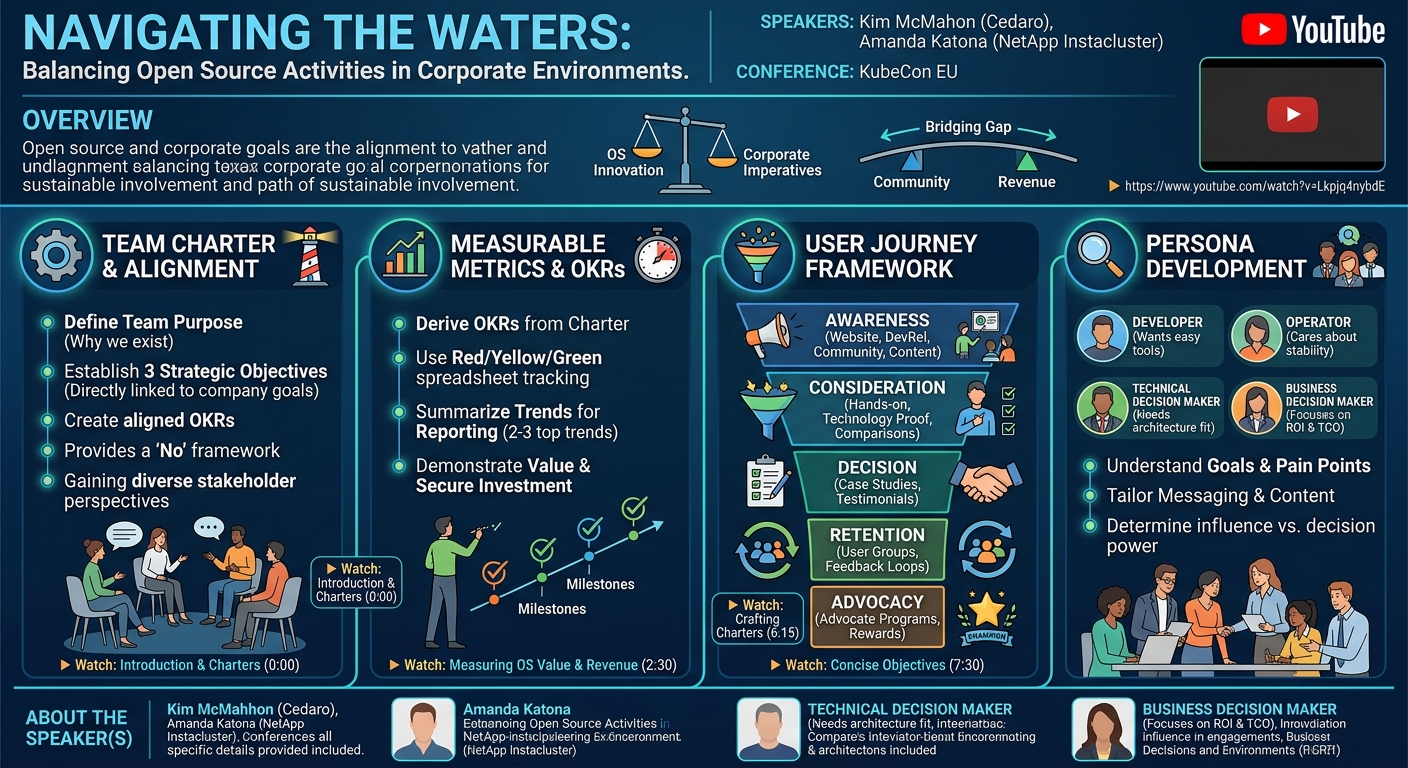
The core findings of McMahon and Katona's presentation revolve around a suite of interconnected strategic and operational frameworks designed to harmonize open source activities with corporate objectives. These findings provide a clear pathway for organizations to navigate the complexities of this balance.
Firstly, the absolute necessity of a team charter emerged as a foundational element. This charter is not merely a bureaucratic document but a living framework that defines the open source team's purpose, strategic objectives, and how its success will be measured, critically linking these to overarching company goals. It serves as a communication tool, an alignment mechanism, and a powerful instrument for the team to define its scope and, importantly, to say "no" to activities that do not serve its approved mission.
Secondly, the talk emphasized the critical role of metrics and Objectives and Key Results (OKRs) in translating the charter's high-level objectives into measurable, quarterly actions. By adopting OKRs, organizations can track progress, identify areas needing attention, and demonstrate tangible contributions. The presenters highlighted the practical application of OKRs, deriving objectives directly from the charter to streamline the process and minimize internal debate.
Thirdly, the concept of a user journey was presented as a vital tool for understanding how users interact with open source projects and technologies, from initial discovery to becoming advocates. This framework, adapted from traditional sales and marketing funnels, helps teams strategically plan their engagement efforts across different stages: Awareness, Consideration, Decision, Retention, and Advocacy. Understanding this journey allows for targeted communication and content strategies.
Finally, the talk underscored the importance of persona development. Before engaging users along the journey, teams must deeply understand who they are talking to—be it developers, operators, technical decision-makers, or business decision-makers. Crafting detailed personas, including their goals, pain points, and motivations, ensures that all content and engagement efforts are relevant, valuable, and impactful. These combined findings offer a robust, integrated approach to ensuring open source activities are not just productive but also strategically aligned and demonstrably valuable to the corporate entity.
Technical Deep Dive
▶ Watch: The importance of creating an open source charter (4:00)
While the talk doesn't delve into code or specific security protocols, its "technical deep dive" lies in its rigorous exposition of organizational and strategic frameworks. These methodologies provide a structured, almost engineering-like approach to managing the complex interplay between open source contributions and corporate goals.
The cornerstone of this approach is the team charter. Amanda Katona detailed a precise, multi-step process for its creation. It begins with extensive stakeholder interviews: "15-minute interviews with as many people as possible," ranging from individual contributors to the CEO. During these interviews, four key questions are posed:
- Do you have experience working with open source or developer teams?
- What's your view on how things are currently working?
- What's going to define success for you?
- What are the expectations of the program itself?
This data-gathering phase, which Katona noted can involve speaking with "over 30 people," is crucial for gaining diverse perspectives and building early alignment. Following this, the charter is drafted and then shared with the team for iterative feedback, encouraging them to "trash it" and challenge assumptions, ensuring collective ownership. The charter itself comprises several critical components: a clear statement of "Why does this team exist?", typically a paragraph that can be reused for new hires; a concise list of three strategic objectives ("Anything over three, you're probably going to fail"); a definition of "What does success look like?"; and an outline of "How you're going to do it." This structured document becomes the north star for the open source team.
Building on the charter, the talk introduced Objectives and Key Results (OKRs) as the primary mechanism for measuring progress and ensuring accountability. Katona explained that the charter's approved strategic objectives directly become the OKRs' objectives, eliminating debate. Key Results are then specific, measurable actions to be completed within a quarter. For tracking, she recommended a simple spreadsheet using color codes (red, yellow, green) and percentage completion to provide immediate visual feedback on progress. Reporting involves summarizing "two to three top trends" from the data, rather than overwhelming stakeholders with raw numbers, allowing for deeper dives if questions arise. Kim McMahon exemplified this by discussing her use of similar spreadsheets to track Marketing Qualified Leads (MQLs), correlating them with various indicators to understand performance trends.
The article then moved to the user journey, a framework adapted for open source and technology adoption. This journey consists of five distinct stages:
- Awareness: The initial phase where users learn about the project or technology. Tools include websites, events, content, social media, and crucially, the involvement of DevRel (Developer Relations) and community teams.
- Consideration: Users actively evaluate the technology. This involves getting "hands-on" – downloading an open source project, trying a product, or engaging in a demo/proof of concept. Strategies include well-placed website calls-to-action and targeted emails with "high-value content" like "technology proof" and comparisons.
- Decision: Users commit to adopting the technology. Marketing and advocacy teams work closely with sales (if applicable), utilizing case studies and testimonials to demonstrate real-world applicability and build trust, even for open source projects.
- Retention: Keeping existing users engaged. This is primarily the responsibility of support and product teams but is aided by marketing, advocacy, and community efforts through regular interactions, user groups, and feedback loops.
- Advocacy: The ultimate goal, where users become proponents, promoting the technology without being asked. This can be nurtured through advocate programs and reward systems.
Crucial to the user journey is persona development. McMahon stressed the importance of knowing "who we're talking to." Personas go beyond job titles, detailing "what they care about," "what's their goal," "why would they be looking for something new," and "what's at stake if they don't solve the problem." She presented an example chart showing the depth of detail, including whether they are a user, influencer, technical decision-maker (often an operator), or business decision-maker. This deep understanding informs content creation and engagement strategies, ensuring relevance and value for each target audience.
Finally, the talk synthesized these elements, illustrating how different teams contribute across the user journey phases. The Awareness phase is largely driven by marketing, community, and DevRel, with others "dragged along." Consideration brings in sales to help users understand benefits and get hands-on. The Decision phase heavily relies on case studies and testimonials to prove the technology's efficacy in the user's environment. This integrated approach ensures that all efforts are coordinated and strategically aligned.
Demo / Proof of Concept
▶ Watch: How to craft and refine the team charter document (6:15)
While the presentation did not feature a live technical demonstration, McMahon and Katona effectively provided "proofs of concept" through three distinct real-world organizational examples. These case studies illustrated how their frameworks—charters, OKRs, user journeys, and personas—can be applied to solve common challenges faced by companies engaged in open source.
The first example described a restructuring within a large vendor with multiple open source projects and for-sale products. The problem was significant: open source engineering teams were distributed, reporting into product managers with product-specific goals, leading to isolated engineers, a lack of cohesiveness, and no clear open source engagement metrics. The solution involved "pulling everybody together into a group" to foster cohesiveness, implement processes, and establish open source metrics. This included creating a shared charter, facilitating knowledge sharing between communities, and securing general manager approval. The results were compelling: improved team "stickiness" and satisfaction due to relevant goals, and the implementation of processes that led to a 90% customer resolution rate for issues originating in open source projects, significantly enhancing customer support.
The second example focused on a smaller organization bringing in its first marketing or advocacy hire. Prior to this, the company struggled with growth, lacking leads for its revenue-generating products and community growth for its open source project. The solution was to hire a Head of Marketing to develop a comprehensive strategy and messaging, prioritizing research into past efforts and, crucially, setting up robust tracking mechanisms for data collection. The executed plan concentrated on awareness and technology proof. Through dedicated efforts in SEO, PR, additional content creation, and increased social media presence, the organization achieved impressive results: web metrics grew three times (pages visited and time on site), the number of names in their database doubled month-over-month, and product trials also doubled. This demonstrated the power of strategic, data-driven marketing in a nascent open source/product environment.
The third and final example presented an established, large cloud-native vendor that contributed to, created, and used open source technology within its products. The challenge here was a looming planning cycle where the organization realized it was "just going through the motions," lacking innovation and relevance. The solution involved a radical shift: "questioning everything," "thinking differently," and reconnecting with core company goals. This required intensive brainstorming sessions to identify what the company "should actually be doing" to remain relevant. Key actions included "doubling down" on effective content (shifting from blogs to short-form video, acknowledging attention spans "under two minutes"), increasing presence at conferences through CFPs (Call for Papers) to spread awareness and give back to the community, and tightly integrating these efforts with marketing's user journey. The outcome was successful: the team "continued to be relevant and their team kept their jobs," highlighting the critical importance of continuous strategic re-evaluation and adaptation to market trends.
These examples collectively served as powerful evidence that the presented frameworks are not just theoretical constructs but practical, impactful tools for aligning open source activities with corporate success across different organizational contexts and stages of maturity.
Defensive Implications
▶ Watch: Defining clear and concise strategic objectives (max three) (7:30)
For organizations, the defensive implications of McMahon and Katona's talk are profound, centering on the strategic protection and optimization of their open source investments. In this context, "defensive" refers to the proactive measures companies can take to safeguard their resources, maintain relevance, and ensure that their open source efforts contribute positively to their long-term viability, rather than becoming a drain or a source of internal conflict.
Firstly, implementing a team charter acts as a crucial defensive mechanism against resource sprawl and misaligned efforts. Without a clear charter, open source teams can easily become fragmented, pursuing ad-hoc projects that may not serve the company's strategic goals. The charter provides a "framework and gives you the ability to say no," protecting the team from distractions and ensuring resources are focused on high-impact activities. This prevents the costly scenario of engineers working in isolation on projects that lack clear business relevance or do not advance the company's core mission.
Secondly, the adoption of OKRs and rigorous metrics defends against the risk of unquantifiable value. In a corporate environment, activities that cannot demonstrate measurable impact are vulnerable to budget cuts and reduced headcount. By tying open source contributions to specific, approved objectives and tracking them with clear key results, organizations can defend the value of their open source programs to executives. This ensures continued investment and prevents the perception that open source is merely a cost center rather than a value driver. The ability to report "two to three top trends" from data provides a concise, defensible narrative of progress.
Thirdly, understanding and mapping the user journey and developing detailed personas offers a defense against ineffective communication and engagement. Generic content or engagement strategies often fail to resonate with diverse user groups, leading to wasted marketing spend and missed opportunities for community growth. By tailoring content to specific personas at different stages of their journey (e.g., "technology proof" for consideration, "case studies" for decision), companies can ensure their messaging is impactful and efficient, maximizing the return on their outreach efforts. This proactive approach prevents the erosion of community trust and ensures that advocacy efforts are organic and genuine.
Finally, the talk's emphasis on continuous relevance and adaptation, particularly highlighted in the third example, serves as a defense against stagnation and obsolescence. The cloud-native landscape evolves rapidly; relying on outdated content strategies (e.g., blogs when "people are watching videos" with "attention spans are under two minutes") or neglecting community engagement through conferences can lead to a loss of influence and market position. By continually questioning assumptions, brainstorming new approaches, and aligning with evolving company goals and user behaviors, organizations can proactively defend their strategic position and ensure their open source contributions remain impactful and innovative. This proactive vigilance is essential for long-term sustainability and competitive advantage in the open source-driven tech industry.
Key Takeaways
- Embrace Revenue as an Open Source Reality: Organizations must accept and integrate the necessity of revenue generation into their open source strategy to ensure sustainability and continued contributions.
- Establish a Clear Team Charter: A well-defined charter, built through broad stakeholder interviews and iterative feedback, is critical for aligning open source activities with corporate goals, providing direction, and empowering teams to prioritize effectively.
- Leverage OKRs for Measurable Impact: Translate charter objectives into specific, measurable OKRs to track progress, demonstrate value, and secure ongoing investment for open source initiatives, using simple tracking methods like color-coded spreadsheets.
- Map the Open Source User Journey: Understand the five stages (Awareness, Consideration, Decision, Retention, Advocacy) to tailor engagement strategies and content, ensuring effective communication and maximum impact at each step.
- Develop Detailed User Personas: Deeply understand target users—developers, operators, decision-makers—by identifying their goals, pain points, and motivations to create relevant and valuable content and engagement programs.
- Adapt and Stay Relevant: Continuously evaluate and adapt open source strategies, content formats (e.g., video over blogs), and community engagement methods (e.g., conferences) to align with evolving user behaviors and market trends, ensuring the team's ongoing value and impact.
About the Speaker(s)
Kim McMahon is the Head of Marketing with Cedaro. She has an extensive background working with open source communities, a journey she began alongside Amanda Katona in 2017. Her experience includes marketing for open source foundations and working for organizations that managed both open source projects and for-profit products, giving her a unique perspective on balancing these often-divergent interests.
Amanda Katona works with NetApp Instacluster, focusing on open source data infrastructure. She has been deeply involved with the Kubernetes journey for over a decade, contributing significantly to the community. Her expertise lies in understanding the technical and community aspects of open source, and she is passionate about sharing her learned experiences to help others navigate the open source landscape within corporate environments.
Reviews
Dr. Zero (Offensive Security Researcher) — STRONG ACCEPT
This KubeCon talk by McMahon and Katona delivers a surprisingly robust framework for organizations to strategically manage and justify their open source contributions. While not a technical deep-dive into code, it provides concrete, actionable methodologies—team charters, OKRs, user journeys, and persona development—that translate open source efforts into measurable business value. It cuts through the typical corporate platitudes, offering a pragmatic roadmap for aligning community engagement with revenue generation, backed by tangible examples of impact across different organizational scales.
Heather Calloway (CISO) — STRONG ACCEPT
This KubeCon talk by McMahon and Katona delivers a highly valuable and pragmatic framework for integrating open source activities into corporate strategy. It compellingly addresses the critical tension between community-driven development and corporate revenue goals, offering actionable methodologies like team charters, OKRs, user journeys, and persona development. The presentation excels at translating the often-ambiguous value of open source contributions into measurable business impact, providing executives and leaders with the tools to ensure strategic alignment, clear accountability, and sustained investment in open source initiatives.