Was Leslie Lamport Right? - Sarah Christoff, Edera & Nic Jackson, Hashicorp
Sarah Christoff, Edera, Nic Jackson, Hashicorp
KubeCon + CloudNativeCon Europe 2025 · Session
Overview
In this engaging KubeCon EU talk, "Was Leslie Lamport Right?", Sarah Christoff and Nic Jackson take attendees on a journey through the foundational concepts of distributed systems, as pioneered by computer science legend Leslie Lamport. Far from a dry academic lecture, the speakers weave a captivating historical narrative, drawing parallels between ancient Byzantine military strategies and modern computing challenges. The core question posed is whether Lamport's theories, developed decades ago with "pen and paper," remain relevant and accurate in today's complex, cloud-native environments.
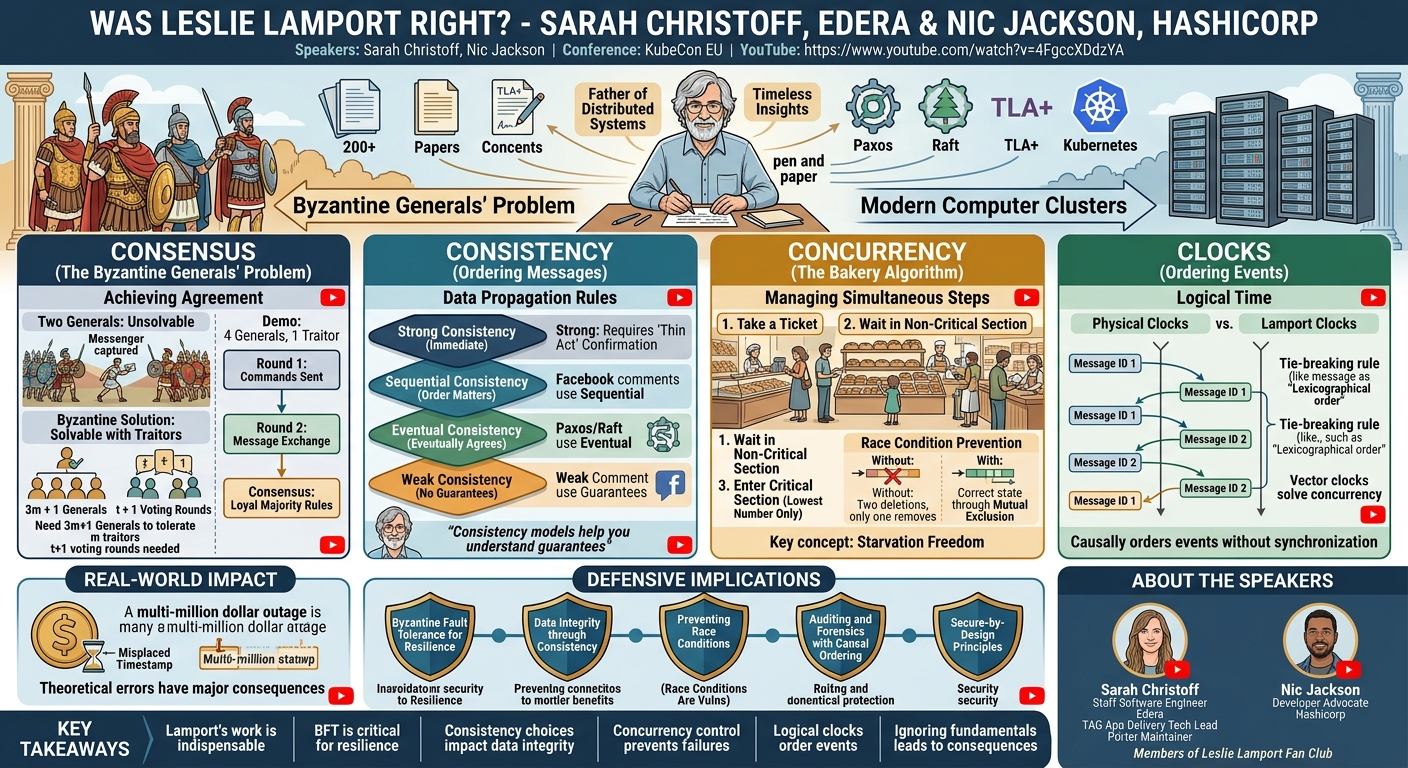
Key moments
- 0:00 Speakers introduction and talk agenda
- 1:00 Leslie Lamport's enduring influence on distributed systems
- 1:47 Introducing the Byzantine Generals Problem theme
- 4:00 The Two Generals Problem: why it's unsolvable
- 6:00 Byzantine Generals Problem with traitors and conflicting information
- 7:45 The solution: how four generals can tolerate one traitor
Was Leslie Lamport Right? - Sarah Christoff, Edera & Nic Jackson, Hashicorp
Speakers: Sarah Christoff, Staff Software Engineer, Edera; Nic Jackson, Developer Advocate, Hashicorp
Conference: KubeCon EU
YouTube: https://www.youtube.com/watch?v=4FgccXDdzYA
Overview
In this engaging KubeCon EU talk, "Was Leslie Lamport Right?", Sarah Christoff and Nic Jackson take attendees on a journey through the foundational concepts of distributed systems, as pioneered by computer science legend Leslie Lamport. Far from a dry academic lecture, the speakers weave a captivating historical narrative, drawing parallels between ancient Byzantine military strategies and modern computing challenges. The core question posed is whether Lamport's theories, developed decades ago with "pen and paper," remain relevant and accurate in today's complex, cloud-native environments.
The presentation meticulously unpacks four critical pillars of distributed systems: consensus, consistency, concurrency, and clocks. Christoff and Jackson not only explain these concepts but also contextualize them within Lamport's original papers, using the famous Byzantine Generals' Problem as a recurring storytelling device. Their goal is to demonstrate Lamport's enduring influence on technologies like Kubernetes, Paxos, and Raft, and to highlight the practical implications of understanding these deep theoretical underpinnings for anyone building or operating distributed applications.
This talk is particularly important for software engineers, architects, and anyone involved in designing reliable and robust systems. It underscores that despite the rapid evolution of technology, the fundamental problems of coordination and agreement in distributed environments remain the same. By revisiting Lamport's brilliant solutions, the speakers provide invaluable insights into building fault-tolerant, predictable, and ultimately more secure systems, proving that the insights of the "father of distributed systems" are indeed timeless.
Background
▶ Watch: Speakers introduction and talk agenda (0:00)
Leslie Lamport, often hailed as the "father of distributed systems," has an unparalleled legacy in computer science, with approximately 200 published papers that have shaped the very fabric of modern computing. His work, much of which predates the widespread availability of personal computers, laid the theoretical groundwork for how independent computational units can achieve agreement and maintain a coherent state. Key contributions include the Paxos algorithm, a cornerstone for distributed consensus, which in turn influenced Raft, a more understandable alternative widely adopted in systems like Kubernetes for leader election and log replication. Lamport also developed TLA+, a formal specification language used to design and test distributed systems, ensuring their correctness before implementation.
The talk frames its exploration of Lamport's work through the lens of one of his most famous thought experiments: the Byzantine Generals' Problem. This problem, first described in a 1982 paper, illustrates the challenge of achieving consensus among a group of distributed actors (generals) where some may be unreliable or even malicious (traitors). The narrative begins with the simpler Two Generals' Problem, where two generals on opposing sides of a city need to agree on a coordinated attack. They can only communicate via messengers who might be captured or lost. The fundamental issue is that neither general can be absolutely certain that their message, or the acknowledgment of their message, has been received by the other. This infinite regress of acknowledgments makes the problem provably unsolvable in computer science, highlighting the inherent difficulties of achieving guaranteed agreement over unreliable communication channels. This foundational understanding sets the stage for Lamport's more robust solutions to the Byzantine Generals' Problem, which accounts for explicit treachery.
Key Findings
▶ Watch: Introducing the Byzantine Generals Problem theme (1:47)
The central "finding" of the talk, and indeed the overarching message, is the profound and enduring correctness of Leslie Lamport's work in distributed systems. Despite being developed with "pen and paper" decades ago, his theories provide the essential blueprint for understanding and building today's complex distributed architectures. The speakers demonstrate this through several key areas:
- Byzantine Fault Tolerance: Lamport's solution to the Byzantine Generals' Problem, requiring
3m + 1generals (wheremis the number of traitors) andt + 1voting rounds (wheretis the number of traitors), provides a concrete, mathematical framework for achieving consensus even in the presence of malicious or faulty nodes. This formula is critical for designing highly resilient systems. - Consistency Models: The talk elucidates four fundamental consistency models – eventual, weak, strong, and sequential. Understanding the guarantees and restrictions of each model (e.g., eventual consistency in Paxos and Raft, the rarity and difficulty of strong consistency) is crucial for designing systems that meet specific data integrity and availability requirements.
- Concurrency Control: Lamport's insights into concurrency, particularly his work on mutual exclusion and the Bakery Algorithm, remain vital for preventing race conditions and ensuring the correct execution of critical sections of code. The concept of starvation freedom—guaranteeing that every process eventually gets access to a critical resource—is a key finding for fair resource allocation.
- Logical Clocks: The introduction of Lamport clocks provides a simple yet powerful mechanism for ordering events in a distributed system, even without perfectly synchronized physical clocks. By assigning message IDs and applying a consistent tie-breaking rule, Lamport clocks solve the problem of ambiguous event ordering. The talk also briefly touches on Vector clocks as a more advanced solution for determining causality and concurrency.
- Practical Relevance: The speakers emphasize that these theoretical concepts are not academic curiosities but are deeply embedded in everyday computing systems, from databases to cloud platforms. The anecdote of a multi-million dollar outage caused by a single misplaced timestamp underscores the very real-world consequences of misunderstanding or misimplementing these foundational principles.
Technical Deep Dive
▶ Watch: The Two Generals Problem: why it's unsolvable (4:00)
The talk dives deep into the four pillars of distributed systems, explaining each concept with clarity and referencing Lamport's original contributions.
Consensus: The Byzantine Generals' Problem Solved
The concept of consensus is introduced through the historical narrative of the Byzantine Generals' Problem. After establishing the unsolvability of the Two Generals' Problem due to the lack of guaranteed message delivery, the talk escalates to the Byzantine scenario, where generals might be traitors, sending conflicting information.
Lamport's breakthrough solution requires a minimum number of loyal generals to outnumber traitors. Specifically, to tolerate m traitors, a system needs 3m + 1 generals. For instance, to tolerate one traitor (m=1), you need 3*1 + 1 = 4 generals. The talk illustrates this: if a commander sends an "attack" order, and one of the three subordinate generals is a traitor, the other two loyal generals will still receive two "attack" messages and one "retreat" message (from the traitor). With a majority rule, they can correctly deduce the commander's true intent and agree to attack.
However, the problem extends beyond just the number of generals. Achieving consensus also requires multiple rounds of message exchange or "voting." The formula for voting rounds is t + 1, where t is the number of traitors. So, for one traitor, you need 1 + 1 = 2 rounds of voting. The first round is the commander sending orders. The second round involves each general sharing the messages they received with all other generals. This allows loyal generals to identify conflicting information and, by comparing messages, disregard those sent by a traitor. The talk explicitly shows a scenario with seven generals and two traitors, which would require 3*2 + 1 = 7 generals and 2 + 1 = 3 voting rounds to achieve consensus. This recursive exchange of information allows the system to filter out misleading messages and converge on a single, agreed-upon decision.
Consistency: Ordering Messages in a Siege
Consistency models dictate the rules for how data changes are propagated and observed across a distributed system. The speakers adapt these models to the siege scenario, emphasizing that "all messages must be present in a specific order to gain this knowledge." John the Unic, in their narrative, identifies three key areas: message consistency (data consistency), soldier availability (node availability), and tolerance to bad actors (network partitions/connectivity issues).
Four primary consistency models are discussed:
- Eventual Consistency: Guarantees that a message will eventually be delivered, but makes no promises about whether the inquired message will be the most up-to-date. This is common in distributed databases and is the model often employed by algorithms like Paxos and Raft, prioritizing availability over immediate consistency.
- Weak Consistency: Offers no guarantees. Messages might be delivered, or they might not. Data might be stale or missing entirely. While easy to implement, it's generally undesirable for critical systems.
- Strong Consistency: Ensures that every read or message inquiry returns the most up-to-date information, no matter what. This typically involves a confirmation or acknowledgment (like a "thin act" from a general) before a write is considered complete. It is very hard to achieve in distributed systems due to the overhead of coordinating all nodes.
- Sequential Consistency: A more nuanced model where operations appear to execute in a single, global sequential order, and all processes see the same order of operations. However, the order itself might not reflect the real-time order of events. The example given is Facebook comments: if two comments are posted simultaneously, a refresh might show one appearing before the other, but subsequent refreshes will maintain that same relative order for all observers.
Understanding these models is paramount for designing systems with appropriate data guarantees. As Lamport states, knowing consistency models "will help you understand the guarantees and restrictions of a distributed system and understand how you should design your system."
Concurrency: The Bakery Algorithm
Concurrency deals with managing multiple operations that appear to run simultaneously. Sarah Christoff, humorously noting Lamport's claim of never taking a computer science course (a sentiment she shares), defines a computation as a series of steps, where a step is a transition from one state to the next. Lamport emphasizes thinking about computing in terms of transitions rather than just end states. An invariance is a condition that always remains true throughout a program's execution, even as transformations occur.
The critical problem in concurrency is mutual exclusion, ensuring that only one piece of code can access a critical section (a shared resource) at a time. Without it, operations can interfere with each other, leading to incorrect results (e.g., two removal operations on a linked list only removing one item).
Lamport's Bakery Algorithm (from his 1974 paper "A New Solution of Dijkstra's Concurrent Programming Problem") provides a classic solution to mutual exclusion that is also starvation-free. Starvation freedom means that every process attempting to enter a critical section will eventually succeed. The algorithm is based on a relatable real-world analogy:
- When customers (processes) enter a bakery, they take a number from a ticket dispenser.
- They wait in a non-critical section (browsing wares) until their number is called.
- Numbers are served in lowest-to-highest order.
- If a customer "halts" (a process fails) in the non-critical section, they exit.
- When a customer's number is called, they enter the critical section (placing an order with the baker), where only one customer and baker can interact at a time. This interaction must complete.
The deconstructed algorithm, while mathematically intense, avoids the use of semaphores, showcasing Lamport's elegant approach to fundamental problems.
Clocks: Ordering Events in a Distributed World
The final pillar is clocks, specifically logical clocks as opposed to physical time. The problem is illustrated with a scenario where Michael sends an "attack at 10:30" message. George, seeing an opportunity, sends a "attack at 8:30" message to Harold. If Michael's original message arrives at Harold after George's message, Harold has conflicting orders and a decision problem. John faces similar issues. Without a consistent way to order events, consensus is impossible.
Lamport's incredibly simple solution is to introduce Lamport clocks. When an event (like sending a message) occurs, it's assigned a message ID or a timestamp from the sender's logical clock. When a recipient receives a message, they increment their own logical clock to be greater than or equal to the message's timestamp. This ensures that if event A "happened before" event B, then A's Lamport timestamp will be less than B's.
In the George/Harold example, if Michael's message has ID 1 and George's message (sent later, but potentially arriving earlier) has ID 2, Harold can correctly prioritize George's message because it has a higher ID. If two messages arrive with the same Lamport timestamp, a tie-breaking rule is needed. Lamport suggests using a lexicographical order (e.g., based on node names) or a predetermined order (e.g., Michael's orders always take precedence as the commanding general). The key is that all participants must apply the same tie-breaking logic.
The talk briefly mentions Vector clocks as an advancement that solves the problem of concurrency. Unlike Lamport clocks, which only provide a partial ordering (if A happened before B, then A's clock < B's clock), vector clocks provide a total ordering and can determine if two events are concurrent. Each node maintains a vector of logical clocks, one for every node in the system, which is sent with each message. This allows recipients to determine precisely which messages a sender has seen, and thus, causality. Despite their complexity, Lamport clocks remain widely used today, a testament to their elegance and effectiveness.
Demo / Proof of Concept
▶ Watch: Byzantine Generals Problem with traitors and conflicting information (6:00)
The talk included a live demonstration of the Byzantine Generals' Problem to illustrate how consensus is achieved in the presence of a traitor. The demo focused on the scenario with four generals (a commander and three subordinate generals) and one traitor.
Initially, the commander sends an "attack" message to all three generals. In the first round of voting, the demo clearly showed that no consensus was achieved because John, the traitor, received "retreat" instead of "attack" (or perhaps sent "retreat" to others). Therefore, the generals had conflicting information and could not agree on a unified action.
The demonstration then progressed to the second round of voting, as required by Lamport's t + 1 rounds formula (for one traitor, two rounds are needed). In this round, each general shares the messages they received with every other general. Even though John, the traitor, sent "retreat" messages to Harold and George, the loyal generals (Harold and George) now had enough information to achieve consensus. They received the original "attack" from the commander, and then from each other, they exchanged messages. By comparing the messages, they could deduce the conflicting information from the traitor and collectively agree to attack. The demo successfully showcased how, despite the presence of a single traitor, the system could converge on a correct decision.
The speakers acknowledged the complexity of demonstrating the seven-general, two-traitor scenario (requiring three voting rounds) within the limited time, but affirmed that "the formula works." The demonstration served as a powerful visual aid, solidifying the understanding of Lamport's theoretical solution to a fundamental distributed systems challenge.
Defensive Implications
▶ Watch: The solution: how four generals can tolerate one traitor (7:45)
While "Was Leslie Lamport Right?" is fundamentally about distributed systems theory rather than explicit cybersecurity, the principles discussed have profound defensive implications for building robust, reliable, and inherently more secure systems. Understanding and applying Lamport's work directly contributes to a strong security posture.
- Byzantine Fault Tolerance for Resilience: The ability to achieve consensus even when some nodes are malicious or faulty (traitors) is a cornerstone of system resilience. In a security context, this means a system can continue to operate correctly and maintain its integrity even if a subset of its components is compromised, misconfigured, or actively attacked. Designing systems that can tolerate
mtraitors using3m + 1participants directly mitigates the impact of insider threats, advanced persistent threats (APTs) that compromise multiple nodes, or sophisticated denial-of-service attacks. Without this, a single compromised node could lead to system-wide failures or incorrect state. - Data Integrity through Consistency Models: Choosing the appropriate consistency model is critical for data integrity. Inconsistent data can be exploited in numerous ways:
- An attacker could manipulate stale data to bypass security checks.
- Conflicting information could lead to incorrect authorization decisions.
- Financial systems could suffer multi-million dollar losses if transactions are not strongly or sequentially consistent.
The anecdote of the multi-million dollar outage caused by a misplaced timestamp highlights the catastrophic financial and legal repercussions of consistency failures. Defenders must ensure that critical data, especially in security-sensitive contexts like authentication, authorization, or audit logs, adheres to a consistency model strong enough to prevent such vulnerabilities.
- Preventing Race Conditions with Concurrency Control: Mutual exclusion and algorithms like the Bakery Algorithm are essential for preventing race conditions in shared resources. Race conditions are a common source of security vulnerabilities, allowing attackers to:
- Bypass access controls by interleaving operations.
- Corrupt data by simultaneously writing to the same memory location.
- Achieve privilege escalation by exploiting timing windows.
Proper concurrency control ensures that critical sections of code, such as those handling sensitive data or making security decisions, are executed atomically and without interference, thereby eliminating an entire class of potential exploits.
- Auditing and Forensics with Logical Clocks: Lamport clocks and Vector clocks provide a reliable mechanism for ordering events in a distributed system. This causal ordering is invaluable for security auditing and forensic analysis. When a security incident occurs, understanding the precise sequence of events across multiple distributed components is crucial for:
- Identifying the root cause of a breach.
- Tracing an attacker's actions.
- Reconstructing the timeline of an attack.
Without a consistent logical clock, correlating events from different machines becomes a near-impossible task, severely hindering incident response capabilities.
- Secure-by-Design Principles: Ultimately, Lamport's work provides the theoretical bedrock for building secure-by-design distributed systems. By understanding these fundamental challenges and their elegant solutions, engineers can proactively design systems that are inherently resilient to faults and attacks, maintain data integrity, and provide verifiable event ordering. Ignoring these principles leads to brittle systems that are prone to unpredictable behavior, difficult to debug, and ultimately, much harder to secure against sophisticated adversaries. The talk implicitly argues that a deep understanding of these foundational concepts is not just about reliability, but about building systems that can withstand the adversarial nature of the internet.
Key Takeaways
- Leslie Lamport's foundational work is indispensable: His theories on consensus, consistency, concurrency, and clocks, developed decades ago, remain profoundly relevant and correct for designing modern distributed systems.
- Byzantine Fault Tolerance is critical for resilience: To achieve consensus in the presence of
mtraitors,3m + 1generals andt + 1voting rounds are required, providing a robust framework for fault-tolerant system design. - Choosing the right consistency model is paramount: Understanding the guarantees of eventual, weak, strong, and sequential consistency directly impacts data integrity, availability, and the overall reliability of a distributed application.
- Concurrency control prevents critical failures: Mechanisms like mutual exclusion and the Bakery Algorithm are essential for preventing race conditions, ensuring data correctness, and achieving starvation freedom in shared resource access.
- Logical clocks provide essential event ordering: Lamport clocks offer a simple yet powerful method for causally ordering events in distributed systems, crucial for debugging, auditing, and maintaining a coherent system state.
- Ignoring fundamentals leads to real-world consequences: As demonstrated by the multi-million dollar outage caused by a timestamp error, a lack of understanding or misapplication of these core distributed systems concepts can result in severe operational, financial, and security repercussions.
About the Speaker(s)
Sarah Christoff is a Staff Software Engineer at Edera, a company focused on providing a platform for Kubernetes application delivery. She is a prominent figure in the open-source community, serving as a maintainer for Porter (porter.dev), a tool for cloud-native application bundles. Additionally, she is a Tech Lead for TAG App Delivery, contributing to the advancement of cloud-native technologies. A self-proclaimed "founder and member number one of the Leslie Lamport fan club," Sarah brings a passionate and approachable perspective to complex distributed systems topics, often relating them to her own journey of learning computer science.
Nic Jackson is a Developer Advocate at Hashicorp, a company well-known for its infrastructure automation software. As the "inaugural but one member of the Leslie Lamport fan club," Nic shares Sarah's enthusiasm for Lamport's work. His role as a developer advocate involves educating and empowering developers, making him adept at translating intricate technical concepts into understandable narratives, as evidenced by his contribution to the historical storytelling in this talk.
Reviews
Dr. Zero (Offensive Security Researcher) — MUST SEE
This isn't just a talk; it's a goddamn masterclass in distributed systems fundamentals. Christoff and Jackson dissect Lamport's work with surgical precision, proving that the 'pen and paper' theories from decades ago are not just relevant, but absolutely critical for anyone building or securing modern cloud-native systems. They cut through the noise and deliver pure, unadulterated technical truth, making complex concepts digestible without dumbing them down. This is the kind of foundational knowledge that prevents multi-million dollar outages and stops attackers in their tracks. If you're building anything distributed, this is required viewing.
Heather Calloway (CISO) — STRONG ACCEPT
This KubeCon talk on Leslie Lamport's foundational work, framed by the Byzantine Generals' Problem, delves into the critical pillars of distributed systems: consensus, consistency, concurrency, and clocks. While highly technical, it powerfully underscores that these abstract concepts are not academic curiosities but fundamental to building resilient, secure, and financially sound systems. The speakers effectively bridge theory to real-world consequences, demonstrating how a misstep in understanding these principles can lead to multi-million dollar outages and significant business exposure. For security leaders, this presentation offers indispensable insight into the engineering bedrock…