Project Lightning Talk: Kubernetes Ontologies With Meshery - Yash Sharma, Maintainer
Yash Sharma, Maintainer
KubeCon + CloudNativeCon Europe 2025 · Project Lightning Talk
Overview
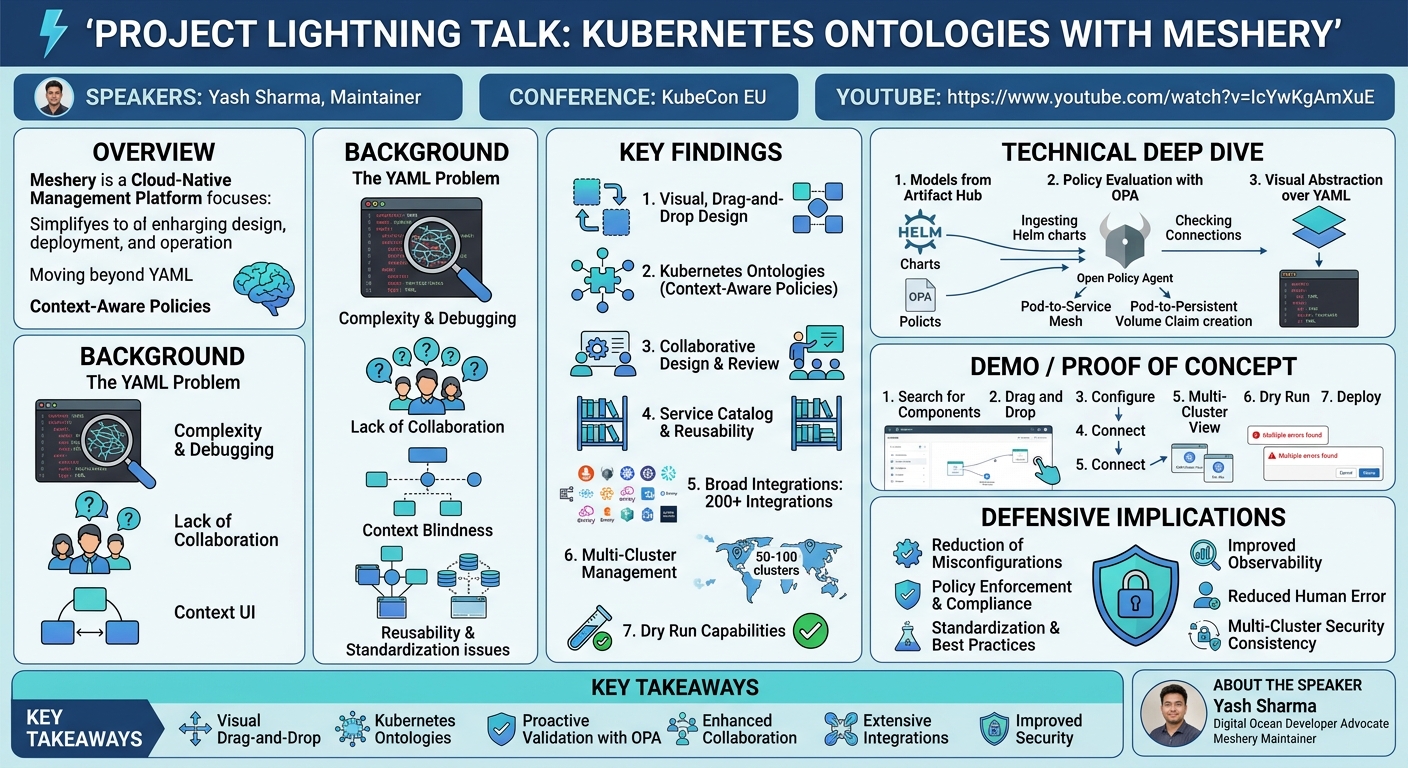
In the rapidly evolving landscape of cloud-native infrastructure, managing Kubernetes deployments efficiently and securely remains a significant challenge. Yash Sharma, a developer advocate at Digital Ocean and a maintainer of the CNCF sandbox project Meshery, presented a lightning talk at KubeCon EU titled "Kubernetes Ontologies With Meshery." This presentation introduced Meshery as a comprehensive cloud-native management platform designed to simplify the design, deployment, and operation of Kubernetes environments.
Key moments
- 0:00 Introduction to Meshery and the YAML problem
- 0:50 Meshery's visual design and context-aware policies
- 2:20 Understanding Meshery's policy evaluation and ontologies
- 3:00 Conceptual demo: designing and deploying with Meshery
- 3:50 Multi-cluster management and dry run capabilities
- 4:15 Simplifying Kubernetes experience and how to contribute
Project Lightning Talk: Kubernetes Ontologies With Meshery
Speakers: Yash Sharma, Maintainer
Conference: KubeCon EU
YouTube: https://www.youtube.com/watch?v=IcYwKgAmXuE
Overview
In the rapidly evolving landscape of cloud-native infrastructure, managing Kubernetes deployments efficiently and securely remains a significant challenge. Yash Sharma, a developer advocate at Digital Ocean and a maintainer of the CNCF sandbox project Meshery, presented a lightning talk at KubeCon EU titled "Kubernetes Ontologies With Meshery." This presentation introduced Meshery as a comprehensive cloud-native management platform designed to simplify the design, deployment, and operation of Kubernetes environments.
The core innovation highlighted in Sharma's talk is Meshery's concept of Kubernetes ontologies, which refers to its ability to understand and enforce context-aware policies and relationships between various Kubernetes resources. By moving beyond traditional YAML-based configuration, Meshery aims to provide a visual, collaborative interface that reduces debugging time, automates complex tasks, and ensures the integrity of cloud-native designs. This talk is particularly relevant for platform engineers, DevOps teams, and developers grappling with the complexity of modern distributed systems, offering a glimpse into a future where infrastructure management is more intuitive and less error-prone.
Background
▶ Watch: Introduction to Meshery and the YAML problem (0:00)
The journey into cloud-native computing has brought unparalleled agility and scalability, but not without its operational overheads. A central pain point for many organizations, as highlighted by Sharma, is the pervasive reliance on YAML files for configuration. While YAML provides a human-readable format for defining infrastructure, its declarative nature often leads to challenges:
- Complexity and Debugging: As Kubernetes clusters grow, so does the volume and complexity of YAML configurations. Debugging syntax errors, misconfigurations, or subtle logical flaws across hundreds or thousands of lines of YAML can be an incredibly tedious and time-consuming task, directly impacting deployment velocity and system stability.
- Lack of Collaboration: Traditional YAML-centric workflows often lack robust built-in mechanisms for team collaboration, peer review, and shared understanding of infrastructure designs. This can lead to silos, inconsistencies, and a higher potential for human error.
- Context Blindness: Standard YAML manifests, by themselves, do not inherently understand the logical relationships or dependencies between different Kubernetes resources. For instance, a
Poddefinition doesn't inherently know if it should connect to aService Meshor needs aPersistent Volume Claim. This lack of context can lead to invalid configurations that only fail at deployment time, consuming valuable developer time. - Reusability and Standardization: Without a centralized, intelligent catalog, reusing existing infrastructure patterns or enforcing organizational standards across multiple teams or projects becomes difficult, leading to duplicated effort and inconsistent deployments.
Meshery emerges as a response to these challenges, aiming to abstract away the low-level YAML complexities and introduce an intelligent, visual layer that understands the underlying Kubernetes object model and its relationships. By doing so, it seeks to streamline the entire cloud-native management lifecycle, from design to deployment, and foster a more collaborative and efficient operational environment.
Key Findings
▶ Watch: Understanding Meshery's policy evaluation and ontologies (2:20)
Yash Sharma's presentation underscored several key findings and contributions that Meshery brings to the cloud-native management space:
- Visual, Drag-and-Drop Infrastructure Design: Meshery fundamentally transforms the way cloud-native infrastructure is designed. Instead of writing verbose YAML files, users can leverage a visual interface where they can drag and drop Kubernetes components like pods, services, and persistent volumes onto a canvas. This intuitive approach drastically lowers the barrier to entry for new users and significantly accelerates the design process for experienced ones.
- Kubernetes Ontologies (Context-Aware Policies): This is the central theme of the talk. Meshery is intelligent enough to understand the relationships and interdependencies between different Kubernetes resources. This "ontology" allows it to enforce context-aware policies, meaning it can determine if a pod can logically connect to a service mesh, or if a pod can reside within a specific namespace. This proactive validation prevents misconfigurations before deployment, saving significant debugging time.
- Collaborative Design and Review: The platform is built with collaboration in mind. Users can invite peers and team members to review, collaborate on, and share infrastructure designs. This fosters a shared understanding of the infrastructure and promotes best practices across teams, moving away from siloed YAML management.
- Extensive Service Catalog and Reusability: Meshery offers a service catalog that allows teams to store, search, and reuse existing infrastructure designs. If a team has already built and validated a particular setup, others can easily discover and deploy it, eliminating the need to recreate infrastructure from scratch. This promotes standardization and efficiency.
- Broad Integration Support: Meshery boasts support for more than 200 integrations with various cloud-native technologies. This extensive compatibility ensures that users can manage a wide array of tools and services within the CNCF ecosystem and beyond, all from a single platform.
- Multi-Cluster Management: The platform is not limited to managing a single Kubernetes cluster. It can connect with and manage 50 to 100 clusters simultaneously, providing a unified dashboard for large-scale deployments and hybrid cloud strategies.
- Dry Run Capabilities: Before committing to a full deployment, Meshery allows users to perform a dry run. This crucial feature enables users to validate their designs against the target cluster's configuration and policies, identifying potential errors or conflicts without impacting live environments.
These findings collectively position Meshery as a powerful tool for simplifying the complex world of cloud-native infrastructure, making it more accessible, collaborative, and resilient.
Technical Deep Dive
▶ Watch: Conceptual demo: designing and deploying with Meshery (3:00)
Meshery's ability to implement "Kubernetes Ontologies" and provide an intelligent, context-aware management platform is underpinned by several key technical mechanisms and architectural decisions. The platform leverages existing cloud-native tools and concepts to deliver its unique value proposition.
At the heart of Meshery's intelligence lies its understanding of Kubernetes resource relationships. Instead of just treating Kubernetes manifests as isolated definitions, Meshery builds a semantic model of the cloud-native environment. This model defines not only the individual components (e.g., Pod, Service, Deployment) but also the logical connections and constraints between them.
- Models and Artifact Hub Integration:
Meshery constructs what it refers to as "models". These models are essentially comprehensive definitions and schemas for various cloud-native components and their associated configurations. To populate these models, Meshery automatically integrates with Artifact Hub, a prominent CNCF project that acts as a central repository for cloud-native artifacts, including Helm charts, OPA policies, Kubernetes manifests, and more.
As Sharma explained, Meshery "automatically go[es] to the artifact hub grab all the things put it together in a folder we call it as a model." This process allows Meshery to ingest a vast library of component definitions, such as EC2 instances within an AWS model, or Pods and Services within a Kubernetes model. These models contain the necessary metadata, schemas, and default values to represent each component accurately within Meshery's visual design canvas. The fact that Meshery supports "more than 200 integrations" is a direct testament to its ability to leverage and consolidate information from various sources, including Artifact Hub, into these internal models.
- Policy Evaluation with OPA (Open Policy Agent):
The enforcement of "Kubernetes Ontologies" – Meshery's context-aware policies – is primarily driven by Open Policy Agent (OPA). OPA is a general-purpose policy engine that enables unified, context-aware policy enforcement across the entire stack. Meshery uses OPA to evaluate relationships and ensure the validity of user designs.
When a user connects components visually, Meshery doesn't just draw a line; it triggers an OPA policy evaluation. For instance:
- Pod-Service Mesh Relationship: If a user attempts to connect a
Podto aService Mesh, OPA policies within Meshery can validate whether this connection is permissible given the pod's configuration, the service mesh's capabilities, and organizational policies. It checks if thePodis properly annotated or configured to be part of the mesh. - Pod-Persistent Volume Relationship and Automatic Claim Creation: A concrete example provided by Sharma is, "If you connect your pod with a persistent volume mishy will automatically create a volume claim for you." This demonstrates a sophisticated policy. An OPA policy could detect the intention to connect a
Podto aPersistent Volumeand, if aPersistent Volume Claim(PVC) doesn't exist or isn't properly configured, Meshery, guided by OPA, can automatically generate the necessary PVC manifest. This significantly reduces manual effort and ensures correct resource provisioning. - Namespace Constraints: Meshery can also enforce policies like whether "a pod can live inside a name space or not." This could involve checking role-based access controls (RBAC), resource quotas, or specific organizational policies that restrict certain pod types to certain namespaces.
- Visual Interface and Abstraction:
The visual drag-and-drop interface serves as a powerful abstraction layer over the underlying complexities of Kubernetes manifests. When a user manipulates components on the canvas, Meshery translates these visual interactions into concrete YAML or JSON definitions, validated against its internal models and OPA policies. The platform provides configuration panels for each component, allowing users to specify parameters without directly editing YAML.
- Multi-Cluster Management Architecture:
Meshery's capability to connect with "50 to 100" Kubernetes clusters implies a robust agent-based or API-driven architecture. Typically, a central Meshery instance would communicate with agents or directly with the Kubernetes API servers of registered clusters. This allows for centralized design, deployment, and monitoring across a distributed fleet of clusters, presenting a unified view of their health and deployed services. The "dry run" feature also leverages this multi-cluster connectivity, allowing Meshery to simulate deployments against the specific configurations of target clusters.
In essence, Meshery combines comprehensive resource models sourced from Artifact Hub, a powerful policy engine in OPA, and an intuitive visual interface to create an intelligent, context-aware management platform that simplifies cloud-native operations and enforces best practices through its understanding of Kubernetes ontologies.
Demo / Proof of Concept
▶ Watch: Multi-cluster management and dry run capabilities (3:50)
Yash Sharma's talk included a demonstration of Meshery's visual design capabilities, although he candidly mentioned that his live cluster "got busted" and he wouldn't be able to deploy the design in real-time. Despite this, his explanation clearly illustrated the intended workflow and the core features of the platform's user interface.
The demonstration began with a depiction of Meshery's canvas-based visual interface. This is where users interactively build their cloud-native infrastructure. Sharma described how users would:
- Search for Components: On the left-hand side of the interface, there's a search bar. Users can type in the name of a Kubernetes resource they wish to add, such as "pod" or "service."
- Drag and Drop: Once a component is found, it can be dragged and dropped directly onto the main canvas area. For example, a "pod" icon would appear on the canvas.
- Configure Components: After dropping a component, users can select it to access a configuration panel. Here, they can specify various parameters for the resource without needing to manually edit YAML. Sharma mentioned that Meshery automatically places the pod within a namespace, demonstrating its context-awareness.
- Connect Resources: The visual interface allows users to draw connections between different components. For instance, a user could connect a
Podto aServiceor aPersistent Volume. As discussed in the technical deep dive, these connections trigger Meshery's ontology-based policy evaluations. - Multi-Cluster Management View: The demo also showed how Meshery can display the status of multiple connected Kubernetes clusters. Users can see "how many clusters are active right now or not," indicating Meshery's capability to manage a fleet of clusters from a single pane of glass. This is crucial for organizations operating across various environments.
- Dry Run Functionality: Before deploying, the platform offers a dry run option. Sharma emphasized its importance: "You just want to make sure okay my design is correct or not." He showed that his own design had "multiple errors coming in my designs which I need to fix before deploying it as well," perfectly illustrating the value of pre-deployment validation. This feature helps identify misconfigurations or policy violations early, preventing issues in live environments.
- Deployment: The final step, had the cluster been operational, would be to hit the "deploy" button. This action would translate the visual design into actual Kubernetes manifests and apply them to the selected cluster(s).
Even without a live deployment, the demo effectively conveyed Meshery's user experience: a simplified, visual, and intelligent approach to designing and validating cloud-native infrastructure, drastically reducing the traditional reliance on manual YAML authoring and debugging.
Defensive Implications
▶ Watch: Simplifying Kubernetes experience and how to contribute (4:15)
While "Kubernetes Ontologies With Meshery" is not a security-focused talk in the traditional sense of identifying vulnerabilities or exploits, its emphasis on intelligent, policy-driven infrastructure management carries significant defensive implications for cloud-native environments. By streamlining operations and enforcing design integrity, Meshery contributes to a stronger security posture in several key ways:
- Reduction of Misconfigurations (Attack Surface Reduction): A leading cause of security incidents in Kubernetes is misconfiguration. Manual YAML authoring is prone to errors – incorrect network policies, overly permissive RBAC roles, unencrypted secrets, or exposed services. Meshery's visual, drag-and-drop interface, coupled with its context-aware policies (ontologies) and dry run capabilities, significantly reduces the likelihood of these misconfigurations. By validating relationships (e.g., "if a pod can make a connection with service mesh or not") and enforcing best practices before deployment, Meshery helps ensure that only correctly configured and policy-compliant infrastructure is provisioned, thereby directly shrinking the attack surface.
- Policy Enforcement and Compliance: The integration with Open Policy Agent (OPA) for policy evaluation is a critical defensive feature. OPA allows organizations to define granular security policies (e.g., all images must come from approved registries, all pods must have resource limits, specific labels must be present for auditing). Meshery's use of OPA ensures that these policies are enforced at the design and deployment stages. This proactive enforcement helps maintain compliance with internal security standards, industry regulations (e.g., PCI DSS, HIPAA), and government mandates.
- Standardization and Best Practices: The service catalog and collaborative design features promote the use of standardized, pre-approved, and securely configured infrastructure patterns. Instead of each team reinventing the wheel and potentially introducing new vulnerabilities, they can reuse validated designs. This consistency makes it easier to audit, monitor, and secure the entire environment, as deviations from the baseline are more easily identified.
- Improved Observability and Auditability: A visual representation of infrastructure designs provides better clarity and understanding than raw YAML files. This enhanced observability makes it easier for security teams to review proposed changes, understand the architecture, and identify potential security weak points. The collaborative nature also fosters a more transparent design process, aiding in auditability.
- Reduced Human Error: By automating the creation of dependent resources (e.g., automatically creating a
Persistent Volume Claimwhen aPodconnects to aPersistent Volume) and validating configurations visually, Meshery minimizes human error. Human error is a well-known factor in security breaches, and reducing it through intelligent automation contributes directly to a more resilient system.
- Multi-Cluster Security Consistency: For organizations managing "50 to 100 clusters," ensuring consistent security policies across all environments is a monumental task. Meshery's multi-cluster management capabilities allow security policies and validated designs to be applied uniformly across the entire fleet, preventing security gaps that might arise from disparate configurations in different clusters.
In summary, Meshery acts as a preventative security control by ensuring that cloud-native infrastructure is designed, validated, and deployed correctly and consistently according to defined policies, thereby reducing the risk of misconfigurations and bolstering the overall defensive posture of Kubernetes environments.
Key Takeaways
- Visual, Drag-and-Drop Design: Meshery simplifies Kubernetes infrastructure creation with an intuitive visual interface, eliminating the need for direct YAML authoring and accelerating design processes.
- Kubernetes Ontologies for Context-Aware Policies: The platform's core innovation lies in its understanding of logical relationships between Kubernetes resources, enabling context-aware policy enforcement (e.g., valid pod-service mesh connections) to prevent misconfigurations.
- Proactive Validation with OPA and Dry Runs: Meshery leverages Open Policy Agent (OPA) for robust policy evaluation and offers a crucial dry run feature, allowing users to validate designs and identify errors before deployment, enhancing reliability and security.
- Enhanced Collaboration and Reusability: With a collaborative design environment and a comprehensive service catalog, Meshery promotes team cooperation, fosters shared understanding, and enables the efficient reuse of validated infrastructure patterns.
- Extensive Cloud-Native Integration and Multi-Cluster Management: Supporting over 200 integrations and capable of managing dozens of Kubernetes clusters simultaneously, Meshery provides a unified platform for diverse and large-scale cloud-native environments.
- Improved Security Posture through Reduced Misconfiguration: By enforcing policies and simplifying complex deployments, Meshery significantly reduces human error and misconfigurations, directly contributing to a stronger and more compliant security posture for Kubernetes infrastructure.
About the Speaker(s)
Yash Sharma is a developer advocate at Digital Ocean and a maintainer of Meshery, a CNCF sandbox project. His role involves advocating for developer-centric solutions and contributing to the open-source community, particularly within the cloud-native ecosystem. As a maintainer of Meshery, he is deeply involved in the project's development, guiding its evolution as a cloud-native management platform designed to simplify Kubernetes operations through visual design and intelligent policy enforcement. His work focuses on improving the developer and operator experience in complex distributed systems.
Reviews
Dr. Zero (Offensive Security Researcher) — STRONG ACCEPT
This lightning talk on Meshery's Kubernetes Ontologies presents a genuinely valuable approach to tackling the perennial problem of Kubernetes complexity and YAML hell. The platform's visual design, coupled with intelligent, context-aware policy enforcement via OPA, offers a practical solution for platform engineers and DevOps teams. While the live demo encountered issues, the explanation of the technical mechanisms and the clear impact on reducing misconfigurations and promoting standardization make this a strong contribution to cloud-native operational efficiency and security.
Heather Calloway (CISO) — STRONG ACCEPT
This presentation on Meshery offers a compelling vision for cloud-native management that directly addresses pervasive security challenges in Kubernetes environments. By abstracting YAML complexity and enforcing context-aware policies via visual design, it significantly reduces misconfigurations, standardizes deployments, and enables robust policy-as-code. While framed for platform engineers, its implications for risk reduction, compliance, and scalable security posture are substantial, making it highly relevant for security leadership evaluating next-generation defensive controls.