Project Lightning Talk: Opening + Welcome - Jorge Castro, CNCF
Jorge Castro, CNCF
KubeCon + CloudNativeCon Europe 2025 · Project Lightning Talk
Overview
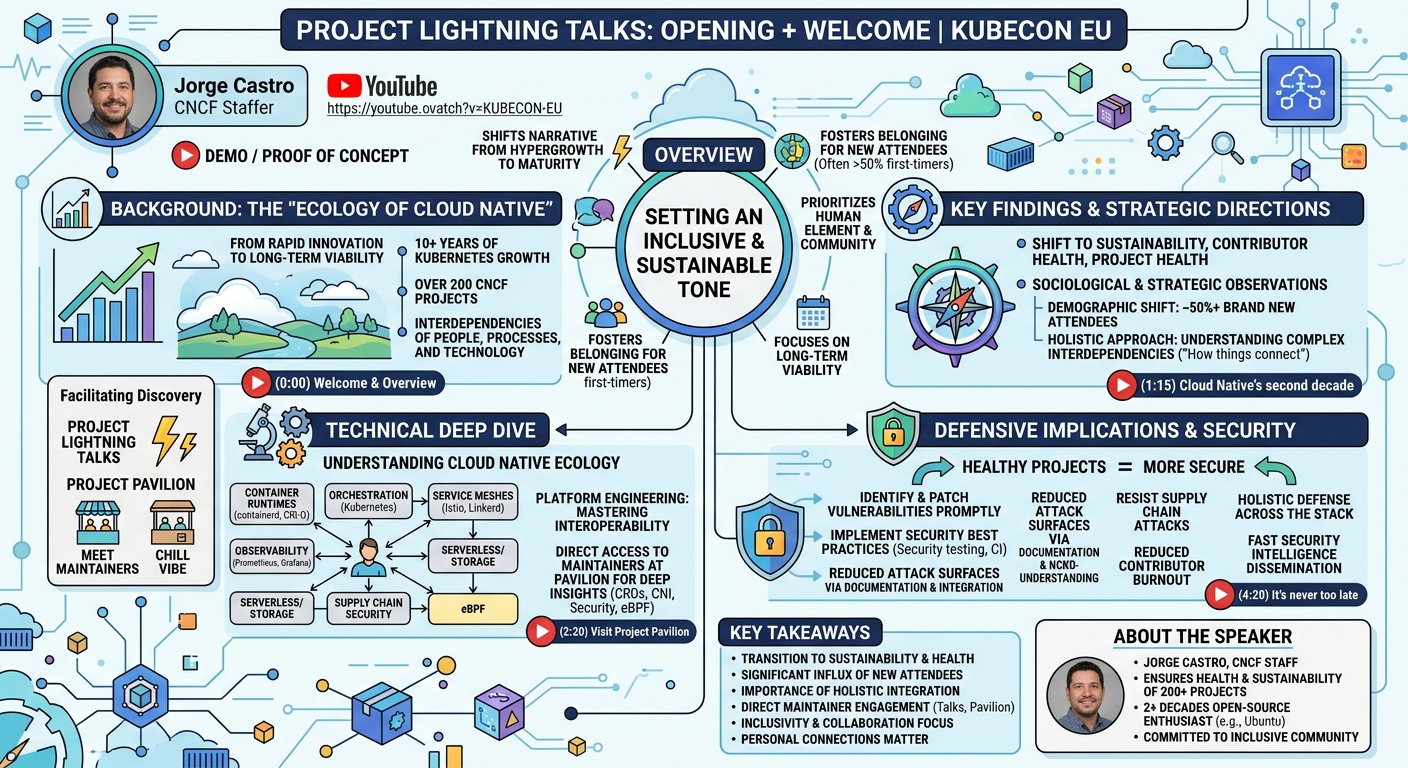
Jorge Castro, a seasoned CNCF staffer, delivered the opening and welcome address for the Project Lightning Talks at KubeCon EU. Far from a traditional technical presentation, this talk served as a crucial cultural cornerstone for the conference, setting an inclusive and community-focused tone for attendees. Castro’s primary objective was to orient new participants, foster a sense of belonging, and articulate the evolving priorities of the cloud-native ecosystem as it enters its "second decade."
Key moments
- 0:00 Welcome to Project Lightning Talks and overview
- 0:30 Welcoming new attendees and 'chillops' room concept
- 1:15 Cloud Native's second decade: sustainability and health
- 2:20 Visit the Project Pavilion: meet maintainers
- 3:00 Jorge offers personal help and guidance
- 3:40 Encouraging networking and open community culture
- 4:20 It's never too late to start your journey
Project Lightning Talk: Opening + Welcome
Speakers: Jorge Castro, CNCF Staffer
Conference: KubeCon EU
YouTube: https://www.youtube.com/watch?v=3Gm5QNXcp2g
Overview
Jorge Castro, a seasoned CNCF staffer, delivered the opening and welcome address for the Project Lightning Talks at KubeCon EU. Far from a traditional technical presentation, this talk served as a crucial cultural cornerstone for the conference, setting an inclusive and community-focused tone for attendees. Castro’s primary objective was to orient new participants, foster a sense of belonging, and articulate the evolving priorities of the cloud-native ecosystem as it enters its "second decade."
The talk is significant because it shifts the narrative from pure technological hypergrowth, which characterized Kubernetes' initial rise, to a more mature focus on sustainability, contributor health, and the overall health of open-source projects. Castro emphasized that KubeCon is not merely a venue for consuming technical information but a vibrant hub for human connection, collaboration, and discovery across the more than 200 projects under the CNCF umbrella. This foundational address underscores the critical human element that underpins the development and long-term viability of the vast and complex cloud-native landscape.
Background
▶ Watch: Welcome to Project Lightning Talks and overview (0:00)
The Cloud Native Computing Foundation (CNCF) ecosystem has experienced unprecedented growth over the past decade, largely driven by the widespread adoption of Kubernetes. This period, characterized by rapid innovation and expansion, established cloud native as a dominant paradigm in modern software development. However, as any technology matures, the challenges shift from initial adoption and feature development to long-term viability and community health. Castro's talk directly addresses this transition, framing the current era as the "second decade of cloud native."
This new phase necessitates a focus beyond just technology. The "ecology of cloud native," as Castro termed it, encompasses not only the technical integrations but also the people, processes, and relationships that sustain the ecosystem. The sheer scale of the CNCF, with over 200 diverse open-source projects, presents a complex web of interdependencies. Ensuring the health and longevity of these projects, and by extension, the entire cloud-native stack, requires a concerted effort in areas like contributor health, project governance, and fostering a welcoming environment for new participants. The talk highlighted that over 50% of KubeCon attendees are often first-timers, underscoring the continuous need for onboarding and integration into this rapidly expanding community. The Project Lightning Talks and the Project Pavilion were explicitly designed as mechanisms to facilitate this discovery and connection, offering a "chill vibe" and direct access to project maintainers without the pressure of sales pitches.
Key Findings
▶ Watch: Cloud Native's second decade: sustainability and health (1:15)
As an opening and welcome address, Jorge Castro's talk did not present specific technical findings or research results typical of a conference deep dive. Instead, it laid out critical observations and strategic directives regarding the state and future trajectory of the cloud-native community. These "findings" are more sociological and strategic than technical, yet they have profound implications for the technical health and longevity of the ecosystem.
Firstly, Castro highlighted the demographic shift within the cloud-native community, noting that "over 50% of KubeCon attendees are brand new." This signifies a continuously growing and vibrant community, but also a persistent challenge in onboarding and integrating new talent effectively. The implication is that community-building initiatives, like the Project Lightning Talks and the Project Pavilion, are not merely ancillary activities but essential components for sustaining growth and knowledge transfer.
Secondly, the talk articulated a strategic pivot for the entire cloud-native movement: the transition into its "second decade" will be defined by growth, sustainability, contributor health, and the health of our projects. This is a significant "finding" as it reframes success metrics beyond mere adoption rates or feature velocity. It acknowledges the inherent challenges of maintaining a vast open-source ecosystem, emphasizing the need for robust governance, dedicated maintainership, and a focus on preventing contributor burnout. This shift in focus is critical for ensuring the long-term reliability and security of cloud-native infrastructure, as healthy projects are inherently more resilient and well-maintained.
Finally, Castro underscored the importance of a holistic approach to cloud native, stating, "This is not about just the technology. It's about the people. It's about integration. It's about what thing connects this thing to that thing to that thing." This observation emphasizes the interconnectedness of the 200+ CNCF projects and the necessity for developers and platform engineers to understand the broader "ecology" rather than focusing on isolated components. The "finding" here is that true value creation in cloud native comes from understanding these complex interdependencies and fostering collaboration across project boundaries. This perspective guides how attendees should approach the conference, encouraging them to seek out connections between technologies and the people behind them at the Project Pavilion.
Technical Deep Dive
▶ Watch: Visit the Project Pavilion: meet maintainers (2:20)
This specific opening address by Jorge Castro did not delve into a technical deep dive of any particular project, protocol, or architecture. Its purpose was foundational and orientational, rather than an exploration of specific technical implementations. However, the talk implicitly framed the immense technical complexity and diversity that KubeCon attendees would encounter throughout the conference, particularly through the lens of the 200+ open-source projects under the CNCF.
Castro's concept of the "ecology of cloud native" alludes to the intricate technical landscape where "what thing connects this thing to that thing to that thing" is paramount. This statement, while not detailing specific technical integrations, highlights the reality of modern platform engineering. Engineers are constantly tasked with combining a multitude of specialized tools—ranging from container runtimes like containerd and CRI-O, orchestration systems such as Kubernetes, service meshes like Istio or Linkerd, observability tools like Prometheus and Grafana, to serverless frameworks and storage solutions. Each of these components represents a significant technical domain, with its own APIs, configuration models, and operational considerations. The challenge lies not just in understanding individual components but in mastering their interoperability and secure integration to form cohesive, resilient, and performant platforms.
The lightning talks, which followed Castro’s opening, and the Project Pavilion, were presented as the primary avenues for attendees to engage with this technical depth. These venues offer direct interaction with maintainers and core contributors who possess intimate knowledge of project internals, design choices, and future roadmaps. For instance, discussions at the Project Pavilion might cover the intricacies of a Custom Resource Definition (CRD) within Kubernetes, the implementation details of a specific CNI (Container Network Interface) plugin, the security model of a supply chain security tool like Notary, or the performance characteristics of an eBPF-based networking solution. While Castro's talk did not provide these specifics, it effectively signposted where attendees could find such detailed technical content, emphasizing the importance of understanding the underlying mechanics and interconnectedness of the cloud-native stack to build robust and scalable systems.
Demo / Proof of Concept
▶ Watch: Encouraging networking and open community culture (3:40)
As a welcome and introductory talk, there was no technical demonstration or proof of concept presented by Jorge Castro. The session's intent was to provide a high-level overview of the conference's spirit and the cloud-native community's direction, rather than to showcase specific technological implementations.
However, the entire premise of the Project Lightning Talks, which Castro was introducing, is built around rapid-fire demonstrations and concise presentations of technical work. These subsequent talks would feature developers and researchers showcasing their projects, tools, and innovative solutions, often including live coding, architectural diagrams, or practical use cases. Similarly, the Project Pavilion, which Castro strongly encouraged attendees to visit, functions as a perpetual informal "demo" space. Here, maintainers engage directly with users, often walking them through project features, explaining code snippets, or illustrating deployment patterns on whiteboards. This environment facilitates a hands-on understanding of how various CNCF projects function and can be applied in real-world scenarios, effectively serving as a continuous series of mini-demos and proofs of concept for attendees seeking deeper technical insights.
Defensive Implications
▶ Watch: It's never too late to start your journey (4:20)
This welcome address, by its nature, did not directly present specific defensive implications related to cybersecurity vulnerabilities or attack vectors in cloud-native environments. However, the overarching themes articulated by Jorge Castro—sustainability, project health, contributor health, and holistic integration—have profound, albeit indirect, defensive implications for cloud-native security postures.
A core tenet of the talk was the shift towards sustainability and project health in the "second decade of cloud native." From a defensive perspective, healthy open-source projects are inherently more secure. Projects with active maintainers, a robust contributor base, and clear governance models are more likely to:
- Identify and patch vulnerabilities promptly: Engaged communities mean more eyes on the code and a higher likelihood of discovering and addressing security flaws (e.g., CVEs) before they can be exploited.
- Implement security best practices: Healthy projects often have dedicated security testing, continuous integration (CI) pipelines with security checks, and adherence to secure coding guidelines.
- Provide clear documentation: Well-documented projects enable users to configure them securely, understand their security features, and follow best operational practices to minimize attack surfaces.
- Resist supply chain attacks: A transparent and well-governed project with a healthy contributor base is less susceptible to malicious code injection or other forms of supply chain compromise, which remain a significant threat in the open-source ecosystem.
Castro's emphasis on the "ecology of cloud native" and understanding "what thing connects this thing to that thing to that thing" also carries significant defensive weight. Modern cloud-native platforms are complex integrations of numerous components. Security vulnerabilities often arise at the seams between these components due to misconfigurations, incompatible security models, or unaddressed trust boundaries. Defenders must adopt a holistic view, understanding the interdependencies and attack surfaces across the entire stack, from the host operating system to the application layer, and encompassing networking, storage, and identity management. The Project Pavilion, by fostering direct interaction with maintainers, provides an invaluable opportunity for security professionals to understand the security models and integration points of specific projects, enabling them to design more resilient and secure architectures.
Furthermore, the focus on contributor health indirectly impacts security. Burnout among maintainers can lead to neglected projects, delayed security patches, and a general decline in code quality. By prioritizing the well-being of contributors, the CNCF aims to ensure a sustained effort in maintaining the security posture of critical infrastructure components. Finally, the welcoming and inclusive community ethos, encouraging collaboration and open discussion, facilitates faster dissemination of security intelligence and collective problem-solving when vulnerabilities are discovered, strengthening the overall defensive posture of the cloud-native ecosystem.
Key Takeaways
- Cloud Native's Evolving Focus: The cloud-native ecosystem is transitioning into its "second decade," shifting emphasis from hypergrowth to sustainability, contributor health, and the long-term health of open-source projects.
- Growing Community: KubeCon continues to attract a significant influx of new attendees, with over 50% often being first-timers, underscoring the vibrant and continuously expanding nature of the cloud-native community.
- Holistic Integration is Key: Understanding the "ecology of cloud native" and how its 200+ CNCF projects connect and integrate is crucial for building robust platforms, emphasizing that the focus should extend beyond individual technologies to their interplay and the people behind them.
- Direct Engagement with Maintainers: The Project Lightning Talks and the Project Pavilion are specifically designed as vital hubs for discovery, encouraging attendees to interact directly with project maintainers and core contributors for in-depth knowledge and community building.
- Inclusivity and Collaboration: The cloud-native culture promotes inclusivity, urging attendees to meet new people, share problems, and actively contribute to the community's growth by always "leaving a spot open for the next person."
- Personal Connection Matters: Beyond technical learning, the conference emphasizes the importance of making personal connections and building relationships within the community, which are essential for navigating the complex cloud-native landscape and fostering a positive experience.
About the Speaker(s)
Jorge Castro is a dedicated staff member of the Cloud Native Computing Foundation (CNCF). His primary role involves ensuring the health and sustainability of the diverse portfolio of over 200 open-source projects under the CNCF umbrella. Castro is a long-time open-source enthusiast and contributor, with a history spanning over two decades, including significant work on projects like Ubuntu alongside figures such as Alan Pope. He is deeply committed to fostering a vibrant, healthy, and inclusive cloud-native community, serving as a guide and advocate for attendees at conferences like KubeCon.
Reviews
Dr. Zero (Offensive Security Researcher) — STRONG ACCEPT
This was a substantive strategic keynote that effectively set the tone for KubeCon EU, signaling a crucial shift in focus for the cloud-native ecosystem. While not a technical deep-dive, Jorge Castro delivered a clear, direct message about the transition into the 'second decade' of cloud native, prioritizing sustainability, contributor health, and holistic project integration over mere hypergrowth. This provides valuable, actionable signal for anyone involved in the CNCF landscape, delivered by a highly credible source. It avoids the usual conference fluff and offers genuine direction.
Heather Calloway (CISO) — STRONG ACCEPT
This opening address by Jorge Castro, while not a technical deep dive, delivers a critical message for security leaders: the long-term health and sustainability of the cloud-native ecosystem are paramount for institutional resilience. By shifting focus to contributor well-being, project governance, and the holistic integration of open-source components, Castro highlights the often-overlooked human and organizational dimensions that directly impact the security and operational stability of the platforms we build. This talk underscores that effective governance of technology dependencies extends beyond code to the health of the communities that create and maintain them, making it essential…