OTel Me How To Get My Open Source Community Taken Seriously: Lessons... Reese Lee & Adriana Villela
Reese Lee, Adriana Villela
KubeCon + CloudNativeCon Europe 2025 · Session
Overview
In this insightful KubeCon EU session, Adriana Villela and Reese Lee, both prominent maintainers of the OpenTelemetry (OTel) End User Special Interest Group (SIG), shared their comprehensive journey and accumulated wisdom in fostering a thriving open-source community. The talk, titled "OTel Me How To Get My Open Source Community Taken Seriously: Lessons Learned as OTel Maintainers," delves into the practical strategies, successes, and challenges encountered while building a vibrant, inclusive, and responsive ecosystem around one of the cloud-native world's most critical observability projects.
Key moments
- 0:00 Welcome and speaker introductions
- 2:00 OpenTelemetry project origins and standardization
- 3:20 OpenTelemetry community values: vendor neutral, egalitarian
- 5:50 Understanding OpenTelemetry's SIGs and Working Groups
- 6:30 Identifying the missing dedicated space for end users
- 7:00 Proposal and acceptance of the End User Working Group
- 7:50 End-user needs continuously evolve with the project
OTel Me How To Get My Open Source Community Taken Seriously: Lessons Learned as OTel Maintainers
Speakers: Adriana Villela, Principal Developer Advocate, Dynatrace; Reese Lee, Senior Developer Relations Engineer, New Relic
Conference: KubeCon EU
YouTube: https://www.youtube.com/watch?v=Hdrf5QosFTw
Overview
In this insightful KubeCon EU session, Adriana Villela and Reese Lee, both prominent maintainers of the OpenTelemetry (OTel) End User Special Interest Group (SIG), shared their comprehensive journey and accumulated wisdom in fostering a thriving open-source community. The talk, titled "OTel Me How To Get My Open Source Community Taken Seriously: Lessons Learned as OTel Maintainers," delves into the practical strategies, successes, and challenges encountered while building a vibrant, inclusive, and responsive ecosystem around one of the cloud-native world's most critical observability projects.
The speakers, representing competing observability vendors (Dynatrace and New Relic respectively), exemplify OTel's core principle of vendor neutrality, showcasing how collaboration transcends corporate rivalry for the greater good of the project. Their presentation serves as a valuable blueprint for any organization or individual looking to cultivate an engaged open-source community, emphasizing the paramount importance of listening to end users, maintaining transparency, and proactively creating avenues for contribution and feedback.
This article dissects the core tenets of their community-building philosophy, detailing the specific initiatives and operational methodologies that have propelled the OTel End User SIG to prominence. It highlights how a deliberate focus on user experience, structured engagement, and a welcoming atmosphere can transform an emergent project into a widely adopted standard, demonstrating that the human element is as crucial as technical excellence in the realm of open source.
Background
▶ Watch: Welcome and speaker introductions (0:00)
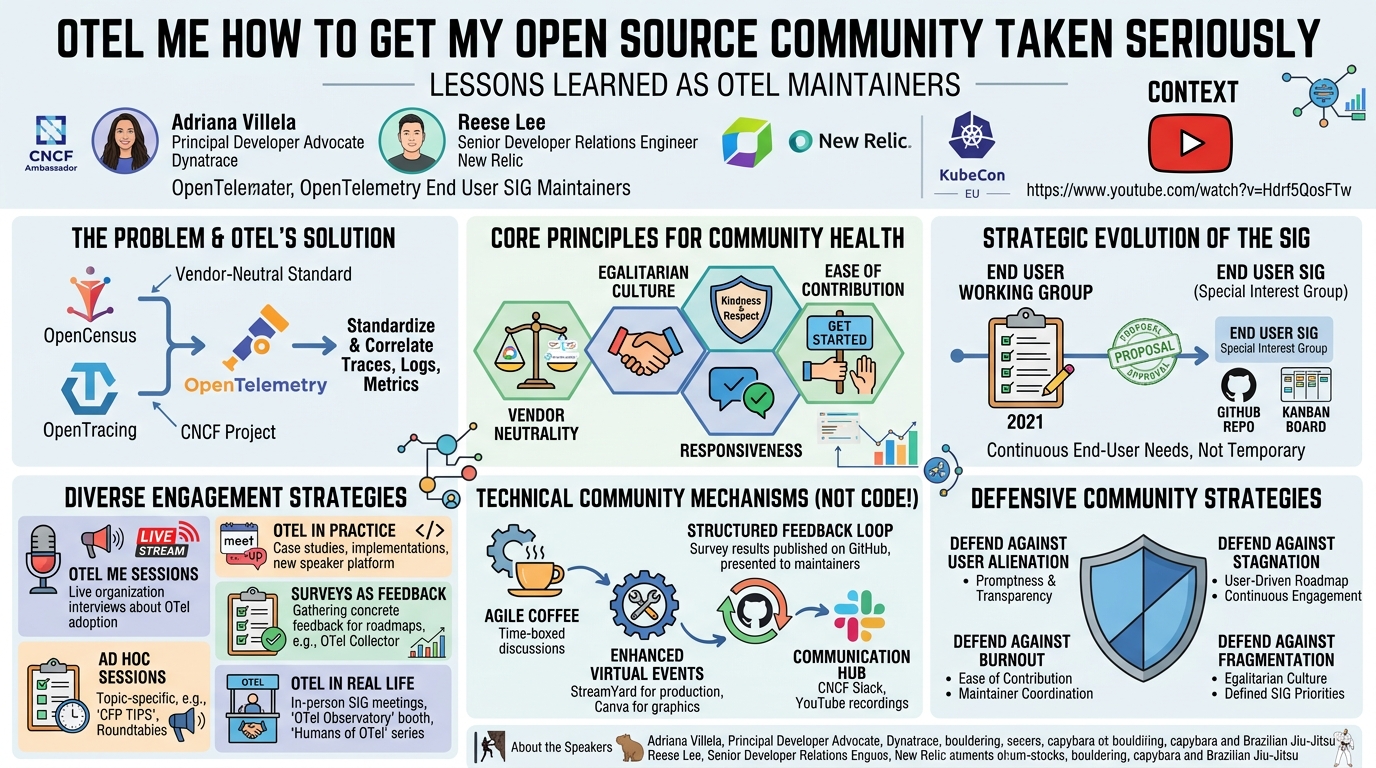
The genesis of OpenTelemetry (OTel) in 2019 marked a pivotal moment in the observability landscape. It was born from the strategic merger of two competing projects: OpenCensus (backed by Google) and OpenTracing (a Cloud Native Computing Foundation (CNCF) project). Prior to this consolidation, the industry faced fragmentation, with numerous proprietary and open-source instrumentation frameworks vying for adoption. OTel emerged with the explicit goal of standardizing instrumentation for traces, logs, and metrics, and crucially, enabling the correlation of these three pillars of telemetry data—a capability not widely available or standardized at the time.
As a vendor-neutral, open-source standard, OTel's design philosophy was deeply influenced by the Kubernetes community, striving for an ecosystem where no single vendor dominates. This commitment fosters a collaborative environment, as exemplified by the speakers themselves, who despite working for competitive companies, operate as unified advocates for OTel. The project benefits from the backing of all major observability vendors, a testament to its foundational role in modern cloud-native architectures. The community prides itself on being egalitarian, thoughtful, and respectful, actively promoting kindness and constructive feedback, which has been instrumental in attracting and retaining contributors, even those new to open source like Adriana Villela, who noted the welcoming nature of her first pull request experience.
The End User Working Group (later to become a SIG) was established in 2021, a couple of years into OTel's journey. Reese Lee's manager at the time, Shuan Quan, along with figures like Alolita Sharma and Ted Young, identified a critical gap: the absence of a dedicated space for end users. In OTel's infancy, documentation was still evolving, and users lacked clear resources to ask questions, share experiences, or understand best practices. Recognizing that end-user needs would be continuous rather than temporary, a proposal was put forth to convert the working group into a permanent Special Interest Group (SIG). This transition, blessed by the governance committee, elevated the End User SIG's authority, granting it its own GitHub repo and Kanban board, which significantly boosted its visibility and ability to attract new contributors. This evolution from a temporary working group to a permanent SIG underscores the project's commitment to prioritizing and continuously addressing the practical challenges and evolving requirements of its user base.
Key Findings
▶ Watch: OpenTelemetry community values: vendor neutral, egalitarian (3:20)
The talk highlighted several key findings and successful strategies employed by the OTel End User SIG to cultivate a robust and engaged open-source community:
- The Imperative of Dedicated End-User Focus: The most fundamental finding was the critical need for a dedicated space for end users. The OTel project, like many foundational open-source initiatives, initially focused heavily on technical development. The creation and subsequent elevation of the End User Working Group to a permanent SIG demonstrated a mature understanding that user feedback is not a temporary concern but a continuous input stream vital for project relevance and adoption. This shift provided a formal channel for users to voice needs, share implementations, and receive guidance.
- Diverse and Evolving Engagement Strategies: The SIG successfully implemented and iterated on a variety of engagement formats to cater to different user needs and preferences:
- OTel Me Sessions: Structured, live-streamed interviews with user organizations about their OTel adoption journeys (tech stack, motivations, specific implementations). These sessions not only provided valuable insights back to maintainers but also served as educational content for other potential adopters.
- OpenTelemetry in Practice: Meetup-style events featuring end users or contributors presenting specific OTel use cases or implementations. This format encouraged knowledge sharing and provided a low-stakes platform for new speakers to practice their presentations.
- Surveys as a Feedback Mechanism: Collaborating with other SIGs (e.g., the OTel Collector SIG), the End User SIG crafted and disseminated surveys to gather concrete, quantifiable feedback. These results directly informed project roadmaps and improvements, providing tangible evidence of user needs that resonated strongly with maintainers. The success of the initial OTel Collector survey led to demand from other SIGs, necessitating a formalized process for survey management to prevent "survey fatigue."
- Ad Hoc Sessions: Flexible events like "CFP tips" for aspiring conference speakers or roundtables with observability experts, demonstrating responsiveness to immediate community needs and fostering broader connections.
- OTel in Real Life Events: Physical presence at conferences like KubeCon EU, including the "OTel Observatory" booth, in-person SIG meetings, and the "Humans of OTel" interview series. These initiatives humanized the project, connecting users and contributors face-to-face and reinforcing the community's welcoming nature.
- Core Principles for Community Health: The speakers identified several non-negotiable principles for sustaining a healthy open-source community:
- Responsiveness and Transparency: Promptly addressing user questions (even by pointing to the right resources) prevents frustration and fosters trust. Transparency in decision-making and project status builds confidence.
- Ease of Contribution: Actively working to lower the barrier to entry for new contributors is crucial for growth.
- Consistent Engagement: Regular events, even small ones, keep the community active and engaged, ensuring the project remains "top of mind."
- Vendor Neutrality: A strict adherence to vendor neutrality, as embodied by the speakers themselves, is vital for broad adoption and prevents commercial bias from alienating potential users or contributors.
- Consideration for Time Zones and Availability: Acknowledging the global nature of open source by coordinating schedules and ensuring coverage across different regions.
- Scaling Challenges of Success: A significant finding was that success itself brings new challenges. As the End User SIG grew, attracting more maintainers and enthusiastic contributors, the need for clearly defined priorities and a unified agenda became paramount. The speakers acknowledged the emerging "scaling issue" of coordinating a larger group and preventing "kingdom building" where individual agendas might diverge from collective goals. This illustrates that community management is an ongoing process of adaptation and refinement.
In essence, the OTel End User SIG's journey provides a compelling case study for how intentional community building, driven by a deep understanding of user needs and a commitment to core open-source values, can significantly contribute to the widespread adoption and long-term viability of a critical technical project.
Technical Deep Dive
▶ Watch: Understanding OpenTelemetry's SIGs and Working Groups (5:50)
While the talk did not delve into the internal technical architecture of OpenTelemetry itself, it provided a profound "technical deep dive" into the mechanisms and architectures of building and sustaining an open-source community. This involved the structured application of governance models, communication protocols, and event management tooling to achieve specific community objectives.
At the core of OTel's community structure are Special Interest Groups (SIGs) and Working Groups. The talk clarified a crucial distinction: Working Groups are temporary, focused on achieving specific, time-bound objectives, whereas SIGs are permanent entities addressing ongoing concerns. The End User SIG's evolution from a working group to a permanent SIG was a strategic technical decision, signifying the project's formal recognition that end-user feedback is a perpetual requirement, not a temporary project. This transition provided the SIG with greater authority, its own dedicated GitHub repo for managing contributions and documentation, and a Kanban board for tracking tasks and workflows, thereby formalizing its operational structure.
For community engagement, the SIG adopted several "technical" approaches to information dissemination and interaction:
- Agile Coffee Format: For early "End User Discussion Groups," the SIG employed an Agile coffee format. This structured approach to discussions involves time-boxing topics (e.g., 15 minutes per topic) to ensure efficiency and cover all agenda items. This is a methodological "tool" for managing group dynamics and maximizing productive dialogue.
- Enhanced Virtual Event Production: The SIG significantly upgraded its virtual event capabilities. Moving from standard Zoom meetings, they adopted StreamYard for live streaming their "OTel Me" and "OpenTelemetry in Practice" sessions. This platform allowed for higher production value, including custom animations and professional overlays, which the speakers noted helped capture audience attention in a crowded online environment. For creating visually appealing promotional materials, they utilized Canva, a design tool, to produce "eye-catching event graphics." These choices reflect a technical investment in presentation and communication to enhance community engagement.
- Structured Feedback Loop via Surveys: A key "technical" contribution of the End User SIG is its formalized process for conducting surveys. Collaborating with other SIGs, such as the OTel Collector SIG, they developed structured questionnaires designed to gather specific feedback on components, features, and roadmap priorities. The results of these surveys are treated as critical data, publicly available on the SIG's GitHub repo, and are presented to maintainers to directly influence project development. This establishes a robust, data-driven feedback loop, transforming anecdotal user feedback into actionable intelligence for the project's technical direction. The mention of the Target Allocator as a topic in an "OTel in Practice" session further illustrates how these forums dive into specific technical components of OTel.
- Communication Channels: Beyond formal events, the SIG leverages standard open-source communication tools. The CNCF Slack channel for OTel serves as a primary hub for real-time interaction, support, and ad-hoc questions. The SIG actively monitors and responds to queries, even if just to redirect users, embodying the principle of responsiveness. Their YouTube channel hosts recordings of all live-streamed events, creating a persistent, accessible library of community knowledge.
The "technical deep dive" here is less about code and more about the systematic application of processes, platforms, and methodologies to build, maintain, and scale a complex, distributed, human-centric system—the open-source community itself. It showcases how dedicated infrastructure (GitHub, Kanban), communication platforms (Slack, StreamYard), and structured feedback mechanisms (surveys, Agile formats) are as critical to the health of an open-source project as its core codebase.
Demo / Proof of Concept
▶ Watch: Proposal and acceptance of the End User Working Group (7:00)
This particular conference talk, "OTel Me How To Get My Open Source Community Taken Seriously: Lessons Learned as OTel Maintainers," did not feature a live technical demonstration or a proof of concept of OpenTelemetry software itself, nor any security exploit. The core subject matter was the strategic and operational aspects of building and nurturing an open-source community.
Instead, the entire presentation served as a "proof of concept" for the effectiveness of the community-building strategies employed by the OTel End User SIG. The speakers effectively "demonstrated" their methodologies by presenting the various initiatives they have successfully implemented, such as the "OTel Me" sessions, "OpenTelemetry in Practice" events, and the impactful survey program. The success metrics, while not quantified with specific percentages, were evident in the growing engagement, the demand for more surveys from other SIGs, and the general vibrancy described within the OTel community. The "Humans of OTel" interview series, specifically mentioned as an initiative to connect people with the project, acts as a qualitative "demo" of the human face behind the code, reinforcing the idea that open source thrives on personal connection and visible contributions.
Defensive Implications
▶ Watch: End-user needs continuously evolve with the project (7:50)
While the talk did not address traditional cybersecurity defensive measures against vulnerabilities or attacks, it offered profound "defensive implications" for the sustainability, health, and resilience of an open-source project and its community. These strategies are crucial for defending against common pitfalls that can lead to project stagnation, contributor burnout, community fragmentation, or loss of relevance.
- Defending Against User Alienation and Frustration:
- Responsiveness and Transparency: The emphasis on promptly answering questions in the Slack channel, even if just by pointing to the right resource, is a critical defense against users feeling ignored or frustrated. Lack of response is a primary driver of user disengagement.
- Vendor Neutrality: Strictly maintaining vendor neutrality defends against the perception of commercial capture or favoritism. This ensures that the project remains a level playing field for all users and vendors, preventing a "forking" of interests or the exodus of contributors who feel their efforts are being co-opted. This is a direct defense against commercial influence undermining the common good.
- Defending Against Stagnation and Irrelevance:
- Structured Feedback Mechanisms (Surveys): By actively soliciting and formalizing user feedback through surveys, the End User SIG defends against maintainers developing features that don't align with real-world user needs. This proactive data collection (e.g., for the OTel Collector roadmap) ensures the project evolves in a user-driven direction, maintaining its relevance and adoption.
- Consistent Engagement and Diverse Formats: Hosting regular events (OTel Me, In Practice, ad hoc sessions) defends against the community fading into obscurity. Consistent interaction keeps the project "top of mind" and maintains momentum, preventing the slow decay that can afflict less active open-source projects.
- Defending Against Contributor Burnout and Lack of Growth:
- Ease of Contribution: Actively working to make it easier for people to contribute, including providing resources like "how to contribute" blog posts and fostering a welcoming environment, defends against a shrinking contributor base. It ensures a healthy pipeline of new talent and distributes the workload, mitigating burnout among existing maintainers.
- Formalized Governance (SIG vs. Working Group): The clear distinction and transition from a temporary working group to a permanent SIG for end-user concerns defends against ad-hoc, unsustainable efforts. It provides a formal structure, dedicated resources (GitHub repo, Kanban board), and recognized authority, ensuring long-term commitment and stability for crucial community functions.
- Time Zone Accommodation and Maintainer Coverage: Strategies to cover different time zones and ensure critical mass of maintainers at meetings defend against key personnel being overwhelmed or unavailable, which can lead to delays and frustration within the community.
- Defending Against Internal Friction and Disunity:
- Egalitarian and Thoughtful Community Culture: Emphasizing kindness, respect, and constructive feedback, as Adriana highlighted from her own experience, defends against the "egos in the room" or "snowflakes" that can poison a community's culture. This cultural defense mechanism fosters a safe and inclusive environment, promoting collaboration over conflict.
- Scaling Processes for New Contributors: Acknowledging the challenge of scaling a growing SIG and defining priorities defends against internal "kingdom building" or fragmentation of effort. Proactive planning for how to align new contributors ensures that growth remains cohesive and productive, preventing internal friction from derailing the SIG's mission.
In summary, the defensive implications from this talk are about building a resilient, adaptable, and inclusive community that can withstand the internal and external pressures common to open-source projects, ensuring its long-term health and continued impact.
Key Takeaways
- Vendor neutrality and egalitarianism are foundational principles for open-source projects like OpenTelemetry, fostering broad adoption, collaborative contributions, and a respectful community environment, even among competing organizations.
- Dedicated spaces and formal structures for end-user feedback, such as the OTel End User SIG, are crucial for ensuring a project remains relevant, user-driven, and aligned with real-world needs, evolving from temporary working groups to permanent entities as user requirements persist.
- Diverse and consistent engagement strategies—ranging from structured interviews ("OTel Me") and technical presentations ("OpenTelemetry in Practice") to comprehensive surveys and in-person events—are vital for maintaining community vibrancy, facilitating knowledge exchange, and gathering actionable insights.
- Prioritizing responsiveness, transparency, and ease of contribution builds trust and encourages sustained participation. Timely communication, clear pathways for involvement, and a welcoming culture are essential for attracting and retaining contributors.
- Investing in production value and effective communication tools (e.g., StreamYard for live streams, Canva for graphics) enhances event reach and engagement, helping an open-source project stand out in a crowded digital landscape.
- Proactive planning for scaling is critical for successful open-source communities. As a SIG grows in members and initiatives, formalizing processes for managing feedback, aligning new contributors, and defining priorities becomes essential to prevent fragmentation and maintain a unified vision.
About the Speaker(s)
Adriana Villela is a CNCF Ambassador, blogger, and podcaster, and serves as a maintainer of the OpenTelemetry End User SIG. By day, she is a Principal Developer Advocate at Dynatrace, where she focuses heavily on OpenTelemetry and observability. With 25 years in the tech industry, Adriana has dedicated the last three to open source, finding a welcoming and constructive community in OTel. Outside of her professional life, she enjoys bouldering in various cities and has a fondness for capybaras. Adriana hosts a podcast, "Developer Advocacy Live," which features guests like Kelsey Hightower and Lysa Fong Jones, and has an O'Reilly video course on observability with OTel.
Reese Lee is a Senior Developer Relations Engineer at New Relic and also co-maintains the OpenTelemetry End User SIG. She is an active contributor to the OTel community and shared her initial positive experiences of being welcomed into the various SIG meetings. In her spare time, Reese has been training in Brazilian Jiu-Jitsu for about a year. Both Adriana and Reese highlighted their collaborative relationship as OTel maintainers, despite working for competing observability companies, exemplifying the project's strong commitment to vendor neutrality.
Reviews
Dr. Zero (Offensive Security Researcher) — STRONG ACCEPT
This session, presented by OTel End User SIG maintainers Adriana Villela and Reese Lee, offers a highly practical and honest blueprint for cultivating a robust open-source community. It meticulously details strategies for user engagement, feedback mechanisms, and governance, emphasizing the critical role of vendor neutrality and a welcoming culture. While not a deep dive into technical exploits, it provides profound insights into the operational 'architecture' required to sustain a vital open-source project, delivering actionable lessons for anyone involved in community building or project sustainability.
Heather Calloway (CISO) — STRONG ACCEPT
This session by OTel maintainers Adriana Villela and Reese Lee offers a critical look at the institutional mechanisms required to build and sustain a vital open-source project. While not a cybersecurity talk in the traditional sense, it provides a compelling blueprint for community governance, accountability, and resilience—factors that directly underpin the stability and security of any organization relying on foundational open-source technologies like OpenTelemetry. The commitment to vendor neutrality, structured feedback loops, and dedicated end-user engagement are powerful lessons in ensuring the long-term viability and trustworthiness of critical infrastructure.