Building a Ubiquitous Cloud Native: Beyond the Intersectionality
KubeCon + CloudNativeCon Europe 2025 · Session
Overview
This talk delves into the critical, often understated, work of building and sustaining cloud-native communities around the globe. Presented by Audrey Montenegro, a core CNCF employee focused on Kubernetes Community Days (KCDs) and CloudNative Community Groups, alongside experienced community organizers Satyam, Karolina Valencia, and Pavl, the session provides a comprehensive look at the rewards, challenges, and best practices involved in fostering a truly ubiquitous cloud native ecosystem. It explores how local chapters and events serve as vital conduits for knowledge sharing, career development, and the overall health of the open-source landscape.
Key moments
- 0:00 Welcome and global organizer introductions
- 2:18 CNCF projects and global community statistics
- 3:15 Community feedback via organizer and attendee quizzes
- 3:48 Rewards and benefits of meetups for all
- 4:20 New Delhi's challenge: managing large audiences and logistics
- 7:45 Sao Paulo's challenge: consistency and organizer team building
- 8:50 Increasing company awareness of open source importance
Building a Ubiquitous Cloud Native: Beyond the Intersectionality
Speakers: Audrey Montenegro (Core CNCF Employee), Satyam (OSS Developer at Dvturn, Co-organizer Cloud Native New Delhi), Karolina Valencia (Cloud Native Chapter Organizer, Sao Paulo & Lima Peru), Pavl (Co-organizer CNCF Krakow Chapter)
Conference: KubeCon EU
YouTube: https://www.youtube.com/watch?v=didMaFDxRAc
Overview
This talk delves into the critical, often understated, work of building and sustaining cloud-native communities around the globe. Presented by Audrey Montenegro, a core CNCF employee focused on Kubernetes Community Days (KCDs) and CloudNative Community Groups, alongside experienced community organizers Satyam, Karolina Valencia, and Pavl, the session provides a comprehensive look at the rewards, challenges, and best practices involved in fostering a truly ubiquitous cloud native ecosystem. It explores how local chapters and events serve as vital conduits for knowledge sharing, career development, and the overall health of the open-source landscape.
The discussion transcends mere event logistics, examining the intricate "architecture" of community governance, the cultivation of diverse voices, and the strategic approaches required to ensure long-term viability. While not a traditional security talk, its focus on community resilience, sustainability, and protection against organizational pitfalls offers a unique perspective on securing the future of the cloud-native movement. The speakers articulate why a thriving, inclusive global community is not just a nice-to-have, but an essential component for the widespread adoption and continuous innovation of cloud-native technologies, impacting everything from project maintainership to enterprise integration.
The session underscores the importance of local engagement in democratizing access to cloud-native knowledge and opportunities. By sharing insights from diverse regions—India, Latin America, Europe, and Africa—the panelists highlight the varied cultural, logistical, and developmental hurdles that communities face, and crucially, how they are collectively addressing them. This collaborative spirit, guided by the Cloud Native Computing Foundation (CNCF) values, is presented as the bedrock upon which a truly global and equitable cloud-native future can be built.
Background
▶ Watch: Welcome and global organizer introductions (0:00)
The Cloud Native Computing Foundation (CNCF), established in 2015 under the Linux Foundation umbrella, has rapidly grown into a cornerstone of the modern software industry. With a portfolio boasting 215 projects, including household names like Kubernetes, Prometheus, and Envoy, the CNCF's influence extends across virtually every facet of cloud computing. However, the success of these projects is not solely dependent on technical innovation; it heavily relies on the strength and reach of its global community. This talk centers on the Kubernetes Community Days (KCDs)—one to two-day summits—and the myriad CloudNative Community Groups (CNCGs), which serve as local hubs for engagement.
Initially, the process of establishing new CNCF chapters was less stringent, leading to a proliferation of groups, some of which became inactive over time. As Audrey Montenegro noted, there were instances of chapters that hadn't hosted an event in two years, creating a perception of activity without actual engagement. This historical context highlights the problem that this talk aims to address: how to ensure sustainable growth and meaningful participation across a rapidly expanding global network of communities. The challenge lies in balancing the desire for broad reach with the necessity of maintaining quality, consistency, and alignment with CNCF's core values.
The inherent value of these community groups and KCDs is multi-faceted. For attendees, they offer invaluable opportunities to learn, share mindshare, and elevate their careers by connecting with peers and experts. For organizers, the rewards include personal fulfillment from bringing open-source topics to their local communities, building professional networks, and contributing to the broader ecosystem. However, these rewards are often accompanied by significant challenges, which vary dramatically depending on the regional context. From managing overwhelming attendance in densely populated areas to overcoming foundational awareness gaps in emerging markets, the journey to a ubiquitous cloud native is paved with unique obstacles that require collaborative, adaptable solutions.
Key Findings
▶ Watch: Community feedback via organizer and attendee quizzes (3:15)
The panel discussion illuminated several critical findings regarding the state and future of cloud-native community building:
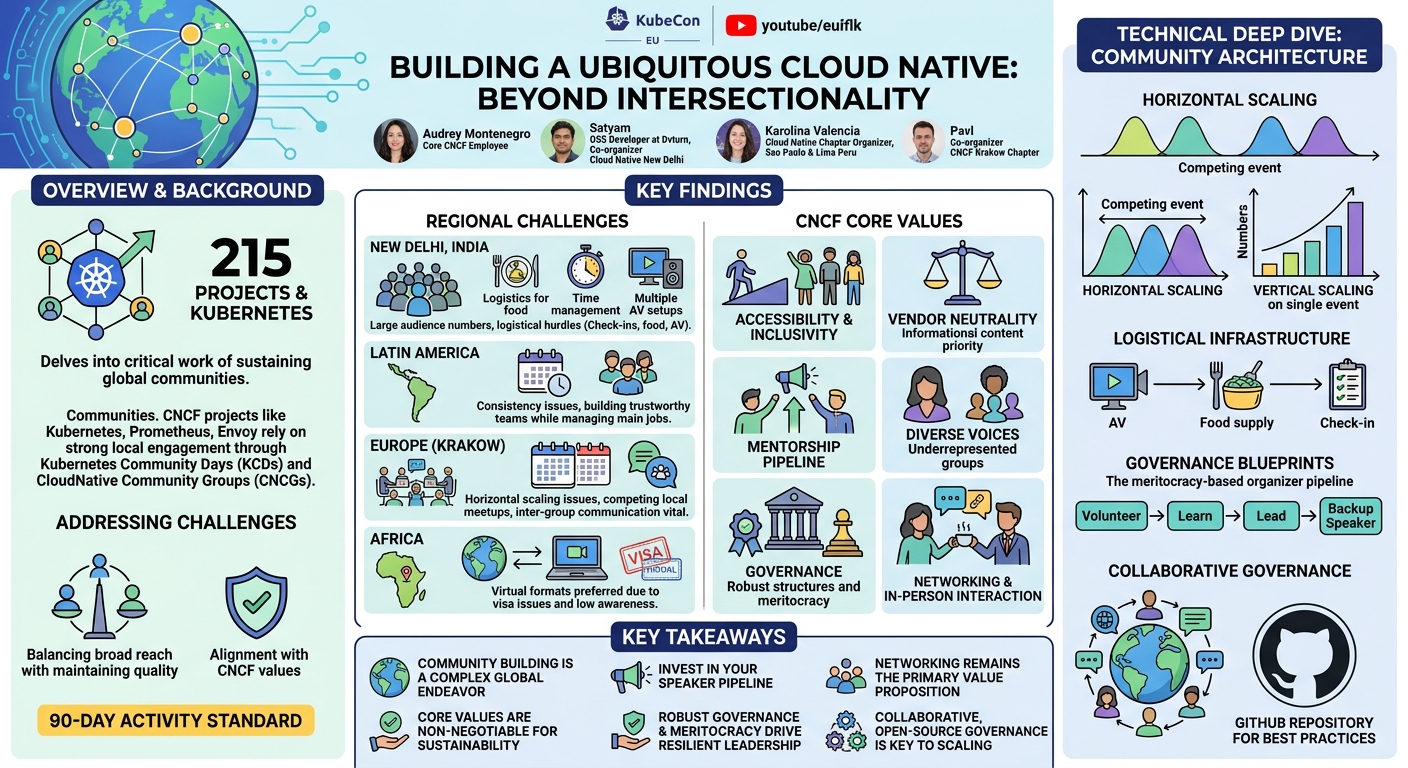
- Diverse Regional Challenges are Paramount: The "happy problem" of large audience numbers in New Delhi (often 200+ attendees per meetup) introduces significant logistical hurdles in time management (check-ins, scheduling), AV setup (multiple speaker devices), and food logistics (ordering days in advance for specific cuisines, managing unexpected turnouts). In contrast, Latin American communities often struggle with consistency and building trustworthy organizer teams that can sustain meetups over long periods, especially given that all organizers have primary jobs. Europe, specifically Krakow, faces horizontal scaling issues due to competing tech meetups on the same days, making inter-community communication vital to avoid diluting attendance. African chapters, as represented by Anita (via Pavl), frequently encounter difficulties with in-person meetups due due to lower open-source awareness and visa issues for speakers, often relying on virtual formats. North American challenges are more varied, encompassing speaker recruitment, venue availability, and cost.
- CNCF Core Values Drive Community Health: The discussion heavily emphasized adherence to accessibility, inclusivity, and vendor neutrality. Pavl highlighted the importance of bringing unexperienced speakers—including juniors and those new to the stage—to share fresh perspectives and build confidence, fostering a vital mentorship pipeline. Karolina stressed the need to actively promote women and underrepresented groups on stage, advocating for mentoring programs and the use of captioning resources for the deaf and hard of hearing. Satyam underscored the commitment to vendor neutrality, prioritizing informational content over promotional material, and structuring meetups with theme-based content that caters to all skill levels, from beginners to advanced.
- Sustainable Growth Requires Robust Governance: The CNCF's evolution to a 90-day activity standard for chapters reflects a commitment to active engagement. The panelists discussed the need for improved governance models for chapters, particularly regarding the structure of city, state, and country chapters. Satyam detailed New Delhi's meritocracy-based organizer onboarding process, where aspiring organizers start as volunteers, learn the ecosystem, and demonstrate commitment over five to six months, including being prepared as backup speakers if needed. This proactive approach ensures knowledgeable and dedicated leadership. The GitHub repository for community best practices was presented as a collaborative platform for evolving these governance standards.
- Networking is the Foremost Value Proposition: Despite the increasing availability of online resources and recordings, the interactive quiz results and speaker consensus strongly indicated that networking and in-person interaction are the primary reasons attendees participate in meetups. Pavl noted that recordings, while valuable for accessibility, can sometimes reduce in-person attendance. The "getting out of the bubble" aspect, sharing diverse experiences, and the potential for career advancement through connections were highlighted as irreplaceable benefits.
- Accessibility Extends Beyond Digital: While live captioning and recording sessions for YouTube were discussed as crucial for accessibility, audience feedback through the quiz revealed a strong interest in physical accessibility and quiet spaces at meetups. This indicates a broader understanding of inclusivity that addresses various needs beyond just digital content delivery.
Technical Deep Dive
▶ Watch: Rewards and benefits of meetups for all (3:48)
While this talk does not delve into the technical specifics of cloud-native software, it offers a profound "technical deep dive" into the architecture and operational mechanics of building and sustaining global open-source communities. The challenges and solutions discussed can be viewed through the lens of distributed systems management and organizational resilience engineering.
Community Architecture and Scaling Challenges:
- Horizontal and Vertical Scaling: Pavl eloquently framed community growth in terms of horizontal and vertical scaling. Horizontally, communities must manage competition from other local tech meetups, requiring inter-group communication to coordinate schedules and avoid "resource contention" for attendees. Vertically, the challenge is scaling engagement within a single meetup, as exemplified by New Delhi's struggle to accommodate 200+ attendees. This necessitates robust event management protocols for check-ins, timekeeping, and comfort.
- Logistical "Infrastructure": Satyam detailed the "infrastructure" of event logistics: reliable AV setup (handling multiple speaker devices, anticipating failures), food supply chain management (ordering Indian food days in advance, dynamic re-ordering for unexpected turnouts), and efficient attendee flow management (check-ins, seating). These are critical operational components that, if poorly managed, can lead to system degradation (delayed starts, unhappy attendees).
- "Vendor Lock-in" Prevention: The principle of vendor neutrality is a core architectural constraint. Satyam's emphasis on informational content over promotional talks serves as a protective mechanism against undue commercial influence, ensuring that the community remains focused on learning and collaboration rather than marketing. This requires careful speaker vetting and content review.
Governance and Operational Blueprints:
- Meritocracy-based Organizer Pipeline: New Delhi's model for onboarding organizers is a robust governance blueprint. It emphasizes meritocracy, where individuals start as volunteers and progressively earn leadership roles through demonstrated commitment and a five to six-month learning period. This ensures that organizers possess not only passion but also a deep understanding of the cloud-native ecosystem and the ability to act as backup speakers if primary speakers are unavailable. This acts as a failover mechanism for content delivery.
- Distributed Team Management: Karolina highlighted the "tricky" nature of building trustworthy organizer teams that can consistently deliver meetups. This is akin to managing a distributed team where members contribute asynchronously (outside their main jobs). Success hinges on clear communication, shared responsibilities, and mutual support to maintain the 90-day activity standard set by CNCF.
- Content Delivery Strategy: Satyam described a theme-based content strategy that caters to a broad audience, from beginners to advanced. This ensures broad accessibility of knowledge and avoids alienating segments of the community. Incorporating unexperienced speakers (as advocated by Pavl) is a deliberate strategy to diversify content, introduce fresh perspectives, and build a sustainable speaker pipeline for future KCDs and CubeCons.
- Accessibility Features (A/B Testing & Implementation): The discussion touched upon live captioning (using open-source tools provided by the CNCF's deaf and hard-of-hearing group) and session recordings for YouTube. Pavl's experience highlighted a potential trade-off: while recordings enhance accessibility for those unable to attend, they can sometimes reduce in-person attendance, suggesting a need for communities to A/B test or make conscious decisions based on their specific audience demographics and goals. The emphasis on physical accessibility and quiet spaces reflects a growing understanding of diverse user needs.
- Collaborative Governance Repository: The GitHub repository for community groups is a practical "technical" tool for collaborative governance. It allows organizers worldwide to open discussions and pull requests to refine best practices for chapters, ensuring that standards are globally relevant and consensus-driven before being merged. This decentralized approach leverages open-source principles for community management.
This "technical deep dive" reveals that building a ubiquitous cloud native involves intricate planning, adaptable strategies, and a deep understanding of human factors, mirroring the complexity often found in software systems themselves.
Demo / Proof of Concept
▶ Watch: Sao Paulo's challenge: consistency and organizer team building (7:45)
While the talk did not feature a traditional software demonstration, it effectively showcased two forms of "proof of concept" in action:
- Interactive Audience Quizzes: The speakers engaged the live audience with two interactive quizzes—one for organizers and one for attendees—using a platform like Mentimeter. The results were displayed live, providing real-time insights into audience preferences, challenges, and motivations. This served as a live data collection mechanism, demonstrating the diversity of opinions on topics like preferred meetup format (in-person vs. virtual), interesting cloud-native topics (observability, security, EBPF, Rust, not just AI), favorite foods (tacos, snacks, no pizza!), and reasons for attending meetups (networking, clarity, community, knowledge). This interactive element was a direct "proof" of the varying needs and perspectives across the cloud-native community.
- The GitHub Repository for Community Best Practices: The panelists repeatedly referred to a GitHub repository specifically for CloudNative Community Groups. This repository, maintained by CNCF core employees like Audrey Montenegro, serves as a collaborative "living document" for governance standards and best practices. It's presented as a proof of concept for how a globally distributed organization can manage and evolve its community guidelines in an open and transparent manner. Organizers are encouraged to contribute by opening discussions and pull requests, ensuring that any proposed changes or new standards are vetted by diverse regional perspectives before being adopted. This exemplifies the open-source ethos applied to community management itself, providing a tangible platform for collective improvement.
These "demonstrations" reinforced the talk's central theme: that understanding and adapting to the diverse needs of a global community requires continuous feedback, collaboration, and a willingness to evolve governance structures through collective effort.
Defensive Implications
▶ Watch: Increasing company awareness of open source importance (8:50)
In the context of community building, "defensive implications" shift from protecting systems against cyber threats to safeguarding the health, sustainability, and integrity of the community itself. This talk provided crucial insights for defending against common pitfalls that can undermine growth and engagement:
- Defending Against Organizer Burnout and Inconsistency: Karolina's emphasis on building trustworthy organizer teams directly addresses burnout. Distributing workload, fostering mutual support, and establishing clear roles are defensive strategies against individual fatigue leading to meetup inconsistency. The CNCF's 90-day activity standard acts as a gentle enforcement mechanism, while Satyam's meritocracy model cultivates a robust, resilient organizer pool with shared responsibilities and backup capabilities.
- Defending Against Content Irrelevance and Promotional Hijacking: Satyam's strict adherence to vendor neutrality and focus on informational, theme-based content is a key defense. This protects the community from becoming a marketing platform, ensuring that meetups remain valuable learning environments. Organizers must proactively vet speakers and talk descriptions to prevent "vendor lock-in" of attention, as Pavl humorously recounted experiences with overly promotional talks.
- Defending Against Exclusion and Lack of Diversity: The call to action for elevating new voices, especially unexperienced speakers and underrepresented groups (women, minorities), is a defense against homogeneity and stagnation. Actively seeking out diverse perspectives, providing mentorship, and ensuring physical accessibility and digital accessibility (e.g., live captioning for the deaf/hard of hearing) are critical defenses against inadvertently creating exclusive environments.
- Defending Against Logistical Failures: The detailed accounts of challenges in New Delhi (AV issues, food shortages, check-in delays) highlight the importance of robust event planning and contingency strategies. Having backup speakers (as New Delhi's organizers are trained to be) is a direct defense against last-minute speaker cancellations. Proactive communication with venues and vendors, and anticipating attendee numbers, mitigates operational vulnerabilities.
- Defending Against Community Fragmentation and Competition: Pavl's experience in Krakow with competing meetups underscores the need for inter-community collaboration. Establishing communication channels with other local tech groups to coordinate schedules is a defense against fragmenting the local audience pool. This promotes a healthier, more collaborative local ecosystem.
- Defending Against Stagnation in Governance: The establishment of a GitHub repository for community governance is a defense against static, top-down rules. It allows for continuous, collaborative improvement of policies, ensuring they remain relevant and equitable across diverse regions. This open-source approach to policy-making ensures the governance itself is resilient and adaptable.
- Defending Against Regional Disparities: The acknowledgment of challenges in Africa (visa issues, foundational awareness) highlights the need for tailored support mechanisms. Instead of a one-size-fits-all approach, recognizing and addressing specific regional barriers (e.g., facilitating virtual events, targeted educational outreach) is crucial for equitable global growth and preventing entire regions from being left behind in the cloud-native adoption curve.
In essence, the defensive implications of this talk revolve around building resilient, inclusive, and self-sustaining cloud-native communities that can adapt to challenges, maintain their core values, and continue to serve as vital engines for open-source innovation worldwide.
Key Takeaways
- Community Building is a Complex Global Endeavor: Fostering a truly ubiquitous cloud native requires understanding and addressing a diverse array of regional challenges, from managing overwhelming attendance and logistical complexities in dense urban centers to building consistent organizer teams and raising basic awareness in emerging markets.
- Core Values are Non-Negotiable for Sustainability: Adherence to vendor neutrality, inclusivity, and accessibility is paramount. Prioritizing informational content, actively promoting diverse voices (including unexperienced speakers and underrepresented groups), and providing resources like live captioning and physical accessibility are critical for long-term community health.
- Invest in Your Speaker Pipeline: Actively bringing unexperienced speakers to the stage is vital. It not only provides fresh perspectives and strengthens foundational knowledge but also builds confidence, fosters mentorship, and creates a sustainable pipeline of talent for future KCDs and larger conferences like CubeCon.
- Robust Governance and Meritocracy Drive Resilient Leadership: Sustainable growth necessitates clear, adaptable governance models and a meritocracy-based approach to organizer selection. Processes that involve volunteering, learning the ecosystem, and demonstrating commitment (e.g., being prepared as backup speakers) ensure dedicated and knowledgeable leadership, protecting against burnout and inconsistency.
- Networking Remains the Primary Value Proposition: Despite the convenience of recordings, in-person networking and the opportunity to "get out of the bubble" and share diverse experiences are consistently cited as the most exciting and valuable aspects of meetups, driving career advancement and collaborative problem-solving.
- Collaborative, Open-Source Governance is Key to Scaling: Utilizing tools like a GitHub repository for community best practices allows for decentralized, consensus-driven evolution of governance standards. This open approach ensures that policies are globally relevant, adaptable, and reflect the collective wisdom of the worldwide organizer community.
About the Speaker(s)
Audrey Montenegro serves as a core employee at the Cloud Native Computing Foundation (CNCF). Her primary focus is on organizing and supporting Kubernetes Community Days (KCDs), which are one to two-day summits, as well as managing and fostering CloudNative Community Groups globally. She plays a pivotal role in ensuring the health and growth of these essential local cloud-native ecosystems.
Satyam is an OSS Developer at Dvturn and a dedicated co-organizer of Cloud Native New Delhi. Under his and his fellow organizers' leadership, Cloud Native New Delhi has grown to become the largest cloud-native community in Asia within just one year, a testament to their efforts in community building and engagement.
Karolina Valencia brings extensive experience in community organizing across Latin America. She has been instrumental in building and organizing cloud-native chapters in Sao Paulo and Lima, Peru. Furthermore, she has organized KCDs in Sao Paulo, Rio de Janeiro, and Lima, Peru, and participated in the inaugural Cube Day Colombia, the first CNCF event in Latin America. Her work provides valuable insights into the unique challenges and opportunities in the region.
Pavl represents the European perspective as a co-organizer of the CNCF Krakow chapter. He is also a key figure in organizing the first KCD in Warso, scheduled for this year. His experience extends to other significant tech events like AWS Community Day and DevOps Days, providing a broad understanding of community dynamics. He also spoke on behalf of Anita, who was unable to travel from Africa due to visa issues, highlighting the global challenges faced by community leaders.
Reviews
Dr. Zero (Offensive Security Researcher) — STRONG ACCEPT
This panel provided a surprisingly deep dive into the operational mechanics and governance architecture required to scale and sustain global open-source communities. While not a traditional security talk, its rigorous examination of community resilience, distributed team management, and defensive strategies against organizational pitfalls offers critical insights for anyone involved in large-scale technical ecosystems. The speakers, all deeply embedded in CNCF community efforts, delivered concrete examples and actionable strategies, making this a valuable session for its intended audience.
Heather Calloway (CISO) — STRONG ACCEPT
This session, while not a traditional security talk, offers crucial insights into the governance, resilience, and sustainability of global cloud-native communities. It directly addresses the institutional health of the open-source ecosystem, a critical dependency for any enterprise leveraging cloud-native technologies. The discussion on robust governance models, vendor neutrality, and fostering diverse leadership provides a vital framework for understanding the long-term viability and security of our software supply chain.