Lightning Talk: High Availability With '503: Unavailable' - Robert-Jan Huijsman, Reboot
Robert-Jan Huijsman, Reboot
KubeCon + CloudNativeCon Europe 2025 · Lightning Talk
Overview
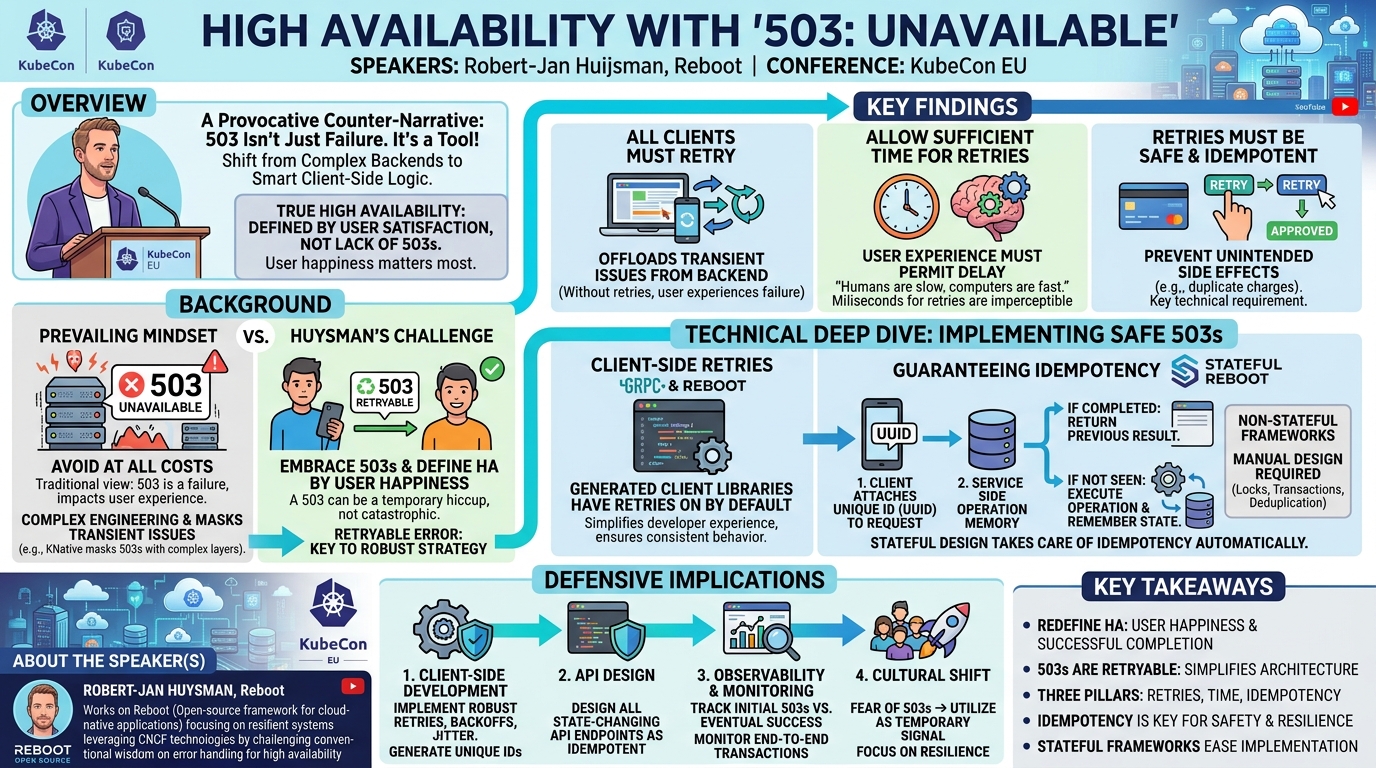
In a world where engineers meticulously craft complex architectures to avoid returning a 503 Unavailable error, Robert-Jan Huijsman of Reboot presented a provocative counter-narrative at KubeCon EU. His lightning talk, "High Availability With '503: Unavailable'," challenged the conventional wisdom that a 503 response inherently signifies a failure in a highly available system. Instead, Huijsman argued that, when handled correctly, 503s can be a powerful tool for simplifying system design and achieving true high availability, defined by user satisfaction rather than the absence of specific HTTP error codes.
Key moments
- 0:00 High availability definition and challenging 503 errors
- 0:58 Knative's complexity to avoid simple 503 responses
- 1:59 Reboot's philosophy: embracing 503s and client retries
- 2:18 First condition: All clients must be configured to retry
- 2:56 Second condition: User experience allows time for retries
- 3:40 Third condition: API retries must be idempotent (safe)
- 4:26 Conclusion: Safely returning 503s for high availability
High Availability With '503: Unavailable'
Speakers: Robert-Jan Huijsman, Reboot
Conference: KubeCon EU
YouTube: https://www.youtube.com/watch?v=0adVcinYGC8
Overview
In a world where engineers meticulously craft complex architectures to avoid returning a 503 Unavailable error, Robert-Jan Huijsman of Reboot presented a provocative counter-narrative at KubeCon EU. His lightning talk, "High Availability With '503: Unavailable'," challenged the conventional wisdom that a 503 response inherently signifies a failure in a highly available system. Instead, Huijsman argued that, when handled correctly, 503s can be a powerful tool for simplifying system design and achieving true high availability, defined by user satisfaction rather than the absence of specific HTTP error codes.
The core premise of the talk is that a 503 is a retryable error. If a client retries quickly enough and the subsequent attempt succeeds, the end-user experience remains positive, thus fulfilling the promise of high availability. Huijsman introduced Reboot, an open-source framework for cloud-native applications, as a practical demonstration of this philosophy. Reboot deliberately "sprinkles 503s around as if they are free," relying on intelligent client-side retry mechanisms and a foundational principle of idempotency to ensure robust, user-friendly service even in the face of temporary backend unavailability.
This talk is particularly significant for architects and developers working with distributed systems and microservices, where transient failures are an inevitable reality. By reframing the 503 from a catastrophic failure to a manageable, retryable state, Huijsman offered a path to simpler, more resilient systems. The approach advocates for shifting the burden of temporary unavailability from complex backend infrastructure to smart client-side logic, fundamentally altering how we perceive and design for high availability in the cloud-native landscape.
Background
▶ Watch: High availability definition and challenging 503 errors (0:00)
The prevailing engineering mindset often dictates that a 503 Unavailable response is an unequivocal indicator of system failure, something to be avoided at all costs. This aversion stems from the traditional understanding that such an error directly impacts user experience and signifies a broken service. Consequently, significant engineering effort and architectural complexity are often invested in preventing 503s, even when a service is genuinely experiencing temporary unavailability.
Huijsman highlighted this common approach by referencing the architecture of KNative, a popular serverless platform. He pointed out that KNative's design includes specific components and logic solely dedicated to not sending a 503 response when an application might, in fact, be temporarily unavailable. This illustrates the lengths to which systems are designed to mask transient issues, often introducing overhead and complexity that could otherwise be avoided. The perceived "failure" of a 503 drives engineers to build intricate layers of abstraction and redundancy, aiming for a facade of continuous availability even when underlying services might be momentarily struggling.
However, Huijsman challenged this perspective by redefining high availability not as the absence of error codes, but as the happiness of the user. If a request ultimately succeeds within a useful amount of time, even after one or more retries, the user's experience is unaffected, and the service can still be considered highly available. This redefinition posits that a 503, being a retryable error according to the HTTP specification, can be an integral part of a robust high availability strategy. The problem, therefore, isn't the 503 itself, but rather the lack of a comprehensive system design that embraces its retryable nature. This talk aimed to bridge that gap, offering a "different way" to leverage 503s for enhanced system resilience and simplicity.
Key Findings
▶ Watch: Reboot's philosophy: embracing 503s and client retries (1:59)
The central finding of Robert-Jan Huijsman's talk is that the 503 Unavailable HTTP status code, traditionally viewed as a definitive failure, can be strategically embraced to achieve high availability. This paradigm shift is contingent upon three critical principles, which together form a robust framework for designing resilient cloud-native applications.
Firstly, the most fundamental finding is that all clients must retry when an error occurs. If clients do not implement retry logic, then sending a 503 indeed results in a failed user experience. However, when clients are designed to automatically retry, a transient 503 becomes a temporary hiccup rather than a terminal failure. This offloads the immediate resolution of transient issues from the backend service to the client, simplifying backend architecture.
Secondly, the user experience must inherently allow sufficient time for these retries to happen. This finding acknowledges the practical realities of human-computer interaction. As Huijsman eloquently put it, "humans are slow, computers are fast." For most user-facing applications, the latency introduced by a few quick retries is imperceptible to a human user. This allows the system to absorb temporary service interruptions without degrading the perceived quality of service.
Finally, and most crucially, retries must be safe, meaning they must be idempotent. This is perhaps the most significant technical finding, as it addresses the potential for unintended side effects when operations are retried. An idempotent operation is one that, when executed multiple times with the same parameters, produces the same result as if it had been executed only once. Without idempotency, a retry could lead to duplicate actions (e.g., charging a customer twice), which is unacceptable. Ensuring idempotency transforms the retry mechanism from a potential hazard into a reliable recovery strategy.
These three findings collectively form the foundation for Reboot's approach, demonstrating how a deliberate strategy of returning 503s, coupled with intelligent client behavior and robust API design, can lead to simpler, more resilient, and ultimately highly available systems that prioritize user happiness.
Technical Deep Dive
▶ Watch: First condition: All clients must be configured to retry (2:18)
The technical implementation of embracing 503 Unavailable for high availability, as demonstrated by the Reboot framework, relies heavily on establishing a tightly coupled contract between the service and its clients, particularly concerning retries and idempotency.
The first technical pillar is ensuring client-side retries. Huijsman emphasized that if clients do not retry, the entire model collapses. Reboot addresses this by building upon gRPC, a high-performance, open-source universal RPC framework. A key innovation in Reboot is that, unlike standard gRPC client libraries, the client libraries generated by Reboot have retries turned on by default. This means that when a developer uses Reboot to define their services, the generated client code automatically incorporates retry logic for transient errors like 503s. This significantly lowers the barrier to entry for developers, as they don't need to manually implement complex retry mechanisms, exponential backoffs, or jitter themselves. The framework provides this essential functionality out-of-the-box, ensuring a consistent and reliable client behavior across all services built with Reboot.
The second technical consideration is the temporal allowance for retries within the user experience. While not a direct technical implementation, it's a critical design constraint that influences the effectiveness of the retry strategy. Reboot's most popular client library is for React, a JavaScript library for building user interfaces. Applications built with React typically involve human users interacting with a browser. As humans are inherently slower than computers, the small delays introduced by a few retries (often in the order of milliseconds) are generally imperceptible. This makes the React client an ideal candidate for this model, as the user-facing latency budget is generous enough to accommodate the necessary retry attempts without degrading the perceived performance or responsiveness of the application.
The most intricate technical aspect, and arguably the cornerstone of this approach, is guaranteeing idempotency for all operations that might be retried. An operation is idempotent if executing it multiple times has the same effect as executing it once. Huijsman illustrated this with a simple "give me a thousand pounds" example: if the request is sent twice but the intention is to receive the amount only once, the operation must be idempotent. Achieving this requires two technical components:
- Client-attached Request ID: The client must attach a unique ID to each request. This identifier allows the service to distinguish between a new, unique request and a retry of a previous request. This ID is typically a UUID or a similar globally unique identifier generated by the client before sending the initial request.
- Service-side Operation Memory: The service needs to remember what operations it has completed and which it has not. When a request with a given ID arrives, the service first checks its internal state to see if an operation with that specific ID has already been successfully processed.
- If the operation has already been completed, the service can simply return the previous result without re-executing the side effects.
- If the operation is in progress, the service might wait for it to complete or return an appropriate status indicating the ongoing process.
- If the operation has not been seen before, the service proceeds with its execution.
Reboot simplifies this complex requirement significantly because it is a stateful framework. This means Reboot is designed from the ground up to manage and persist state effectively, including the history of operations. As a result, Reboot can automatically "take care of it for you," handling the storage and lookup of request IDs and the status of operations internally. This alleviates application developers from the arduous task of implementing idempotency logic for every API endpoint. In frameworks that are not inherently stateful, this burden falls squarely on the application developer, requiring careful design of database transactions, distributed locks, and request deduplication logic to ensure safety. By abstracting this complexity, Reboot enables developers to confidently return 503s, knowing that their system will remain safe and consistent despite retries.
Demo / Proof of Concept
▶ Watch: Third condition: API retries must be idempotent (safe) (3:40)
While Robert-Jan Huijsman's lightning talk did not include a live, explicit demo of a system failing with a 503 and then recovering, the Reboot framework itself serves as the practical implementation and proof of concept for the principles discussed. Reboot is presented as an open-source framework specifically designed to demonstrate and operationalize the concept of achieving high availability by strategically embracing 503 errors. Its architecture, which includes gRPC-based client libraries with default retries and a stateful design that ensures idempotency, embodies the "different way" of handling temporary unavailability. The existence and functionality of Reboot validate that this approach is not merely theoretical but a tangible, deployable solution for cloud-native application development.
Defensive Implications
▶ Watch: Conclusion: Safely returning 503s for high availability (4:26)
Embracing 503s as a strategy for high availability has profound defensive implications, necessitating a shift in how engineers design, implement, and monitor their systems.
Firstly, client-side development becomes paramount. Defenders must ensure that all clients interacting with such services are designed with robust retry mechanisms enabled by default. This includes not just custom-built clients but also ensuring that any third-party libraries or proxies in the request path are configured to handle 503s as retryable errors, potentially with exponential backoff and jitter to prevent thundering herd problems. Furthermore, clients must consistently generate and attach unique request IDs to every operation to facilitate idempotency on the server side. Developers need to be educated on the importance of these IDs and the underlying idempotency principles.
Secondly, API design must fundamentally incorporate idempotency. Every API endpoint that performs a state-changing operation must be designed to be idempotent. This requires careful consideration during the design phase, mapping out potential side effects and how they can be safely re-executed or prevented from duplicating. For services not using a framework like Reboot, this means implementing explicit logic to store request IDs, check for prior execution, and return cached results for duplicate requests. This adds a layer of complexity to API development but is crucial for system reliability.
Thirdly, observability and monitoring strategies need to adapt. Instead of solely focusing on the presence of 503s as a critical alert, monitoring systems should differentiate between persistent 503 errors (indicating a genuine, prolonged outage) and transient 503s that are successfully resolved by client retries. Key metrics would include the rate of initial 503 responses versus the eventual success rate of user-initiated operations. This allows defenders to understand the true impact on user experience, rather than being alarmed by every temporary service blip. Tools should be configured to track end-to-end transaction success rather than just single request/response cycles.
Fourthly, this approach simplifies backend architecture by offloading complexity. Instead of building intricate load balancers, circuit breakers, and caching layers solely to mask transient backend issues, the focus can shift to robust, idempotent service implementations. This can lead to simpler, more maintainable microservices that are easier to scale and troubleshoot. Defenders can leverage this simplicity to reduce attack surface and improve overall system clarity.
Finally, there's a cultural shift required within engineering teams. The traditional fear of 503s must be replaced by an understanding of their utility as a signal for temporary unavailability that can be gracefully handled. This empowers teams to design systems that are more resilient to transient failures, acknowledging the inherent unreliability of distributed systems, rather than fighting against it with ever-increasing complexity. Defenders should champion this shift, promoting best practices for client-side retries and server-side idempotency across all development teams.
Key Takeaways
- Redefine High Availability: True high availability is about user happiness and successful request completion within a useful timeframe, even if it involves transient errors and retries.
- Embrace 503s as Retryable: The 503 Unavailable status code is intended for retryable errors. Leveraging this can simplify backend architecture.
- Three Pillars for Safe 503s:
- Clients must implement robust retry logic.
- User experience needs to allow time for retries (e.g., human-facing applications).
- All retried operations must be idempotent to prevent unintended side effects.
- Idempotency is Key: To ensure safety, clients need to attach a unique ID to each request, and services must remember completed operations to avoid duplicate execution.
- Frameworks Can Simplify: Frameworks like Reboot, which are stateful and generate client libraries with default retries, can significantly ease the implementation of this high-availability model.
- Shift in System Design: This approach encourages designing simpler backend services, shifting the complexity of transient failure handling to intelligent clients and idempotent API design.
About the Speaker(s)
Robert-Jan Huijsman is associated with Reboot, an open-source framework designed to develop cloud-native applications. His work with Reboot focuses on building resilient systems that leverage CNCF technologies, particularly by challenging conventional wisdom around error handling to achieve high availability. The talk at KubeCon EU reflects his expertise in cloud-native development and his innovative approach to distributed system design.
Reviews
Dr. Zero (Offensive Security Researcher) — STRONG ACCEPT
This talk cuts through the noise, challenging the industry's religious aversion to the 503 status code. Huijsman argues that when handled correctly, 503s are a feature, not a bug, for high availability. By forcing client-side retries and demanding true idempotency, it promises simpler, more robust systems. This is a pragmatic, no-bullshit approach to an old problem, and frankly, it's about time someone said it.
Heather Calloway (CISO) — STRONG ACCEPT
This talk provocatively redefines high availability, arguing that strategically embracing 503 'Unavailable' responses, rather than meticulously avoiding them, can lead to simpler, more resilient systems. By emphasizing client-side retries, user experience tolerance, and, critically, server-side idempotency, it shifts the focus from avoiding error codes to ensuring ultimate user satisfaction. This approach offers a pragmatic path for organizations to enhance their operational resilience and data integrity in complex distributed environments, providing clear guidance on how to design and monitor systems for true business continuity.