Cloud Native Communities in Action: How Japan Shaped Its Path To KubeCon
KubeCon + CloudNativeCon Europe 2025 · Session
Overview
This insightful panel discussion, "Cloud Native Communities in Action: How Japan Shaped Its Path To KubeCon," brought together key figures instrumental in fostering the cloud-native ecosystem in Japan. The speakers — Uina Camura, Shu Muto, Noria Gquest, and Syan (La Pang) — detailed the journey of the Japanese community, highlighting the establishment of the Cloud Native Community Japan (CNCJ) and its pivotal role in connecting local developers with the global Cloud Native Computing Foundation (CNCF) landscape. Their narrative culminates in the successful bid to host the inaugural KubeCon Japan in 2024, a significant milestone for the region.
Key moments
- 0:00 Speakers introduce themselves and talk topic
- 2:00 Forming CNCJ and its initial activities in Japan
- 4:00 Impact of Kubernetes upstream training and local communities
- 8:00 Japan's historical isolation from global tech trends
- 8:40 Linux Foundation's strategy to boost global collaboration
- 10:00 How local events increased Japanese Linux kernel contributions
Cloud Native Communities in Action: How Japan Shaped Its Path To KubeCon
Speakers: Uina Camura (Hitachi, CNCF Governing Board, Cloud Native Community Japan Organizer), Shu Muto (NC Solution Innovators, SIGUI Chair, CNCF Ambassador, Kubernetes Upstream Training Japan Organizer), Noria Gquest (Linux Foundation Japan), Syan (La Pang) (IBM Research Tokyo, CNCF Project Contributor, Cloud Native Community Japan Organizer, KubeCon Japan Co-Chair)
Conference: KubeCon EU
YouTube: https://www.youtube.com/watch?v=wb8K3RV6Sbw
Overview
This insightful panel discussion, "Cloud Native Communities in Action: How Japan Shaped Its Path To KubeCon," brought together key figures instrumental in fostering the cloud-native ecosystem in Japan. The speakers — Uina Camura, Shu Muto, Noria Gquest, and Syan (La Pang) — detailed the journey of the Japanese community, highlighting the establishment of the Cloud Native Community Japan (CNCJ) and its pivotal role in connecting local developers with the global Cloud Native Computing Foundation (CNCF) landscape. Their narrative culminates in the successful bid to host the inaugural KubeCon Japan in 2024, a significant milestone for the region.
The talk meticulously unpacks the unique challenges faced by non-English-speaking communities, including linguistic barriers, time zone differences, and cultural nuances that historically hindered engagement with global open-source projects. It showcases the strategic initiatives, collaborative efforts, and dedicated training programs that have transformed Japan from a region lagging in cloud-native adoption to a vibrant, contributing force within the CNCF. This presentation is invaluable for any community or organization looking to replicate a similar success story, offering a blueprint for bridging geographical and cultural divides in the pursuit of open-source collaboration and technological advancement.
The significance of this talk extends beyond a mere recounting of events; it serves as a powerful case study in community building and global integration. By illustrating how a concerted effort can overcome significant obstacles—from securing corporate sponsorships to developing effective contributor training—the speakers provide actionable insights for fostering inclusive and thriving open-source communities worldwide. The lessons learned from Japan's journey offer a compelling argument for the importance of localized efforts, direct interaction, and dedicated support in empowering diverse populations to contribute meaningfully to the cloud-native ecosystem.
Background
▶ Watch: Speakers introduce themselves and talk topic (0:00)
Historically, Japan faced unique hurdles in the adoption of cloud-native technologies and in establishing robust connections with the global CNCF upstream community. As Uina Camura noted, Japan was initially "behind in the adoption of cloud native technologies," lacking official ties to the broader CNCF ecosystem (02:00). This isolation was not unique to cloud native; Noria Gquest from the Linux Foundation highlighted a broader trend within the Japanese industry to become "more and more isolated from the global trends" (08:00). This inherent nature, coupled with significant language and cultural barriers, made direct participation in global open-source projects challenging for Japanese developers.
To counteract this, a collaborative effort was launched approximately one and a half years prior to the talk, leading to the creation of the Cloud Native Community Japan (CNCJ). This new entity served as a central hub, bringing together individuals from CNCF member companies, local community organizers, and the Linux Foundation Japan (02:00). CNCJ immediately became active, organizing various Special Interest Groups (SIGs) focused on areas like security and sustainability, holding monthly meetups, and initiating upstream training programs to cultivate new contributors (02:00).
Prior to CNCJ's formation, Japan already possessed a foundational, albeit fragmented, open-source landscape. Shu Muto detailed several key initiatives:
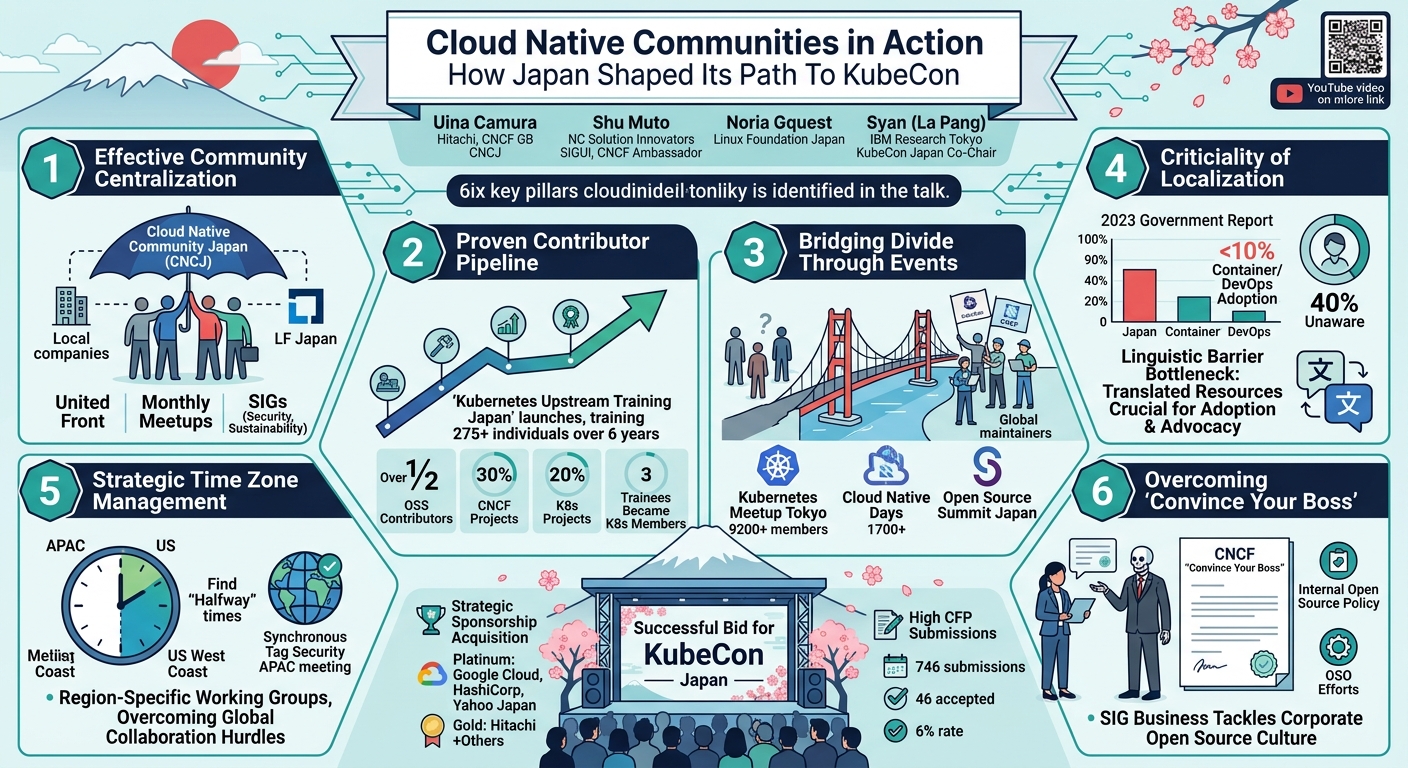
- Kubernetes Upstream Training Japan: Launched in 2019, this program was modeled after the Kubernetes Contributor Summit's new contributor workshop. Over six years, it held 12 events, attracting 275 trainees. Muto-san reported impressive outcomes, with over 10% of trainees being students, almost half contributing to Open Source Software (OSS), approximately 30% contributing to CNCF projects, and over 20% to Kubernetes projects. Notably, three trainees successfully advanced to become K8s members (04:00). The training program benefited from a diverse group of six active trainers from various companies and a university.
- Kubernetes Meetup Tokyo: Initiated in 2016, this community boasted over 9,200 members across 78 events over nine years. It also spawned sub-communities like Kubernetes Meetup Novice and Cloud Native Meetup Tokyo (05:00).
- Cloud Native Days (previously Container Days): As the largest cloud-native conference in Japan, it started in 2018, hosting 14 conferences over seven years, including specialized events on CI/CD and observability. These events consistently drew an average of 1,700 attendees in Tokyo. During the COVID-19 pandemic, the community innovatively developed an open-source live-stream platform called Dreamcast to sustain engagement (06:00).
- Open Source Summit Japan: An annual event organized by the Linux Foundation in Japan since 2009, this conference typically attracts around 1,000 attendees, establishing itself as one of the top international open-source conferences in the country (06:00).
Despite these local efforts, the challenge of connecting with the global community remained. Noria Gquest drew parallels to the early days of the Linux kernel community in Japan, where the Linux Foundation's LinuxCon Japan event, starting around 2009-2010, played a crucial role. By bringing global maintainers to Japan, it provided local engineers with direct interaction, fostering confidence to submit patches. This initiative significantly increased contributions from Japanese companies like Fujitsu and Renesas, which eventually became top Linux kernel contributors (08:00-10:00). This historical precedent underscored the critical importance of hosting a major international event like KubeCon locally to bridge the gap between Japanese talent and the global cloud-native ecosystem.
Key Findings
▶ Watch: Impact of Kubernetes upstream training and local communities (4:00)
The talk revealed several critical findings concerning community development, global engagement, and the specific dynamics within Japan’s cloud-native landscape:
- Effective Community Centralization: The formation of Cloud Native Community Japan (CNCJ) approximately 1.5 years prior to the talk proved to be a highly effective strategy for consolidating disparate local efforts. CNCJ successfully united individuals from CNCF member companies, local community organizers, and the Linux Foundation Japan under a single umbrella, facilitating coordinated activities such as Special Interest Groups (SIGs) for security and sustainability, monthly meetups, and dedicated upstream training (02:00).
- Proven Contributor Pipeline: The Kubernetes Upstream Training Japan program demonstrated a robust model for cultivating new open-source contributors. With 275 trainees over 12 events, it achieved significant conversion rates: almost half of trainees contributed to Open Source Software (OSS), 30% to CNCF projects, and 20% to Kubernetes projects. The ultimate success was evidenced by three trainees becoming K8s members, illustrating a clear and effective pathway from learning to active contribution (04:00).
- Bridging the Global-Local Divide through Events: Hosting KubeCon Japan for the first time was identified as a paramount achievement and a crucial mechanism for integrating the Japanese community with the global cloud-native ecosystem. This initiative directly addressed the historical isolation and provided invaluable opportunities for local engineers to interact directly with global maintainers, fostering collaboration and overcoming engagement barriers (02:00, 09:00, 10:00).
- Strategic Time Zone Management: Speakers acknowledged the pervasive challenge of time zone differences for online collaboration. Solutions included finding "halfway" meeting times (e.g., 7 AM US West Coast aligning with 11 PM Japan) and establishing region-specific working groups, such as the newly launched Tag Security APAC meeting. This approach allowed for synchronous collaboration among participants in similar time zones, enhancing productivity and inclusion (12:00, 24:00).
- The "Convince Your Boss" Barrier: A significant hurdle for individual contributions and conference attendance was identified as securing company support and permission. Syan (La Pang) mentioned that while some companies, like IBM Research, support contributions with evidence, others may not. The talk highlighted the existence of CNCF's "Convince Your Boss" page, which provides sample letters to advocate for the value of participation. This pointed to a broader need for internal open-source culture and clear organizational policies (14:00, 18:00, 20:00).
- Criticality of Localization for Adoption: Noria Gquest presented a startling finding from a 2023 Japanese government report (the Digital Transformation Report 2023): less than 10% adoption of technologies like containers or methodologies like DevOps in Japan, with an alarming 40% of respondents unaware of these concepts. This low awareness and adoption were directly attributed to the lack of translated, cutting-edge technical information. The finding unequivocally underscored that localization of resources is not merely helpful but "really, really important" for technology distribution, enterprise adoption, and internal advocacy within non-English-speaking markets (20:00-22:00).
- Strategic Sponsorship Acquisition: Securing high-level local sponsorships was presented as a decisive factor in convincing CNCF to approve KubeCon Japan. Uina Camura explained that organizers proactively demonstrated their ability to gather significant local sponsors, including prominent Japanese companies like Hitachi (a top-tier sponsor) and international tech giants like Google Cloud, HashiCorp, and Yahoo Corporations as platinum sponsors. This financial backing was crucial for covering the substantial costs associated with a large-scale event (26:00-28:00).
- High Quality and Interest in KubeCon Japan Submissions: Syan (La Pang), as a KubeCon Japan co-chair, shared impressive statistics for the upcoming event: out of 746 Call for Proposals (CFP) submissions, only 46 were accepted, resulting in a highly competitive 6% acceptance rate. This indicated both a strong local interest in presenting and a high bar for quality content, comparable to top-tier global conferences (28:00).
Technical Deep Dive
▶ Watch: Japan's historical isolation from global tech trends (8:00)
While not a "technical deep dive" in the traditional sense of code exploitation or system architecture, this talk offers a profound look into the technical mechanisms and strategic methodologies employed to build, sustain, and integrate a vibrant cloud-native community. The "technology" here lies in the processes, platforms, and cultural engineering required for a global open-source ecosystem to thrive across diverse linguistic and geographic landscapes.
Central to Japan's community growth is its Upstream Training Methodology. Based on the highly effective Kubernetes Contributor Summit's new contributor workshop, this program is designed to transform enthusiastic learners into active open-source contributors. The structure focuses on practical engagement, providing a guided pathway for individuals to navigate the complexities of contributing to large-scale projects like Kubernetes. Muto-san detailed the tangible results: 275 trainees, with a significant portion moving on to direct contributions to CNCF and Kubernetes projects, demonstrating the efficacy of a structured, hands-on approach to onboarding (04:00).
The Community Structure itself is a key technical artifact. CNCJ functions as a meta-organization, orchestrating various Special Interest Groups (SIGs), such as those dedicated to security and sustainability. This modular approach allows for focused collaboration on specific topics while maintaining a unified identity. The existence of sub-communities like Kubernetes Meetup Novice further illustrates a tiered approach to community engagement, catering to different experience levels and fostering a welcoming environment for beginners (02:00, 05:00).
A significant "technical" challenge addressed was Linguistic Barriers. Muto-san elaborated on the fundamental difference in word order between Japanese (Subject-Object-Verb) and English (Subject-Verb-Object). This structural disparity creates inherent difficulties in real-time translation and synchronous understanding, even with advanced tools (16:00). The community's "technical solution" to this human problem involves cultural adaptation: encouraging participants not to fear imperfect English and explicitly promoting the use of emojis (like smiley faces) to convey kindness and reduce intimidation for beginners in online interactions (17:00). This highlights how socio-technical interventions are critical for inclusive participation.
The emphasis on Documentation and Contributor Playgrounds underscores another technical enabler. While Kubernetes-related projects are generally well-documented, the sheer volume can be overwhelming. The talk implicitly advocates for accessible, structured documentation and dedicated "contributor playground" environments that allow new users to experiment and learn without fear of breaking production systems (18:00). These resources are essential for self-paced learning and reducing the initial friction of contribution.
The discussion around Open Source Adoption in Enterprises revealed a "technical" barrier rooted in organizational policy. Many companies lack established open-source policies, and internal procedures for contributing can be overly complicated or time-consuming. The SIG Business of CNCJ was formed specifically to tackle these Open Source Office (OSO)-related topics, demonstrating a structured community effort to influence corporate culture and streamline the process of enterprise contributions (18:00-20:00). This represents a "technical deep dive" into the organizational mechanics of open-source integration.
Perhaps the most compelling "technical" finding relates to Localization as a Technical Enabler. Noria Gquest's reference to the Digital Transformation Report 2023 from the Japanese government starkly illustrated the direct correlation between the availability of localized technical information and the adoption rate of cutting-edge technologies. With <10% adoption of containers/DevOps and 40% unaware, the absence of Japanese translations for critical technical resources was identified as a primary bottleneck. Therefore, translation is not just a convenience but a fundamental technical requirement for widespread distribution and strategic adoption of cloud-native technologies in non-English-speaking markets (20:00-22:00).
Finally, the initiative to conduct CFP Hacking/Speaker Training showcases a technical approach to increasing community representation. These specialized meetups guide potential speakers on how to craft compelling Call for Proposals (CFPs) and effectively present at conferences. By demystifying the process and sharing insider tips, these sessions aim to increase the number of KubeStrOnauts (Kubernetes speakers) from Japan, thereby technically enhancing the community's global visibility and influence (23:00-24:00).
Demo / Proof of Concept
▶ Watch: Linux Foundation's strategy to boost global collaboration (8:40)
This particular talk did not feature a live technical demonstration or a software proof of concept in the traditional sense. Instead, the entire presentation served as a proof of concept for successful community building, strategic collaboration, and the effective organization of a major international technology event in a non-English-speaking region. The "demo" was the tangible evidence of the Japanese community's journey and its achievements.
The most prominent demonstration of success was the impending KubeCon Japan event, scheduled for June 16-17 at the Hilton Hotel in Odaiba, Tokyo. The speakers presented concrete metrics underscoring the event's viability and the community's engagement:
- Sponsorship Acquisition: Syan (La Pang) detailed the impressive sponsorship roster, including three platinum sponsors (Google Cloud, HashiCorp, and Yahoo Corporations), nine gold members, thirteen silver members, and two startup members. This robust financial backing, secured through persistent efforts, was a critical factor in CNCF's approval of KubeCon Japan (28:00). Hitachi's role as a top-tier sponsor was also highlighted by Uina Camura (26:00).
- Call for Proposals (CFP) Engagement: The event received 746 submissions, from which only 46 were accepted, resulting in a highly competitive 6% acceptance rate. This figure not only demonstrates the strong local interest in contributing to the cloud-native discourse but also the high quality and rigor applied by the 61-member program committee in curating the content (28:00).
Beyond KubeCon Japan, the talk highlighted other "proofs of concept" for their community-building methodologies:
- Upstream Training Success: The Kubernetes Upstream Training Japan program's statistics—275 trainees, with 30% contributing to CNCF projects and 3 becoming K8s members—serve as a quantifiable demonstration of their effective contributor pipeline (04:00).
- Community Growth: The sheer size and activity of local groups, such as Kubernetes Meetup Tokyo with over 9,200 members and 78 events, and Cloud Native Days with an average of 1,700 attendees, showcased the vibrant and expansive nature of the Japanese cloud-native community (05:00-06:00).
- Cultural Adaptations: The successful launch of the Tag Security APAC meeting, collaborating on whitepapers despite time zone differences, served as a proof of concept for their strategies to overcome geographical and temporal barriers through regional alignment (24:00).
In essence, the entire presentation was a powerful "show, don't tell" narrative, where the speakers presented the results of their strategic and organizational efforts as the ultimate demonstration of their methodologies' effectiveness.
Defensive Implications
▶ Watch: How local events increased Japanese Linux kernel contributions (10:00)
Given that this talk focuses on community building and conference organization rather than security vulnerabilities or exploits, the concept of "defensive implications" must be reframed. Instead, we can analyze the strategic implications for the health, growth, and resilience of open-source ecosystems. The insights from Japan's journey offer crucial lessons for defending against stagnation, isolation, and lack of diversity within global open-source projects.
- Defending Against Community Isolation and Stagnation: The historical tendency of the Japanese industry to become isolated (08:00) serves as a warning. Proactive measures, such as establishing central community hubs like CNCJ (02:00) and hosting major international events like KubeCon locally (09:00), are vital "defenses" against insularity. These initiatives foster direct interaction with global maintainers, preventing local communities from becoming disconnected from the leading edge of open-source development.
- Building a Resilient Contributor Pipeline: The success of the Kubernetes Upstream Training Japan program (04:00) provides a defensive strategy against contributor burnout and a shrinking talent pool. By actively training and onboarding new contributors, especially students and those new to OSS, communities ensure a continuous influx of fresh perspectives and labor, critical for the long-term sustainability of projects. This is a defense against project decay due to lack of maintenance or innovation.
- Strengthening Global Adoption through Localization: The stark findings from the Japanese government's report regarding low technology adoption due to lack of translated resources (20:00-22:00) underscore the "defensive" necessity of localization efforts. Without content available in local languages, technologies risk limited adoption in vast non-English-speaking markets. Investing in translation and culturally relevant documentation is a defense against fragmented market penetration and ensures broader global impact for open-source projects.
- Mitigating Linguistic and Cultural Barriers: The explicit strategies for addressing language differences (e.g., encouraging imperfect English, using emojis) and cultural nuances (e.g., building trust with global maintainers) (08:00, 17:00) are crucial "defenses" against exclusion. These efforts ensure that open-source communities are truly diverse and inclusive, allowing talent from all backgrounds to contribute without undue friction, thereby enriching the projects with varied viewpoints and skills.
- Empowering Enterprise Open Source Contribution: The discussion around the "convince your boss" challenge and the role of SIG Business of CNCJ (14:00, 18:00-20:00) highlights the need for internal organizational defenses. Many enterprises face internal policy hurdles that prevent their engineers from contributing to open source. Providing templates, guidance, and advocating for internal open-source offices are "defenses" against corporate inertia, unlocking a vast pool of potential contributors and fostering a symbiotic relationship between industry and open source.
- Securing Financial Viability for Community Events: The emphasis on strategic sponsorship acquisition (26:00-28:00) acts as a "defensive" measure for community events. Large-scale conferences like KubeCon are vital for knowledge exchange and networking but are costly. Demonstrating the ability to secure significant local and international sponsorship ensures the financial sustainability of these critical community touchpoints, protecting them from cancellation or reduced scope.
In summary, the "defensive implications" of this talk lie in understanding and proactively addressing the systemic challenges that can hinder the growth, diversity, and global impact of open-source projects. By implementing strategies like those championed by the Japanese cloud-native community, the broader open-source ecosystem can fortify its resilience and ensure its continued expansion and relevance worldwide.
Key Takeaways
- Centralized Community Hubs are Essential: Establishing a unifying entity like Cloud Native Community Japan (CNCJ) is crucial for consolidating local efforts, fostering collaboration among diverse groups, and providing a clear point of contact for engagement with global open-source ecosystems.
- Structured Upstream Training Drives Contribution: Dedicated programs like Kubernetes Upstream Training Japan are highly effective in converting learners into active open-source contributors, providing a vital pipeline for project sustainability and growth by systematically overcoming initial barriers.
- Localization is a Critical Enabler for Adoption: The lack of translated technical resources significantly hinders technology adoption and awareness in non-English-speaking regions. Prioritizing localization efforts is not merely a convenience but a fundamental strategic imperative for expanding the global reach and impact of cloud-native technologies.
- Strategic Event Hosting Bridges Global Gaps: Bringing major international conferences like KubeCon to local regions provides invaluable opportunities for direct interaction between local engineers and global maintainers, effectively overcoming geographical, linguistic, and cultural barriers that contribute to historical isolation.
- Overcoming Barriers Requires Multi-faceted Strategies: Addressing challenges such as time zone differences (e.g., APAC-focused meetings), language barriers (e.g., encouraging imperfect English, using emojis), and corporate policies (e.g., "convince your boss" resources, SIG Business efforts) requires deliberate, multi-faceted approaches.
- Local Sponsorship is Key for Major Events: Demonstrating the ability to secure robust local and international sponsorships is a critical factor for communities seeking to host large-scale events, as financial backing is essential for covering the significant logistical and operational costs.
About the Speaker(s)
The panel comprised four distinguished individuals actively shaping the cloud-native landscape in Japan and globally:
- Uina Camura: Hailing from Hitachi, Uina Camura plays a significant role in the Cloud Native Computing Foundation (CNCF), serving on its Governing Board. She is also a key organizer of the Cloud Native Community Japan (CNCJ), leading efforts to foster and expand the cloud-native ecosystem in the country.
- Shu Muto: Representing NC Solution Innovators, Shu Muto is deeply embedded in the Kubernetes and CNCF communities. He holds the position of SIGUI chair, is a recognized CNCF Ambassador, and is a principal organizer for the Kubernetes upstream training initiatives in Japan, actively cultivating new contributors.
- Noria Gquest: A staff member at the Linux Foundation, Noria Gquest is instrumental in supporting CNCF's business operations within the Japanese market. Her work focuses on assisting the Japanese cloud-native community in its growth and integration with the broader global ecosystem.
- Syan (La Pang): From IBM Research in Tokyo, Syan, widely known as La Pang, is an active contributor to various CNCF projects. She is also an organizer of the Cloud Native Community Japan (CNCJ) and holds the prestigious position of co-chair for the inaugural KubeCon Japan, playing a pivotal role in bringing the conference to the region.
Reviews
Dr. Zero (Offensive Security Researcher) — MUST SEE
This panel provided an exceptional, highly detailed case study on how the Japanese cloud-native community systematically overcame significant linguistic, cultural, and logistical barriers to foster a thriving local ecosystem and successfully host KubeCon Japan. The speakers, who were instrumental in this journey, offered a robust blueprint for community building, contributor development, and global integration, packed with concrete strategies and measurable outcomes that are invaluable for any organization or region seeking to replicate similar success.
Heather Calloway (CISO) — STRONG ACCEPT
This talk presents a compelling case study on how strategic community building, localization, and institutional advocacy transformed Japan's cloud-native adoption and global engagement. While not a security talk, it offers critical insights into the governance of technology ecosystems and the profound business risks of isolation. The panel provides a clear, actionable blueprint for overcoming cultural and linguistic barriers, directly impacting enterprise digital transformation and the health of the open-source talent pipeline upon which all modern security depends.