A Hacker's Eye View On CISA's Secure By Design
Dave Aitel
S4x24 - ICS Security Conference · Day 3 · Stage 2
Overview
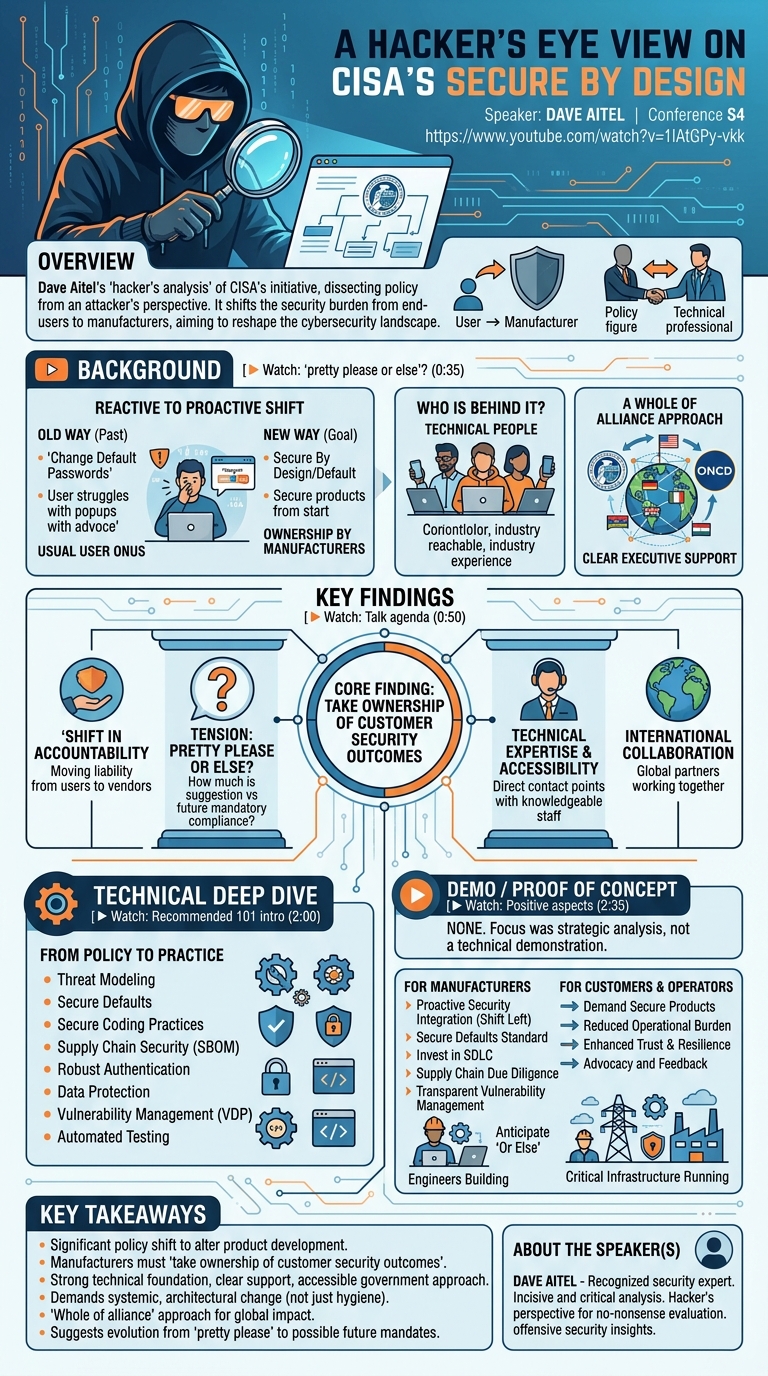
In a candid address at the S4 conference, renowned security expert Dave Aitel offered a "hacker's analysis" of the U.S. Cybersecurity and Infrastructure Security Agency's (CISA) "Secure by Design/Default" initiative. Aitel's talk cut through the policy rhetoric to examine the fundamental questions surrounding this increasingly pervasive government program: how much of it is a gentle suggestion, and how much is a precursor to mandatory compliance? This initiative, despite its "awkward name" as Aitel noted, is poised to reshape the cybersecurity landscape, shifting the burden of security from end-users to product manufacturers and developers.
Key moments
- 0:35 CISA's Secure by Design: 'pretty please or else'?
- 0:50 Talk agenda: who, what, why, how, right/wrong
- 2:00 Recommended 101 intro to Secure by Design themes
- 2:35 Positive aspects: technical, reachable, executive support
- 2:50 Secure by Design's 'whole of alliance' approach
A Hacker's Eye View On CISA's Secure By Design
Speakers: Dave Aitel
Conference: S4
YouTube: https://www.youtube.com/watch?v=1lAtGPy-vkk
Overview
In a candid address at the S4 conference, renowned security expert Dave Aitel offered a "hacker's analysis" of the U.S. Cybersecurity and Infrastructure Security Agency's (CISA) "Secure by Design/Default" initiative. Aitel's talk cut through the policy rhetoric to examine the fundamental questions surrounding this increasingly pervasive government program: how much of it is a gentle suggestion, and how much is a precursor to mandatory compliance? This initiative, despite its "awkward name" as Aitel noted, is poised to reshape the cybersecurity landscape, shifting the burden of security from end-users to product manufacturers and developers.
Aitel’s presentation provided an outsider's perspective on CISA's program, dissecting its "who, what, why, and how" through the lens of an attacker. He highlighted the unique characteristics of the initiative, particularly its broad international scope and the unprecedented accessibility of its technical leadership. The core of "Secure by Design" revolves around vendors taking ownership of customer security outcomes—a concept that, while seemingly straightforward, carries profound implications for product development, liability, and the future of critical infrastructure protection.
The significance of Aitel's analysis lies in its critical yet constructive evaluation. While acknowledging the positive aspects, such as the involvement of experienced technical professionals and clear executive support, he challenged the audience to consider the practical enforcement mechanisms and the true depth of the program's intended impact. For an industry grappling with persistent vulnerabilities and an ever-evolving threat landscape, understanding the hacker's perspective on such a foundational policy shift is crucial for anticipating future challenges and proactively embedding security into the very fabric of technology.
Background
▶ Watch: CISA's Secure by Design: 'pretty please or else'? (0:35)
The "Secure by Design/Default" initiative by CISA, often co-championed with the Office of the National Cyber Director (ONCD) and other global partners, represents a strategic pivot in national and international cybersecurity policy. For decades, the prevailing approach to cybersecurity largely placed the onus on end-users to secure their environments—a philosophy exemplified by ubiquitous, yet often ignored, advice like "please change default passwords on your devices." This reactive, user-centric model has proven insufficient in an era of sophisticated, state-sponsored attacks and complex supply chain vulnerabilities.
The genesis of "Secure by Design" stems from a recognition that fundamental flaws in product design and insecure default configurations contribute significantly to the global attack surface. Instead of relying on patching vulnerabilities post-release or expecting users to configure complex security settings, the initiative advocates for security to be an inherent characteristic of products from their inception. Aitel pointed to a specific podcast featuring Paul Rosenzweig (moderator), Jack Cable, Bob Lord, Lauren, and Jen as an excellent "101 introduction" to these themes, underscoring the depth of thought and technical expertise driving the program. Rosenzweig's opening question in that discussion—"What in this is beyond please change default passwords on your devices?"—perfectly encapsulates the initiative's ambition to transcend basic hygiene and address systemic security deficiencies.
A notable characteristic highlighted by Aitel is the "who" behind the program. Unlike many traditional government initiatives, "Secure by Design" is championed by a diverse group of technical people with industry experience. This includes individuals who are "reachable," offering "a face and a name and an email and a phone number where you can call up and ask questions." This accessibility, coupled with clear executive support from CISA, ONCD, and other agencies, marks a "new way of doing government" and lends significant credibility and momentum to the effort. Furthermore, Aitel emphasized that this is not merely a "whole of government approach" but a "whole of alliance approach." The initiative extends beyond traditional partnerships like the "Five Eyes" intelligence alliance, encompassing a broad international sweep of nations. This global collaboration is crucial for securing the interconnected infrastructure that transcends national borders, acknowledging that cybersecurity is a collective responsibility that cannot be contained within any single nation's purview.
Key Findings
▶ Watch: Talk agenda: who, what, why, how, right/wrong (0:50)
Dave Aitel's "hacker's analysis" distilled the essence of CISA's Secure by Design/Default initiative into several critical findings, primarily centered on the profound shift in accountability it proposes. The paramount finding, reiterated as the "biggest one" and "core" of the program, is the directive for product manufacturers to "take ownership of customer security outcomes." This principle represents a fundamental reorientation of responsibility, moving away from the historical expectation that end-users bear the primary burden of securing products, and instead placing that accountability squarely on the shoulders of the developers and vendors.
This shift has several layers of implications. Firstly, it acknowledges that the complexity of modern technology often makes it unreasonable for typical users to adequately secure their systems. By demanding ownership from vendors, the initiative aims to build security in from the ground up, making products inherently more resilient. Secondly, Aitel highlighted the inherent tension within this government program: how much is a polite request ("pretty please") and how much foreshadows regulatory or legal mandates ("or else")? This ambiguity is a key aspect of the hacker's perspective, as attackers constantly probe for weaknesses, not just technical ones, but also those in policy and enforcement. The eventual resolution of this tension will dictate the program's true impact on industry behavior.
Another significant finding is the unprecedented level of technical expertise and accessibility underpinning the initiative. Aitel praised the involvement of seasoned technical professionals and industry veterans, along with the provision of direct contact points within government agencies. This transparency and engagement are a "new feature" in government programs, fostering a more collaborative environment. Coupled with clear executive support from major cybersecurity bodies like CISA and ONCD, this indicates a serious, top-down commitment to the "Secure by Design" philosophy. Finally, the "whole of alliance approach" is a critical finding, signifying a global, rather than merely national, commitment to these principles. This broad international collaboration, extending beyond traditional alliances, recognizes the interconnected nature of global cyber infrastructure and the necessity for a unified front in addressing systemic vulnerabilities. This collective international pressure could significantly accelerate the adoption of secure development practices across diverse markets.
Technical Deep Dive
▶ Watch: Recommended 101 intro to Secure by Design themes (2:00)
While Dave Aitel's talk focused on the policy and strategic implications of CISA's "Secure by Design/Default" initiative, his hacker's perspective implicitly calls for a profound technical transformation. The core tenet—taking ownership of customer security outcomes—demands a fundamental rethinking of how software and hardware are designed, developed, and deployed. Aitel’s reference to Paul Rosenzweig’s question, "What in this is beyond please change default passwords on your devices?", underscores that the initiative aims far beyond superficial security measures, driving towards deep-seated architectural and operational changes.
From a technical standpoint, "Secure by Design" translates into several critical practices and principles that must be embedded throughout the entire Software Development Life Cycle (SDLC):
- Threat Modeling and Risk Assessment: Security must begin at the design phase. This involves proactive threat modeling, identifying potential attack vectors, vulnerabilities, and the impact of compromises before a single line of code is written. Engineers should systematically analyze system architecture, data flows, and interactions to anticipate and mitigate risks, moving beyond reactive security.
- Secure Defaults and Minimal Attack Surface: Products should ship with secure configurations by default. This means strong, unique passwords (or passwordless authentication), least privilege access, disabled unnecessary services, and encrypted communications as standard. The goal is to minimize the attack surface from day one, so that even if a user does not actively configure security, the product remains reasonably secure. This directly addresses the "beyond default passwords" challenge.
- Secure Coding Practices: Developers must adhere to rigorous secure coding standards to prevent common vulnerabilities such as buffer overflows, SQL injection, cross-site scripting (XSS), and insecure deserialization. This requires ongoing training, static and dynamic analysis tools (SAST/DAST), and peer reviews focused on security. Languages and frameworks that offer built-in security features and memory safety should be prioritized where appropriate.
- Supply Chain Security: Ownership of security outcomes extends to the entire software supply chain. This includes ensuring the security of third-party libraries, open-source components, and development tools. Implementing Software Bill of Materials (SBOMs), verifying component integrity, and vetting suppliers become crucial to prevent the introduction of vulnerabilities through dependencies.
- Robust Authentication and Authorization: Beyond default passwords, "Secure by Design" necessitates strong, multi-factor authentication (MFA) mechanisms, robust authorization frameworks based on the principle of least privilege, and secure session management. This minimizes the impact of credential theft and unauthorized access.
- Data Protection: Data at rest and in transit must be protected through strong encryption, key management, and data loss prevention (DLP) strategies. Access to sensitive data should be strictly controlled and logged.
- Vulnerability Management and Disclosure: Vendors must establish transparent and effective vulnerability disclosure programs (VDPs), actively solicit security research, and commit to timely patching. This includes clear communication channels and processes for external researchers to report findings, fostering a collaborative security ecosystem.
- Automated Security Testing: Integrating automated security tests, fuzzing, and penetration testing into the continuous integration/continuous deployment (CI/CD) pipeline ensures that security is continuously validated throughout the development lifecycle, catching issues early and frequently.
While Aitel did not delve into specific code examples or protocols, his analysis implies that CISA's initiative is pushing for a paradigm where these technical considerations are not optional add-ons but foundational requirements, baked into the very architecture and engineering processes of every product. The "hacker's eye view" recognizes that true security comes from systemic robustness, not just user-level vigilance.
Demo / Proof of Concept
▶ Watch: Positive aspects: technical, reachable, executive support (2:35)
The talk delivered by Dave Aitel was a strategic and policy-oriented analysis of CISA's "Secure by Design/Default" initiative, rather than a technical demonstration. Consequently, there was no live demo or proof of concept presented during the session. Aitel’s focus was on dissecting the governmental program, its implications, and the underlying philosophy from a hacker's perspective.
Defensive Implications
▶ Watch: Secure by Design's 'whole of alliance' approach (2:50)
Dave Aitel's "hacker's analysis" of CISA's "Secure by Design/Default" initiative carries profound defensive implications for both product manufacturers (vendors) and end-users (customers), particularly those operating critical infrastructure. The core message—take ownership of customer security outcomes—demands a fundamental shift in mindset and practice across the industry.
For Product Manufacturers and Developers:
- Proactive Security Integration: The most significant implication is the necessity to embed security from the earliest stages of product conceptualization and design. This means moving away from a reactive "bolt-on" security model to a proactive "shift-left" approach. Threat modeling should become a mandatory step in every design sprint, systematically identifying and mitigating potential vulnerabilities before development begins.
- Secure Defaults as Standard: Vendors must ensure that all products ship with the most secure configurations enabled by default. This includes strong, unique passwords or passwordless authentication, disabled unnecessary services, encrypted communications, and least privilege access principles applied to all user roles. The burden of securing a product should not fall on the end-user to configure it correctly.
- Investment in Secure Development Lifecycle (SDLC): Companies need to invest heavily in a robust SDLC that prioritizes security. This encompasses comprehensive developer training in secure coding practices, mandatory use of Static Application Security Testing (SAST) and Dynamic Application Security Testing (DAST) tools, regular penetration testing, and rigorous code reviews focused on security vulnerabilities.
- Supply Chain Security Due Diligence: The "ownership of outcomes" extends to the entire software supply chain. Manufacturers must rigorously vet third-party components, open-source libraries, and development tools. Implementing Software Bill of Materials (SBOMs) and conducting regular audits of dependencies are no longer optional but essential to ensure the integrity of the final product.
- Transparent Vulnerability Management: Establishing a clear, accessible, and responsive Vulnerability Disclosure Program (VDP) is crucial. This demonstrates a commitment to security and fosters trust with the security research community. Timely patching and transparent communication about vulnerabilities are expected, showcasing genuine ownership.
- Anticipation of "Or Else" Scenarios: While CISA's initiative currently operates largely on a "pretty please" basis, Aitel's analysis suggests an eventual shift towards "or else." Manufacturers should proactively adopt these principles to avoid potential future regulatory mandates, compliance costs, and liability issues. Early adoption can also become a competitive differentiator, building a reputation for trustworthiness.
- Collaboration and Information Sharing: The "whole of alliance" approach implies a greater need for international collaboration. Vendors should be prepared to engage with government agencies and industry peers, sharing threat intelligence and best practices to collectively raise the baseline of cybersecurity.
For Customers and Operators (especially Critical Infrastructure):
- Demand Secure Products: Customers gain significant leverage. They should actively demand products that demonstrably adhere to Secure by Design principles. Procurement processes should incorporate rigorous security requirements, inquiring about vendor's SDLC, threat modeling practices, default security configurations, and vulnerability management programs.
- Reduced Operational Burden: The initiative aims to reduce the operational security burden on end-users. By purchasing products that are inherently secure, organizations can potentially lower their security configuration overhead, reduce the frequency of patching critical zero-days, and minimize their exposure to common attack vectors.
- Enhanced Trust and Resilience: Products built with security by design principles are inherently more resilient against cyber threats. This leads to increased trust in the technology and improved operational continuity, particularly vital for critical infrastructure sectors.
- Advocacy and Feedback: Customers should provide feedback to vendors and government bodies like CISA regarding the effectiveness of these initiatives. Their experiences can help refine policies and push for stronger industry standards.
In essence, CISA's "Secure by Design/Default" initiative, as interpreted by Dave Aitel, signals a new era where cybersecurity is a shared responsibility, with a heavy emphasis on proactive measures by those who build the technology. Defenders must adapt by demanding, developing, and deploying technology that has security woven into its very fabric, rather than patched on as an afterthought.
Key Takeaways
- CISA's "Secure by Design/Default" initiative represents a significant and deliberate shift in cybersecurity policy, aiming to fundamentally alter how technology products are developed and secured.
- The core principle of the initiative is that product manufacturers must "take ownership of customer security outcomes," moving the primary burden of security from end-users to vendors.
- The program is distinguished by its strong foundation of technical expertise, industry experience, and clear executive support from agencies like CISA and ONCD, fostering a more accessible and engaged government approach.
- "Secure by Design" extends beyond basic security hygiene (like changing default passwords) to demand systemic, architectural, and operational changes in product development, including secure defaults, threat modeling, and robust supply chain security.
- The initiative is characterized by a "whole of alliance approach," involving broad international collaboration that extends beyond traditional partnerships, underscoring the global nature of cybersecurity challenges.
- While currently framed as a "pretty please," the long-term trajectory of "Secure by Design" suggests a potential evolution towards "or else" scenarios, implying future regulatory or market-driven mandates for secure development practices.
About the Speaker(s)
Dave Aitel is a recognized security expert known for his incisive and often critical analysis of cybersecurity trends and government policies. In his S4 talk, he adopted a "hacker's analysis" perspective, aiming to provide a no-nonsense evaluation of CISA's "Secure by Design/Default" initiative. Aitel's approach is characterized by a willingness to "rough up" vendors and challenge conventional wisdom, while also acknowledging the collaborative spirit and positive developments within the security community. His insights stem from a deep understanding of offensive security, allowing him to dissect policy initiatives from the viewpoint of those who might exploit their weaknesses.
Reviews
Dr. Zero (Offensive Security Researcher) — STRONG ACCEPT
Aitel delivers a sharp, no-bullshit analysis of CISA's 'Secure by Design' initiative, cutting through the policy speak to expose its true implications. He highlights the critical shift in vendor accountability and the underlying technical demands this policy will place on the industry. This isn't a zero-day drop, but it's essential signal for anyone building or defending systems, providing a rare, candid look at a policy that will impact how we all operate.
Heather Calloway (CISO) — MUST SEE
Dave Aitel's analysis of CISA's Secure by Design initiative is a critical piece for any security leader. He precisely articulates the program's core demand for vendors to own customer security outcomes, a fundamental shift in accountability that will reshape our industry. This isn't just policy chatter; it's a clear signal of an impending rebalancing of risk and liability, requiring immediate strategic attention from CISOs and their boards.