Reducing Reputation Risk In Cyber Incidents
Jennifer Dulles
S4x24 - ICS Security Conference · Day 3 · Stage 3
Overview
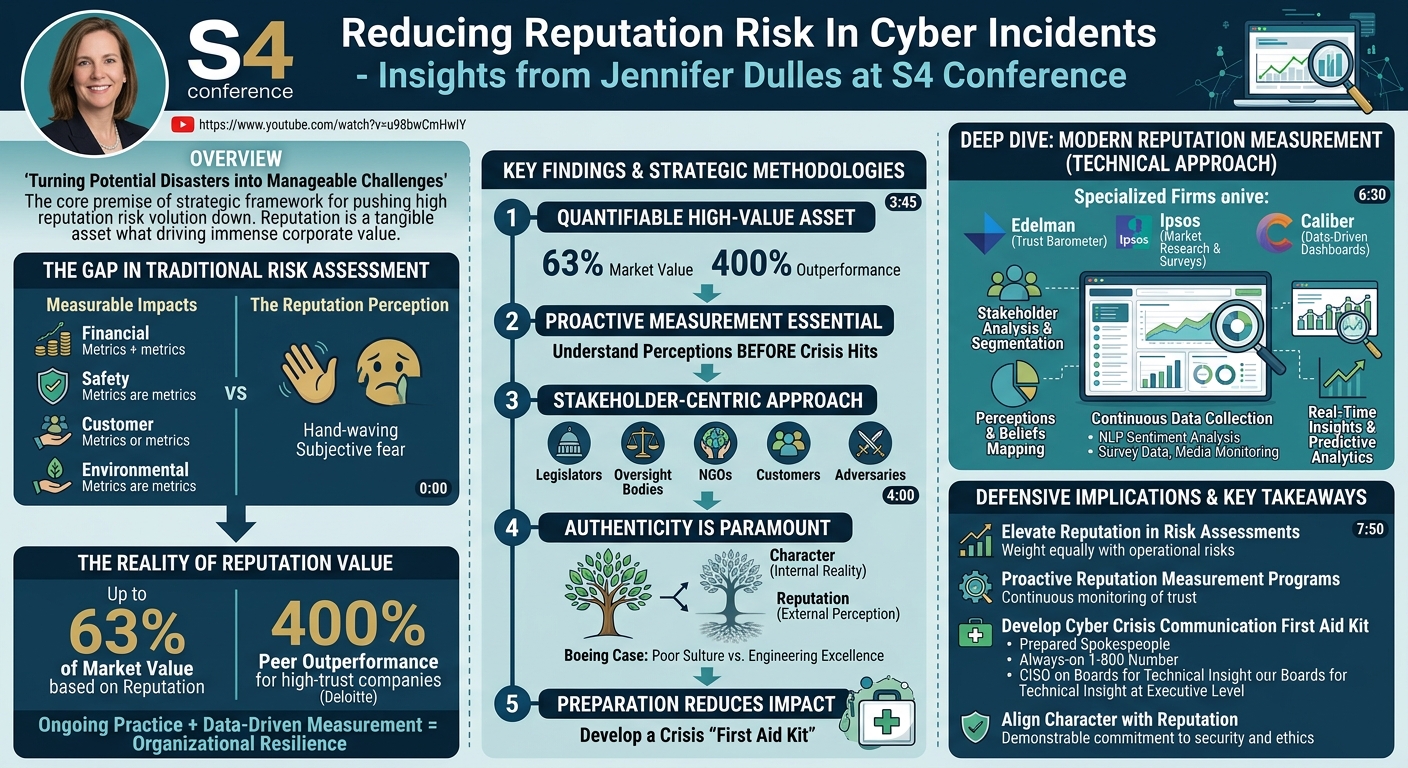
In an era where cyber incidents are not just technical failures but also public relations crises, Jennifer Dulles, a distinguished expert in reputation management, delivered a thought-provoking talk at S4, challenging the cybersecurity community to re-evaluate how they assess and mitigate risk. The core premise of her presentation, titled "Reducing Reputation Risk In Cyber Incidents," was to address a common organizational dilemma: situations where the tangible impacts of a cyber attack — financial loss, safety concerns, customer disruption, or environmental damage — are deemed low, yet the perceived reputational damage is catastrophically high. This disparity often leads to significant internal fear and paralysis, despite the actual operational impact being manageable.
Key moments
- 0:00 Addressing high reputation risk in low-impact cyber incidents
- 2:00 Reputation: an ongoing practice that drives significant market value
- 3:45 How to measure reputation beyond broad hand-waving?
- 4:00 Understanding and measuring perceptions across all stakeholders
- 6:30 Leveraging technology and firms for data-driven reputation insights
- 7:50 Tailored reputation measurement: perception shifts, value shifts
Reducing Reputation Risk In Cyber Incidents
Speakers: Jennifer Dulles
Conference: S4
YouTube: https://www.youtube.com/watch?v=u98bwCmHwIY
Overview
In an era where cyber incidents are not just technical failures but also public relations crises, Jennifer Dulles, a distinguished expert in reputation management, delivered a thought-provoking talk at S4, challenging the cybersecurity community to re-evaluate how they assess and mitigate risk. The core premise of her presentation, titled "Reducing Reputation Risk In Cyber Incidents," was to address a common organizational dilemma: situations where the tangible impacts of a cyber attack — financial loss, safety concerns, customer disruption, or environmental damage — are deemed low, yet the perceived reputational damage is catastrophically high. This disparity often leads to significant internal fear and paralysis, despite the actual operational impact being manageable.
Dulles's talk aimed to provide a strategic framework for "pushing reputation down" from a high or catastrophic risk level to a more moderate or low one, even when the underlying incident is unavoidable. She underscored that reputation is not merely an abstract concept but a tangible asset that drives immense corporate value. By integrating proactive reputation management strategies, organizations can build resilience and agility, transforming potential disasters into manageable challenges and safeguarding their invaluable public trust. Her insights offered a crucial external perspective to a technical audience, emphasizing that robust cybersecurity is incomplete without an equally robust communication and reputation strategy.
Background
▶ Watch: Addressing high reputation risk in low-impact cyber incidents (0:00)
Traditionally, organizations evaluate the impact of potential incidents across several well-defined categories: financial, safety, customer, and environmental. For each, clear metrics and mitigation strategies exist. If a piece of expensive equipment is at risk, protection measures are implemented, or recovery protocols are enhanced to reduce the financial impact. If customer service is threatened, contingency plans are developed. However, when it comes to reputation, the assessment often devolves into what the talk host described as "hand-waving"—a vague, subjective fear rather than a measurable risk. This lack of concrete metrics and actionable strategies for reputation risk leaves many organizations vulnerable, even when their operational resilience is strong.
Dulles highlighted that this perception misunderstands the fundamental nature and value of reputation. Reputation, she argued, is an ongoing practice that inherently drives value through trust. She cited compelling statistics to underscore this point: some estimates suggest that as much as 63% of an organization's market value is based on its reputation. Furthermore, a study by Deloitte revealed that companies with high levels of trust outperform their peers by 400%. These figures transform reputation from an intangible concern into a critical strategic asset, demanding the same rigor in measurement and management as any other business function, including cybersecurity. Just as cybersecurity requires regular measurement and monitoring of threats and vulnerabilities, so too does reputational health require continuous assessment and proactive management. The problem exists because organizations often fail to understand their current reputational state or the specific perceptions held by their diverse stakeholders, leaving them unprepared when a crisis inevitably strikes.
Key Findings
▶ Watch: How to measure reputation beyond broad hand-waving? (3:45)
The talk revealed several key findings that reposition reputation management from a reactive public relations exercise to a proactive, data-driven strategic imperative, especially in the context of cyber incidents:
- Reputation is a Quantifiable and High-Value Asset: Far from being an abstract concept, reputation directly translates into tangible business value. With 63% of corporate market value potentially tied to reputation and trusted companies outperforming peers by 400% (Deloitte), it is a critical asset demanding strategic investment and measurement.
- Proactive Measurement is Essential for Resilience: Just like cybersecurity, reputational health requires continuous measurement and monitoring. Organizations must understand the current perceptions and beliefs of their entire stakeholder ecosystem before a crisis hits to build resilience and agility, rather than reacting catastrophically.
- Stakeholder-Centric Approach: Effective reputation management necessitates a tailored understanding of diverse stakeholder groups (legislators, customers, NGOs, even adversaries) and their specific perceptions. Generic approaches are insufficient; an organization's reputation is a mosaic of these varied views.
- Authenticity (Character) is Paramount: Drawing on Abraham Lincoln's adage, "Character is the tree, reputation is the shadow that it casts," Dulles emphasized that sustainable reputation is built on genuine organizational character and preparedness. Discrepancies between internal reality (e.g., poor safety culture) and external perception (e.g., engineering excellence) lead to significant reputational damage, as exemplified by the Boeing case.
- Preparation Reduces Catastrophic Impact: Having a "first aid kit" for crisis—including prepared spokespeople, an always-on communication channel, and integration of technical insights at the executive level—is crucial for managing the narrative and mitigating reputational fallout during and after an incident. This preparedness transforms potential disasters into manageable events.
Technical Deep Dive
▶ Watch: Understanding and measuring perceptions across all stakeholders (4:00)
While "Reducing Reputation Risk In Cyber Incidents" is not a technical talk in the traditional sense of presenting code, exploits, or network architectures, it delves deeply into the methodologies and data-driven approaches that constitute the technical backbone of modern reputation management. This involves a systematic, analytical process akin to security operations, but applied to public perception.
The cornerstone of this technical deep dive is the concept of reputation measurement. Dulles emphasized that this is no longer a subjective exercise but an area of significant innovation, mirroring advancements in cybersecurity metrics. The process begins with a comprehensive stakeholder analysis. Organizations must identify and segment their entire ecosystem of influence, which includes, but is not limited to:
- Legislators and Congress: Whose policy decisions and oversight can profoundly impact operations and public standing.
- Oversight Bodies: Regulatory agencies that monitor compliance and can impose penalties or public scrutiny.
- Non-Governmental Organizations (NGOs): Activist groups or public interest organizations that can mobilize public opinion.
- Customers: The end-users of products and services, whose loyalty and trust are directly tied to revenue.
- Adversaries: This unique category, particularly relevant in the S4 context, refers to entities (e.g., nation-states, cybercriminal groups, competitors) that might actively seek to damage an organization's reputation through disinformation or exploitation.
Once stakeholders are identified, the next technical step is to understand their perceptions and beliefs about the organization. This involves moving beyond anecdotal evidence to concrete data. Dulles highlighted that technology has made this process significantly easier and more precise. She mentioned several key players and methodologies:
- Edelman: An internationally recognized public relations firm known for its annual Trust Barometer, which provides broad insights into global trust trends. While their annual study offers macro-level data, their expertise extends to tailored reputation measurement for individual clients.
- Ipsos: A prominent market research firm that conducts extensive work in reputation management. Ipsos utilizes sophisticated survey methodologies, public opinion polling, and media analysis to track and quantify perceptions across various demographics and stakeholder groups.
- Caliber: A newer startup specifically cited by Dulles, which provides data-driven insights on reputation available in a dashboard on a regular basis. This exemplifies the shift towards real-time or near real-time monitoring.
The "technical" aspect here lies in the sophisticated data collection, aggregation, and analytical tools employed by such firms. This includes:
- Sentiment Analysis: Leveraging natural language processing (NLP) to analyze vast amounts of text data from news articles, social media, public statements, and reviews to gauge the emotional tone and public sentiment towards an organization.
- Survey Design and Deployment: Crafting tailored questionnaires for specific stakeholder groups, ensuring statistical validity and unbiased data collection.
- Media Monitoring and Analysis: Tracking media mentions across traditional and digital channels, identifying key narratives, and assessing their reach and impact.
- Predictive Analytics: Using historical data and current trends to forecast potential shifts in reputation and identify emerging risks.
- Dashboard Visualization: Presenting complex reputational data in an accessible, actionable format, allowing executives to monitor key metrics and understand the impact of organizational actions. For instance, Dulles described how a company's decision to cease operations in Russia and the subsequent announcement could be tracked in a dashboard to observe the net effects on perception.
Crucially, Dulles stressed that these measurement programs are highly tailored. There is no one-size-fits-all "industry standard score" because each organization's stakeholder landscape and strategic objectives are unique. The technical challenge is to design a measurement framework that accurately reflects these specific dynamics, allowing organizations to track shifts in perception and correlate them with internal actions or external events. This continuous, data-driven monitoring enables organizations to understand if their "character" (internal reality and actions) aligns with their "reputation" (external perception), providing an early warning system for potential reputational crises.
Demo / Proof of Concept
▶ Watch: Leveraging technology and firms for data-driven reputation insights (6:30)
The talk "Reducing Reputation Risk In Cyber Incidents" did not feature a live demonstration or a technical proof of concept in the traditional cybersecurity sense (e.g., an exploit demonstration). Instead, Jennifer Dulles highlighted the capabilities of existing commercial entities and their innovative approaches to reputation measurement. She specifically mentioned companies like Edelman, Ipsos, and the startup Caliber, which provide data-driven insights and dashboards for ongoing reputation monitoring. These examples serve as conceptual proofs of concept, illustrating that sophisticated tools and methodologies are readily available to quantify and track reputational health, making it as measurable as other business metrics.
Defensive Implications
▶ Watch: Tailored reputation measurement: perception shifts, value shifts (7:50)
The insights shared by Jennifer Dulles carry significant defensive implications for cybersecurity professionals and organizational leadership. Integrating reputation management into the broader cybersecurity strategy is no longer optional but a critical component of holistic risk mitigation.
- Elevate Reputation in Risk Assessments: Cybersecurity teams, often focused on technical vulnerabilities and operational impacts, must recognize reputation as a primary risk vector. When conducting risk assessments, the potential reputational fallout should be weighted equally with financial, safety, and operational impacts. This means going beyond a vague "high" rating to a structured, measurable assessment.
- Proactive Reputation Measurement Programs: Organizations should implement ongoing perception management programs using tools and methodologies discussed in the "Technical Deep Dive." This involves continuous monitoring of stakeholder perceptions, much like continuous vulnerability monitoring. Understanding the current state of trust and sentiment allows for proactive communication and relationship building, rather than reactive damage control. Firms like Caliber, offering dashboard-based insights, represent the kind of tools that can enable this.
- Develop a Cyber Crisis Communication "First Aid Kit": Just as incident response plans are crucial for technical recovery, a pre-prepared communication strategy is vital for reputational defense. This "first aid kit" should include:
- Always-on 1-800 Number: A dedicated, accessible channel for stakeholders to get information during a crisis.
- Prepared Spokespeople: A cadre of media-trained individuals, including C-suite executives and, potentially, carefully selected technical experts. These individuals must be adept at translating complex technical issues into clear, concise, and reassuring messages for diverse audiences without oversharing sensitive details.
- Technical Insight at the Executive Level: The increasing presence of CISOs on boards is a positive trend, as it ensures technical realities inform strategic communication. Technical teams must prepare their executives not just with facts, but with the context and narrative required for high-stakes engagements, such as testifying before Congress, as illustrated by the Colonial Pipeline scenario.
- Align Character with Reputation: The most potent defense against reputational damage is genuine organizational character. This means that an organization's commitment to cybersecurity, its investment in resilience, and its ethical posture must be authentic and demonstrable. As Dulles highlighted with the Boeing example, a disconnect between perceived excellence and actual practices (e.g., safety culture issues) can be devastating. Defenders must ensure that the security measures they implement are not just for compliance, but genuinely enhance the organization's preparedness and integrity.
- Strategic Communication of Cyber Resilience: Organizations must proactively communicate their commitment to cyber resilience to their stakeholders. This isn't about bragging or revealing sensitive details, but about demonstrating a responsible, agile, and prepared stance. In a post-incident scenario, transparent communication about steps taken, lessons learned, and ongoing improvements can rebuild trust and mitigate long-term reputational harm. The goal is to build agility and responses into the organizational fabric, so that when events inevitably happen, they don't feel catastrophic but rather like a challenge for which the organization is prepared.
By adopting these defensive implications, cybersecurity professionals can help their organizations not only withstand cyber attacks but also preserve and enhance their most valuable asset: their reputation.
Key Takeaways
- Reputation is a Measurable, High-Value Asset: It directly impacts market value (63% of corporate market value) and financial performance (400% outperformance for trusted companies, per Deloitte).
- Proactive Reputation Management is Essential: Similar to cybersecurity, reputational health requires continuous measurement and monitoring of stakeholder perceptions, not just reactive crisis response.
- Understand Your Stakeholder Ecosystem: Effective reputation management demands a tailored approach based on the specific perceptions of diverse groups, including legislators, customers, NGOs, and even potential adversaries.
- Invest in Data-Driven Tools: Modern technology and specialized firms (e.g., Edelman, Ipsos, Caliber) provide dashboards and data-driven insights to track reputational shifts and the impact of organizational actions.
- Build a Crisis Communication "First Aid Kit": Prepare spokespeople, establish clear communication channels (like an always-on 1-800 number), and ensure technical insights inform executive-level messaging during incidents.
- Align Character with Perception: Sustainable reputation is built on authentic organizational character and demonstrated preparedness; a disconnect between internal reality and external perception can lead to severe reputational crises.
About the Speaker(s)
Jennifer Dulles is an expert in reputation management and communication, bringing a critical, often overlooked, perspective to the field of cybersecurity. Her insights bridge the gap between technical security measures and the broader impact of incidents on an organization's public image and trust. While specific title and company information were not provided in the transcript or metadata, her expertise lies in advising organizations on how to proactively manage and protect their reputation, particularly in times of crisis. Her appearance at S4 underscores the growing recognition within the cybersecurity community that technical resilience must be complemented by strategic communication and robust reputational defense.
Reviews
Dr. Zero (Offensive Security Researcher) — STRONG ACCEPT
This talk by Jennifer Dulles provides a much-needed, no-nonsense framework for managing reputational risk in cyber incidents, moving beyond the typical "hand-waving" to a data-driven approach. It correctly identifies reputation as a quantifiable, high-value asset often mishandled by organizations. Dulles offers concrete strategies, including continuous measurement of stakeholder perceptions and the development of a 'crisis communication first aid kit,' making it a highly actionable session for executives and cybersecurity leaders looking to integrate communication rigor into their incident response.
Heather Calloway (CISO) — MUST SEE
Jennifer Dulles's S4 talk provides a crucial framework for understanding and mitigating reputation risk in cyber incidents, moving beyond subjective fear to quantifiable, strategic management. She effectively elevates reputation from an abstract concern to a measurable, high-value asset, offering actionable insights for CISOs to integrate proactive communication and stakeholder analysis into their security programs and executive decision-making. This presentation is a vital guide for any security leader looking to bridge the gap between technical resilience and institutional accountability.