"I feel physically safe but not politically safe": Understanding the Digital Threats and Safety Practices of OnlyFans Creators
Ananta Soneji (PhD Student · Arizona State University), Vaughn Hamilton, Adam Doupé, Allison McDonald, Elissa M. Redmiles
33rd USENIX Security Symposium · Day 1 · USENIX Security '24 · USENIX Security '24
Overview
This talk, presented by Ananta Soneji and her colleagues, delves into the complex digital security landscape faced by OnlyFans creators, a unique demographic at the intersection of sex work and content creation. While OnlyFans offers significant financial autonomy through its direct-to-consumer subscription model, its mainstream visibility, coupled with the persistent stigma surrounding sex work, exposes creators to a distinct set of digital threats. The research presented aims to provide a nuanced understanding of these challenges, ranging from online harassment and content leakage to systemic platform risks like precarity and censorship, and to document the proactive safety practices creators adopt.
Key moments
- 0:00 Introduction: OnlyFans creators at unique risk
- 1:05 Transformative aspects and unique challenges of OnlyFans
- 2:08 Impact of OnlyFans' mainstream visibility on creators
- 3:07 Research methodology and participant recruitment
- 4:10 Common and unique digital risks faced by creators
- 4:30 Creators' active defenses against toxic content and harassment
- 6:08 The inevitability and severe impact of content leaks
- 7:06 OnlyFans chargebacks: unique financial burden on creators
"I feel physically safe but not politically safe": Understanding the Digital Threats and Safety Practices of OnlyFans Creators
Speakers: Ananta Soneji, PhD Student; Vaughn Hamilton; Adam Doupé; Allison McDonald; Elissa M. Redmiles
Conference: USENIX Security '24
YouTube: https://www.youtube.com/watch?v=hfoZajrU-ZE
Overview
This talk, presented by Ananta Soneji and her colleagues, delves into the complex digital security landscape faced by OnlyFans creators, a unique demographic at the intersection of sex work and content creation. While OnlyFans offers significant financial autonomy through its direct-to-consumer subscription model, its mainstream visibility, coupled with the persistent stigma surrounding sex work, exposes creators to a distinct set of digital threats. The research presented aims to provide a nuanced understanding of these challenges, ranging from online harassment and content leakage to systemic platform risks like precarity and censorship, and to document the proactive safety practices creators adopt.
The importance of this research lies in its focus on a vulnerable yet increasingly prominent community within the digital economy. Sex workers have historically faced significant societal and legal challenges, and their migration to online platforms like OnlyFans introduces novel digital risks that are often overlooked by mainstream security discourse. By highlighting the specific threats—both common to online content creators and unique to sex work platforms—and the strategies creators employ, this study advocates for enhanced support systems and risk reduction measures tailored to their needs.
Ultimately, the talk sheds light on how financial opportunities on platforms like OnlyFans come with substantial personal and digital security costs. It underscores the critical need for platform designers, policymakers, and security researchers to acknowledge and address the systemic issues that undermine the safety and autonomy of creators, particularly those in marginalized professions. The findings reveal a community that feels "physically safe but not politically safe," a sentiment reflecting the deep-seated anxieties about platform reliability and external pressures.
Background
▶ Watch: Introduction: OnlyFans creators at unique risk (0:00)
Sex workers have long been identified as an at-risk community, contending with profound societal stigma, legal repercussions, and physical dangers. In the digital realm, prior work has established that general content creators also face significant risks, including hate, harassment, impersonation, and stalking, despite the lucrative financial prospects their work offers. OnlyFans creators occupy a unique and particularly vulnerable position, bridging these two at-risk groups by publishing explicit content on a platform that has achieved unprecedented mainstream visibility for a sex work-associated service.
OnlyFans operates on a subscription-based social media model, allowing creators to monetize content directly from their "fans" behind a paywall. This direct-to-consumer approach grants creators a level of control over their content and earnings that is transformative, especially for sex workers who have historically lacked autonomy. However, the platform's design also contributes to its unique risk profile: it lacks internal discoverability. To grow their audience, creators must engage in self-promotion on other social media platforms, exposing themselves to varied and often stricter terms of service. The platform's public visibility surged following celebrity involvement and media attention, leading to a rapid increase in users and, consequently, potential income for creators. Yet, this prominence exacerbates the challenges stemming from sex work stigma, making OnlyFans creators exceptionally susceptible to digital threats.
To investigate how OnlyFans creators navigate these intertwined factors of sex work stigma and prominence, the researchers conducted a qualitative study involving 43 OnlyFans creators. Participants were recruited in two cohorts: one at the onset of the COVID-19 pandemic and another following OnlyFans' controversial (and later reversed) announcement to ban sexually explicit content in August 2021. This dual recruitment strategy allowed the researchers to examine both ongoing digital safety concerns and the immediate and residual impacts of sudden policy shifts. Data was collected through semi-structured interviews covering topics such as safety and privacy practices, perceptions of the platform, the impact of policy changes, and overall OnlyFans experiences. For analysis, an inductive open coding approach was used to create an initial codebook, which was then cross-referenced with Kurt Thomas and colleagues' online hate and harassment framework to ensure thoroughness and grounding in established research. This rigorous methodology revealed both common and unique risks faced by this specific creator community.
Key Findings
▶ Watch: Impact of OnlyFans' mainstream visibility on creators (2:08)
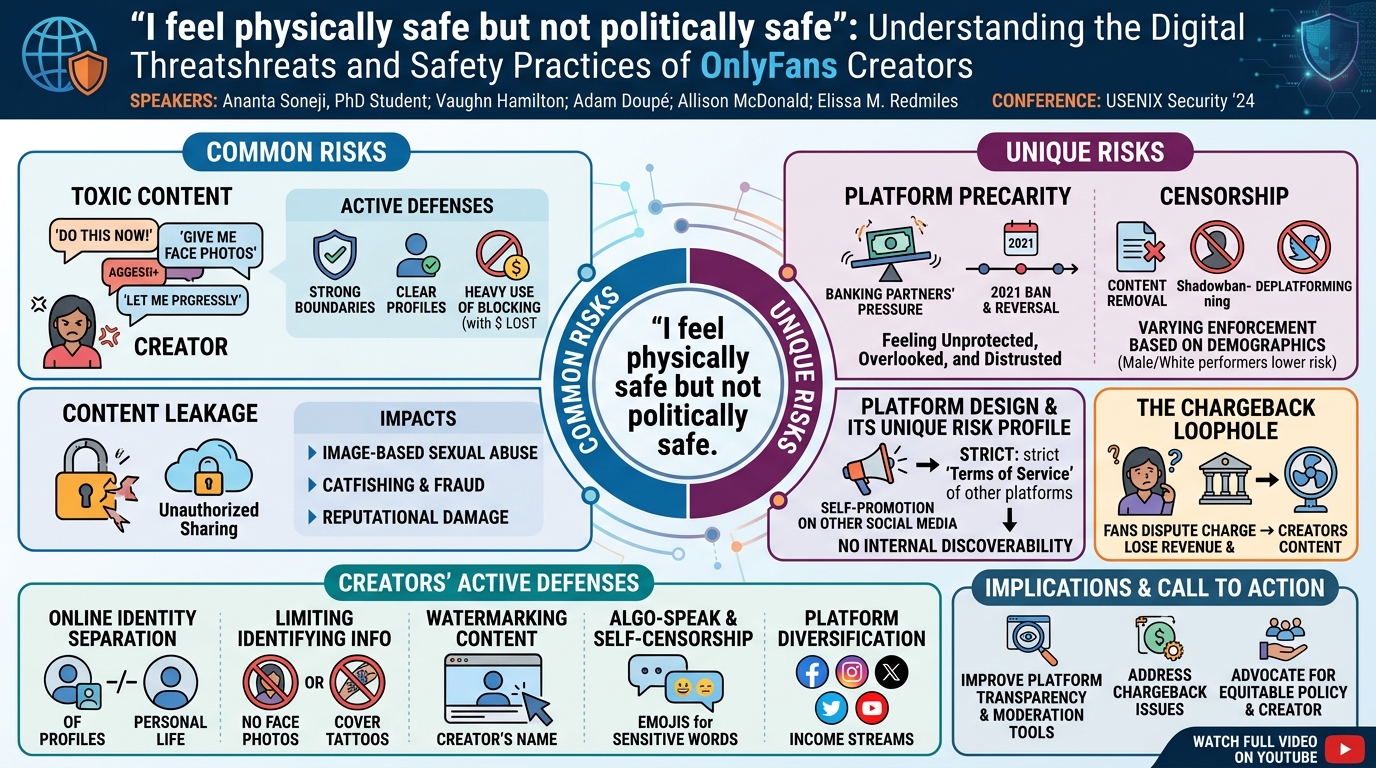
The research identified four primary categories of digital threats faced by OnlyFans creators, categorized into "common risks" shared with other online communities and "unique risks" stemming from the specific nature of their work and the platform:
- Toxic Content: This is a common risk, manifesting as harassment, boundary violations, and online hate directed at creators. Unlike mainstream content creators who often adopt passive defenses, OnlyFans creators employ active strategies to manage this.
- Content Leakage: Another common risk, involving the unauthorized viewing and sharing of explicit content. For OnlyFans creators, this is not merely a privacy violation but a form of image-based sexual abuse with significant financial and reputational consequences, exacerbated by issues like chargebacks.
- Platform Precarity: A unique risk highlighted by the abrupt policy changes, such as the 2021 ban on sexual content. This demonstrates the platform's vulnerability to external financial pressures and leaves creators feeling insecure about their long-term stability and autonomy.
- Censorship: A unique and pervasive risk, extending beyond OnlyFans to the external platforms creators use for promotion. This includes content removal, deplatforming, and shadowbanning, often enforced inconsistently and disproportionately based on creators' demographics.
These findings underscore how the intersection of sex work and content creation, coupled with OnlyFans' unique operational model and mainstream visibility, creates a digital environment fraught with complex and interconnected threats.
Technical Deep Dive
▶ Watch: Common and unique digital risks faced by creators (4:10)
The "technical" aspects of this study primarily revolve around the mechanisms of digital threats and the sophisticated, often costly, digital safety practices employed by OnlyFans creators. While not involving traditional software vulnerabilities or exploit development, the deep dive focuses on the systemic security challenges embedded within platform architectures and societal stigmas.
Toxic Content and Active Defenses:
OnlyFans creators routinely encounter toxic content, which manifests in various forms. This includes direct harassment, such as fans ignoring explicit boundaries (e.g., demanding face photos despite creator disclaimers), making inappropriate or excessive demands, and engaging in general online hate based on appearance, race, or gender. This constant pressure significantly impacts creators' well-being and their ability to manage work-life boundaries.
In contrast to mainstream content creators who often adopt passive defenses like ignoring harassment, OnlyFans creators employ active defense mechanisms. They proactively establish strong boundaries in their profiles and direct communications, clearly stating what they are and are not willing to share. As one participant noted, "You're welcome to send requests but I have every right to then deny them." Crucially, creators also make heavy use of platform features like blocking. While effective for immediate safety, blocking a fan directly translates to lost revenue, highlighting a significant financial cost associated with digital self-defense on a direct-subscription platform. This mechanism, though empowering, forces creators to choose between financial stability and personal safety.
Content Leakage and Multi-Layered Protection:
Content leakage is viewed as an inevitable threat by creators, given the explicit nature of their work. This involves unauthorized viewing and sharing of their paid content, constituting a major privacy violation and a form of image-based sexual abuse. Motivations for leakage range from outing creators as sex workers in their personal or professional lives—carrying severe reputational risks (e.g., "engineering world does not look too highly upon OnlyFans")—to catfishing and financial fraud where stolen content is used to impersonate creators for monetary gain.
A particularly insidious financial threat is chargebacks. Unlike typical e-commerce where vendors bear the burden of disputed charges, OnlyFans shifts this responsibility to creators. When a fan disputes a charge with their bank, creators lose both the revenue and, effectively, the control over content that has already been consumed, often without any recourse. This "loophole" leaves creators feeling unprotected and frustrated.
To combat content leakage, creators implement a suite of proactive defense mechanisms, often balancing privacy with their need for prominence:
- Limiting Visibility: Some creators consciously limit their public presence to reduce the likelihood of their content being discovered and leaked, although this can hinder growth and income.
- Watermarking Content: Creators often apply watermarks to their explicit content, hoping that if leaked, it might direct viewers back to their original OnlyFans page, though this is not a foolproof solution.
- Monitoring Internet Presence: Actively searching for their leaked content online to initiate takedown requests, a time-consuming and emotionally taxing process.
- Online Identity Separation: A critical strategy involves meticulously separating their OnlyFans identity from their personal and professional social media profiles. This is a constant vigilance, as "it is so easy to get people who are creepy and trying to find my Facebook account."
- Limiting Identifying Information: Within the content itself, creators proactively avoid showing identifying features (e.g., specific tattoos, unique room details, faces) to make it harder for individuals to trace them.
Platform Precarity and the Illusion of Safety:
The concept of platform precarity emerged as a unique and significant risk. The abrupt policy change in August 2021, where OnlyFans initially announced a ban on sexually explicit content, dramatically illustrated this vulnerability. This decision was driven by pressure from banking partners, showcasing how external financial institutions can dictate platform policy, overriding creator interests. Creators felt completely overlooked, learning about the ban not from OnlyFans directly, but from news articles. The policy reversal did little to mitigate the damage; it instilled a deep sense of uncertainty and eroded trust, leaving creators feeling "not as politically safe as I did at first." This incident highlighted that while OnlyFans might offer physical safety from traditional street-based risks, the digital environment introduces a new form of political and economic insecurity.
Censorship and Navigating Algorithmic Gatekeepers:
The lack of internal discoverability on OnlyFans forces creators to promote their content on other mainstream social media platforms (e.g., TikTok, Instagram, Twitter). This exposes them to the often stricter and varied Terms of Service (ToS) of these external platforms, creating a complex compliance challenge. Creators frequently experience content removal, deplatforming, or shadowbanning—where content visibility is silently reduced, leading to decreased engagement and earnings.
A particularly concerning finding was the observed variance in censorship based on creator demographics, with participants acknowledging that their risk of being censored was lower as a male or white performer.
To defend against platform risks of precarity and censorship, creators engage in sophisticated self-censorship strategies:
- Self-Censorship: Content is self-censored not only on promotional platforms but sometimes even on OnlyFans itself, to avoid triggering moderation algorithms.
- Algospeak: Creators deliberately misspell words or substitute sensitive terms with emojis or alternative phrasing to bypass automated moderation filters and remain discoverable.
- Platform Diversification: In response to the 2021 ban, creators expressed a strong desire to diversify their income streams and content publication across multiple platforms. This "don't put all your eggs in one basket" approach is a direct reaction to precarity.
- Utilizing Other Sex Work Platforms: For content that is explicitly prohibited on mainstream or even OnlyFans due to stricter rules, creators migrate to other, often smaller or niche, sex work platforms that have more permissive content policies, thereby preserving their self-expression and income.
These "technical" defenses, while not code-based, represent sophisticated user-level security practices developed in response to complex socio-technical challenges, demonstrating a high degree of digital literacy and resilience within the OnlyFans creator community.
Demo / Proof of Concept
▶ Watch: Creators' active defenses against toxic content and harassment (4:30)
This research presented a qualitative study based on interviews with OnlyFans creators, focusing on their experiences and perceptions of digital threats and safety practices. As such, the talk did not include a technical demonstration or a proof of concept related to software vulnerabilities or exploits. The "proof" of their findings was derived from the rich, detailed narratives shared by the 43 interviewed creators, which robustly illustrated the systemic issues discussed.
Defensive Implications
▶ Watch: OnlyFans chargebacks: unique financial burden on creators (7:06)
The findings from this study carry significant defensive implications for a range of stakeholders, including platform developers, policymakers, digital safety advocates, and OnlyFans creators themselves. Addressing the unique challenges faced by this community requires a multi-faceted approach.
For OnlyFans and other content creation platforms:
- Improve Transparency and Communication: Platforms must adopt transparent communication strategies regarding policy changes, especially those with significant impact on creators' livelihoods. Abrupt, externally-driven policy shifts, like the 2021 content ban, erode trust and leave creators feeling disempowered. Proactive dialogue and clear justification are essential.
- Address Chargeback Loopholes: The current chargeback system unfairly burdens creators. Platforms should implement mechanisms to protect creators from financial losses due to fraudulent chargebacks, potentially by assuming more of the risk themselves or by providing robust dispute resolution processes that consider the unique nature of digital content sales.
- Enhance Moderation Tools and Support: While blocking features are crucial, platforms should explore additional tools that empower creators to manage toxic interactions without directly impacting their income. This could include tiered moderation options, shadowban features for abusive fans (where the fan thinks their content is seen but it's not by the creator), or more sophisticated filtering capabilities.
- Ensure Equitable ToS Enforcement: The observed demographic-based disparities in censorship on promotional platforms highlight a need for platforms to review and refine their moderation algorithms and human review processes to ensure fairness and consistency, avoiding bias against specific content types or creator demographics.
- Support Creator Autonomy and Diversification: Platforms should recognize and potentially facilitate creators' efforts to diversify their content and income streams, rather than making creators feel locked in. This acknowledges the precarity inherent in relying on a single platform.
For Policymakers and Digital Safety Advocates:
- Acknowledge Unique Risks of Sex Work: Policy discussions around online safety must specifically acknowledge the unique intersection of sex work stigma and digital content creation. General online safety frameworks may not adequately protect this community.
- Advocate for Creator Protections: Push for policies that protect independent digital creators from predatory practices like unfair chargeback policies and arbitrary deplatforming driven by external financial pressures.
- Fund Research into Socio-Technical Risks: Continue to support research that explores the socio-technical challenges faced by marginalized online communities, providing data-driven insights for effective interventions.
For OnlyFans Creators (and other similar content creators):
- Prioritize Identity Separation: Reinforce the importance of maintaining strict separation between online professional identities and personal lives to mitigate the risk of doxing and real-world repercussions.
- Implement Robust Content Protection: Employ strategies like watermarking and limiting identifying information within content to deter leakage and make stolen content traceable.
- Actively Set and Enforce Boundaries: Be explicit about boundaries in profiles and communications. Utilize platform blocking tools as necessary, understanding the trade-offs.
- Diversify Platforms and Income Streams: To mitigate platform precarity, creators should consider distributing their content and building audiences across multiple platforms, reducing reliance on a single service.
- Stay Informed and Network: Engage with other creators and advocacy groups to share information about emerging threats and effective defense strategies.
By implementing these defensive measures, stakeholders can collectively work towards creating a safer, more equitable digital environment for OnlyFans creators, allowing them to harness the financial opportunities of the platform without compromising their digital and personal safety.
Key Takeaways
- Systemic Precarity and Censorship are Major Threats: OnlyFans creators face significant challenges from abrupt platform policy shifts (driven by external financial pressures) and pervasive censorship on both OnlyFans and promotional platforms, leading to deep insecurity and a sense of being "politically unsafe."
- Stigma and Prominence Shape Risk Management: The unique combination of sex work stigma and the platform's mainstream visibility deeply influences how creators perceive and manage risks like toxic content and content leakage, often forcing them to make difficult trade-offs between safety and growth.
- Financial Exploitation via Chargebacks Undermines Trust: The mechanism of chargebacks, which shifts financial and content loss burdens onto creators, represents a unique form of exploitation that erodes trust in the platform's commitment to creators' interests.
- Creators Employ Proactive, Costly Defense Mechanisms: Despite the challenges, creators are not passive victims. They actively engage in sophisticated digital safety practices, including strong boundary setting, identity separation, watermarking, self-censorship (including algospeak), and platform diversification, often incurring significant financial or reputational costs.
- Need for Enhanced Platform Support and Policy: Addressing these issues requires platforms to improve transparency, rectify unfair financial practices (like chargebacks), provide better moderation tools, and ensure equitable enforcement of terms of service. Policymakers and advocates must recognize and address the unique vulnerabilities of sex workers in the digital economy.
About the Speaker(s)
The primary presenter for this talk was Ananta Soneji, a PhD student from Arizona State University. Her work focuses on understanding the digital threats and safety practices of OnlyFans creators, contributing to the broader field of online safety and security research for at-risk communities. She collaborated with Vaughn Hamilton, Adam Doupé, Allison McDonald, and Elissa M. Redmiles on this research, bringing together expertise in computer science, security, and human-computer interaction to provide a comprehensive analysis of this complex socio-technical landscape.
Reviews
Dr. Zero (Offensive Security Researcher) — STRONG ACCEPT
This research delivers a critical, deep dive into the unique and often overlooked digital security challenges faced by OnlyFans creators. It meticulously details how sex work stigma, platform design flaws, and external pressures create a landscape of toxic content, content leakage, and economic precarity, while also highlighting the sophisticated, costly defensive strategies creators employ. The talk delivers actionable insights for platforms and policymakers by exposing systemic failures.
Heather Calloway (CISO) — STRONG ACCEPT
This research offers a critical lens on platform governance and the systemic risks faced by content creators, highlighting the profound impact of external financial pressures and inconsistent policy enforcement. It provides actionable insights for platform providers and policymakers to address issues of precarity and unfair practices, resonating with broader challenges in third-party risk and institutional accountability.