How Do We Leverage CVE Root Cause Mapping and CWE Data to Prevent New Vulnerabilities?
Jeremy (Red Hat), Alex
CVE/FIRST VulnCon 2025 · Main Stage
Overview
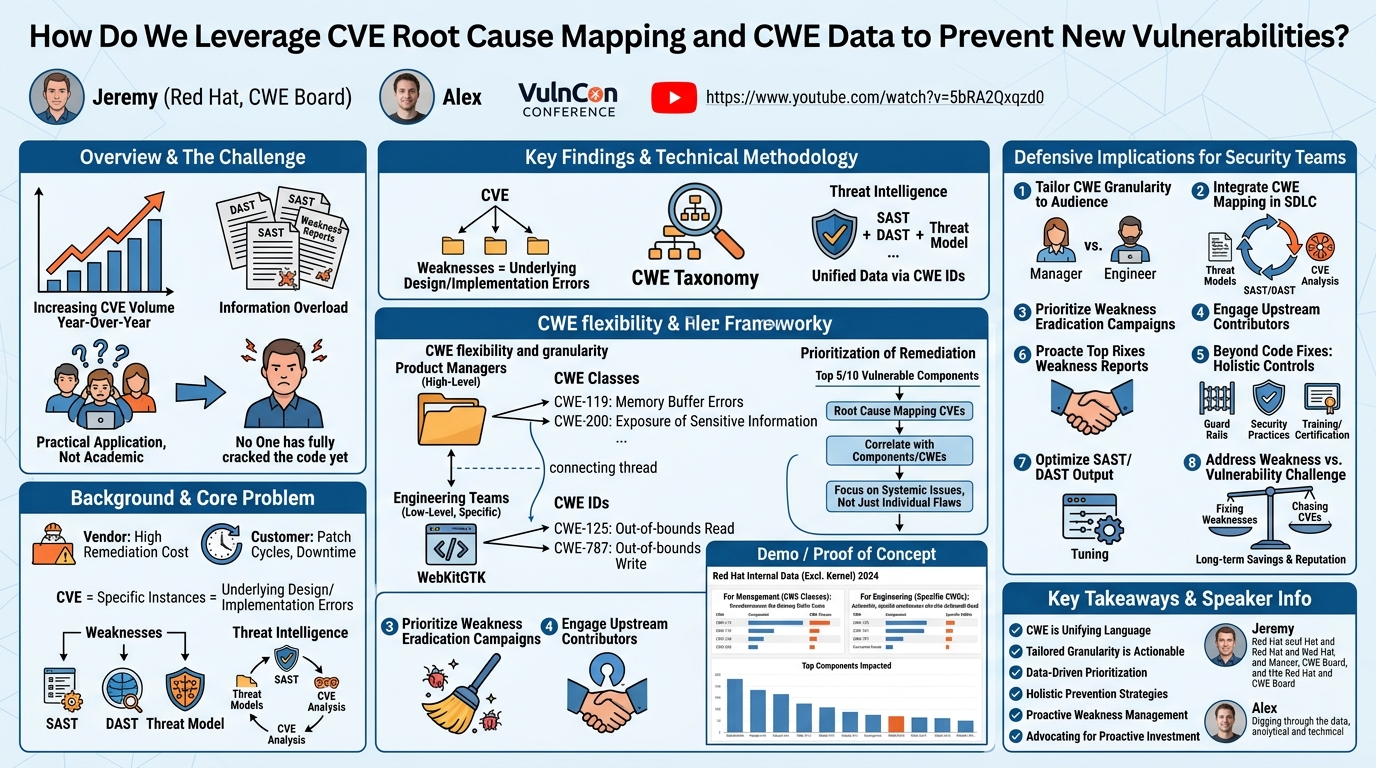
In an era where the volume of reported vulnerabilities (CVEs) continues to escalate year-over-year, security teams and software vendors face an immense challenge: how to effectively manage, prioritize, and ultimately reduce these security flaws. This talk by Jeremy and Alex tackles this pressing issue by proposing a methodology that leverages CVE root cause mapping and Common Weakness Enumeration (CWE) data. The core premise is that while CVEs represent specific instances of vulnerabilities, underlying weaknesses are the fundamental design or implementation mistakes that lead to them. By identifying and addressing these root weaknesses, organizations can prevent entire classes of vulnerabilities from emerging in the first place.
Key moments
- 0:00 Introduction and the core problem statement
- 4:00 Origins of weaknesses and threat intelligence
- 5:25 Unifying diverse data sources with CWE taxonomy
- 6:10 Blending data for actionable insights and filtering
- 7:05 Practical examples and CWE's flexibility for audience
How Do We Leverage CVE Root Cause Mapping and CWE Data to Prevent New Vulnerabilities?
Speakers: Jeremy, Alex
Conference: VulnCon
YouTube: https://www.youtube.com/watch?v=5bRA2Qxqzd0
Overview
In an era where the volume of reported vulnerabilities (CVEs) continues to escalate year-over-year, security teams and software vendors face an immense challenge: how to effectively manage, prioritize, and ultimately reduce these security flaws. This talk by Jeremy and Alex tackles this pressing issue by proposing a methodology that leverages CVE root cause mapping and Common Weakness Enumeration (CWE) data. The core premise is that while CVEs represent specific instances of vulnerabilities, underlying weaknesses are the fundamental design or implementation mistakes that lead to them. By identifying and addressing these root weaknesses, organizations can prevent entire classes of vulnerabilities from emerging in the first place.
Jeremy, a long-time veteran at Red Hat and a member of the CWE board, articulates a personal frustration with the often academic nature of CWE data, advocating for its practical application to genuinely improve product security. The speakers contend that no one has yet fully cracked the code on how to effectively use CWE data for proactive vulnerability prevention. Their presentation outlines concrete suggestions for blending diverse security data sources—such as threat models, static application security testing (SAST), dynamic application security testing (DAST) results, and CVE root cause analyses—into a unified framework using CWE identifiers. This unified data, they argue, can then be used to prioritize remediation efforts, communicate effectively with different audiences (from product managers to engineers), and integrate security deeper into the development lifecycle to foster a more secure software ecosystem.
The talk is particularly relevant for software vendors, product security organizations, and development teams grappling with the high costs of vulnerability remediation and the overload of security information. By offering a structured approach to identifying and tackling the root causes of vulnerabilities, Jeremy and Alex aim to shift the focus from reactive patching to proactive prevention, ultimately reducing the overall number of security advisories and improving the security posture of software products.
Background
▶ Watch: Introduction and the core problem statement (0:00)
The increasing volume of CVEs presents a significant, unsustainable challenge for software vendors and consumers alike. As new software is constantly introduced, the rate at which vulnerabilities are discovered and reported outpaces the capacity for traditional, reactive remediation. This leads to an "overload of information" for software developers, who are bombarded with findings from DAST tools, SAST scanners, and various weakness reports, often perceived as "noise" rather than actionable intelligence. Jeremy highlights his role at Red Hat, often being the "bad guy" who dictates vulnerability priorities, underscoring the difficulty in making these tasks manageable for engineering teams.
Beyond the sheer volume, vulnerability remediation is an expensive endeavor. For vendors, it means dedicating significant engineering resources to fixing issues. For customers, it translates to frequent patching cycles, system downtime, and operational costs. The speakers emphasize that the ultimate goal should be to reduce the number of vulnerabilities, not just fix them as they appear.
This problem stems from underlying weaknesses, which are the fundamental design flaws, implementation errors, or configuration mistakes that serve as the root cause for vulnerabilities. These weaknesses can exist across various layers, including firmware, hardware, and software, and are often uncovered through threat modeling, SAST tools, or general code review. The increasing demand for threat intelligence further highlights the need to aggregate data from diverse sources—including weakness data—to identify the riskiest components or products and focus remediation efforts strategically. The critical insight here is that all these disparate sources of security findings, from potential issues identified during threat modeling to actual vulnerabilities reported as CVEs, can be mapped back to a common identifier: a CWE ID. The CWE taxonomy provides a standardized language and hierarchical structure to categorize these underlying weaknesses, offering a powerful tool for finding commonality and making sense of the vast landscape of security data.
Key Findings
▶ Watch: Origins of weaknesses and threat intelligence (4:00)
The central finding of this talk is the transformative power of blending diverse security data sources using CWE as a unifying taxonomy. The speakers assert that by consistently mapping findings from threat models, SAST/DAST tools, and CVE root cause analyses to CWE identifiers, organizations can gain unprecedented clarity and actionable insights into their software's security posture. This approach moves beyond merely collecting data for its own sake, transforming it into a strategic asset for preventing future vulnerabilities.
A key contribution is the concept of CWE flexibility and granularity. The CWE hierarchy allows for different levels of specificity, which is crucial for tailoring information to various audiences. For high-level stakeholders like product managers, reporting can focus on broader CWE classes or categories (e.g., "Memory Buffer Errors"). For engineering teams, the same underlying data can be presented with much greater specificity, detailing lower-level CWEs like "Out-of-bounds Read" or "Exposure of Sensitive Information to an Unauthorized Actor." This ensures that the message is relevant and actionable for the intended recipient without losing the "connecting thread" of the underlying weakness.
Furthermore, the speakers highlight a practical methodology for prioritization. By analyzing internal vulnerability data (e.g., from Red Hat Enterprise Linux), they demonstrated how to identify the most common CWEs and the most impacted components. This allows security teams to move beyond an overwhelming list of issues and instead focus on a manageable set of "top 5" or "top 10" components or weakness types that contribute disproportionately to vulnerability volume. This targeted approach enables engineering teams to address systemic issues rather than just individual vulnerability instances.
Finally, the talk emphasizes that addressing weaknesses isn't solely about fixing code. Key findings include the importance of implementing guard rails, enhancing security practices, and deploying controls—especially for deeply ingrained weaknesses that may not be easily resolved through code changes (e.g., specific memory management paradigms in a kernel). This holistic view broadens the scope of defensive strategies beyond mere code patches.
Technical Deep Dive
▶ Watch: Unifying diverse data sources with CWE taxonomy (5:25)
The technical core of the proposed methodology revolves around the harmonization and intelligent utilization of security data through the CWE taxonomy. The speakers advocate for a deliberate decision within organizations to unify their data sources—including threat models, SAST/DAST results, and CVE root cause mapping—under a single identifier scheme: CWE. This involves an initial effort to map existing data and processes to CWE IDs, creating a consistent baseline.
Once this data blending is achieved, the power of the CWE taxonomy comes to the forefront. CWEs are structured hierarchically, from broad "classes" and "categories" down to very specific "weaknesses." This tiered structure is instrumental in providing context-aware reporting. For instance, a high-level CWE like CWE-119: Improper Restriction of Operations within the Bounds of a Memory Buffer (often referred to as "Memory Buffer Errors" in the talk) can serve as an umbrella for management discussions. This broad category encompasses a range of specific issues, such as CWE-125: Out-of-bounds Read or CWE-787: Out-of-bounds Write. Similarly, CWE-200: Exposure of Sensitive Information to an Unauthorized Actor covers various ways data can be leaked. The ability to "drill down" from a high-level class to a specific weakness allows for precise communication with engineers without losing the overarching context for product managers.
Alex illustrated this with practical examples drawn from Red Hat's internal data for 2024, excluding kernel vulnerabilities. Their analysis identified a set of top CWEs impacting components like WebKitGTK. Initially, these might be presented at a higher level:
- Memory Buffer Errors (e.g., CWE-119)
- Exposure of Sensitive Information (e.g., CWE-200)
- Out-of-bounds Read (e.g., CWE-125)
However, for engineering teams, this is refined to more actionable, specific CWEs:
- CWE-125: Out-of-bounds Read
- CWE-200: Exposure of Sensitive Information to an Unauthorized Actor
This demonstrates how the same underlying weakness can be communicated with varying degrees of specificity, ensuring relevance for different audiences. The "connecting thread" of CWE ensures that even when discussing at a high level, the underlying specific issues are implicitly understood and can be traced.
The methodology extends to prioritization of remediation efforts. By performing root cause mapping on reported CVEs and correlating them with components, organizations can identify which components are most frequently impacted and by which types of CWEs. Jeremy emphasized the importance of filtering this data to present manageable chunks to engineering teams—perhaps focusing on the top 5 or 10 most vulnerable components or prevalent weakness types. This allows teams to concentrate their efforts on areas with the highest security debt, gradually "chipping away" at systemic issues rather than being overwhelmed by a flood of individual CVEs. This targeted approach transforms raw data into a strategic roadmap for security improvements.
Finally, the talk highlighted the integration of these metrics into development pipelines. By embedding CWE-based checks and metrics into the SDLC, organizations can proactively identify and measure weaknesses early in the development cycle. This enables a shift-left approach, catching issues before they manifest as exploitable vulnerabilities. Moreover, the speakers pointed out that solutions aren't always code changes; for certain foundational weaknesses, especially in areas like memory management within a kernel, implementing guard rails, enhancing security practices, or deploying robust controls might be more effective than attempting to refactor core code that is unlikely to change. This holistic perspective on addressing weaknesses underscores the technical depth required to truly prevent vulnerabilities.
Demo / Proof of Concept
▶ Watch: Blending data for actionable insights and filtering (6:10)
While the talk did not feature a live, interactive demonstration in the traditional sense, the speakers provided compelling proof-of-concept illustrations using real-world data from Red Hat's internal analysis. Alex presented concrete examples of how their team processes and categorizes vulnerabilities impacting Red Hat Enterprise Linux components (excluding the kernel) in 2024.
These illustrations served to validate the core concepts of CWE granularity and data-driven prioritization. Alex showcased how the same set of vulnerabilities could be analyzed to identify common CWEs at different levels of abstraction:
- High-level (for management): Identifying broad categories like "Memory Buffer Errors" (e.g., CWE-119) or "Exposure of Sensitive Information" (e.g., CWE-200) as prevalent issues affecting components such as WebKitGTK. This level provides an overview suitable for strategic decision-making.
- Low-level (for engineering): Breaking down these high-level categories into more specific and actionable weaknesses, such as CWE-125: Out-of-bounds Read or CWE-200: Exposure of Sensitive Information to an Unauthorized Actor. This specificity is crucial for engineers to understand the exact nature of the flaw and implement targeted fixes.
The speakers further explained how this analysis allows for prioritization by component. By mapping CVE root causes to specific components and their associated CWEs, they could identify the "top five" or "top ten" components exhibiting the most frequent or critical weaknesses. This method transforms an overwhelming volume of vulnerability data into a focused, manageable set of targets for engineering teams, allowing them to address systemic issues in high-impact areas rather than chasing individual CVEs in isolation. This practical application of their methodology, using real data to generate actionable insights, effectively served as the talk's proof of concept, demonstrating the tangible benefits of their approach.
Defensive Implications
▶ Watch: Practical examples and CWE's flexibility for audience (7:05)
The insights from this talk offer several critical implications for defenders, guiding them toward more proactive and effective security strategies:
- Tailor Communication to the Audience: Defenders should adapt the granularity of CWE data based on the recipient. Use high-level CWE categories (e.g., CWE-119 for memory issues) when communicating with product managers or executives to convey strategic risk, and detailed, specific CWEs (e.g., CWE-125: Out-of-bounds Read) when engaging directly with engineering teams to provide actionable guidance.
- Integrate CWE Mapping into the SDLC: Embed CWE root cause mapping and analysis into every stage of the Secure Development Lifecycle (SDLC). This includes threat modeling, SAST/DAST outputs, and post-disclosure CVE analysis. By standardizing on CWE as a common language, all security tools and processes can contribute to a unified understanding of weaknesses.
- Prioritize Weakness Eradication Campaigns: Leverage aggregated CWE data to identify the most prevalent or critical weakness classes within an organization's software portfolio. Defenders can then launch targeted "eradication campaigns" (as suggested by an audience member) to systematically eliminate these weakness types across products, rather than just patching individual vulnerabilities. This involves prioritizing specific CWEs (e.g., focusing on remote code execution or memory corruption classes over less critical ones).
- Engage Upstream Contributors: For organizations heavily reliant on open-source components, share CWE root cause data with upstream projects. This fosters a collaborative approach to fixing weaknesses at their source, benefiting the entire ecosystem and reducing the burden on downstream consumers.
- Beyond Code Fixes: Holistic Security Controls: Recognize that not all weaknesses are fixable through code changes alone. Defenders should advocate for and implement broader security measures, including:
- Guard Rails: Architectural or runtime controls that prevent the exploitation of certain weakness types.
- Security Practices: Standardized development practices that reduce the introduction of weaknesses.
- Training: Mandatory, specialized secure coding training (e.g., C, JavaScript) tailored to developers' specific technology stacks, potentially with certification or "security champions" programs.
- Proactive Weakness Reporting: Implement internal "Top N Weakness Reports" (as shared by Jim Duncan from Juniper's experience with Junos). These annual or periodic reports, even if not perfectly comprehensive, generate significant internal attention and drive efforts to fix systemic weaknesses before they become exploitable vulnerabilities. The focus should be on what weaknesses appear, not just their precise ranking.
- Optimize SAST/DAST Output: Use the organization's historical vulnerability data, mapped to CWEs, to prioritize and tune the findings from SAST and DAST tools. This feedback loop helps reduce noise and ensures that developers focus on the most relevant and impactful automated findings.
- Address the "Weakness vs. Vulnerability" Challenge: Be prepared for the "uphill battle" of convincing management and developers to fix weaknesses that are not yet exploitable vulnerabilities. Highlight the long-term cost savings, reduced technical debt, and improved product reputation that come from proactive remediation, even if it means diverting resources from feature development in the short term. The challenge is to articulate the predictive value of CWE data.
Key Takeaways
- CWE as the Unifying Language: The Common Weakness Enumeration (CWE) provides a crucial, standardized taxonomy for blending and interpreting diverse security data, from threat models and SAST/DAST results to CVE root cause analyses.
- Tailored Granularity for Actionability: Leveraging CWE's hierarchical structure allows organizations to present vulnerability data with appropriate specificity for different audiences—high-level classes for management and detailed weaknesses for engineering teams.
- Data-Driven Prioritization: By mapping CVE root causes to CWEs and components, security teams can identify the most impactful weakness types and vulnerable components, enabling focused, manageable remediation efforts rather than reactive patching.
- Holistic Prevention Strategies: Effective vulnerability prevention extends beyond just code fixes to include implementing architectural guard rails, enhancing security practices, and providing targeted secure coding training.
- Proactive Weakness Management: Integrating CWE metrics into development pipelines and creating internal "Top N Weakness Reports" helps identify and address underlying flaws before they manifest as exploitable vulnerabilities, reducing long-term security debt.
- Advocating for Weakness Remediation: Overcoming the challenge of convincing stakeholders to fix weaknesses that are not yet vulnerabilities requires clear communication of the predictive value and long-term benefits of proactive security investments.
About the Speaker(s)
Jeremy is a long-standing employee at Red Hat, where he focuses on security-related topics. His passion for the subject stems from the increasing volume of CVEs and the need to leverage existing data, particularly CWE, to improve product security in a practical, rather than purely academic, manner. Jeremy also sits on the CWE board, bringing a vendor's perspective to the common weakness enumeration efforts. He is deeply committed to finding ways to make CWE data useful for preventing new vulnerabilities and reducing the "baggage of carrying around underlying weaknesses."
Alex is Jeremy's co-presenter. While specific biographical details are not extensively covered in the transcript, Jeremy notes that Alex has a particular knack for "digging through the data," indicating a strong analytical and technical role in the research and presentation of their findings. Together, they presented their suggestions for leveraging CVE root cause mapping and CWE data to drive meaningful security improvements.
Reviews
Dr. Zero (Offensive Security Researcher) — SOLID
Jeremy and Alex present a sensible, practitioner-oriented framework for using CWE root cause mapping to move from reactive patching toward proactive vulnerability prevention. The talk is honest about its own limitations — they openly admit nobody has fully solved this problem — and the Red Hat RHEL data gives it a grounding that keeps it from floating off into pure abstraction. It's a competent process talk aimed squarely at product security teams and vulnerability managers at software vendors. It won't make experts learn something they don't already know at a conceptual level, but it packages the 'use CWE as a unifying taxonomy' argument more concretely than most, and the audience Q&A…
Heather Calloway (CISO) — SOLID
A competent, practitioner-driven talk from Red Hat on using CWE taxonomy to unify security data sources and drive proactive vulnerability prevention. The methodology is sound and the audience-tiering concept is genuinely useful. But this is a talk for AppSec engineers and product security managers at software vendors — it doesn't reach the governance layer, and it stops short of addressing the institutional and organizational conditions that make this kind of program succeed or fail. Useful reference material for the right audience. Not a session that changes how security leaders think.