The Rise and Fall of Binary Exploitation
Stephen Sims
DEF CON 32 Main Stage · Day 1 · Main Stage
Overview
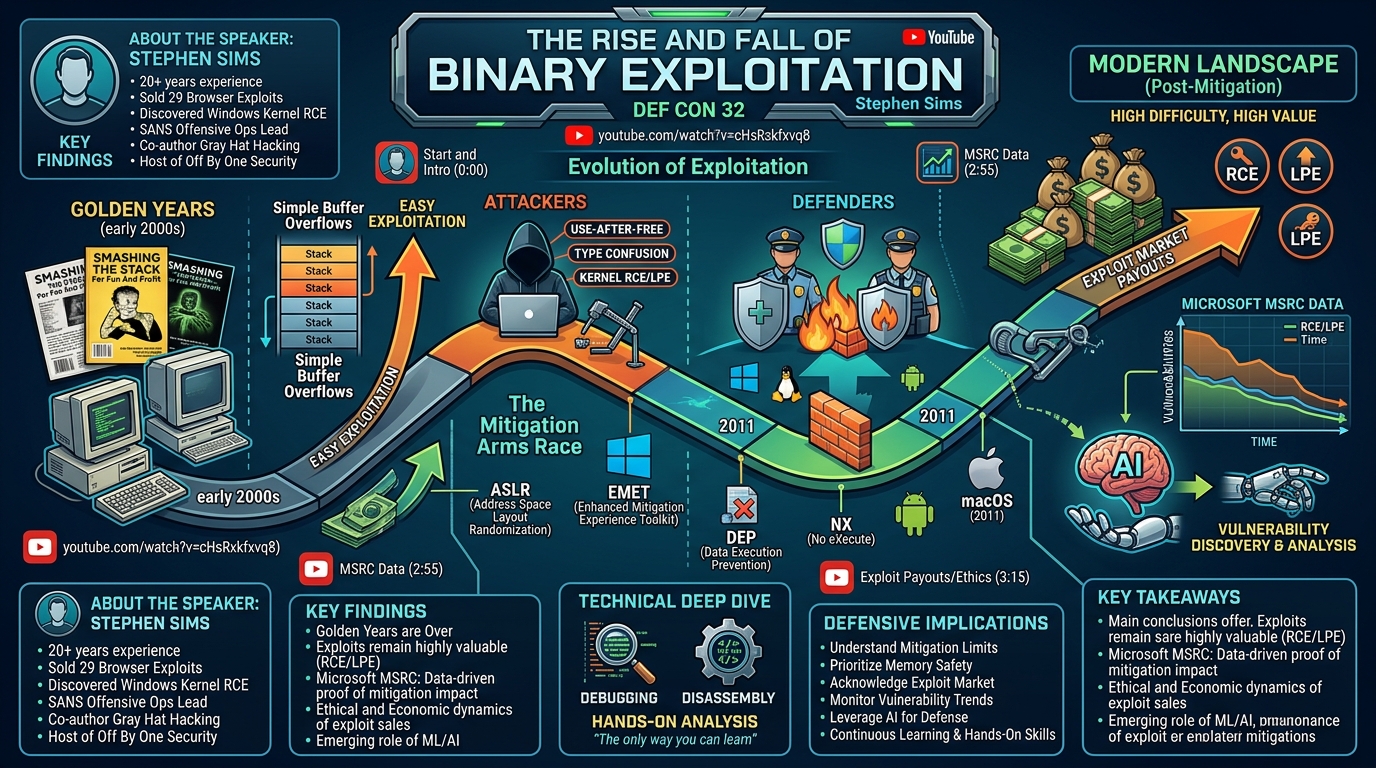
Stephen Sims, a veteran vulnerability researcher with two decades of experience, delivered a compelling talk at DEF CON 32 titled "The Rise and Fall of Binary Exploitation." This presentation offered a retrospective on the evolution of software exploitation, tracing its trajectory from the "golden years" of relatively unmitigated systems to the significantly more complex landscape of today. Sims explored how the proliferation of robust operating system mitigations has dramatically altered the difficulty and value of memory corruption vulnerabilities, while also touching upon the ethical considerations surrounding exploit sales and the emerging role of artificial intelligence in vulnerability research.
Key moments
- 0:00 Stephen Sims introduces himself and his extensive experience
- 2:30 Overview of talk agenda: mitigations, data, payouts, AI, technical deep dive
- 2:55 Introducing Microsoft MSRC's cutting-edge vulnerability data
- 3:15 Discussing exploit payouts and ethical considerations
- 3:45 Emphasizing debugging mitigations for true understanding and bypass
- 4:05 Defining the 'golden years' before effective security mitigations
The Rise and Fall of Binary Exploitation
Speakers: Stephen Sims
Conference: DEF CON 32
YouTube: https://www.youtube.com/watch?v=cHsRxkfxvq8
Overview
Stephen Sims, a veteran vulnerability researcher with two decades of experience, delivered a compelling talk at DEF CON 32 titled "The Rise and Fall of Binary Exploitation." This presentation offered a retrospective on the evolution of software exploitation, tracing its trajectory from the "golden years" of relatively unmitigated systems to the significantly more complex landscape of today. Sims explored how the proliferation of robust operating system mitigations has dramatically altered the difficulty and value of memory corruption vulnerabilities, while also touching upon the ethical considerations surrounding exploit sales and the emerging role of artificial intelligence in vulnerability research.
The talk served as both a historical account and a practical guide, providing insights into the current state of offensive security. Sims underscored the enduring importance of deep technical understanding, even as the nature of vulnerability research shifts. His discussion was particularly relevant for both aspiring and seasoned security professionals, offering a unique perspective from someone who has actively sold 29 browser exploits and discovered multiple kernel vulnerabilities, including a Windows RCE.
Ultimately, Sims' presentation highlighted that while the "golden years" of easy binary exploitation may be over, the underlying principles of understanding system internals and debugging mitigations remain paramount. The talk aimed to equip attendees with a framework for approaching modern vulnerability research, emphasizing hands-on analysis and a critical evaluation of the evolving threat landscape, making it a crucial discussion for anyone involved in exploit development, reverse engineering, or defensive security strategies.
Background
▶ Watch: Stephen Sims introduces himself and his extensive experience (0:00)
The landscape of binary exploitation has undergone a profound transformation since its nascent stages. Stephen Sims contextualized this evolution by recalling an era he refers to as the "golden years"—a period predating the widespread implementation of robust operating system security mitigations. During this time, seminal works like Aleph One's "Smashing The Stack For Fun And Profit" and pioneering efforts by researchers such as Brad Spangler at Openwall laid the groundwork for understanding memory corruption vulnerabilities. Exploiting buffer overflows and other memory safety issues was comparatively straightforward due to the lack of protective measures, allowing attackers to reliably execute arbitrary code.
Operating systems were slow to adopt comprehensive defensive strategies. Sims pointed out that while Windows began integrating significant mitigations like EMET (Enhanced Mitigation Experience Toolkit), predicted by researchers like Trust from Scope and Wag, macOS was notably behind. ASLR (Address Space Layout Randomization), a fundamental mitigation designed to randomize the memory locations of key program components, didn't appear in macOS until around 2011, long after its introduction in Windows Vista. This staggered adoption created varying levels of exploitability across different platforms.
Sims' personal journey mirrors this historical progression. With nearly two decades in vulnerability research, he has witnessed firsthand the escalating difficulty of exploit development. His early career allowed him to discover and sell numerous vulnerabilities, including 29 browser exploits (primarily use-after-free and type confusion bugs) and multiple Windows kernel vulnerabilities, one of which was a lucrative Remote Code Execution (RCE). This deep personal experience forms the bedrock of his perspective, enabling him to speak authoritatively on the "rise and fall" from a practitioner's standpoint. The talk, therefore, is rooted in the historical context of evolving attack and defense techniques, setting the stage for understanding the current state of the art.
Key Findings
▶ Watch: Introducing Microsoft MSRC's cutting-edge vulnerability data (2:55)
Stephen Sims' talk unveiled several critical findings and observations pertinent to the contemporary state of binary exploitation and vulnerability research. These insights span the effectiveness of modern mitigations, the economics of exploit development, and the emerging influence of artificial intelligence.
First and foremost, Sims unequivocally stated that the "golden years" of easily exploitable memory corruption bugs are long over. The pervasive implementation of sophisticated security mitigations across modern operating systems has made exploit development significantly harder. Despite this increased difficulty, memory corruption bugs, particularly those leading to Remote Code Execution (RCE) or Local Privilege Escalation (LPE), remain exceptionally valuable in the current market.
A key highlight was the presentation of unpublished, cutting-edge data from Microsoft's MSRC (Microsoft Security Response Center). This data provided a unique perspective on the trends of RCEs and LPEs over time, demonstrating how Microsoft perceives the evolution of vulnerability types and the impact of their defensive efforts. While specific figures were not detailed in the transcript, the emphasis was on showing how the landscape of exploitable bugs has shifted and how effective mitigations have become in reducing certain classes of vulnerabilities.
Sims also delved into the economics of vulnerability research, specifically discussing exploit payouts. He acknowledged the controversial nature of exploit sales, highlighting the ethical considerations involved. The discussion covered the various types of buyers in the market and the substantial financial rewards associated with high-impact vulnerabilities, particularly RCEs, underscoring the lucrative nature of discovering and selling advanced exploits.
Furthermore, the talk addressed the rapidly growing influence of Machine Learning (ML) and Artificial Intelligence (AI) in vulnerability research. Sims recognized this as a "hot topic" that will continue to shape the field, suggesting that AI will play an increasingly significant role in both the discovery and analysis of vulnerabilities, potentially altering the traditional methods of exploit development.
Finally, a core finding and recommendation from Sims was the critical importance for researchers and defenders to engage in hands-on debugging and disassembler analysis of new security mitigations. He asserted that this is the "only way you can learn" and truly understand how a mitigation works, how effective it is, or how it might be bypassed, rather than solely relying on published information. This emphasizes a practical, deep-dive approach to staying ahead in the ever-evolving security arms race.
Technical Deep Dive
▶ Watch: Discussing exploit payouts and ethical considerations (3:15)
The technical core of Stephen Sims' presentation revolved around understanding the evolution and impact of operating system mitigations, coupled with a strong emphasis on practical, hands-on analysis. He began by briefly tracing the historical arc of mitigations, noting that while the early days of computing offered little protection, modern OSes like Windows and macOS have progressively integrated robust defenses. Windows, for instance, saw significant advancements starting with EMET, while macOS lagged somewhat, with ASLR only appearing around 2011. Today, all major operating systems are in a "pretty good state" regarding their built-in protections.
Sims then introduced the unpublished data from Microsoft MSRC, which provided a strategic view of vulnerability trends. This data highlighted the changing prevalence of Remote Code Execution (RCE) and Local Privilege Escalation (LPE) vulnerabilities over time. While the specific graphs and numbers were not detailed in the transcript, the implication was that this internal Microsoft data illustrates the effectiveness of their mitigation strategies in reducing the impact or frequency of certain bug classes, pushing attackers towards more complex or novel exploit techniques. This underscores a continuous arms race where mitigation development directly influences the type and difficulty of exploitable bugs.
A significant portion of the technical discussion, though not a live demonstration, focused on the methodological approach to understanding new mitigations. Sims advocated for a rigorous, hands-on process: "every time a new mitigation comes out, I love to jump into debuggers and disassemblers and go and understand it as best I can." He specifically mentioned examining "one specific mitigation that is implemented in the Windows kernel" as an example of this methodology. While the talk did not delve into the specifics of that particular mitigation due to time constraints, the critical takeaway was the process itself.
To truly understand a new mitigation, whether for bypass or defense, Sims stressed the necessity of:
- Debugging: Attaching a debugger to the operating system or application to observe the mitigation's behavior in real-time. This allows researchers to see how code paths are altered, how memory is protected, and how execution flow is controlled.
- Disassembly: Using a disassembler to analyze the compiled code of the mitigation. This provides a low-level view of the instructions, enabling an understanding of the exact logic, checks, and mechanisms employed by the defense.
This approach is crucial for several reasons:
- Effectiveness Assessment: Defenders can gauge how robust a mitigation truly is.
- Bypass Identification: Attackers can identify weak points or logical flaws in the mitigation's implementation that could lead to a bypass.
- Independent Verification: It allows researchers to move beyond high-level descriptions and gain a concrete, verifiable understanding of the technology.
Beyond mitigations, Sims briefly touched on the role of Machine Learning (ML) and Artificial Intelligence (AI) in vulnerability research. While not a deep dive into specific AI techniques, he acknowledged their growing importance as a "hot topic" that will undoubtedly influence future vulnerability discovery and analysis. This suggests a future where automated tools, powered by AI, could assist in tasks like fuzzing, static analysis, and even exploit generation, further shifting the technical landscape of exploitation.
The discussion on exploit payouts, though not strictly technical, highlights the economic forces driving technical research. The high value of RCEs, particularly Windows kernel RCEs, signifies the extreme technical sophistication required to achieve them in a post-mitigation era. This financial incentive fuels the development of advanced technical skills and the pursuit of novel bypass techniques.
Demo / Proof of Concept
▶ Watch: Emphasizing debugging mitigations for true understanding and bypass (3:45)
While Stephen Sims' talk, "The Rise and Fall of Binary Exploitation," was deeply technical in its discussion of mitigation evolution and analysis methodologies, it did not include a live demonstration or a specific proof of concept during the presentation. The speaker explicitly stated his desire "not to do a talk without being technical" and mentioned looking at "one specific mitigation that is implemented in the Windows kernel." However, the subsequent content in the transcript focuses on the methodology of understanding mitigations through debugging and disassemblers, rather than a detailed walkthrough of a particular mitigation's inner workings or its bypass. The emphasis was on advocating for a hands-on approach to learning and analysis, rather than demonstrating a specific exploit or mitigation bypass in real-time.
Defensive Implications
▶ Watch: Defining the 'golden years' before effective security mitigations (4:05)
The insights shared by Stephen Sims offer several critical defensive implications for organizations and security professionals striving to protect their systems in the modern threat landscape.
- Understand Mitigation Effectiveness: Defenders must recognize that while operating system mitigations like ASLR and DEP/NX have significantly raised the bar for attackers, they are not foolproof. Sims' emphasis on debugging and disassembling mitigations is equally vital for defenders. By understanding the precise mechanisms and limitations of these protections, security teams can better assess their true effectiveness against sophisticated adversaries and identify potential weaknesses before they are exploited.
- Prioritize Memory Safety: Despite the increased difficulty, memory corruption bugs (e.g., use-after-free, type confusion) remain highly valuable and are still being discovered, especially in critical components like browsers and kernels. Defenders should continue to prioritize secure coding practices that prevent these classes of vulnerabilities and invest in tools that can detect them, such as advanced static and dynamic analysis.
- Stay Current with Vulnerability Trends: The unpublished Microsoft MSRC data discussed by Sims highlights the dynamic nature of vulnerability trends. Defenders need to stay informed about the types of vulnerabilities that are most prevalent and valuable, particularly RCEs and LPEs, as these represent the highest risk. This awareness helps in focusing defensive efforts and patching strategies effectively.
- Acknowledge the Exploit Market: The existence of a lucrative exploit market for high-impact bugs means that well-resourced adversaries have access to powerful zero-day capabilities. Defenders cannot solely rely on public disclosures; they must assume that advanced vulnerabilities are being actively exploited in the wild. This necessitates a proactive security posture, emphasizing defense-in-depth, continuous monitoring, and rapid incident response.
- Prepare for AI in Offense and Defense: The burgeoning role of Machine Learning (ML) and Artificial Intelligence (AI) in vulnerability research will impact both sides of the security coin. Defenders should explore how AI can be leveraged for faster vulnerability detection, automated patching, threat intelligence analysis, and anomaly detection to counter AI-powered offensive tools.
- Embrace Continuous Learning and Hands-On Analysis: Sims' core message for researchers—to "jump into debuggers and disassemblers" to understand mitigations—applies equally to defenders. Security engineers and incident responders should cultivate deep technical skills in reverse engineering and debugging. This enables them to analyze new threats, understand exploit techniques, and verify the efficacy of their security controls independently, moving beyond relying solely on vendor claims.
Key Takeaways
- The "golden years" of easy binary exploitation are over, with modern OS mitigations significantly increasing the difficulty of exploit development.
- Despite increased difficulty, memory corruption bugs, especially RCEs and LPEs, remain highly valuable in the current exploit market.
- Hands-on debugging and disassembler analysis are essential for understanding, bypassing, or defending against new security mitigations.
- Microsoft MSRC data indicates shifting trends in RCE and LPE vulnerabilities, reflecting the ongoing evolution of the security landscape.
- The ethical considerations and lucrative payouts associated with exploit sales continue to shape the vulnerability research ecosystem.
- Machine Learning (ML) and Artificial Intelligence (AI) are poised to play an increasingly significant role in future vulnerability discovery and analysis.
About the Speaker(s)
Stephen Sims is a highly experienced vulnerability researcher with a career spanning nearly 20 years. Early in his career, he developed a passion for computing and hacking, including using hex editors for video game modifications. He is known for discovering and selling numerous exploits, including 29 browser exploits, primarily focused on use-after-free and type confusion vulnerabilities. Sims has also identified several Windows kernel vulnerabilities, notably a Remote Code Execution (RCE). He has maintained extensive relationships within the security community, stemming from his time living on "Hacker Island" in San Francisco.
Beyond his exploit development work, Stephen Sims is a respected educator and author. He serves as the offensive operations curriculum lead at the SANS Institute, where he teaches advanced exploit development courses. He is also one of the co-authors of the popular "Gray Hat Hacking" book series, with a seventh edition currently under discussion. Furthermore, Sims hosts a weekly security stream called "Off By One Security," where he shares his knowledge and hosts notable guests, emphasizing his commitment to giving back to the community.
Reviews
Dr. Zero (Offensive Security Researcher) — MUST SEE
This talk by Stephen Sims is a masterclass in the evolution of binary exploitation, delivered by a true titan in the field. Sims leverages his two decades of hands-on experience and unique access to present a brutally honest assessment of the current state of offensive security. The inclusion of unpublished MSRC data, combined with a fervent call for deep, hands-on debugging of mitigations, provides rare insider signal and actionable insights that will reshape how both aspiring and seasoned professionals approach vulnerability research. It’s a vital discussion for anyone serious about understanding the true arms race.
Heather Calloway (CISO) — STRONG ACCEPT
Stephen Sims delivers a highly credible and unsentimental assessment of the modern exploit landscape, effectively debunking the myth of easy binary exploitation while underscoring the enduring, high-value threat posed by sophisticated memory corruption bugs. His insights into the impact of OS mitigations, exploit economics, and the necessity of deep technical analysis provide crucial context for security leaders navigating strategic investment in secure development, talent, and threat modeling. This talk provides a realistic grounding for executive decision-making under uncertainty, making it a strong recommendation for anyone serious about understanding the true state of offensive…