Prime Cuts from Hacker History :40 Years of 31337
Cult of the Dead Cow
DEF CON 32 Main Stage · Day 1 · Main Stage
Overview
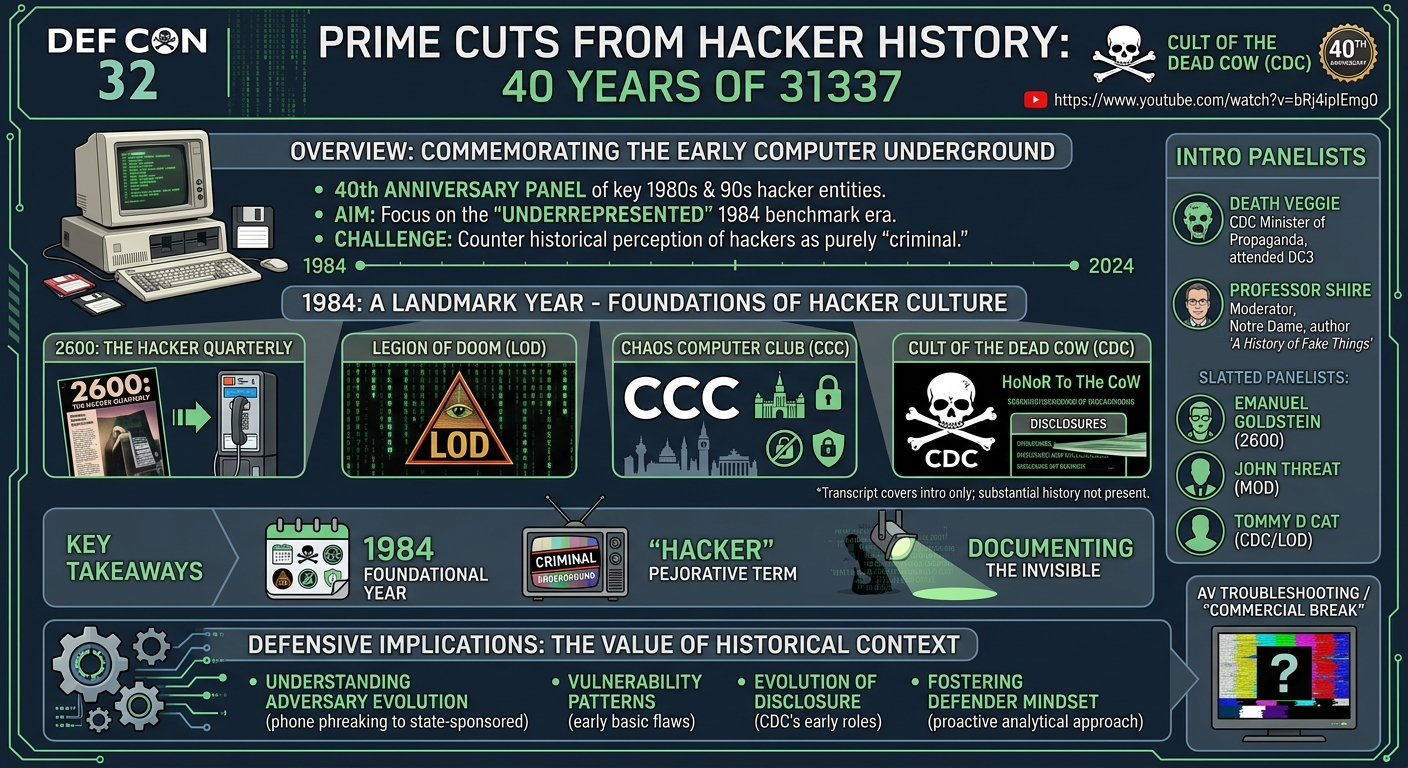
This talk, titled "Prime Cuts from Hacker History :40 Years of 31337," was introduced as a panel discussion designed to commemorate the 40th anniversary of several foundational entities within the computer underground and hacker community. Initiated by Death Veggie, the Minister of Propaganda for the Cult of the Dead Cow (CDC), the panel aimed to bring together prominent figures from this era to discuss the early days of hacking, specifically focusing on the 1980s and early 1990s. The significance of 1984 as a benchmark year for the establishment of groups like CDC, 2600 magazine, the Legion of Doom (LOD), and the Chaos Computer Club (CCC) was highlighted as the central theme.
Key moments
- 0:00 Introduction: 40th anniversary of hacker groups
- 0:40 Panel focus: Underrepresented 80s/90s hacker history
- 1:10 Introducing the esteemed panel of early hacker legends
- 1:50 Panelists take the stage to audience applause
- 2:15 Technical difficulties interrupt the panel start
- 2:30 Humorous 'commercial break' during AV troubleshooting
Prime Cuts from Hacker History :40 Years of 31337
Speakers: Cult of the Dead Cow
Conference: DEF CON 32
YouTube: https://www.youtube.com/watch?v=bRj4ipIEmg0
Overview
This talk, titled "Prime Cuts from Hacker History :40 Years of 31337," was introduced as a panel discussion designed to commemorate the 40th anniversary of several foundational entities within the computer underground and hacker community. Initiated by Death Veggie, the Minister of Propaganda for the Cult of the Dead Cow (CDC), the panel aimed to bring together prominent figures from this era to discuss the early days of hacking, specifically focusing on the 1980s and early 1990s. The significance of 1984 as a benchmark year for the establishment of groups like CDC, 2600 magazine, the Legion of Doom (LOD), and the Chaos Computer Club (CCC) was highlighted as the central theme.
The purpose of this retrospective was to shed light on a period of hacker history that is often considered "underrepresented," largely due to its genuinely underground nature and the prevailing public perception of "hacker" as a pejorative term synonymous with "criminal." By assembling key individuals from these pioneering groups, the panel sought to offer authentic insights and narratives from a time when the digital landscape was rapidly evolving, and the nascent hacker culture was taking shape. It aimed to provide a historical perspective that could correct misconceptions and preserve the true origins of the community.
However, it is crucial to note that the provided transcript for this article covers only the introductory remarks and the setup phase of the panel discussion. The substantive content, the actual historical discussions, anecdotes, and insights from the panelists, are not present in the supplied material. Consequently, this article will reflect the scope of the provided transcript, focusing on the stated intentions, historical context, and the participants introduced, rather than the detailed content of the panel itself.
Background
▶ Watch: Introduction: 40th anniversary of hacker groups (0:00)
The genesis of this panel discussion is rooted in a significant historical observation: the year 2024 marks the 40th anniversary of 1984, a year described as a collection of "benchmarks in the computer underground and the hacking thing." This particular year saw the simultaneous founding of several highly influential organizations and publications that would go on to define the early hacker ethos and community. Among these were the Cult of the Dead Cow (CDC), a prominent hacking group known for its pioneering work in disclosure and its role in shaping public perception of hacking; 2600: The Hacker Quarterly, a seminal magazine that became a vital communication channel and intellectual hub for hackers globally; the Legion of Doom (LOD), one of the most infamous and skilled hacking groups of the era; and the Chaos Computer Club (CCC), a German hacker association that has grown into one of Europe's largest and most respected organizations focusing on technology, privacy, and freedom of information.
The panel's moderator, Death Veggie, emphasized that the focus would primarily be on the 80s and early 90s, a period he described as being "underrepresented" in the broader historical narrative of computing and cybersecurity. During this time, the hacker community truly operated "underground," characterized by dial-up bulletin board systems (BBSs), phone phreaking, and early network exploration. The term "hacker" itself carried a heavily negative connotation in the mainstream press, often being "synonymous with criminal." This hostile public perception, coupled with the nascent nature of digital security and the lack of widespread internet access, meant that many of the stories, innovations, and cultural developments within these early groups remained largely unchronicled or misunderstood by the general public.
The stated goal of assembling this panel was therefore to bridge this historical gap. By bringing together luminaries like Emanuel Goldstein of 2600, John Threat of MOD, and other figures from CDC and LOD, the event aimed to provide firsthand accounts and perspectives on the origins of a movement that would eventually have profound impacts on technology, privacy, and information security. The panel sought to offer a nuanced understanding of this pivotal era, moving beyond the simplistic "criminal" label to explore the motivations, intellectual curiosity, and collaborative spirit that also defined early hacker culture. The moderation by Professor Shire from Notre Dame, author of a book on the "history of fake things on the internet," further underscored the academic and historical intent behind documenting these formative years.
Key Findings
▶ Watch: Introducing the esteemed panel of early hacker legends (1:10)
As the provided transcript covers only the introductory remarks and the setup of the panel, it does not contain the substantive discussions or specific key findings that would typically emerge from a full conference talk. The panel's stated intention was to explore and reveal historical insights, but the actual delivery of these insights is not present in the material.
However, the primary "finding" or premise established in the introduction is the identification of 1984 as a singularly pivotal and benchmark year for the foundational elements of the computer underground and the broader hacking movement. This assertion is supported by the simultaneous establishment of several highly influential entities within that year:
- Cult of the Dead Cow (CDC): A group that would become known for its pioneering work in vulnerability disclosure and its significant cultural impact.
- 2600: The Hacker Quarterly: A crucial publication that served as a forum for information exchange, technical articles, and community building.
- Legion of Doom (LOD): One of the most technically proficient and legendary hacking groups of its time.
- Chaos Computer Club (CCC): A German organization that would grow into a globally recognized voice for digital rights, privacy, and responsible technology use.
The introductory remarks also frame the underrepresentation of 80s and early 90s hacker history as a critical observation, highlighting the need for such a panel to preserve and disseminate these stories. It underlines the historical context where the term "hacker" was widely considered a "dirty word" and synonymous with "criminal" in mainstream media, underscoring the challenges faced by the early community in shaping its own narrative. These points, while foundational to the panel's purpose, are presented as observations or premises rather than specific findings derived from the panel's discussion.
Technical Deep Dive
▶ Watch: Panelists take the stage to audience applause (1:50)
The introductory segment of this panel, as captured in the provided transcript, does not delve into specific technical details, code, protocols, or architectures. The panel's stated intent is to explore the historical and cultural aspects of early hacking, rather than present new technical research or vulnerabilities.
The discussion, as outlined by Death Veggie, was meant to be a retrospective on the origins and evolution of the hacker community, focusing on the societal perception and the foundational groups formed in a pivotal year like 1984. While these groups (Cult of the Dead Cow, Legion of Doom, 2600 magazine, Chaos Computer Club) were undoubtedly involved in significant technical explorations and developments during their time, the introductory remarks do not elaborate on any specific technical achievements, tools, exploits, or methodologies they might have pioneered or discussed. The focus remains on the historical context and the cultural significance of these entities rather than their technical contributions. Therefore, a technical deep dive based on the provided material is not possible.
Demo / Proof of Concept
▶ Watch: Technical difficulties interrupt the panel start (2:15)
Given the historical and panel discussion format of "Prime Cuts from Hacker History," a live demonstration or proof of concept was not part of the introductory segment. The focus was entirely on setting the stage for a retrospective on the origins and evolution of the hacking subculture, introducing the topic, the moderator, and the panelists. The nature of the talk, designed to explore historical narratives and the cultural impact of early hacker groups, inherently suggests that a technical demonstration would not be a primary component. The provided transcript contains no mention or implication of any demo or proof of concept being presented.
Defensive Implications
▶ Watch: Humorous 'commercial break' during AV troubleshooting (2:30)
The initial segment of this talk, being a historical panel introduction, does not present immediate defensive implications in terms of specific vulnerabilities, attack techniques, or mitigation strategies. The discussion centers on the cultural and historical context of early hacking, rather than contemporary threats or defensive measures.
However, understanding the historical context of the hacker community, as intended by this panel, can offer broader, indirect insights for defenders:
- Understanding Adversary Evolution: By examining the origins of prominent hacking groups and their motivations in the 1980s and early 1990s, defenders can gain a deeper appreciation for how the cyber threat landscape has evolved. The transition from curiosity-driven exploration and phone phreaking to more organized, financially motivated, or state-sponsored attacks provides crucial context for predicting future trends.
- Historical Vulnerability Patterns: While not explicitly detailed in the introduction, the historical period covered by the panel saw the discovery and exploitation of fundamental software and network vulnerabilities. Reflecting on these early weaknesses can reinforce the importance of basic security hygiene, secure coding practices, and understanding the foundational principles of system design that are still relevant today.
- Cultural Context of Disclosures: Groups like the Cult of the Dead Cow played a significant role in establishing early norms around vulnerability disclosure. Understanding the historical tension between "underground" discovery and responsible disclosure can inform modern approaches to threat intelligence sharing, bug bounty programs, and industry collaboration.
- Long-Term Security Mindset: The early hacker ethos, often driven by intellectual curiosity and a desire to understand how systems truly work, laid some groundwork for the modern cybersecurity profession. Recognizing this heritage can help foster a more proactive and analytical mindset in defenders, encouraging them to think like an attacker to better protect systems.
Ultimately, while no direct actionable defensive steps are provided, the panel's intent to illuminate the foundational history of hacking serves as a crucial educational component for anyone involved in cybersecurity, providing context that can indirectly inform a more robust and historically aware defensive posture.
Key Takeaways
- 1984 was a landmark year for the computer underground, witnessing the founding of several pivotal hacker groups and publications.
- Key entities established in 1984 include the Cult of the Dead Cow (CDC), 2600 magazine, the Legion of Doom (LOD), and the Chaos Computer Club (CCC).
- The panel aimed to address the underrepresentation of 80s and early 90s hacker history, a period when the scene was genuinely underground.
- During this era, the term "hacker" was widely viewed as negative, often synonymous with "criminal" in the mainstream press.
- The discussion was intended to feature prominent figures from these foundational groups, including Emanuel Goldstein of 2600 and John Threat of MOD, moderated by Professor Shire.
About the Speaker(s)
The panel was introduced by Death Veggie, who serves as the Minister of Propaganda for the Cult of the Dead Cow (CDC). He noted his long history with DEF CON, having attended since DEF CON 3. His role in CDC highlights his involvement with one of the most historically significant hacker groups that originated in 1984.
The panel was slated to be moderated by Professor Shire from Notre Dame. Professor Shire is also the author of a book titled "a history of fake things on the internet," which was published in December, indicating expertise in digital history and online phenomena.
While the full panel discussion is not detailed in the provided transcript, the introduction mentioned several other prominent figures who were intended to participate. These included representatives from various hacker groups such as the Cult of the Dead Cow, the Legion of Doom (LOD), Eric (Emanuel Goldstein) of 2600 magazine, John Threat from MOD, and Tommy D Cat, all recognized as significant individuals within the early hacker community. Their collective presence was intended to offer diverse perspectives on the 40 years of hacker history being celebrated.
Reviews
Heather Calloway (CISO) — STRONG ACCEPT
This panel's introduction sets the stage for a critical historical retrospective on the origins of the hacker community. While the provided material only covers the setup, the stated intent to explore the foundational years of groups like CDC, 2600, LOD, and CCC in 1984 offers significant strategic value. Understanding the adversary's genesis and the cultural context of early cyber exploration is indispensable for senior security leaders, informing long-term risk posture and institutional realism, even if the introduction itself provides no direct operational takeaways.