Disenshittify or die! How hackers can seize the means of computation
Cory Doctorow
DEF CON 32 Main Stage · Day 1 · Main Stage
Overview
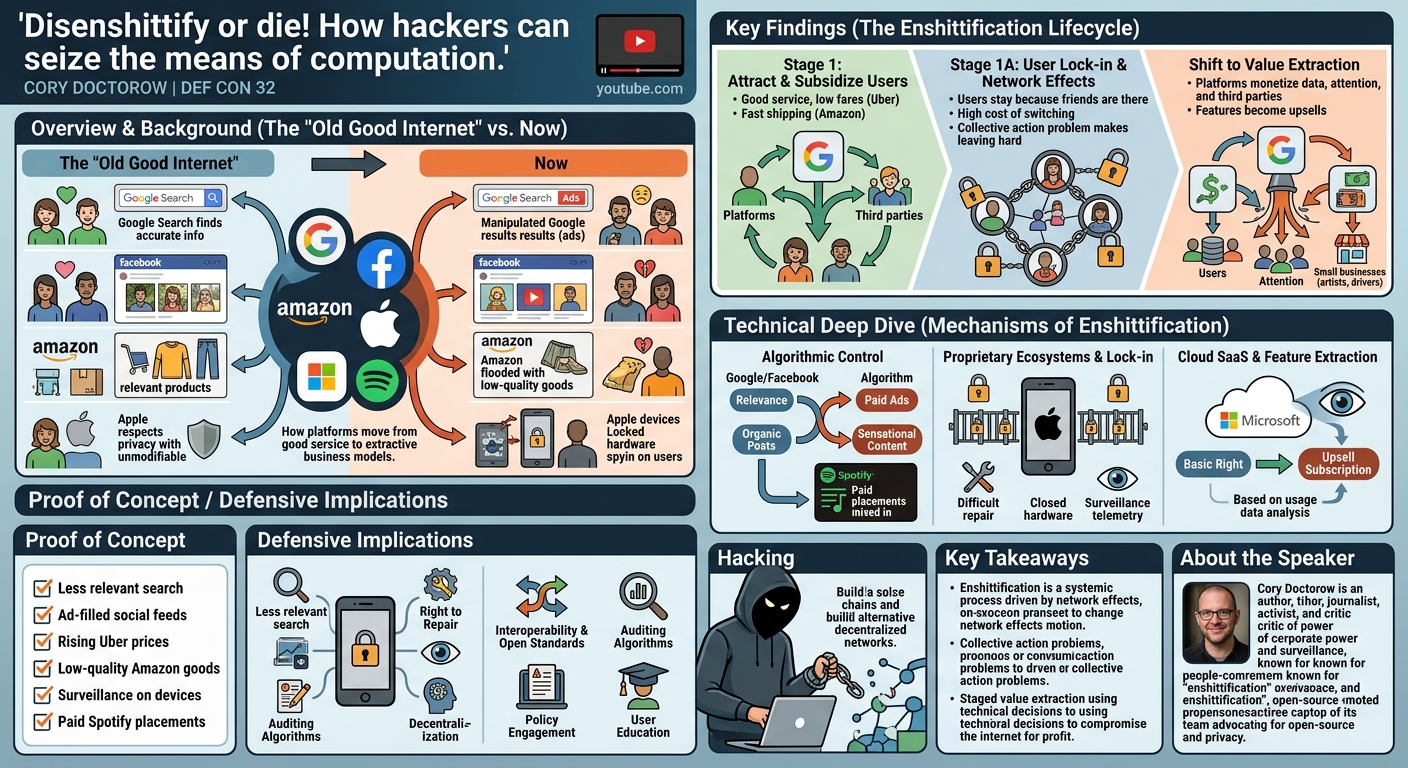
In a compelling and provocative talk at DEF CON 32, renowned author and activist Cory Doctorow introduced and elaborated on his widely discussed concept of enshittification. This presentation delves into the systemic degradation of online platforms and services, arguing that the once vibrant and user-centric internet has been systematically hollowed out by platform monopolies. Doctorow posits that major tech companies, after initially attracting users and third-party providers with superior services and favorable terms, progressively extract more value for themselves, ultimately leading to a diminished experience for everyone else.
Key moments
- 0:00 Opening: What happened to the good internet?
- 0:30 Concrete examples of platform enshittification
- 2:00 Introducing the concept of 'enshittification'
- 2:05 Enshittification Stage 1: Attracting users with value
- 2:25 Enshittification Stage 1A: Locking users in
Disenshittify or die! How hackers can seize the means of computation
Speakers: Cory Doctorow
Conference: DEF CON 32
YouTube: https://www.youtube.com/watch?v=4EmstuO0Em8
Overview
In a compelling and provocative talk at DEF CON 32, renowned author and activist Cory Doctorow introduced and elaborated on his widely discussed concept of enshittification. This presentation delves into the systemic degradation of online platforms and services, arguing that the once vibrant and user-centric internet has been systematically hollowed out by platform monopolies. Doctorow posits that major tech companies, after initially attracting users and third-party providers with superior services and favorable terms, progressively extract more value for themselves, ultimately leading to a diminished experience for everyone else.
Doctorow's talk is a critical examination of the current state of digital platforms, explaining how companies like Google, Facebook, Amazon, Apple, Spotify, and Microsoft have evolved from offering valuable services to implementing extractive business models. He argues that this process is not merely a series of missteps but a predictable outcome of unchecked power, fueled by network effects and a collective action problem that traps users and third-party providers within increasingly unsatisfactory ecosystems. For the security community, this analysis is crucial, as it highlights how the architectural decisions and business strategies of these platforms fundamentally impact user autonomy, privacy, and the overall health of the digital commons, often undermining the very security and control users expect.
Background
▶ Watch: Opening: What happened to the good internet? (0:00)
The talk opens with a poignant question: "What the fuck happened to the old good internet?" Doctorow reminisces about a time when Google search worked effectively, Facebook showed users what they wanted to see, Uber was affordable and paid drivers well, Amazon sold quality products, and Apple defended user privacy. He contrasts this with the contemporary reality: Google search results are often manipulated, Facebook feeds are algorithmically curated for advertiser benefit, Uber drivers are underpaid while prices rise, Amazon is flooded with low-quality drop-shipped goods, Apple devices spy on users and resist modification, Spotify prioritizes paid placements over relevant music, and Microsoft shifts software to cloud subscriptions while monetizing user data and features.
This degradation, Doctorow explains, is rooted in the inherent dynamics of platform monopolies. Initially, platforms offer attractive terms to both users and third-party providers (e.g., drivers on Uber, sellers on Amazon, artists on Spotify) to achieve critical mass. This creates powerful network effects, where the value of the platform increases exponentially with each new participant. Users join Facebook because their friends are there; friends join because they are there. This mutual dependency creates a strong lock-in. Once a platform achieves dominance and users are sufficiently locked in, a collective action problem emerges. While users collectively recognize the platform's declining quality, their individual inability to coordinate a mass exodus means they remain trapped. Leaving would mean losing access to their social networks, essential services, or established business channels. This lock-in provides platforms with immense power, allowing them to shift their focus from serving users to extracting maximum value from them and third-party providers.
Key Findings
▶ Watch: Concrete examples of platform enshittification (0:30)
Doctorow articulates the process of enshittification as a multi-stage phenomenon, though the provided transcript heavily emphasizes the initial stages. He describes it as a predictable lifecycle of platform decay:
- Stage One: Attracting and Subsidizing Users and Third Parties. In this initial phase, the platform offers genuinely good service to attract a large user base. Examples include Google prioritizing the best search results, Facebook showing organic posts from friends, Uber offering low fares, and Amazon subsidizing shipping and returns while highlighting the best product matches. This stage is characterized by the platform being "good to its end users" and often operating at a loss or with razor-thin margins to outcompete incumbents and gain market share.
- Stage 1A: User Lock-in and Network Effects. Crucially, alongside providing excellent service, platforms simultaneously work to lock in their users. This is where network effects become paramount. For social platforms like Facebook, users themselves drive the lock-in; people join because their social circle is already there, creating a strong incentive to stay even as the service degrades. For hardware/software ecosystems like Apple, lock-in is achieved through proprietary systems that make it difficult to switch to competitors without losing functionality or media access. The collective action problem solidifies this lock-in: while users might agree the platform is declining, coordinating a mass exit to an alternative is nearly impossible due to the dispersed nature of their relationships and dependencies.
- The Shift to Value Extraction (Implied Subsequent Stages): While the provided transcript primarily focuses on the detailed description of Stage One and Stage 1A, Doctorow vividly describes the outcomes of subsequent stages, which involve platforms increasingly extracting value. Once users are locked in, platforms can begin to degrade the service for end-users while simultaneously extracting more from third-party providers. This includes:
- Monetizing user data and attention: Shifting from organic content to paid advertisements and algorithmically manipulated feeds (Facebook, Spotify).
- Extracting value from third parties: Charging higher fees, manipulating search results for favored vendors, or allowing low-quality, paid-for content to dominate (Uber, Amazon, Spotify).
- Feature stripping and upsell: Identifying valuable features in basic offerings and moving them to premium tiers or separate subscriptions (Microsoft cloud apps).
- Surveillance and control: Leveraging proprietary hardware and software to monitor user behavior and restrict modification, ostensibly for security but often serving business interests (Apple).
The core finding is that enshittification is not an accident but a deliberate, economically driven process where platforms exploit their monopolistic power derived from user lock-in to shift value from users and third parties to themselves, ultimately leaving everyone but the platform owners worse off.
Technical Deep Dive
▶ Watch: Introducing the concept of 'enshittification' (2:00)
While Doctorow's talk is not a traditional "technical deep dive" into code vulnerabilities or network protocols, it meticulously analyzes the architectural and design decisions that enable enshittification. These are the technical and systemic underpinnings that allow platforms to exert control and extract value.
1. Algorithmic Control and Information Filtering:
Platforms like Google and Facebook leverage complex algorithms to mediate user experience. In their initial, "good" phase, these algorithms were designed to surface relevant information (Google search) or show posts from direct connections (Facebook feed). However, enshittification entails a shift where these algorithms are repurposed to serve platform interests:
- Search Manipulation: Google's search results, once a gold standard for relevance, can now be influenced by advertising revenue or SEO tactics that prioritize commercial interests over genuine utility. This represents a technical shift in ranking factors and content prioritization.
- Feed Enshittification: Facebook's algorithmic feed, which initially showed content from chosen friends, evolved to prioritize "engaging" content (often sensational or polarizing) and, more importantly, paid promotions. This involves sophisticated machine learning models that optimize for metrics like time-on-site or ad impressions, rather than user satisfaction or direct relevance to their social graph.
- Playlist Manipulation (Spotify): Spotify's platform, initially about finding music, now features playlists that include "a bunch of things that someone paid to put in that playlist." This indicates an algorithmic shift from purely listener-centric recommendations to a hybrid model that incorporates commercial incentives, affecting discovery and artist compensation.
2. Hardware and Software Lock-in (Proprietary Ecosystems):
Apple serves as a prime example of technical lock-in through its tightly integrated hardware and software ecosystem:
- Closed Hardware: Apple designs its devices to be difficult or impossible for users to modify. This control extends to repairs, preventing independent repair shops from easily servicing devices and often requiring proprietary tools or parts.
- App Store Monopoly: The App Store acts as a gatekeeper, controlling software distribution and extracting a significant percentage (e.g., 15-30%) from developers. This technical control over the app ecosystem limits user choice and developer autonomy.
- DRM and Media Lock-in: The need for "Apple apps to play the Apple media" signifies the use of Digital Rights Management (DRM) and proprietary formats that restrict interoperability and prevent users from easily moving their purchased media to other devices or platforms.
- Surveillance by Design: Doctorow highlights Apple "spying on you with a device you're not allowed to modify to turn off the surveillance." This points to embedded telemetry, data collection mechanisms, and potentially unchangeable privacy settings that are technically integrated into the operating system and hardware.
3. Cloud Services and Feature Extraction (Software-as-a-Service):
Microsoft's transition from selling software licenses to offering Software-as-a-Service (SaaS) in the cloud illustrates another technical mechanism of enshittification:
- Telemetry and Usage Monitoring: Cloud-based applications allow Microsoft to "watch how you use those apps." This involves extensive telemetry data collection, logging user interactions, feature usage, and workflow patterns. This data is then used not just for product improvement but also for business strategy.
- Dynamic Feature Management and Upselling: By analyzing user telemetry, Microsoft can "figure out which features you value the most, pull them out of the basic right and sell them back to you as an upsell." This is a technical capability to modularize software features, dynamically enable/disable them based on subscription tiers, and leverage data analytics to optimize pricing and monetization strategies. It represents a shift from a fixed product to a continuously evolving, monetized service.
These technical decisions, while often framed as enhancing user experience, security, or efficiency, are fundamentally designed to create and exploit platform power, enabling the multi-stage process of enshittification. They are the mechanisms through which value is rerouted from users and third parties to the platform owners.
Demo / Proof of Concept
▶ Watch: Enshittification Stage 1: Attracting users with value (2:05)
Cory Doctorow's talk did not feature a live technical demonstration or a proof of concept in the traditional sense of a security conference presentation (e.g., showing code exploits or system vulnerabilities). Instead, his "proof of concept" was entirely illustrative, relying on a litany of real-world examples drawn from everyday experiences with major technology platforms.
Doctorow used the observable degradation of services from companies like Google, Facebook, Uber, Amazon, Apple, Spotify, and Microsoft as empirical evidence for his theory of enshittification. Each example served as a mini case study, demonstrating how these platforms initially offered superior value, leveraged network effects to achieve user lock-in, and subsequently degraded service quality or increased extraction from users and third-party providers. For instance, he points to:
- Google's search results becoming less relevant and more influenced by commercial interests.
- Facebook's shift from a chronological, friend-centric feed to an algorithmically manipulated feed filled with sponsored content.
- Uber's rising prices for riders and diminishing pay for drivers.
- Amazon's marketplace being flooded with low-quality, drop-shipped products that obscure legitimate sellers.
- Apple's devices becoming unmodifiable surveillance tools rather than privacy bastions.
- Spotify's playlists prioritizing paid placements over genuine user preferences.
- Microsoft's cloud services extracting key features for upsells based on usage telemetry.
These examples, widely recognizable to the audience, functioned as compelling "proof points" for the pervasive and systemic nature of enshittification, serving to validate his theoretical framework without requiring any specific technical demo.
Defensive Implications
▶ Watch: Enshittification Stage 1A: Locking users in (2:25)
The provided transcript focuses almost entirely on defining and illustrating the problem of enshittification, rather than detailing specific defensive strategies or outlining "how hackers can seize the means of computation." While the talk's title suggests a call to action for hackers, the delivered content within this segment is a comprehensive diagnosis of platform decay. Therefore, direct "defensive implications" in the technical sense (e.g., specific tools, CVEs, or mitigation steps for a particular vulnerability) are not present.
However, based on Doctorow's broader work and the implications of his theory, we can infer several high-level defensive postures and areas where the security and hacking community could contribute to counteracting enshittification:
- Advocacy for Interoperability and Open Standards: A key mechanism of lock-in is proprietary ecosystems (e.g., Apple's hardware/software, Facebook's social graph). Promoting and building technologies that adhere to open standards and allow for easy data portability and interoperability between services can undermine platform monopolies. This would empower users to switch providers without losing their digital lives, thereby weakening the collective action problem.
- Right to Repair and Device Autonomy: Doctorow's critique of Apple's unmodifiable devices directly points to the importance of the Right to Repair movement. Hackers and security researchers can contribute by developing tools and knowledge to enable user modification, repair, and full control over their hardware, circumventing manufacturer-imposed restrictions and surveillance.
- Auditing Algorithms and Transparency: The manipulation of search results, social feeds, and music playlists is driven by opaque algorithms. The security community, with its expertise in reverse engineering and system analysis, could play a role in auditing these algorithms for bias, manipulation, and anti-user practices. Advocating for algorithmic transparency and explainability is crucial.
- Decentralization and Federated Alternatives: The concentration of power in large platforms is a root cause of enshittification. Supporting and building decentralized or federated alternatives (e.g., Mastodon as an alternative to Twitter, peer-to-peer file sharing, open-source cloud solutions) can create competitive pressure and offer users genuine choice outside of monopolistic control.
- Policy and Regulatory Engagement: While not directly technical, Doctorow's work often calls for regulatory intervention. The technical community can inform policymakers about the mechanisms of lock-in, algorithmic harm, and data exploitation, providing expertise to shape effective antitrust and consumer protection laws that address platform power.
- User Education and Empowerment: Educating users about the mechanisms of enshittification, how their data is used, and the implications of platform lock-in can empower them to make more informed choices and demand better services. Hackers and privacy advocates are often at the forefront of such educational efforts.
In essence, while the provided transcript focuses on diagnosing the problem, the "defensive implications" for the hacking community lie in leveraging their technical skills and ethos to dismantle the architectural and systemic foundations of platform power, thereby restoring user agency and fostering a more open, competitive, and user-centric digital environment.
Key Takeaways
- Enshittification is a systemic process: It describes the predictable decay of online platforms, moving from providing good service to users, to extracting value from third parties, and finally to exploiting users, all while retaining market dominance.
- Network effects drive lock-in: Platforms initially attract users and third parties by offering superior value, creating strong network effects that make it difficult for individuals to leave, even as service quality declines.
- The collective action problem traps users: Despite widespread dissatisfaction, the inability of a dispersed user base to coordinate a mass exodus means platforms retain their power, allowing them to continue their extractive practices.
- Value extraction occurs in stages: Platforms first offer value to users, then leverage locked-in users to extract value from third parties (e.g., advertisers, sellers, drivers), and ultimately degrade the user experience to maximize profit for themselves.
- Technical and architectural decisions enable enshittification: Proprietary ecosystems, opaque algorithms, embedded surveillance, and cloud-based feature stripping are key mechanisms platforms use to control users and monetize their data and attention.
- The "old good internet" is a casualty of unchecked platform power: Once innovative and user-friendly services have been compromised by business models that prioritize shareholder value and monopolistic control over user benefit and open competition.
About the Speaker(s)
Cory Doctorow is a highly influential author, journalist, and activist, widely recognized for his work on copyright, digital rights, and the politics of technology. As a prominent critic of corporate power and surveillance, he is a vocal advocate for open-source software, digital privacy, and anti-monopoly efforts. His concept of "enshittification" has garnered significant attention across technology, economics, and policy circles, providing a widely adopted framework for understanding the degradation of online platforms. His appearance at DEF CON 32 underscores the relevance of these broader societal and economic critiques to the technical security community, highlighting how business models and platform architectures directly impact user autonomy and digital security.
Reviews
Dr. Zero (Offensive Security Researcher) — MUST SEE
Cory Doctorow's keynote on 'enshittification' is a brutal, necessary diagnosis of the systemic decay of online platforms. While not a traditional technical deep-dive into exploits, it provides a profoundly important framework for understanding how major tech companies leverage network effects and architectural control to exploit users and third parties. This talk offers critical signal and a call to action for the security community, exposing the 'attack vectors' inherent in platform monopolies and offering a clear, actionable lens through which to view the ongoing degradation of the internet.
Heather Calloway (CISO) — MUST SEE
Cory Doctorow's "Disenshittify or die!" at DEF CON 32 offers a critical and highly relevant diagnosis of platform decay, termed "enshittification." This talk is a must-see for security leaders, providing a profound framework for understanding how unchecked platform power leads to systemic degradation of services, increased business exposure, and fundamental governance failures. While not prescriptive on tactical security controls, it illuminates the institutional conditions and economic incentives driving these risks, demanding a strategic re-evaluation of vendor lock-in, supply chain dependencies, and digital autonomy at the board level.