Loopy Hell(ow): Infinite Traffic Loops at the Application Layer
Yepeng Pan (PhD Student · Six Home Center for Information Security)
33rd USENIX Security Symposium · Day 1 · USENIX Security '24 · USENIX Security '24
Overview
In a presentation at USENIX Security '24, Yepeng Pan unveiled groundbreaking research into application layer traffic loops, a critical yet under-analyzed vulnerability that can lead to severe denial-of-service (DoS) attacks. Titled "Loopy Hell(ow): Infinite Traffic Loops at the Application Layer," the talk, co-authored with Anna (an intern at Saar) and Professor Christin, systematically explores how two or more network services can become entrapped in a self-perpetuating cycle of message exchange, consuming vast amounts of network bandwidth and computational resources. This phenomenon, while conceptually known for decades, has lacked comprehensive, modern analysis across the vast landscape of internet services.
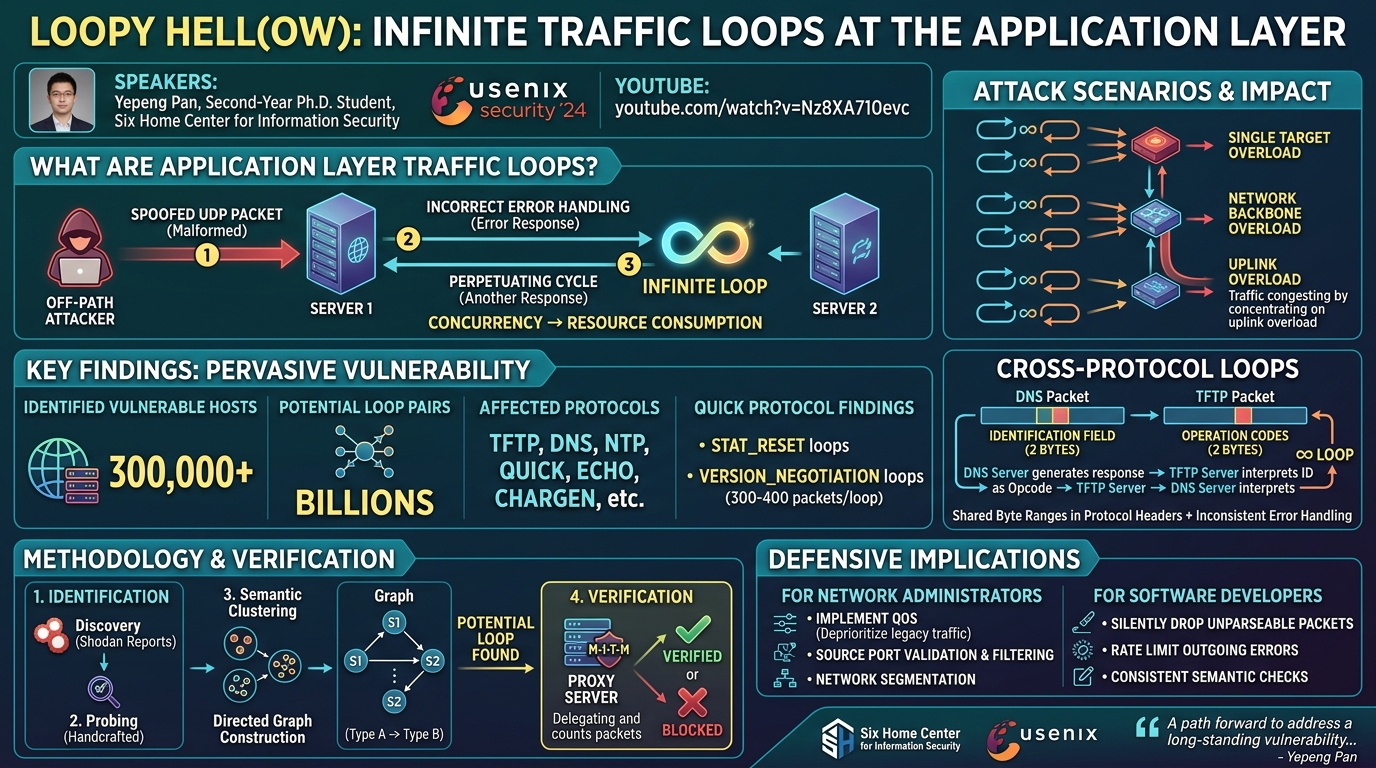
Key moments
- 0:00 Introduction and definition of application layer traffic loops
- 1:00 Detailed example of a DNS application layer traffic loop
- 2:00 Attack scenarios and impact of traffic loops
- 3:00 Systematic methodology for identifying traffic loops in internet
- 5:00 Summary of affected protocols and vulnerable devices found
- 5:45 Quick protocol's high number of affected hosts and loops
- 6:40 Demonstration of cross-protocol loop between DNS and TFTP
- 7:50 Mitigation strategies for administrators and developers
Loopy Hell(ow): Infinite Traffic Loops at the Application Layer
Speakers: Yepeng Pan, Second-Year Ph.D. Student, Six Home Center for Information Security
Conference: USENIX Security '24
YouTube: https://www.youtube.com/watch?v=Nz8XA710evc
Overview
In a presentation at USENIX Security '24, Yepeng Pan unveiled groundbreaking research into application layer traffic loops, a critical yet under-analyzed vulnerability that can lead to severe denial-of-service (DoS) attacks. Titled "Loopy Hell(ow): Infinite Traffic Loops at the Application Layer," the talk, co-authored with Anna (an intern at Saar) and Professor Christin, systematically explores how two or more network services can become entrapped in a self-perpetuating cycle of message exchange, consuming vast amounts of network bandwidth and computational resources. This phenomenon, while conceptually known for decades, has lacked comprehensive, modern analysis across the vast landscape of internet services.
The significance of this work lies in its systematic methodology for identifying and verifying these loops at scale across the internet. Pan detailed how an off-path attacker, by spoofing a source IP and injecting a single malformed packet, can instigate an infinite exchange between vulnerable servers. This can overload a single target, saturate network backbones, or choke critical uplink connections. The research not only quantifies the alarming prevalence of these loops, identifying hundreds of thousands of affected hosts and billions of potential loop pairs, but also provides crucial insights into their underlying causes and proposes practical mitigation strategies for both network administrators and software developers.
The talk highlights that even modern protocols, despite robust RFCs, remain susceptible due to legacy implementations or subtle inconsistencies in error handling. By shining a spotlight on this pervasive issue, Yepeng Pan and his team provide a critical wake-up call for the security community, offering a path forward to address a long-standing vulnerability that poses a significant threat to internet stability and availability.
Background
▶ Watch: Introduction and definition of application layer traffic loops (0:00)
The concept of network traffic loops is not new; rudimentary forms were observed around two decades ago involving simple protocols like Chargen and Echo servers. However, prior to this research, there had been no systematic analysis of application layer traffic loops in the context of the modern internet. Traditional network layer loops, often caused by misconfigured routing, are well-understood and typically addressed by mechanisms like Time-To-Live (TTL) fields. Application layer loops, however, operate at a higher level of the network stack, specifically on top of transport layer protocols like UDP and TCP, though this research specifically focuses on UDP-based applications.
The fundamental problem arises from inconsistent or overly verbose error handling between different implementations of the same application protocol, or even across different protocols. Imagine two servers, both running a service like DNS but using different software versions or configurations. An attacker, operating off-path, can spoof the source IP address of a vulnerable host and send a specially crafted, malformed message to the first server.
Upon receiving this message, the first server, unable to parse or process it, might generate a specific error response – for example, a "command unknown" error in the DNS context. This error message is then sent to the spoofed source IP, which is, in fact, the second vulnerable server. The second server receives this error. Due to differences in its implementation, it might not recognize or correctly interpret the first server's error message. Instead, it might generate its own error response, such as a "not implemented" error, and send it back to the first server. This creates a dangerous cycle: the first server receives the second server's error, interprets it as another unknown command, and responds with its original error, perpetuating the loop indefinitely.
Such loops can be exploited in various denial-of-service scenarios:
- Single Target Overload: An attacker can pair a single target with numerous other vulnerable devices across the internet, directing all loop traffic towards the target to overwhelm its resources.
- Network Backbone Overload: By pairing vulnerable devices within a target network, attackers can generate massive internal traffic, congesting the network's backbone infrastructure.
- Uplink Overload: Combining vulnerable devices within a target network with others across the internet can focus loop traffic on the target's uplink, saturating its connection to the broader internet.
The lack of systematic analysis in recent years meant that the true scale and nature of this threat remained largely unknown, making Pan's research a critical update to the understanding of internet-wide vulnerabilities.
Key Findings
▶ Watch: Attack scenarios and impact of traffic loops (2:00)
The research presented by Yepeng Pan and his team uncovered several critical findings regarding application layer traffic loops, demonstrating their pervasive nature and the significant threat they pose to internet stability.
Firstly, the team developed and applied a novel methodology to systematically identify and verify these loops in the wild. This rigorous approach allowed them to move beyond anecdotal observations to a quantifiable assessment of the problem. Through this methodology, they examined a wide array of UDP-based protocols, categorizing them into legacy protocols (such as Echo and Chargen, which were historically known for loop potential) and non-legacy protocols (including TFTP, DNS, and NTP).
A significant finding was the sheer scale of the vulnerability: the research identified approximately 300,000 vulnerable devices across the internet. This multitude of susceptible hosts translates into an astronomical number of potential loop pairs, estimated to be in the billions. This highlights that the problem is not isolated but a widespread architectural and implementation flaw affecting a substantial portion of internet infrastructure.
Crucially, the team extended their analysis to include the Quick protocol after their paper was accepted, revealing that even modern, actively developed protocols are not immune. They found a high number of potentially affected Quick hosts, primarily susceptible to STAT_RESET packet loops and VERSION_NEGOTIATION packet loops. Despite these vulnerabilities being recognized and addressed in current Quick RFCs, inconsistent or legacy implementations still allowed for the triggering of traffic loops, capable of generating 300 to 400 packet loops between servers. This underscores that adherence to specifications alone is not always sufficient if implementations diverge or fail to handle error conditions robustly.
Perhaps one of the most intriguing discoveries was the existence of cross-protocol traffic loops. These loops occur between servers running entirely different protocols. The research demonstrated that a server running one protocol might inadvertently respond to a message intended for another protocol, leading to a loop. A prime example highlighted was between DNS and TFTP servers. This vulnerability often stems from shared byte ranges in protocol headers used for different purposes. A DNS message, for instance, might have its identification field (the first two bytes) copied by a DNS server into its response. If this response is then received by a TFTP server, which uses the same byte range for its operation codes, the TFTP server might interpret the DNS identification as a valid (or invalid) TFTP opcode, triggering a TFTP response. This response, in turn, could be interpreted by the DNS server, completing a cross-protocol loop.
In summary, the key findings demonstrate that application layer traffic loops are a widespread, multi-faceted threat affecting both legacy and modern protocols, capable of manifesting within a single protocol or across different ones, and impacting hundreds of thousands of devices globally.
Technical Deep Dive
▶ Watch: Summary of affected protocols and vulnerable devices found (5:00)
The core of Pan's research lies in its robust and scalable methodology for identifying and verifying application layer traffic loops. This multi-stage process leverages automated scanning, semantic clustering, and controlled verification to pinpoint vulnerable server pairs.
The methodology begins with identification, which itself is a multi-step process:
- Initial Server Discovery: The first step involves obtaining a comprehensive list of servers running specific protocols. For this, the researchers utilized public internet scanning databases, specifically Shodan server reports, to gather lists of hosts for protocols like DNS, TFTP, and NTP. This provides a broad initial target base.
- Handcrafted Probing: For each protocol under investigation, the team meticulously crafted a set of 20 to 30 unique probes. These probes were designed to be syntactically valid but potentially semantically ambiguous or erroneous, with the goal of eliciting distinctive responses from different server implementations. These handcrafted probes were then sent to the initially discovered servers.
- Response Collection and Semantic Clustering (Round 1): The responses generated by the real servers to the handcrafted probes were collected. Crucially, these responses were not merely grouped by byte-for-byte similarity but were clustered according to their semantic differences. For example, in the case of DNS, a DNS error message would be categorized differently from a standard DNS response packet, even if they shared some header fields. This semantic clustering is vital because traffic loops are often driven by how servers interpret the meaning of incoming messages, especially error messages.
- Second-Round Scanning with Sampled Responses: The sampled, semantically distinct responses from the first round of clustering were then used as new probes for a second round of scanning. This iterative approach is powerful because it allows the methodology to discover how servers react to the actual responses generated by other servers, which is precisely the condition that triggers a loop. The outputs from this second round were again collected and semantically clustered.
- Directed Graph Construction: With the collected and clustered input-output relationships, the researchers constructed a directed graph. In this graph, nodes represent servers, and edges represent the transformation of an input message type into an output message type. For instance, if Server 1, upon receiving an input of Type A, generates an output of Type B, an edge
Server1 (Type A -> Type B)is recorded. Similarly, if Server 2, upon receiving Type B, generates Type A, an edgeServer2 (Type B -> Type A)is recorded. The presence of a cycle in this graph (e.g.,Server1 (A->B)andServer2 (B->A)) indicates a potential traffic loop.
Once a potential loop is identified, the next critical phase is verification:
- Proxy Server as Man-in-the-Middle: To verify if a potential loop is truly exploitable and self-sustaining, the team employed a proxy server acting as a man-in-the-middle. This proxy's role is not to actively participate in the loop but to observe and facilitate it under controlled conditions.
- Triggering the Loop: The proxy server first initiates the loop by sending the designated "Type A" trigger message to Server 1, as identified by the directed graph.
- Passive Delegation and Observation: After the initial trigger, the proxy server passively delegates packets between Server 1 and Server 2. It monitors the traffic flow, counting the number of exchanges.
- Loop Confirmation: If the proxy server observes a sufficient number of continuous packet exchanges between the two servers (indicating a self-sustaining cycle), the traffic loop is deemed verified. At this point, the proxy server intervenes and stops the process to prevent an actual denial-of-service condition from occurring in the wild. This controlled verification ensures that identified loops are genuine and not false positives.
A compelling example of the technical intricacies leading to loops is the cross-protocol vulnerability between DNS and TFTP. The DNS header uses its first two bytes as an identification field. A standard DNS server will typically copy this identification field from an incoming request to its outgoing response. In contrast, the TFTP header uses the exact same byte range (the first two bytes) for its operation codes (e.g., read request, write request, error). This overlap creates a critical vulnerability: a DNS message crafted with a specific identification field could be sent to a DNS server, which then copies this "ID" into its response. If this DNS response packet then reaches a TFTP server, the TFTP server might interpret the DNS identification field as a TFTP operation code. Depending on the value, this could trigger a TFTP response (e.g., an error message for an unrecognized opcode), which in turn could be sent back to the DNS server, potentially closing the loop. This intricate interplay of header interpretation across different protocols highlights a subtle yet powerful mechanism for cross-protocol loop formation.
The inclusion of Quick protocol analysis further demonstrated the robustness of the methodology. Despite Quick's modern design and explicit RFC provisions against loops (like STAT_RESET and VERSION_NEGOTIATION), the team found that implementation discrepancies or adherence to older specifications could still lead to loops generating hundreds of packets. This suggests that even with clear protocol specifications, the real-world deployment and evolution of software can reintroduce vulnerabilities.
Demo / Proof of Concept
▶ Watch: Quick protocol's high number of affected hosts and loops (5:45)
While the talk did not feature a live, real-time demonstration of an attack triggering an infinite loop on production systems (which would be irresponsible given the DoS implications), the research methodology itself incorporates a robust verification phase that serves as the definitive proof of concept.
This verification is performed using a proxy server acting as a controlled man-in-the-middle. After the initial identification phase flags a potential loop between two servers, the proxy server is deployed to confirm its existence. The proxy first injects the specific trigger message (e.g., "Type A" to Server 1) that is predicted to initiate the loop. Subsequently, it passively observes and forwards packets between the two identified servers. The crucial aspect is that the proxy is designed to count the number of exchanges. If it observes a sustained, self-perpetuating exchange of messages between the two servers for a predefined duration or packet count, the loop is considered verified. Once verified, the proxy immediately ceases delegation to prevent any actual denial-of-service impact on the live internet. This systematic and controlled verification process is the practical proof of concept for each identified application layer traffic loop.
Defensive Implications
▶ Watch: Mitigation strategies for administrators and developers (7:50)
The identification of widespread application layer traffic loops necessitates immediate and comprehensive defensive measures from both network administrators and software developers. The research offers practical strategies to mitigate the risk of these denial-of-service vulnerabilities.
For Network Administrators:
- Quality of Service (QoS) Implementation: Administrators should prioritize critical network traffic and deprioritize less important or legacy protocol traffic during periods of congestion. For instance, traffic from protocols like
ChargenorEcho, which are often implicated in loops and have limited legitimate uses today, could be assigned lower priority. This ensures that even if a loop is triggered, essential services remain available. - Source Port Validation and Packet Filtering: Application layer traffic loops typically involve servers responding to each other using their well-known port numbers (e.g., port 53 for DNS, port 69 for TFTP). Network firewalls and intrusion detection/prevention systems (IDS/IPS) can be configured to perform source port validation. If traffic originating from a well-known port is observed behaving anomalously (e.g., excessive, repetitive error messages between two specific hosts), it can be flagged or dropped. Administrators can implement specific packet filtering rules to identify and block such loop-generating traffic, especially if the involved servers and protocols are known.
- Network Segmentation and Isolation: Isolating critical services or those known to be vulnerable into separate network segments can limit the blast radius of a loop attack. If a loop is triggered within a segmented zone, it will be contained and less likely to impact the broader network.
For Developers and Vendors:
- Silent Packet Dropping: A primary cause of application layer loops is overly verbose error handling. When a server receives an unparseable or semantically meaningless packet, the most secure response is often to silently drop the packet without generating any response. This prevents the initiation or perpetuation of a loop, as there is no error message to bounce back and forth. This is a critical design principle for robust protocol implementations.
- Rate Limiting on Error Messages: Many identified loops are triggered and sustained by the exchange of error messages. Implementing aggressive rate limiting specifically on outgoing error messages can significantly curtail the impact of a loop. If a server detects it is sending an unusual volume of error responses to a single destination, it should temporarily cease sending further errors to that destination.
- Consistent Protocol Implementation and Semantic Checks: Developers should strive for strict adherence to protocol specifications and ensure that their implementations perform rigorous semantic checks on incoming packets. This helps prevent misinterpretation of fields that might overlap with other protocols or be used in an unexpected context. Regular audits of error handling logic are essential.
- Regular Updates and Patching: As demonstrated by the Quick protocol findings, even protocols with robust RFCs can be vulnerable due to legacy or inconsistent implementations. Vendors must ensure their software is regularly updated to incorporate the latest security patches and best practices, specifically addressing known loop vulnerabilities.
The research team actively engaged with affected vendors and owners of vulnerable devices, sharing their findings and receiving valuable feedback. This collaborative approach underscores the importance of community effort in mitigating such widespread vulnerabilities. The team also mentioned building an "adversary" (likely a public database or tool) to help the community track and address these vulnerabilities, though the specific link was not provided in the transcript.
Key Takeaways
- Pervasive and Under-researched Threat: Application layer traffic loops constitute a significant, widespread, and historically under-researched denial-of-service (DoS) threat affecting the modern internet, especially UDP-based services.
- Systematic Identification and Verification: A novel, multi-stage methodology involving handcrafted probes, semantic response clustering, directed graph construction, and proxy-based verification was developed to identify and confirm these loops at scale.
- Widespread Vulnerability: The research identified approximately 300,000 vulnerable devices and billions of potential loop pairs across various protocols, including legacy (Echo, Chargen) and non-legacy (DNS, TFTP, NTP) services.
- Modern Protocols are Also Susceptible: Even contemporary protocols like Quick are vulnerable, with loops stemming from issues like
STAT_RESETandVERSION_NEGOTIATIONpacket handling, often due to inconsistent implementations despite RFC guidance. - Cross-Protocol Loops: A critical finding is the possibility of loops occurring between servers running entirely different protocols (e.g., DNS and TFTP) due to shared byte ranges in headers and differing semantic interpretations.
- Actionable Mitigation Strategies: Both network administrators (e.g., QoS, source port validation, packet filtering) and software developers (e.g., silent packet dropping, rate limiting on error messages) have clear, actionable steps to defend against these vulnerabilities.
About the Speaker(s)
Yepeng Pan is a second-year Ph.D. student at the Six Home Center for Information Security. His research focuses on network security, specifically identifying and mitigating vulnerabilities at the application layer. This work, "Loopy Hell(ow): Infinite Traffic Loops at the Application Layer," represents a significant contribution to understanding and addressing long-standing denial-of-service threats in internet protocols. He presented this research at USENIX Security '24, collaborating with Anna (an intern at Saar at the time) and his supervisor, Professor Christin.
Reviews
Dr. Zero (Offensive Security Researcher) — MUST SEE
Pan's research on application layer traffic loops is a critical, overdue examination of a widespread DoS vector. The systematic methodology for identifying and verifying these loops at scale across legacy and modern protocols, including cross-protocol interactions, provides concrete, actionable intelligence for defenders. This is the kind of deep, rigorous work that matters.
Heather Calloway (CISO) — STRONG ACCEPT
This research on application layer traffic loops identifies a pervasive, under-addressed DoS threat with significant real-world business impact. It provides a robust methodology and, crucially, delivers clear, actionable defensive strategies for both network administrators and software developers, bridging the gap between academic findings and operational imperatives.