SpecLFB: Eliminating Cache Side Channels in Speculative Executions
Xiaoyu Cheng (PhD student · Southeast University), Fei Tong, Purple Mountain Laboratories, Hongyu Wang, Wiscom System Co, Zhe Zhou, Fang Jiang, Yuxing Mao
33rd USENIX Security Symposium · Day 1 · USENIX Security '24 · USENIX Security '24
Overview
The talk "SpecLFB: Eliminating Cache Side Channels in Speculative Executions" by Xiaoyu Cheng and colleagues introduces a novel, low-overhead hardware defense mechanism designed to mitigate cache side channel attacks stemming from speculative execution vulnerabilities in modern high-performance processors. Given the pervasive impact of speculative execution flaws, such as Spectre, which allow attackers to infer secret data by observing microarchitectural state changes, this research addresses a critical and persistent security challenge. The presenters highlight the severe limitations of existing defense solutions, which often incur significant performance penalties, demand substantial hardware resources, or lack concrete hardware prototypes, rendering them impractical for real-world deployment.
Key moments
- 0:00 Introduction to speculative cache side channels and solution goals
- 1:00 Detailed explanation of cache side channel attack mechanism
- 3:30 Key design considerations: protection scope and duration
- 6:00 Designing the RB On-Mask for tracking speculative status
- 7:20 LFB security check mechanism for preventing data leakage
SpecLFB: Eliminating Cache Side Channels in Speculative Executions
Speakers: Xiaoyu Cheng; Fei Tong; Purple Mountain Laboratories; Hongyu Wang; Wiscom System Co; Zhe Zhou; Fang Jiang; Yuxing Mao
Conference: USENIX Security '24
YouTube: https://www.youtube.com/watch?v=r0oZCGlhyyk
Overview
The talk "SpecLFB: Eliminating Cache Side Channels in Speculative Executions" by Xiaoyu Cheng and colleagues introduces a novel, low-overhead hardware defense mechanism designed to mitigate cache side channel attacks stemming from speculative execution vulnerabilities in modern high-performance processors. Given the pervasive impact of speculative execution flaws, such as Spectre, which allow attackers to infer secret data by observing microarchitectural state changes, this research addresses a critical and persistent security challenge. The presenters highlight the severe limitations of existing defense solutions, which often incur significant performance penalties, demand substantial hardware resources, or lack concrete hardware prototypes, rendering them impractical for real-world deployment.
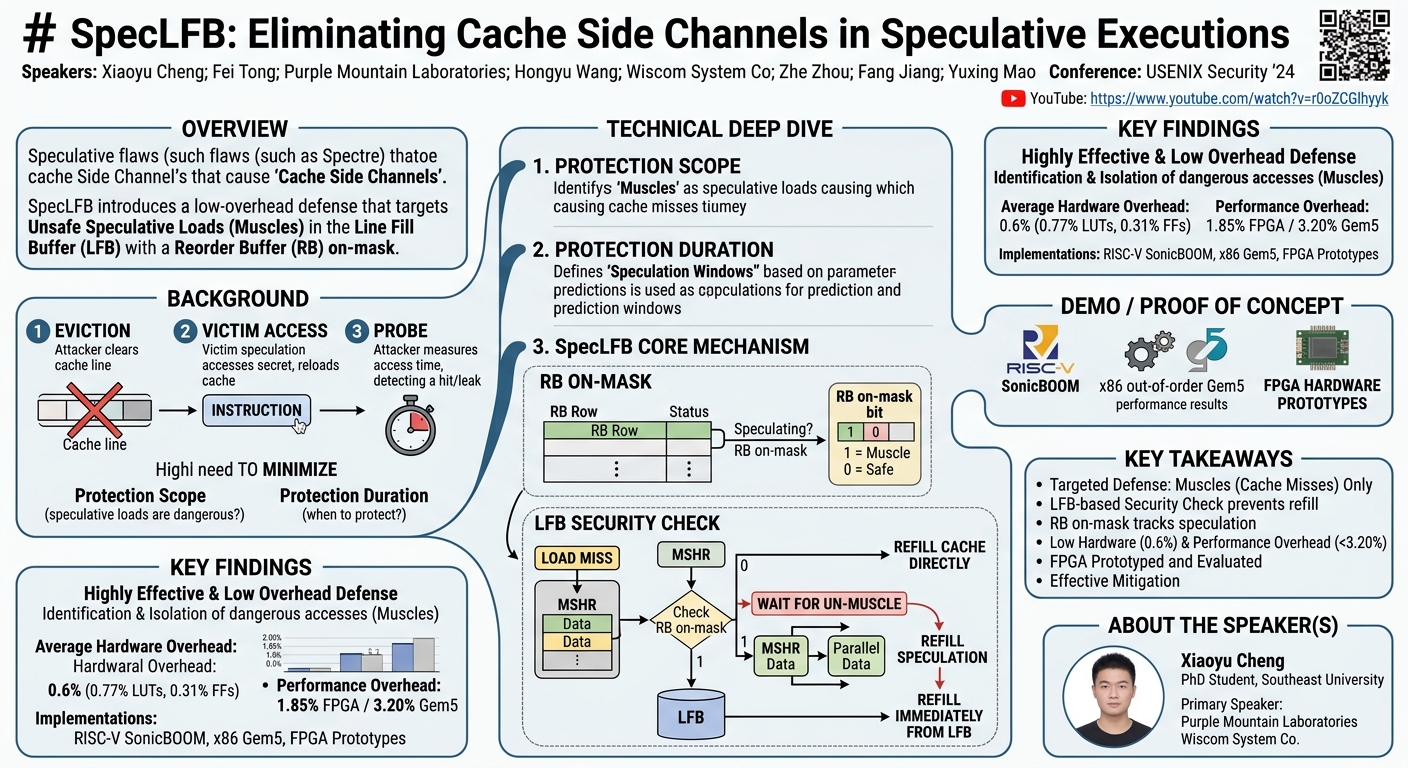
SpecLFB aims to overcome these limitations by intelligently narrowing the scope of protected instructions and optimizing the protection duration. The core innovation lies in identifying and targeting only specific "unsafe" speculative loads—dubbed "muscles"—that are genuinely capable of causing cache misses and thus creating observable side channels. By integrating a security check mechanism within the Line Fill Buffer (LFB), in conjunction with a novel Reorder Buffer (RB) on-mask, SpecLFB effectively prevents the cache refill of sensitive data accessed during mis-speculation without stalling correct program execution. This approach demonstrates a practical path towards securing speculative processors with minimal impact on performance and hardware utilization.
Background
▶ Watch: Introduction to speculative cache side channels and solution goals (0:00)
Modern high-performance processors extensively utilize speculative execution to enhance performance by predicting future instruction paths. While beneficial for speed, this technique introduces a severe vulnerability: speculative attacks. These attacks exploit mis-speculations, where the processor executes instructions that violate program semantics, potentially accessing secret data. During this transient period, the microarchitectural state, including cache occupancy, changes. Attackers can then leverage these changes to establish microarchitectural side channels and leak sensitive information.
Among various microarchitectural side channels, the cache side channel is recognized as the most practical and widely exploited method for data leakage. The process typically involves three phases:
- Eviction: The attacker manipulates the cache to bring a monitored cache line into a non-cached state (a cache miss state).
- Victim Access: The victim program, often during a speculative execution, performs a memory access operation related to secret data. If this access targets the monitored cache line, it reloads the line into the cache.
- Probe: The attacker measures the access time for the monitored cache line. A significantly shorter access time indicates a cache hit, revealing that the victim accessed the line, thereby leaking information about the victim's memory access pattern and, indirectly, secret data.
Cache side channels are broadly categorized into Flush+Reload attacks and Prime+Probe (or conflict-based) attacks, depending on how the cache line is brought into a non-cached state. Numerous prior defense solutions have been proposed, such as making instructions invisible during speculation or employing selective speculation. However, these often suffer from major drawbacks: they incur significant performance overhead, require substantial hardware resources, or exist only as theoretical constructs without practical hardware prototypes, making them unsuitable for real-world application.
The design of an effective and practical defense solution requires careful consideration of two critical aspects to minimize overhead:
- Protection Scope: Which speculative loads genuinely pose a risk? The research identifies that only speculative loads that cause a cache miss in the first phase of a cache side channel attack (when the attacker has evicted the line) are truly exploitable. These specific loads are termed "muscles" (mis-speculated unsafe loads). Experiments confirm that cache miss ratios are significantly higher in speculative attacks, underscoring the importance of targeting these specific events.
- Protection Duration: For a given load, when should protection begin and end? Protection is only necessary during the speculation window, defined by the start and end conditions of various speculation sources (control flow prediction, memory access order prediction, value prediction). Once a speculation is verified as correct, protection can be lifted, as most speculations are indeed correct in normal program execution, thus further reducing performance impact.
Key Findings
▶ Watch: Detailed explanation of cache side channel attack mechanism (1:00)
The central discovery of this research is that a highly effective and low-overhead defense against speculative cache side channels can be achieved by precisely identifying and isolating the specific speculative memory accesses that are truly dangerous. Instead of broadly protecting all speculative loads, SpecLFB introduces the concept of "muscles" (mis-speculated unsafe loads), which are defined as speculative loads that cause cache misses. The authors' experiments confirm that cache miss rates are significantly elevated during speculative attacks exploiting conflict-based cache side channels, validating their focus on these specific events.
Furthermore, SpecLFB establishes a clear framework for defining the protection duration, ensuring that speculative loads are only protected while they are within an active "speculation window" and deprotected once the speculation is verified as correct. This intelligent temporal gating, combined with the narrowed protection scope, is instrumental in achieving the system's remarkably low overhead.
The practical viability of SpecLFB is demonstrated through its implementation in both RISC-V SonicBOOM and x86 out-of-order Gem5 simulator architectures, alongside the construction of FPGA hardware prototypes. This comprehensive evaluation showcases SpecLFB's superior performance, achieving an average hardware resource overhead of only 0.6% (specifically, 0.77% additional LUT utilization and 0.31% flip-flop utilization) and a minimal performance overhead of 1.85% in FPGA hardware experiments and 3.20% in Gem5 simulations. These figures represent a significant improvement over prior art like ST and SSRV, positioning SpecLFB as a highly practical and deployable solution for mitigating a critical class of speculative execution vulnerabilities.
Technical Deep Dive
▶ Watch: Key design considerations: protection scope and duration (3:30)
SpecLFB's design hinges on a precise understanding of the attack surface and a targeted modification of existing processor microarchitectural components. The scheme centers on two key principles: protecting only "muscles" and doing so only within the defined speculation window.
1. Protection Scope: Identifying "Muscles"
The core insight is that not all speculative loads can be exploited to establish a cache side channel. An attacker's ability to leak data relies on observing a change in the cache's occupancy state. This observation is only possible if the victim's speculative load causes a cache miss for a line that the attacker has previously evicted. If a speculative load results in a cache hit, it does not alter the cache's occupancy state in a way exploitable by the typical Prime+Probe or Flush+Reload mechanisms. Therefore, SpecLFB focuses its protection efforts exclusively on "muscles"—speculative loads that result in a cache miss.
2. Protection Duration: Speculation Windows
To minimize overhead, protection is only applied during the active speculation window. This window begins when a processor makes a prediction (e.g., control flow, memory access order, or value prediction) that leads to speculative execution. Protection ends once the processor verifies that speculation as correct. Since the vast majority of speculations are correct, lifting protection promptly significantly reduces performance penalties. The design concept details how the start and end conditions of speculation windows, driven by various prediction sources, dictate when a load needs to be protected and deprotected.
3. SpecLFB's Core Mechanism: RB on-mask and LFB Security Check
SpecLFB introduces two primary architectural components to enforce its protection strategy:
- RB on-mask: This mechanism tracks the speculative status of instructions currently in the Reorder Buffer (RB). The RB is a critical component in out-of-order processors that stores information about all dispatched instructions.
- A one-to-one mapping exists between the RB rows and the bits of the RB on-mask.
- Each bit in the RB on-mask is set to
1if any instruction within its corresponding RB row is currently executing within a speculation window. - Conversely, the bit is reset to
0when all instructions in that RB row are no longer within a speculation window (i.e., their speculation has been verified as correct or they are not speculative). This mask provides a real-time indicator of whether a particular instruction's outcome is still speculative.
- LFB Security Check Mechanism: The Line Fill Buffer (LFB) is another crucial microarchitectural component that works in conjunction with the Miss Status Handling Register (MSHR). When a load instruction results in a cache miss, the MSHR sends a request to lower-level caches or main memory to retrieve the missing data. The LFB temporarily stores this retrieved data while it awaits refill into the cache, allowing cache eviction and refilling to occur in parallel.
- SpecLFB introduces a security check mechanism within the LFB that intercepts the data retrieved from lower memory levels before it can be refilled into the cache.
- When the MSHR receives data for a missing load, this data is not immediately written to the cache. Instead, it is directed through the security check.
- The security check mechanism consults the RB on-mask to determine the speculative status of the requesting load.
- If the corresponding RB on-mask bit is
0, indicating that the load is not a "muscle" (either it's not speculative or its speculation has been verified as correct), the data is allowed to refill the cache directly. - If the RB on-mask bit is
1, indicating that the load is a "muscle" (a speculative load causing a cache miss within an active speculation window), the security check mechanism delays the cache refill. It waits for the RB on-mask bit to become0. - Crucially, during this waiting period, the MSHR can continue to request and retrieve data for other muscles or other cache misses, maintaining parallelism and minimizing performance impact.
- If the speculation associated with the waiting load is subsequently verified as correct (and its RB on-mask bit becomes
0), the data, which is already present in the LFB, can be refilled into the cache immediately from the LFB, without incurring the delay of re-fetching from lower memory levels.
By preventing "muscles" from refilling the cache until their speculation is confirmed as correct, SpecLFB effectively breaks the cache side channel. Attackers can no longer probe access time differences to infer secret data accessed during mis-speculation, as the cache's state is not illicitly altered.
Demo / Proof of Concept
▶ Watch: Designing the RB On-Mask for tracking speculative status (6:00)
The efficacy and practicality of SpecLFB were rigorously evaluated through comprehensive experimental implementations and benchmarks. The researchers implemented SpecLFB in two distinct processor architectures:
- RISC-V SonicBOOM: An open-source, out-of-order RISC-V processor core.
- x86 out-of-order modeling in Gem5 simulator: A widely used full-system simulator for architectural research.
To ensure a highly realistic assessment, FPGA hardware prototypes were built using the SonicBOOM code base. This hardware implementation is a crucial differentiator from many prior theoretical defense proposals, demonstrating SpecLFB's readiness for real-world application.
For security evaluation, SpecLFB was tested against four distinct types of speculative attacks, demonstrating its effectiveness in mitigating these threats. While the specific names of these attack types were not detailed in the transcript, their selection implies a broad coverage of known speculative execution vulnerabilities.
Performance evaluation was conducted using the industry-standard SPEC 2017 Benchmark suit. SpecLFB's performance was directly compared against two competitive schemes: ST for RISC-V architectures and SSRV for x86 architectures. The results consistently showed SpecLFB achieving significantly lower performance overheads.
Furthermore, the hardware resource utilization of SpecLFB was meticulously evaluated on the FPGA platform, comparing it against SSRV. SpecLFB demonstrated remarkably low additional resource consumption, specifically:
- 0.77% additional LUT (Look-Up Table) utilization.
- 0.31% additional Flip-Flop utilization.
These low overhead figures, both in performance and hardware resources, underscore the practical viability of SpecLFB as a deployable defense mechanism in modern processors.
Defensive Implications
▶ Watch: LFB security check mechanism for preventing data leakage (7:20)
SpecLFB offers a practical and architecturally sound approach for defenders to mitigate a critical class of speculative execution vulnerabilities, particularly those exploiting cache side channels. The primary defensive implication is the strategic modification of processor microarchitecture, specifically targeting the Line Fill Buffer (LFB) and integrating a mechanism to track speculative status within the Reorder Buffer (RB).
For processor architects and hardware designers, SpecLFB provides a blueprint for securing future CPU designs. The key takeaways for defensive strategies include:
- Targeted Protection: Moving away from blanket protection of all speculative loads, which incurs high overhead, towards identifying and protecting only "muscles"—speculative loads causing cache misses within a speculation window. This intelligent filtering is crucial for maintaining performance.
- Microarchitectural Modification: The introduction of a security check mechanism within the LFB is a fundamental architectural change. This ensures that data retrieved for a cache miss during speculative execution cannot directly modify the cache state in an exploitable manner.
- Real-time Speculation Tracking: The RB on-mask is vital for accurately tracking the speculative status of instructions. This allows the LFB security check to make informed decisions about when to delay cache refills and when to allow them, ensuring minimal impact on correct program execution.
- Minimizing Performance Impact: By delaying cache refills only for unsafe speculative loads and allowing the MSHR to continue processing other requests during the wait, SpecLFB significantly reduces performance overhead compared to stalling the entire pipeline. The ability to refill directly from the LFB once speculation is verified further optimizes performance.
- Hardware Feasibility: The development of FPGA hardware prototypes demonstrates that SpecLFB is not merely a theoretical concept but a tangible, implementable solution with low hardware resource utilization. This provides confidence for chip manufacturers to consider integrating similar mechanisms into commercial processors.
- Addressing a Critical Gap: SpecLFB directly addresses the long-standing challenge of finding practical, low-overhead defenses against speculative cache side channels, filling a crucial gap where previous solutions have fallen short due to excessive overhead or lack of hardware validation.
Defenders should advocate for the adoption of such targeted hardware-based defenses in new processor designs to build more resilient systems against the evolving landscape of microarchitectural attacks.
Key Takeaways
- Targeted Defense: SpecLFB introduces a low-overhead hardware defense against cache side channels in speculative execution by focusing protection on "muscles"—speculative loads that cause cache misses.
- LFB-based Security: The core mechanism involves a novel security check within the Line Fill Buffer (LFB), which prevents the cache refill of data accessed by unsafe speculative loads until their speculation is verified.
- RB on-mask for Speculation Tracking: A new Reorder Buffer (RB) on-mask component is used to accurately track the speculative status of instructions, enabling the LFB security check to make informed decisions.
- Low Overhead: SpecLFB demonstrates remarkable efficiency, with an average hardware resource overhead of only 0.6% (0.77% LUT, 0.31% flip-flop) and minimal performance overhead (1.85% in FPGA hardware, 3.20% in Gem5 simulation).
- Practical & Prototyped: Unlike many prior solutions, SpecLFB has been implemented and evaluated on FPGA hardware prototypes (RISC-V SonicBOOM) and simulated (x86 Gem5), proving its practical feasibility and deployability.
- Effective Mitigation: By intelligently delaying cache refills for "muscles," SpecLFB effectively eliminates the observable time differences that attackers exploit to leak secret data via cache side channels.
About the Speaker(s)
The primary presenter for "SpecLFB: Eliminating Cache Side Channels in Speculative Executions" was Xiaoyu Cheng, who is a PhD student from Southeast University. The research was a collaborative effort involving several other contributors: Fei Tong, representing Purple Mountain Laboratories; Hongyu Wang from Wiscom System Co; and Zhe Zhou, Fang Jiang, and Yuxing Mao, whose affiliations were not explicitly detailed in the transcript but are part of the broader research team. Their collective work highlights a strong academic and industry collaboration aimed at tackling critical hardware security challenges.
Reviews
Dr. Zero (Offensive Security Researcher) — MUST SEE
This work presents a truly practical hardware defense against speculative cache side channels, a problem long plagued by impractical solutions. By precisely identifying 'muscles' and leveraging the LFB with an RB on-mask, SpecLFB delivers an effective, low-overhead mitigation with actual FPGA prototypes. This isn't just another paper; it's a blueprint for securing future silicon.
Heather Calloway (CISO) — STRONG ACCEPT
This research delivers a highly practical and low-overhead hardware defense against speculative execution cache side channels. It offers a tangible solution to a pervasive architectural vulnerability, setting a new standard for how fundamental processor security can be addressed without crippling performance.