SafeFetch: Practical Double-Fetch Protection with Kernel-Fetch Caching
Victor Duta
33rd USENIX Security Symposium · Day 1 · USENIX Security '24 · USENIX Security '24
Overview
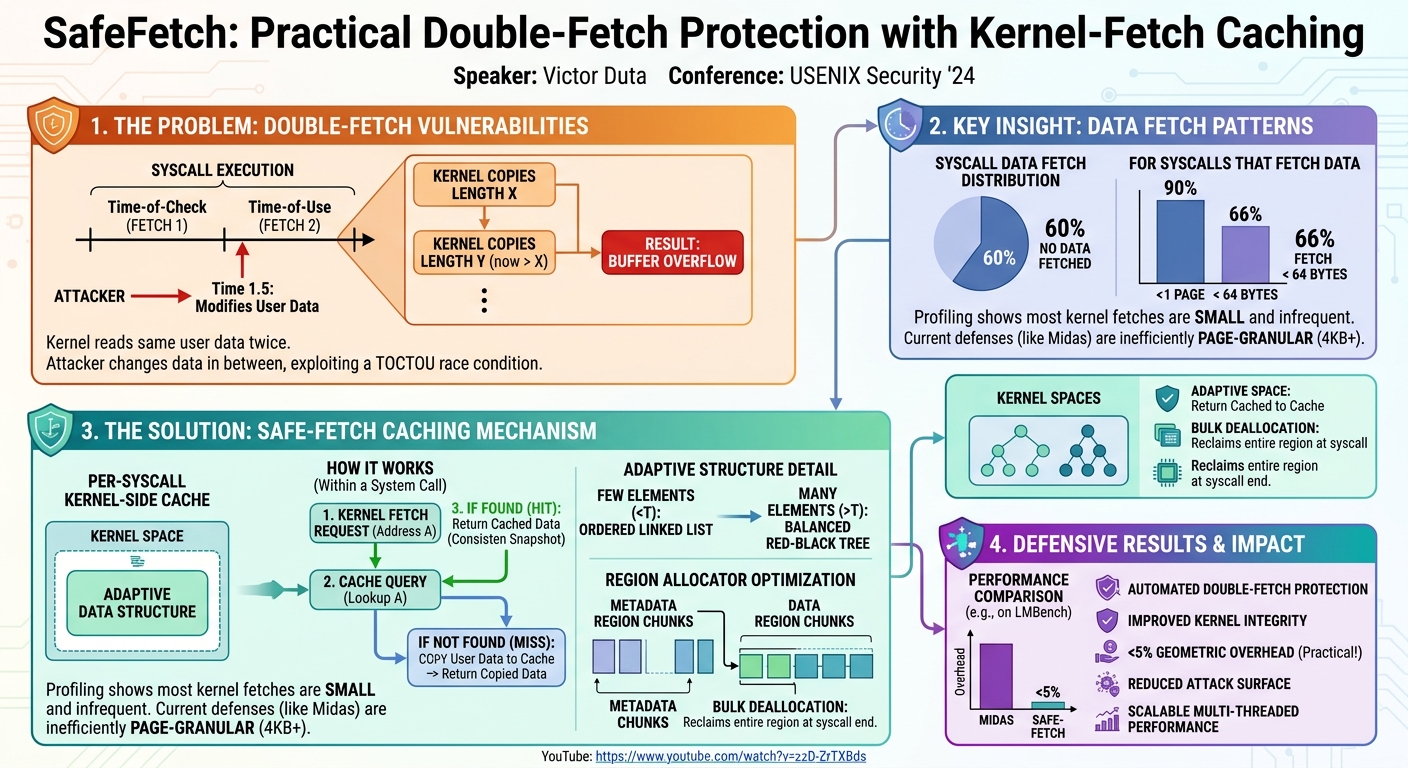
This talk, presented by Victor Duta at USENIX Security '24, introduces SafeFetch, a novel approach to defend the kernel against a critical class of vulnerabilities known as double-fetch bugs. These bugs arise when the kernel fetches the same user-space data multiple times within a single system call without proper re-sanitization, creating a Time-of-Check to Time-of-Use (TOCTOU) race condition. An attacker can exploit this window by modifying the user-space data between the kernel's fetches, leading to privilege escalation, information disclosure, or system instability.
Key moments
- 0:00 Introduction to SafeFetch: double-fetch protection via caching
- 1:45 Understanding the kernel double-fetch vulnerability
- 2:45 Midas: State-of-the-art double-fetch defense and its issues
- 3:50 Key observations: Kernel fetches small, infrequent data
- 4:50 SafeFetch's core: Kernel-side fetch caching mechanism
- 6:10 Adaptive cache structure for varying element counts
- 7:40 Region allocator for efficient cache provisioning and destruction
- 8:50 SafeFetch evaluation against Midas on LMbench
SafeFetch: Practical Double-Fetch Protection with Kernel-Fetch Caching
Speakers: Victor Duta
Conference: USENIX Security '24
YouTube: https://www.youtube.com/watch?v=zzD-ZrTXBds
Overview
This talk, presented by Victor Duta at USENIX Security '24, introduces SafeFetch, a novel approach to defend the kernel against a critical class of vulnerabilities known as double-fetch bugs. These bugs arise when the kernel fetches the same user-space data multiple times within a single system call without proper re-sanitization, creating a Time-of-Check to Time-of-Use (TOCTOU) race condition. An attacker can exploit this window by modifying the user-space data between the kernel's fetches, leading to privilege escalation, information disclosure, or system instability.
SafeFetch proposes an efficient defense mechanism centered around kernel-side fetch caching. By observing that most system calls fetch relatively small amounts of user-space data, SafeFetch caches this data upon its first access, ensuring that subsequent accesses within the same system call retrieve the consistent, cached version. This innovative strategy significantly reduces the performance overhead associated with existing defenses, such as Midas, which relies on page-granular copy-on-write semantics. The research demonstrates SafeFetch's effectiveness with less than 5% geometric overhead across a diverse range of benchmarks.
The significance of SafeFetch lies in its ability to provide robust protection against a pervasive class of kernel vulnerabilities with minimal performance impact. Kernel integrity is paramount for overall system security, and double-fetch bugs represent a persistent threat vector. By offering a practical, low-overhead solution, SafeFetch paves the way for more secure kernel designs and helps mitigate the risks associated with untrusted user-space input, making it a crucial advancement for operating system security.
Background
▶ Watch: Introduction to SafeFetch: double-fetch protection via caching (0:00)
The interaction between user-space applications and the operating system kernel is a fundamental aspect of modern computing. Applications request services from the kernel through system calls, which involve a transition from user mode to kernel mode. During this transition, the kernel often needs to access data provided by the user-space application. This interaction, while necessary, introduces a significant security challenge: the kernel must trust the data it receives, but user-space is inherently untrusted and potentially malicious.
A particularly insidious class of vulnerabilities arising from this interaction is the double-fetch bug. This occurs when a kernel function, within the execution of a single system call, retrieves the same piece of user-space data more than once. The critical vulnerability emerges if an attacker can modify the user-space data between these two fetches. The kernel might perform a security check on the data during the first fetch (the "Time-of-Check") and then operate on a maliciously altered version of that data during the second fetch (the "Time-of-Use"), leading to a TOCTOU race condition. For example, a kernel routine might check if a provided buffer length is within safe bounds, and then later use that length to copy data. If an attacker increases the length between the check and the copy, a buffer overflow could occur.
Historically, defending against double-fetch bugs has been challenging. Developers are often advised to copy all necessary user-space data into kernel-space buffers upon the first access to ensure consistency. However, this manual approach is error-prone and can introduce its own performance overhead, especially if large amounts of data are unnecessarily copied. Automated solutions are therefore highly desirable.
The current state-of-the-art defense mechanism, known as Midas, addresses double-fetch bugs by employing copy-on-write (CoW) semantics. When the kernel first fetches data from a user-space page, Midas marks that entire page as read-only. If a user-space thread subsequently attempts to modify any data on that page while the kernel is still operating on it, a page fault occurs. The operating system then duplicates the page, allowing the user-space thread to modify its private copy, while the kernel continues to operate on the original, now isolated, version of the page. By construction, this ensures that any data fetched by the kernel remains consistent throughout the system call's execution, effectively preventing double-fetch vulnerabilities.
While Midas provides a robust security guarantee, it comes with a non-trivial performance cost. Marking entire pages read-only, duplicating pages, and managing page table entries can introduce significant overhead, particularly in scenarios involving heavy multi-threaded activity where multiple threads might contend for access to shared user-space pages. The speaker noted that Midas's page-granular approach might be overkill, especially given typical kernel fetch patterns. This observation formed the impetus for SafeFetch: to find a more performance-efficient way to achieve the same security guarantees.
Key Findings
▶ Watch: Midas: State-of-the-art double-fetch defense and its issues (2:45)
The development of SafeFetch was predicated on a crucial set of empirical observations derived from profiling kernel behavior across various workloads. These findings challenged the assumptions underpinning page-granular protection mechanisms like Midas and highlighted an opportunity for a more optimized defense strategy.
The primary key finding was that the vast majority of system calls do not fetch large amounts of user-space data. Specifically, profiling revealed that:
- 60% of system call executions do not fetch any user-space data at all. This immediately suggests that any defense mechanism that incurs overhead on every system call, regardless of data access, is inherently inefficient.
- Of the system calls that do fetch data, 90% fetch far less than a single page (typically 4KB). This is a critical insight, as it indicates that marking entire pages read-only, as Midas does, is often an overly broad and inefficient approach. The overhead of page table manipulation and potential page duplication is disproportionate to the small amount of data actually being accessed.
- Drilling down further, 66% of data-fetching system calls fetch even less – specifically, less than 64 bytes. This highlights that a significant portion of user-kernel data transfers involves very small, atomic-like values or short structures.
These observations collectively demonstrated that kernel data fetches are typically small and infrequent. This pattern starkly contrasts with the page-level granularity employed by Midas. The implication is that a defense mechanism that operates at a finer granularity than entire memory pages, and only when data is actually fetched, could achieve similar security guarantees with significantly reduced performance overhead. This insight directly led to the conceptualization of SafeFetch, which leverages kernel-side caching to store only the specific, small buffers fetched by the kernel, rather than protecting entire memory pages. By aligning the defense mechanism with actual kernel data access patterns, SafeFetch aims to provide practical and efficient double-fetch protection.
Technical Deep Dive
▶ Watch: SafeFetch's core: Kernel-side fetch caching mechanism (4:50)
SafeFetch's core innovation lies in its kernel-side fetch caching mechanism, designed to eliminate redundant fetches of user-space data within a single system call. This approach ensures data consistency and prevents TOCTOU vulnerabilities without the high overhead associated with page-granular copy-on-write schemes.
The fundamental principle of SafeFetch is to maintain a per-syscall cache for user-space data. When the kernel, during a system call, attempts to fetch data from user-space for the first time:
- The data is copied into a dedicated cache within kernel space.
- A metadata entry is created in the cache, associating the user-space virtual address with the location of the cached data.
- Subsequent attempts by the kernel to fetch data from the same user-space virtual address within the same system call will first query this cache. If the data is found, it is served directly from the kernel-side cache, completely circumventing any re-fetch from user space. This mechanism, by construction, eliminates the double-fetch scenario and any potential race conditions.
To optimize performance, especially given the observed fetch patterns (small, infrequent fetches, but occasionally larger ones), SafeFetch employs an adaptive data structure for its cache. Initially, for a small number of cached elements, the cache is implemented as an ordered linked list. This is efficient for a few elements, as insertion and search overheads are minimal. However, as the number of cached elements grows (reaching an experimentally determined threshold), the linked list is dynamically transformed into a perfectly balanced red-black tree. A red-black tree offers logarithmic time complexity for search, insertion, and deletion operations, making it significantly more efficient for managing a larger number of cached entries, which might occur in complex system calls. This adaptive approach ensures optimal performance across the spectrum of observed kernel fetch behaviors.
Effective cache management is crucial for SafeFetch's efficiency, particularly given the short lifetime of a system call. SafeFetch utilizes a region allocator to manage the memory for both metadata objects and the actual cached data chunks. Each metadata object stores crucial information such as the user virtual address, the size of the cached data, and pointers for linking within the chosen data structure (linked list or red-black tree). Importantly, the metadata objects also contain a pointer to the actual cached data.
The region allocator operates by provisioning memory in larger chunks. Metadata objects are specifically chunked together into dedicated metadata region chunks, separate from the data chunks. This separation is a deliberate optimization: by grouping metadata objects contiguously in memory, SafeFetch significantly improves CPU cache utilization. When the kernel performs a cache search, it frequently accesses multiple metadata objects (e.g., traversing a red-black tree). Having these objects co-located in CPU cache lines reduces memory access latency, boosting search performance. While merging metadata and data into a single region could simplify allocation, the performance benefits of separating and co-locating metadata were deemed significant.
The lifecycle of the cache is tightly integrated with the system call. The cache is instantiated at the beginning of a system call and destroyed upon its exit. The use of a region allocator greatly simplifies and accelerates cache destruction. Instead of individually deallocating each metadata object and data chunk, which would be prohibitively slow for a potentially large number of cached items, the region allocator simply releases the entire region chunks back to the system. This bulk deallocation is far more efficient.
Furthermore, SafeFetch incorporates optimizations for storage reuse. The region allocator can intelligently reuse some of the allocated storage across system calls that originate from the same process. This reduces the overhead of repeatedly allocating and deallocating memory for frequently invoked system calls within the same process context, further enhancing overall performance.
Finally, the talk briefly mentioned a zero-copy optimization for handling really large user-space fetches. While the majority of fetches are small, scenarios exist where the kernel might legitimately need to access large user buffers (e.g., for read() or write() operations). For these cases, a pure copy-to-cache approach might introduce its own overhead. The zero-copy optimization, detailed further in the paper, likely involves techniques like mapping user pages directly into kernel space with appropriate protections, or using other hardware-assisted mechanisms to avoid redundant data copying while still maintaining consistency guarantees.
Demo / Proof of Concept
▶ Watch: Adaptive cache structure for varying element counts (6:10)
While the talk did not feature an explicit live demonstration, Victor Duta affirmed that SafeFetch was evaluated and shown to work on "a proof of concept bug." This indicates that the system's ability to detect and prevent actual double-fetch vulnerabilities was validated through practical testing, likely involving a known or synthetically created vulnerable kernel component where SafeFetch successfully mitigated the exploit. The speaker also provided a QR code linking to their codebase and artifact evaluation, suggesting that the proof of concept and its results are publicly accessible for review.
Defensive Implications
▶ Watch: SafeFetch evaluation against Midas on LMbench (8:50)
SafeFetch presents significant defensive implications for kernel developers, operating system designers, and security practitioners. By offering an efficient and robust mechanism against double-fetch bugs, it enables a higher standard of kernel security without prohibitive performance costs.
- Automated Double-Fetch Protection: SafeFetch provides an automated, comprehensive defense against a class of vulnerabilities that are notoriously difficult to prevent manually. Kernel developers can integrate SafeFetch into their kernel builds, gaining protection against TOCTOU vulnerabilities arising from user-kernel data interaction without needing to manually audit every single data fetch for potential race conditions. This reduces the burden on developers and improves the overall security posture of the kernel.
- Improved Kernel Integrity: By ensuring that all kernel accesses to user-space data within a system call operate on a consistent snapshot, SafeFetch hardens the kernel against malicious user input. This directly translates to increased system stability and resilience against privilege escalation attacks, information leaks, and denial-of-service vulnerabilities that exploit these race conditions.
- Performance-Conscious Security: The low performance overhead (less than 5% geometric overhead) of SafeFetch is a critical factor. Unlike more intrusive or generalized security mechanisms, SafeFetch's targeted approach means that it can be deployed in production environments without significantly impacting system responsiveness. This makes it a practical candidate for inclusion in mainstream operating system kernels.
- Guidance for Secure Kernel Development: The empirical findings that underpin SafeFetch – specifically, the observation that most syscalls fetch small amounts of data – provide valuable insights for secure kernel development. It reinforces the idea that general-purpose, page-granular defenses may be overly broad and encourages the exploration of more finely-tuned, context-aware security mechanisms.
- Potential for Broader Application: While focused on double-fetch, the core idea of intelligent kernel-side caching for security could potentially be adapted to address other types of kernel vulnerabilities related to inconsistent state or untrusted input, particularly in scenarios where data consistency over a short duration is paramount.
- Tooling and Best Practices: The availability of SafeFetch as an open-source project (indicated by the QR code) allows for community scrutiny, further development, and potential integration into security-hardened kernel distributions. It also establishes a strong benchmark for future kernel security research, demonstrating that high-impact vulnerabilities can be addressed with practical, low-overhead solutions.
In essence, SafeFetch empowers defenders by providing a surgical, efficient, and largely invisible layer of protection against a fundamental class of kernel vulnerabilities, allowing system administrators and users to operate with greater confidence in the integrity of their operating system.
Key Takeaways
- Double-fetch bugs are a critical TOCTOU vulnerability in the kernel, arising from inconsistent user-space data access within a single system call.
- Existing defenses like Midas (copy-on-write) incur significant performance overhead, particularly in multi-threaded scenarios, due to their page-granular approach.
- Kernel profiling revealed that most system calls fetch very little user-space data (60% fetch none, 90% fetch less than a page, 66% fetch less than 64 bytes), making page-granular defenses inefficient.
- SafeFetch introduces a novel kernel-side fetch caching mechanism that stores user-space data on first access, serving subsequent fetches from the cache to ensure consistency.
- SafeFetch employs an adaptive cache data structure (ordered linked list transforming to a red-black tree) and an efficient region allocator for metadata and data, optimizing for both small and larger fetch scenarios.
- SafeFetch achieves robust double-fetch protection with remarkably low overhead, demonstrating less than 5% geometric overhead across diverse benchmarks, significantly outperforming Midas.
About the Speaker(s)
Victor Duta is the sole speaker for this presentation at USENIX Security '24. While the transcript does not provide specific details about his title or affiliation beyond his name, his role in presenting "SafeFetch: Practical Double-Fetch Protection with Kernel-Fetch Caching" indicates his expertise and involvement in advanced operating system security research, particularly concerning kernel vulnerabilities and defense mechanisms. The depth of the technical content and the rigor of the evaluation suggest a strong background in systems security engineering and academic research.
Reviews
Dr. Zero (Offensive Security Researcher) — MUST SEE
This talk presents SafeFetch, a genuinely novel and highly efficient kernel-side caching mechanism that provides robust protection against double-fetch vulnerabilities. It significantly outperforms existing solutions by leveraging empirical data on kernel fetch patterns, offering a practical path to harden operating system kernels without prohibitive overhead.
Heather Calloway (CISO) — STRONG ACCEPT
SafeFetch offers a robust and practical defense against critical double-fetch kernel vulnerabilities with impressively low overhead. By leveraging intelligent kernel-side caching, it significantly enhances core system integrity, addressing a pervasive class of TOCTOU bugs that have direct implications for privilege escalation and systemic risk. This research provides a clear path for OS vendors to harden their kernels and reduce a fundamental attack surface.