DNN-GP: Diagnosing and Mitigating Model's Faults Using Latent Concepts
Shuo Wang, Hongsheng Hu, Jiamin Chang, Benjamin Zi Hao Zhao, Qi Alfred Chen, Minhui Xue
33rd USENIX Security Symposium · Day 1 · USENIX Security '24 · USENIX Security '24
Overview
In an era where machine learning models underpin critical applications from advanced image generation to autonomous systems, their inherent robustness remains a significant challenge. Adversarial attacks, where imperceptible noise can drastically alter a model's classification, and data corruption, such as blurring or shifting, expose fundamental vulnerabilities. The talk "DNN-GP: Diagnosing and Mitigating Model's Faults Using Latent Concepts," presented by Shuo Wang from CSIRO Australia on behalf of his co-authors, introduces a novel framework designed to interpret and understand these model failures at a high, conceptual level, moving beyond pixel-level visualizations.
Key moments
- 0:00 Introduction and the challenge of interpreting model faults
- 2:00 Why existing methods like Grad-CAM fall short
- 3:00 DNN-GP: Diagnosing faults using latent concept space
- 4:30 Overview of DNN-GP's three diagnostic capabilities
- 5:45 DNN-GP reveals diverse adversarial attack strategies
- 7:00 Analyzing data corruption effects in conceptual space
- 8:00 Reconstructing adversarial samples to explain perturbations
- 9:30 Summary and future directions for DNN-GP
DNN-GP: Diagnosing and Mitigating Model's Faults Using Latent Concepts
Speakers: Shuo Wang; Hongsheng Hu; Jiamin Chang; Benjamin Zi Hao Zhao; Qi Alfred Chen; Minhui Xue
Conference: USENIX Security '24
YouTube: https://www.youtube.com/watch?v=KhqU_bloPIk
Overview
In an era where machine learning models underpin critical applications from advanced image generation to autonomous systems, their inherent robustness remains a significant challenge. Adversarial attacks, where imperceptible noise can drastically alter a model's classification, and data corruption, such as blurring or shifting, expose fundamental vulnerabilities. The talk "DNN-GP: Diagnosing and Mitigating Model's Faults Using Latent Concepts," presented by Shuo Wang from CSIRO Australia on behalf of his co-authors, introduces a novel framework designed to interpret and understand these model failures at a high, conceptual level, moving beyond pixel-level visualizations.
DNN-GP addresses the critical need for a structured understanding of why machine learning models make mistakes. While existing techniques like Grad-CAM can highlight important pixels for a decision, they often fail to explain the high-level root cause of misclassification or what "noise" signifies in a structured manner. By mapping adversarial examples and corrupted data into a latent concept space, DNN-GP provides a more abstract and interpretable diagnosis, revealing how specific concepts are manipulated by attacks. This deeper insight is crucial for developing more resilient and reliable machine learning systems.
The significance of DNN-GP lies in its ability to bridge the gap between low-level pixel perturbations and high-level conceptual changes. By offering a structured, meaningful examination of how adversarial noise or data corruption affects a model's internal representation, DNN-GP provides a powerful diagnostic tool. This diagnostic capability not only enhances our understanding of model vulnerabilities but also lays the groundwork for developing more robust defense mechanisms and improving the overall trustworthiness of AI systems.
Background
▶ Watch: Introduction and the challenge of interpreting model faults (0:00)
The rapid advancements in machine learning have led to their widespread deployment across diverse and often critical applications, including sophisticated chatbots, advanced image generators, and video synthesis tools. Despite these remarkable successes, a persistent and pressing concern revolves around the robustness of these models. This vulnerability manifests primarily in two forms: adversarial attacks and data corruption.
Adversarial attacks are a well-known phenomenon where a meticulously trained model, capable of accurately recognizing an object like a panda, can be easily fooled into misclassifying it as a different object, such as a cat, by adding imperceptible noise to the input image. This noise, visually indistinguishable to humans, significantly alters the model's decision-making process. Beyond adversarial perturbations, models are also susceptible to data corruption. A normal sample, when subjected to simple noise or blur, may also become unrecognizable to the model, leading to misclassification. These vulnerabilities highlight a fundamental research question: how do we effectively interpret and understand these model faults, particularly on adversarial examples?
Existing solutions for interpreting model failures often rely on techniques like Grad-CAM. Grad-CAM can visualize which parts of an image are most important for a model's decision. For instance, when an image becomes an adversarial example due to added imperceptible noise, Grad-CAM might show that the model is making decisions based on background information rather than the target object itself. While these visualizations are useful for identifying important features at a pixel level, they fall short in providing a high-level understanding of the root cause of misclassification. They do not explain what the noise means in a structured, conceptual manner. This limitation prevents a deeper understanding of the underlying mechanisms manipulated by attacks and, consequently, hinders the development of more principled and effective defenses against such sophisticated threats. DNN-GP aims to address this gap by offering a conceptual interpretation of model faults.
Key Findings
▶ Watch: DNN-GP: Diagnosing faults using latent concept space (3:00)
The research presented in DNN-GP yields several pivotal findings that significantly advance the understanding of model faults in the presence of adversarial attacks and data corruption. By leveraging latent concepts, DNN-GP offers a high-level, abstract diagnostic capability for various model failures.
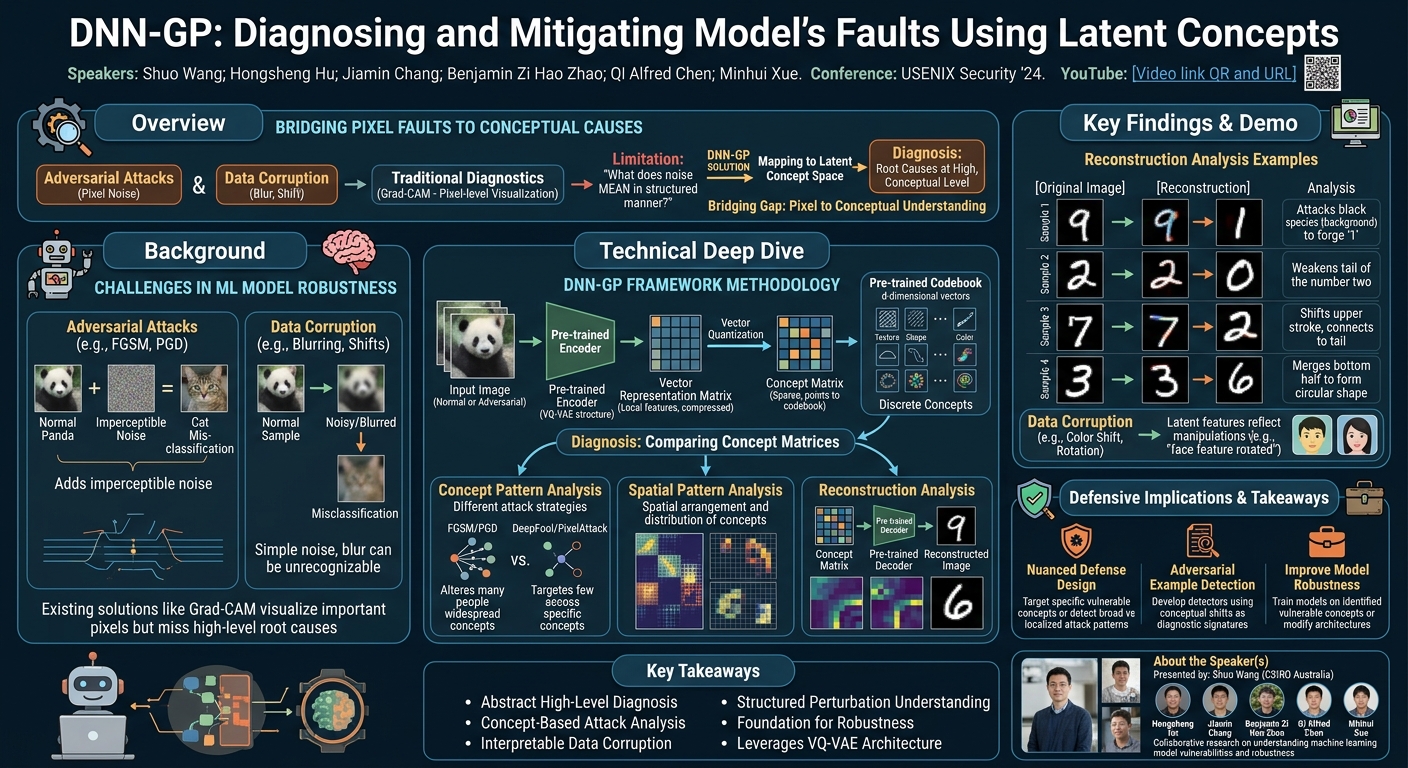
Firstly, through concept pattern analysis, the study revealed that different types of adversarial attacks employ distinct strategies to manipulate a model's decision-making process. Attacks such as FGSM (Fast Gradient Sign Method) and PGD (Projected Gradient Descent) were observed to alter a broad spectrum of concepts to achieve attack success. This suggests a more diffuse manipulation across the model's internal representations. In contrast, attacks like DeepFool and PixelAttack demonstrated a tendency to focus on leveraging specific, targeted concepts to launch their attacks. This finding highlights the varied nature of adversarial perturbations and the importance of understanding their conceptual impact beyond just pixel-level changes.
Secondly, DNN-GP successfully demonstrated its ability to explain how data corruption samples, such as those resulting from color shifts or rotations, manifest in the conceptual space. The framework showed that the latent features within DNN-GP accurately reflect these pixel-level manipulations. For instance, color shift attacks were found to be successful because specific facial features, represented as latent concepts, were altered. Similarly, rotation-based adversarial examples succeeded because the corresponding face features were conceptually rotated. This concrete linkage between pixel-space corruption and latent-space conceptual changes provides a structured and meaningful explanation for why these types of corruptions lead to misclassification.
Lastly, and perhaps most crucially, the research established that the "noisy structured perturbations" inherent in adversarial examples can be explained in a structured, meaningful way through DNN-GP's reconstruction analysis. By mapping adversarial samples into the latent concept matrix and then reconstructing them using the decoder, DNN-GP can illustrate how the attack manipulates the input. For example, in the MNIST dataset, an FGSM attack on a digit '9' might strategically weaken black spaces to make it reconstruct as a '1'. A digit '2' might have its tail weakened, leading to reconstruction as a '0'. A '7' could have its upper stroke shifted and connected to the tail, causing it to resemble a '2'. These reconstructed examples vividly demonstrate that adversarial noise is not merely random but a highly structured manipulation designed to exploit specific conceptual weaknesses in the model, leading to predictable misclassifications. These findings collectively underscore DNN-GP's power in providing abstract and actionable insights into model vulnerabilities.
Technical Deep Dive
▶ Watch: DNN-GP reveals diverse adversarial attack strategies (5:45)
DNN-GP's core innovation lies in its methodology for diagnosing model faults by mapping high-dimensional input data into a lower-dimensional latent concept space. This approach provides a structured, high-level understanding of how adversarial perturbations and data corruptions impact a model's internal representations. The framework is built upon a VQ-VAE (Vector Quantized Variational Autoencoder) like structure, comprising an encoder, a decoder, and a pre-trained codebook.
The process begins with a normal sample, typically an image. This sample is fed into a pre-trained encoder, which transforms the high-dimensional input into a vector representation matrix. Each element within this matrix is a d-dimensional vector, effectively capturing local features of the input. This vector representation is a compressed, abstract understanding of the input's visual components.
Central to DNN-GP is the pre-trained codebook. This codebook is a collection of discrete concepts, where each concept is also a d-dimensional vector. The crucial aspect of these concepts is that each one is designed to capture a distinct structural attribute of the sample. For instance, a concept might represent the "black background of the number seven" or a specific texture, shape, or color pattern. These concepts are learned during the pre-training phase of the VQ-VAE, ensuring they represent meaningful, high-level features.
Once the encoder produces the vector representation matrix, a vector quantization technique is applied. This technique maps each d-dimensional vector in the representation matrix to its closest matching concept vector in the pre-trained codebook. The result of this mapping is a concept matrix. This concept matrix is a sparse representation where each entry points to a specific concept from the codebook, effectively describing the input image in terms of its constituent structural attributes.
When an adversarial example is introduced, it undergoes the exact same procedure: it is encoded into a vector representation matrix, and then quantized against the same pre-trained codebook to produce its own concept matrix. The fundamental insight here is that since adversarial samples are intrinsically different from normal samples—specifically, they contain subtle, crafted perturbations—their resulting concept matrices will differ significantly from those of their clean counterparts. These differences in the concept matrices serve as the primary diagnostic indicator for the model's faults. By comparing the concept matrix of an adversarial sample with that of a normal sample, DNN-GP can pinpoint precisely which structural attributes or concepts have been manipulated by the attack.
Based on this mechanism, DNN-GP offers three distinct diagnostic capabilities:
- Concept Pattern Analysis: This diagnostic method involves identifying and detecting which concepts are common to both normal and adversarial samples, and more importantly, which concepts are specifically targeted or altered by adversarial attacks to manipulate the model's decision. The analysis helps in understanding the attack's strategy at a conceptual level, revealing whether it aims for a broad conceptual shift or a precise, localized manipulation. For example, the talk indicated that FGSM and PGD attacks tend to change many concepts, while DeepFool and PixelAttack focus on specific concepts.
- Spatial Pattern Analysis: While mentioned as a diagnostic capability, the transcript did not elaborate extensively on the specific results or methodology for this part. However, in the context of a VQ-VAE, this would typically involve analyzing the spatial arrangement and distribution of concepts within the concept matrix, looking for localized or global patterns of change induced by perturbations.
- Reconstruction Analysis: DNN-GP's pre-trained decoder plays a crucial role here. After obtaining the concept matrix for an adversarial sample, this matrix can be fed into the decoder to reconstruct an image. By comparing this reconstructed version of the adversarial sample with the original adversarial sample (or even the original clean sample), researchers can visually and analytically understand how the "noisy structured perturbations" work. The reconstruction process, guided by the manipulated concepts, reveals the high-level structural changes the attack intends to induce, offering a clear, interpretable view of the attack's mechanism. This is a powerful way to visualize the conceptual impact of the perturbation, showing how subtle changes in the latent space translate into meaningful alterations in the reconstructed image that lead to misclassification.
In summary, DNN-GP provides a powerful, interpretable framework by leveraging the VQ-VAE architecture to dissect model faults. By translating pixel-level noise into conceptual shifts, it offers a novel lens through which to understand and diagnose the intricate ways adversarial attacks and data corruptions compromise machine learning models. The limitation mentioned is that it only considers the VQ-VAE structure, suggesting future work could explore more advanced VQ-VAE architectures.
Demo / Proof of Concept
▶ Watch: Analyzing data corruption effects in conceptual space (7:00)
The talk effectively demonstrated DNN-GP's diagnostic capabilities through several compelling examples, primarily focusing on the reconstruction analysis and concept pattern analysis to illustrate how adversarial perturbations and data corruptions manifest in the latent concept space.
One key demonstration involved visualizing how different adversarial attacks manipulate concepts. Through concept pattern analysis, the speakers showed that attacks like FGSM and PGD typically involve changing "many concepts" within the latent space to achieve their objective. This indicates a more widespread impact on the model's internal representations. In contrast, attacks such as DeepFool and PixelAttack were shown to "focus on leveraging specific concept[s]" to launch their attacks, suggesting a more targeted and precise manipulation of particular structural attributes. While the specific visualizations of these concept changes were not detailed in the transcript, the takeaway highlights the tool's ability to differentiate attack strategies conceptually.
A more concrete demonstration focused on data corruption examples, specifically color shift and rotation attacks. The presentation showed how these attacks, which create adversarial examples by manipulating color in a face object or rotating an object, are reflected in the conceptual space. The latent features derived by DNN-GP accurately captured these manipulations. For instance, color shift attacks succeeded because "facial features are changed" at the conceptual level, and rotation attacks were successful because "the face feature is rotated" in the latent representation space. This directly links observable pixel-level changes to interpretable conceptual shifts, providing a clear explanation for the model's misclassification.
The most illustrative proof of concept came from the reconstruction of adversarial examples using the DNN-GP decoder, particularly on the MNIST dataset with FGSM attacks. This demonstration vividly explained how "noisy structured perturbations" work:
- Sample 1 (Digit '9'): An FGSM attack on a '9' caused it to be misclassified as a '1'. The DNN-GP reconstruction revealed that the attack "chose to fail in the black species of the number nine" – meaning it manipulated the black background or negative space around the digit – to forge it into a '1'. This shows a strategic alteration of non-digit features to change the digit's identity.
- Sample 2 (Digit '2'): For a digit '2' misclassified as a '0', the reconstruction indicated that "the tail of the number two is weakened." This subtle manipulation of a defining stroke caused the model to perceive it as a different digit.
- Sample 3 (Digit '7'): A '7' was misclassified as a '2'. The reconstruction showed that the attack "shift[ed] the upper stroke of the number seven to the right connecting it at the tail," effectively altering the topology of the digit to resemble a '2'.
- Sample 4 (Digit '3'): A '3' was misclassified as a '6'. The reconstruction demonstrated that the attack "merges the bottom half of the number three forming a circular shape," making it resemble a '6'.
These examples underscore DNN-GP's capability to provide a high-level, structured, and visually interpretable explanation of how adversarial noise, though imperceptible, strategically manipulates specific conceptual components of an image to induce misclassification. The reconstructions serve as tangible evidence of the framework's diagnostic power, translating abstract latent space changes into understandable visual alterations.
Defensive Implications
▶ Watch: Summary and future directions for DNN-GP (9:30)
The diagnostic capabilities of DNN-GP carry significant defensive implications for the field of machine learning security. By providing a high-level, structured understanding of how adversarial attacks and data corruption manipulate a model's latent concepts, DNN-GP offers valuable insights that can inform the development of more robust and targeted defense mechanisms.
Firstly, a deeper conceptual understanding of attack strategies, as revealed by DNN-GP's concept pattern analysis, can enable defenders to design more effective countermeasures. Knowing that certain attacks (e.g., FGSM, PGD) broadly impact many concepts, while others (e.g., DeepFool, PixelAttack) target specific ones, allows for a more nuanced approach to defense. Instead of generic robustness measures, defenses could be tailored to protect the identified vulnerable concepts or to detect patterns of widespread versus localized conceptual manipulation. For instance, if an attack is known to consistently corrupt concepts related to object boundaries, a defense could be engineered to specifically reinforce the model's understanding and representation of such boundaries.
Secondly, the ability to reconstruct adversarial examples and observe the precise structural manipulations that lead to misclassification opens avenues for developing detection mechanisms. If DNN-GP can clearly differentiate the concept matrix of an adversarial sample from a normal one, these differences could potentially serve as features for an adversarial example detector. By monitoring the concept space for unusual patterns or significant deviations from expected conceptual representations, a system could flag suspicious inputs before they cause misclassification. This could involve setting thresholds on the degree of conceptual shift or identifying known "attack signatures" in the latent concept space.
Furthermore, the insights gained from DNN-GP can directly contribute to improving model robustness. By pinpointing the specific concepts that are most susceptible to manipulation, researchers can work on strengthening the model's learning and representation of these critical attributes. This might involve techniques like adversarial training specifically targeting the identified vulnerable concepts, or modifying the model architecture to make its latent concept space more resilient to perturbation. The talk itself highlighted "studying how to use DNN-GP to improve the robustness of the model" as a future research direction, indicating its potential as a tool for proactive model hardening.
Finally, DNN-GP offers a crucial step towards building interpretable and trustworthy AI systems. By demystifying the black box of model failures, it empowers developers and security researchers to understand not just that a model failed, but why it failed at a high conceptual level. This transparency is vital for deploying AI in sensitive applications where understanding errors is as important as achieving high accuracy, fostering greater confidence in the reliability and security of machine learning models.
Key Takeaways
- High-Level Fault Diagnosis: DNN-GP provides an abstract, high-level diagnosis of machine learning model faults by mapping high-dimensional inputs to a low-dimensional latent concept space, offering structured explanations beyond pixel-level insights.
- Concept-Based Attack Analysis: The framework reveals that different adversarial attacks employ distinct strategies in manipulating concepts; FGSM/PGD attacks tend to alter many concepts, while DeepFool/PixelAttack focus on specific ones.
- Interpretable Data Corruption: DNN-GP successfully explains how data corruption (e.g., color shift, rotation) manifests conceptually, showing that latent features directly reflect pixel-level manipulations, leading to a structured understanding of misclassification.
- Structured Perturbation Understanding: Through reconstruction analysis, DNN-GP demonstrates how "noisy structured perturbations" in adversarial examples strategically alter specific conceptual parts of an input (e.g., weakening a '2's tail to make it a '0'), providing a visual and conceptual understanding of attack mechanisms.
- Foundation for Robustness: The diagnostic insights from DNN-GP can inform the development of more targeted and effective defense mechanisms, potentially leading to improved model robustness and the creation of adversarial detection systems based on conceptual shifts.
- Leverages VQ-VAE Architecture: DNN-GP is built upon a VQ-VAE-like structure, utilizing an encoder, decoder, and a pre-trained codebook of discrete concepts to achieve its diagnostic capabilities.
About the Speaker(s)
The paper "DNN-GP: Diagnosing and Mitigating Model's Faults Using Latent Concepts" was presented by Shuo Wang from CSIRO Australia. He presented on behalf of his co-authors, Hongsheng Hu, Jiamin Chang, Benjamin Zi Hao Zhao, Qi Alfred Chen, and Minhui Xue, who were unable to attend the conference. The presentation focused on their collaborative research into understanding and addressing the robustness challenges of machine learning models.
Reviews
Dr. Zero (Offensive Security Researcher) — STRONG ACCEPT
This talk introduces DNN-GP, a novel framework that transcends pixel-level analysis to provide high-level conceptual diagnosis of machine learning model failures. Leveraging a VQ-VAE architecture, it offers a structured understanding of how adversarial attacks and data corruption manipulate latent concepts, providing critical insights for developing more robust AI systems. The ability to reconstruct adversarial examples to show how attacks work at a conceptual level is particularly compelling.
Heather Calloway (CISO) — STRONG ACCEPT
This research offers a critical diagnostic framework for understanding how adversarial attacks and data corruption exploit machine learning models at a conceptual level. By translating low-level perturbations into high-level conceptual shifts, it provides invaluable insights for informing AI risk governance and designing more robust, interpretable AI defenses.