Operationalizing SSVC
Lindsay Sirnik (Branch Chief of Vulnerability Response and Coordination · CISA)
CVE/FIRST VulnCon 2025 · Main Stage
Overview
In the dynamic and often overwhelming landscape of cybersecurity, organizations face a relentless deluge of newly disclosed vulnerabilities. With tens of thousands of vulnerabilities reported annually, the critical challenge lies not just in identifying them, but in effectively prioritizing which ones demand immediate attention and action. This talk, "Operationalizing SSVC," presented by Lindsay Sirnik and Sean Latona from the Cybersecurity and Infrastructure Security Agency (CISA), addresses this fundamental problem head-on by detailing CISA's successful implementation of the Stakeholder-Specific Vulnerability Categorization (SSVC) framework.
Key moments
- 0:00 Welcome and Introduction to SSVC topic
- 2:30 CISA VM's unique mission and diverse stakeholders
- 4:00 CISA VM's key tools and capabilities
- 5:45 The critical challenge of vulnerability prioritization
- 6:20 Introducing SSVC's purpose and CVSS's limitations
- 7:45 How SSVC addresses unique stakeholder needs
Operationalizing SSVC
Speakers: Lindsay Sirnik, Branch Chief of Vulnerability Response and Coordination, CISA; Sean Latona, Chief of Operations for Vulnerability Management, CISA
Conference: VulnCon
YouTube: https://www.youtube.com/watch?v=OTG7ZzGMFsw
Overview
In the dynamic and often overwhelming landscape of cybersecurity, organizations face a relentless deluge of newly disclosed vulnerabilities. With tens of thousands of vulnerabilities reported annually, the critical challenge lies not just in identifying them, but in effectively prioritizing which ones demand immediate attention and action. This talk, "Operationalizing SSVC," presented by Lindsay Sirnik and Sean Latona from the Cybersecurity and Infrastructure Security Agency (CISA), addresses this fundamental problem head-on by detailing CISA's successful implementation of the Stakeholder-Specific Vulnerability Categorization (SSVC) framework.
Sirnik and Latona illuminate how CISA leverages SSVC to move beyond generic vulnerability scores, such as those provided by CVSS, to provide actionable, context-rich guidance to its diverse stakeholders, including federal civilian executive branch (FCEB) agencies, state, local, tribal, and territorial (SLTT) governments, and critical infrastructure sectors. The presentation outlines the structured decision-making process that SSVC offers, enabling CISA to consistently identify and communicate the most impactful threats, thereby optimizing defensive efforts and preventing overreaction to less critical issues. This matters because it shifts the focus from purely technical severity to actual risk and mission impact within specific operational environments.
The speakers highlight SSVC's role as a repeatable and consistent triage framework that considers factors beyond technical exploitability, such as the actual state of exploitation in the wild, the prevalence of affected systems, and the potential mission impact. By sharing CISA's five-year journey with SSVC, including its integration into the Known Exploited Vulnerabilities (KEV) Catalog and public data enrichment efforts, the talk provides a robust blueprint for other organizations seeking to operationalize a more intelligent and tailored approach to vulnerability management.
Background
▶ Watch: Welcome and Introduction to SSVC topic (0:00)
For many years, the Common Vulnerability Scoring System (CVSS) served as the de facto standard for assessing vulnerability severity. CVSS is undeniably valuable for providing a technical understanding of a vulnerability's facets, with its vector string offering insights into potential worst-case technical impacts. However, as CISA's Lindsay Sirnik explains, CVSS has inherent limitations when it comes to prioritizing vulnerabilities for diverse organizations with unique environmental concerns and mission objectives. A high CVSS score, while indicating severe technical impact, does not inherently tell an organization whether that vulnerability poses an immediate, exploitable threat to their specific assets or operations.
The core problem CISA and its stakeholders faced was how to effectively triage and act upon the approximately 40,000 vulnerabilities disclosed annually. Traditional CVSS scores, while offering a technical baseline, often led to a "boy who cried wolf" scenario or, conversely, a failure to prioritize truly critical threats that were already being exploited in the wild. The need was for a framework that could incorporate real-world context, such as the state of exploitation and the specific concerns of CISA's broad stakeholder set (FCEB, SLTT, Critical Infrastructure), into a repeatable and scalable decision-making process.
In response to this critical gap, the Software Engineering Institute (SEI) and CISA collaboratively developed the Stakeholder-Specific Vulnerability Categorization (SSVC) model. SSVC was designed as a decision-tree model that allows organizations to consistently and repeatably prioritize vulnerabilities based on their unique operational context. CISA's Vulnerability Management (VM) mission, as articulated by Sean Latona, is distinct from traditional enterprise VM; it focuses on reducing the prevalence and impact of vulnerabilities across a broad ecosystem, acting "left of an incident" to prevent harm across federal government and critical infrastructure. This unique mission necessitated a prioritization framework that could bridge the gap between technical details and actionable, stakeholder-specific guidance, moving beyond static scores to dynamic, context-driven decisions. SSVC emerged as the solution to this complex challenge.
Key Findings
▶ Watch: CISA VM's key tools and capabilities (4:00)
The central discovery and contribution of this talk is the profound utility and operational effectiveness of the Stakeholder-Specific Vulnerability Categorization (SSVC) framework as implemented by CISA. The key findings underscore SSVC's ability to transform raw vulnerability data into actionable intelligence, enabling targeted responses and efficient resource allocation.
Firstly, SSVC provides a repeatable and consistent decision-making process for vulnerability prioritization. Unlike static scoring systems, SSVC is a dynamic decision tree that allows analysts to walk through a series of context-specific questions. This ensures that the triage process is not only uniform across different analysts but also adaptable to the unique environmental concerns of various stakeholders. CISA's analysts have been using SSVC for five years, starting in April 2020, demonstrating its enduring utility and the development of a strong "mental model" among practitioners.
Secondly, SSVC successfully addresses the limitations of traditional scoring systems like CVSS by incorporating crucial real-world factors. While CVSS provides a technical understanding, SSVC explicitly considers the state of exploitation (e.g., actively exploited in the wild), the prevalence of affected systems, and the mission impact to specific organizational contexts. This shift in focus allows CISA to prioritize vulnerabilities that pose the most significant and immediate threat to its stakeholders, rather than merely those with the highest technical severity score.
Thirdly, CISA's operationalization of SSVC has directly led to tangible improvements in vulnerability management. A prime example is the Known Exploited Vulnerabilities (KEV) Catalog, launched in November 2021, which directly leverages SSVC's focus on actively exploited vulnerabilities to drive mandatory remediation actions across federal agencies via a binding operational directive. Furthermore, CISA now publicly shares the first three SSVC decision points for almost every new CVE through its Vulnrichment and Authorized Data Publisher (ADP) capabilities, providing valuable, context-rich data that other organizations can ingest and integrate into their own decision-making processes. This public sharing exemplifies CISA's commitment to enabling broader cybersecurity resilience.
Finally, SSVC empowers organizations to not only drive action on critical threats but also to "spin down" unnecessary alarms. The framework's ability to provide a nuanced assessment prevents overreaction to vulnerabilities that, despite high technical scores, may have extremely low real-world exploitability or mission impact, thereby conserving valuable resources and reducing alert fatigue. This dual capability—to escalate truly dangerous threats and de-escalate less critical ones—is a cornerstone of SSVC's effectiveness and a major finding from CISA's operational experience.
Technical Deep Dive
▶ Watch: The critical challenge of vulnerability prioritization (5:45)
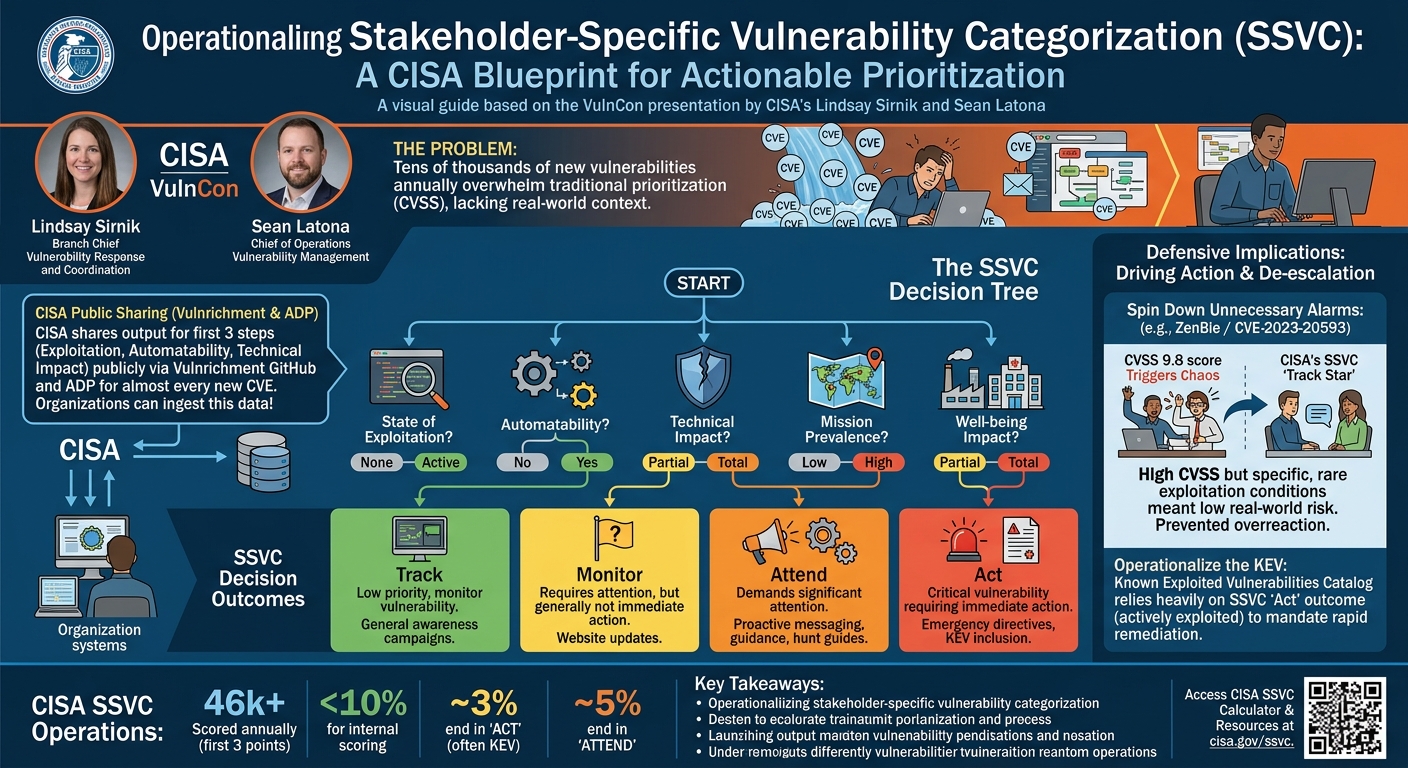
The Stakeholder-Specific Vulnerability Categorization (SSVC) framework is structured as a decision tree designed to guide analysts through a series of contextual questions, leading to a specific action outcome. CISA's implementation of SSVC, while offering flexibility for other organizations, follows a defined path that balances technical assessment with operational impact.
The SSVC decision tree begins with the most critical and immediate question: State of Exploitation. This node has several potential answers, ranging from "None" (no known exploitation) to "Active" (actively exploited in the wild). This initial filter is paramount, as CISA recognizes that vulnerabilities already being exploited pose the most significant and immediate threat to its stakeholders. If a vulnerability is actively exploited, it immediately escalates in priority.
Following the state of exploitation, the tree proceeds to:
- Automatability: Can the vulnerability be exploited automatically or does it require significant manual effort?
- Technical Impact: What is the potential technical consequence if exploited? Options range from "Partial" to "Total" loss of confidentiality, integrity, or availability.
These first three decision points – State of Exploitation, Automatability, and Technical Impact – are crucial because CISA publicly shares their outputs for nearly every new CVE. This information is integrated into CISA's Vulnrichment GitHub and published through its Authorized Data Publisher (ADP) role within the CVE program. This allows other organizations to ingest these initial SSVC assessments, often found within the ADP container of a CVE record's JSON, and use them to inform their own SSVC implementations. For example, a recent CVE might show exploitation: none, automatability: no, and technical_impact: partial.
Internally, CISA's SSVC process extends beyond these initial three points to include additional, more stakeholder-specific considerations:
- Mission Prevalence: How widespread is the vulnerable technology within CISA's stakeholder environments (FCEB, SLTT, Critical Infrastructure)? This assessment leverages both quantitative sources like scanning results from various services offered to FCEB, and qualitative sources such as public acquisition records and market research.
- Well-being: What is the potential impact of an exploit on the performance and operational continuity of mission-critical technologies? This often relies on the deep experience and institutional knowledge of CISA's analysts, who understand what technologies are truly impactful to federal government operations.
The output of navigating the entire SSVC decision tree is one of four decision outcomes, each associated with an escalating color scheme:
- Track (Green, internally called "Monitor"): Indicates a low-priority vulnerability that should be monitored.
- Monitor (Yellow, previously "Track Star"): Requires slightly more attention, but generally not immediate action.
- Attend (Orange): Demands significant attention and potentially proactive messaging or guidance.
- Act (Red): Designates a critical vulnerability requiring immediate and decisive action, often leading to binding operational directives or inclusion in the KEV Catalog.
CISA's operational data demonstrates the efficiency of this multi-stage process. Since February 2024, CISA has scored approximately 46,000 vulnerabilities using the first three SSVC decision points. However, only "under 10%" of these are ingested for further internal scoring through the full decision tree, as CISA can already filter out less relevant vulnerabilities. Of those further scored, only about 8% ultimately lead to an "Action" outcome: approximately 3% land on "Act" (often exploited vulnerabilities, many ending up on the KEV), and about 5% land on "Attend," prompting targeted messaging and guidance. This selective process ensures that CISA's resources are concentrated on the vulnerabilities that truly matter.
It is crucial to note that while CISA's decision tree and calculator are publicly available at cisa.gov/ssvc, the SSVC framework itself is designed with inherent flexibility. Organizations are encouraged to curate their own decision points and outcomes to align with their specific risk appetite, operational context, and stakeholder needs. This adaptability is a core strength, allowing SSVC to be tailored for diverse environments, from small enterprises to large government agencies, and even specialized domains like operational technology (OT) and industrial control systems (ICS).
Demo / Proof of Concept
▶ Watch: Introducing SSVC's purpose and CVSS's limitations (6:20)
While the talk did not feature a live software demonstration of the SSVC calculator, it provided a compelling real-world demonstration of SSVC's practical application and impact through a specific case study: CVE-2023-20593, widely known in the media as "ZenBle." This example powerfully illustrated how SSVC enabled CISA to effectively manage an emerging vulnerability crisis and prevent an unnecessary overreaction across the federal government.
The ZenBle vulnerability, affecting billions of AMD chips and devices, garnered significant media attention, leading to a high demand signal for action from various federal entities. Traditional vulnerability scoring systems, such as CVSS, assigned ZenBle a high score, specifically a 9.8, which on its face suggested an extreme and widespread threat. This high score, coupled with the vast number of affected devices, typically triggers alarm bells and mandates urgent, broad-sweeping responses.
However, when CISA's team, led by Lindsay Sirnik and Sean Latona, ran CVE-2023-20593 through their internal SSVC scoring system, the outcome was significantly different. Based on the specific conditions required for exploitation, SSVC categorized ZenBle as a "Track Star" (internally referred to as "Monitor"). This outcome indicated that while the vulnerability existed, the practical conditions for widespread exploitation in CISA's stakeholder environments were extremely limited or non-existent in 99.9% of affected devices.
Sean Latona described this as a critical moment where SSVC allowed CISA to "walk everybody back off the ledge." By leveraging the SSVC framework, CISA was able to clearly articulate why a vulnerability with a high CVSS score did not warrant an emergency directive or widespread, costly remediation efforts. They explained the parameters and specific requirements for exploitation, demonstrating that despite its technical severity, the real-world risk was low. This practical application of SSVC saved countless hours and resources that would have been expended on an unnecessary, high-priority response, proving the framework's value in providing nuanced, context-driven guidance that goes beyond raw technical scores.
Defensive Implications
▶ Watch: How SSVC addresses unique stakeholder needs (7:45)
The operationalization of SSVC by CISA carries profound defensive implications for any organization grappling with vulnerability prioritization. The framework offers a structured, context-aware approach that significantly enhances an organization's ability to respond effectively and efficiently to threats.
Firstly, SSVC empowers defenders to focus resources on actual threats rather than perceived technical severity. By prioritizing vulnerabilities based on the state of exploitation, prevalence, and mission impact, organizations can ensure that their limited security personnel and remediation budgets are directed towards vulnerabilities that pose the most immediate and critical risk to their operations. This is a crucial shift from merely patching everything with a high CVSS score, which often leads to alert fatigue and inefficient remediation efforts.
CISA's use of SSVC directly translates into a menu of actionable options for its stakeholders. For vulnerabilities categorized as "Track" or "Monitor," CISA might issue general awareness campaigns, update its website with information, or amplify vendor advisories in weekly rollups. As the SSVC outcome escalates to "Attend," more targeted notifications, specific mitigation guidance, or hunt guides are developed. For "Act" vulnerabilities, CISA is prepared to issue emergency directives that mandate specific, rapid remediation actions for federal agencies, as exemplified by the Known Exploited Vulnerabilities (KEV) Catalog. This tiered response mechanism, driven by SSVC outcomes, ensures that communication and action are proportionate to the actual risk.
A critical defensive implication highlighted by Sean Latona is the ability of SSVC to facilitate "spinning down" unnecessary alarms. The ZenBle example (CVE-2023-20593) perfectly illustrates this: despite a high CVSS score and widespread media attention, SSVC's contextual analysis allowed CISA to demonstrate that the real-world exploitability was low, preventing an overreaction and conserving federal resources. This capability is invaluable in combating the "boy who cried wolf" syndrome prevalent in cybersecurity, building trust, and ensuring that legitimate high-priority alerts receive the attention they deserve.
For successful implementation, organizational buy-in is a fundamental prerequisite. As Sean Latona emphasized, all teams, from executive leadership to threat hunting and incident response, must understand and trust the SSVC scoring system. This ensures consistent interpretation and action across disparate units. CISA invested significant effort in ensuring its threat hunting and incident response colleagues understood SSVC, allowing them to effectively integrate it into their post-incident analysis and future prevention strategies.
Finally, SSVC encourages an iterative and adaptive approach to vulnerability management. CISA's "lessons learned" indicate that the SSVC system itself must be flexible. If friction arises, it's the system that needs adjustment, not the analysts or executives. This adaptability includes the potential for different SSVC trees for different triage contexts, such as a specialized tree for Operational Technology (OT) and Industrial Control Systems (ICS) environments, which have unique risk profiles and operational constraints. By sharing its SSVC guide, calculator, and public enrichment data, CISA actively enables other defenders to adopt and adapt this powerful framework, fostering a more resilient and context-aware cybersecurity ecosystem.
Key Takeaways
- Contextual Prioritization: SSVC moves beyond generic technical scores (like CVSS) to prioritize vulnerabilities based on real-world factors such as the state of exploitation, prevalence, and mission impact within an organization's specific operational context.
- Repeatable Decision Tree: The framework provides a consistent and repeatable decision-tree model, ensuring uniform vulnerability triage across analysts and teams, leading to more reliable and predictable outcomes.
- Actionable Outcomes: SSVC translates vulnerability analysis into clear, actionable decision outcomes (Track, Monitor, Attend, Act), enabling proportionate responses from general awareness to mandatory emergency directives.
- Preventing Overreaction: A key benefit is the ability to "spin down" unnecessary alarms, as demonstrated by the ZenBle case, conserving resources by avoiding costly remediation efforts for vulnerabilities with low real-world exploitability despite high technical scores.
- CISA's Operational Success: CISA has successfully operationalized SSVC for five years, integrating it into critical programs like the KEV Catalog and publicly sharing initial SSVC decision points for nearly all new CVEs via Vulnrichment and ADP.
- Adaptability and Buy-in: Effective SSVC implementation requires strong organizational buy-in across all teams and a willingness to iteratively refine the decision tree to suit evolving organizational needs and specific technological environments (e.g., OT/ICS).
About the Speaker(s)
Lindsay Sirnik serves as the Branch Chief of Vulnerability Response and Coordination at CISA, within the cyber security division and the vulnerability management subdivision. Her team is at the forefront of CISA's efforts to manage and coordinate responses to cybersecurity vulnerabilities. Her responsibilities encompass leading the development and management of CISA's Known Exploited Vulnerabilities (KEV) Catalog, overseeing the Coordinated Vulnerability Disclosure (CVD) process, participating in the CVE Program as a CNA (CVE Numbering Authority) and CNA of Last Resort (CNA-LR), and critically, driving the SSVC scoring and its operationalization.
Sean Latona holds the position of Chief of Operations for Vulnerability Management at CISA. In this role, he is responsible for taking the analytical work performed by Lindsay Sirnik's team and other vulnerability management branches, coordinating it across CISA's cyber security division, and translating it into actionable intelligence and directives for various stakeholders. These stakeholders include federal civilian executive branch (FCEB) agencies, state, local, tribal, and territorial (SLTT) communities, and critical infrastructure sectors. His work focuses on driving remediation and mitigation actions, developing communication strategies ranging from alerts and advisories to emergency directives, and ensuring that CISA's vulnerability guidance supports high-level national security objectives from a cyber perspective.
Reviews
Dr. Zero (Offensive Security Researcher) — SOLID
Sirnik and Latona are the right people to give this talk — they built and operate CISA's SSVC pipeline, and they bring five years of real operational data to the table. The ZenBle case study is the strongest moment: a concrete example of SSVC doing what it's supposed to do, walking a high-CVSS panic back with actual contextual reasoning. The public Vulnrichment/ADP data sharing angle is genuinely useful signal for practitioners who didn't know that enrichment existed. But the talk lands as a solid practitioner briefing rather than a must-see research contribution. SSVC itself is not new — the framework has been public for years, the CISA implementation has been discussed in prior venues…
Heather Calloway (CISO) — STRONG ACCEPT
Sirnik and Latona deliver a credible, operationally grounded account of how CISA has used SSVC for five years to turn vulnerability volume into prioritized action. The ZenBle case study is the talk's strongest moment — it shows SSVC working as intended, not just theoretically but under real institutional pressure, walking federal agencies back from a costly overreaction to a 9.8 CVSS score with actual contextual evidence. The talk earns its place because it addresses both directions of prioritization: escalating what matters and de-escalating what doesn't. The gaps are real — organizational change management, the human cost of building analyst judgment at scale, and the question of…