The Enriched CVE Record: Redefining Completeness and Quality for Greater Impact
Alex Summers (CVE and CWE Project Lead · MITRE)
CVE/FIRST VulnCon 2025 · Main Stage
Overview
In this insightful talk from VulnCon, Alex Summers, MITRE's CVE and CWE project lead, illuminated the critical evolution of the Common Vulnerabilities and Exposures (CVE) program, focusing on the journey towards an "enriched CVE record." The presentation underscored how the continuous development of CVE data enrichment is fundamentally redefining what constitutes completeness and quality in vulnerability information. Summers highlighted the indispensable role of active community participation in driving sustained improvement and adoption of more comprehensive data within the cybersecurity ecosystem.
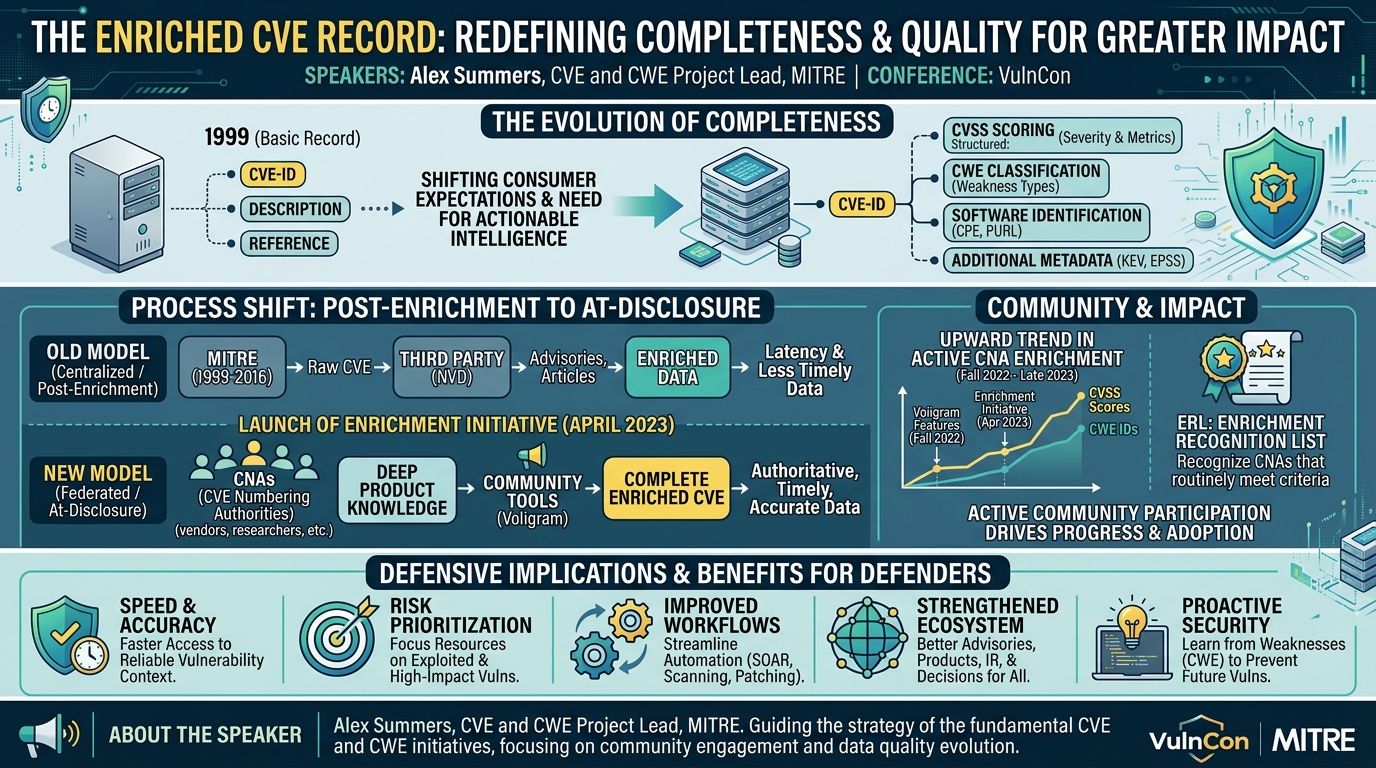
Key moments
- 0:30 Talk's key takeaways: enrichment, community, risk reduction
- 1:00 The basic CVE record in 1999
- 2:40 Evolution of vulnerability standards: CVSS, CWE, software naming
- 5:20 Historical third-party enrichment by NVD and others
- 6:20 CVE program evolved: centralized MITRE to federated CNAs
- 8:20 Community-developed structured CVE data format
- 8:50 CNAs now add enrichment directly at disclosure
The Enriched CVE Record: Redefining Completeness and Quality for Greater Impact
Speakers: Alex Summers, CVE and CWE Project Lead, MITRE
Conference: VulnCon
YouTube: https://www.youtube.com/watch?v=1zvqpba2ka8
Overview
In this insightful talk from VulnCon, Alex Summers, MITRE's CVE and CWE project lead, illuminated the critical evolution of the Common Vulnerabilities and Exposures (CVE) program, focusing on the journey towards an "enriched CVE record." The presentation underscored how the continuous development of CVE data enrichment is fundamentally redefining what constitutes completeness and quality in vulnerability information. Summers highlighted the indispensable role of active community participation in driving sustained improvement and adoption of more comprehensive data within the cybersecurity ecosystem.
The core message of the talk resonated with the pressing need for complete, accurate, and timely CVE records as a cornerstone for reducing cyber security risk and fostering a safer global digital environment. Summers traced the program's history from its rudimentary beginnings in 1999, when a CVE record comprised just three basic elements, to its current sophisticated, federated model. This transformation is not merely an incremental update but a strategic recalibration, empowering CVE Numbering Authorities (CNAs) to become the primary providers of rich, contextual vulnerability data.
The significance of this evolution cannot be overstated. As the landscape of software, connectivity, and cyber threats has grown exponentially in complexity since 1999, the demand for more detailed and actionable vulnerability intelligence has similarly escalated. This talk emphasized how the CVE program, through its adaptability and commitment to community-driven progress, is striving to meet these heightened expectations, ensuring that defenders are equipped with the precise information needed to effectively manage and mitigate cyber risks.
Background
▶ Watch: Talk's key takeaways: enrichment, community, risk reduction (0:30)
The journey of the CVE program began in 1999 with a remarkably simple structure. A CVE record back then consisted of just three fundamental elements: the ID (e.g., CVE-1999-0001), a brief textual description (e.g., "Buffer overflow in Unixware XA auto program allows local users to gain root privilege"), and an external reference pointing to further relevant information. These three elements remain the minimum required components of any CVE record to this day. This initial model, while foundational, was designed for a far less complex digital world.
Over the past 25 years, the cybersecurity landscape has undergone a radical transformation. The proliferation of software, exponential growth in system complexity, increased global connectivity, and the emergence of advanced detection tools have collectively led to a dramatic increase in the volume and sophistication of vulnerabilities. Consequently, vulnerability management itself has become an increasingly intricate and demanding discipline. This burgeoning complexity necessitated a richer, more standardized approach to describing and prioritizing vulnerabilities.
In response to these evolving needs, a suite of other standards and methodologies emerged to complement and enhance the basic CVE record. These include:
- CVSS (Common Vulnerability Scoring System): Developed to provide a standardized, general understanding of vulnerability severity, allowing for consistent risk assessment. CVSS has evolved through several iterations to refine its metrics.
- CWE (Common Weakness Enumeration): Born directly out of the CVE program's observation of recurring patterns in disclosed vulnerabilities, CWE provides a common language and taxonomy for classifying software weaknesses and vulnerability types.
- Software Naming Schemes: Standards like CPE (Common Platform Enumeration) and Package URL (PURL) arose to accurately identify and name software components, crucial for understanding the scope of affected products.
- Other Metadata: More recent additions like KEV (Known Exploited Vulnerabilities) and EPSS (Exploit Prediction Scoring System) provide valuable context on active exploitation and exploitability likelihood, further aiding prioritization.
Historically, the enrichment of CVE records followed a somewhat fragmented path. While some CNAs (CVE Numbering Authorities), which began generating CVE records in a federated model around 2016, might include CVSS scores or CWE IDs directly, a significant portion of the enrichment was performed by third parties. The National Vulnerability Database (NVD), for instance, would pull raw CVE data and, using publicly available information from advisories and articles, make determinations to add CVSS, CWE, and CPE information to records as part of its mission. This model, while effective for a time, led to a "new kind of completeness" expectation from consumers, who grew accustomed to seeing these enriched data points.
A pivotal shift in the CVE program's governance and operational model was essential for scaling. Prior to 2016, every single CVE record was written by the MITRE Corporation. This centralized approach for vulnerability identification and naming proved unsustainable given the sheer volume of vulnerabilities. Recognizing this, the program embarked on a path of federation, empowering a growing community of CNAs. This experiment aimed to scale the program, expand its coverage, and distribute the responsibility of vulnerability disclosure and data generation across a wider, more specialized network. This federated model laid the groundwork for CNAs to eventually take on a more direct role in data enrichment.
Key Findings
▶ Watch: Evolution of vulnerability standards: CVSS, CWE, software naming (2:40)
The talk highlighted several key findings that underscore the transformative journey of the CVE program towards comprehensive data enrichment:
Firstly, there has been a significant redefinition of what constitutes a "complete" CVE record. Consumers and stakeholders now have a strong expectation that a CVE record will include not just the basic ID and description, but also critical metadata such as CVSS scores, CWE identifications, and robust software identity information. This shift reflects the increased complexity of vulnerability management and the need for more actionable intelligence.
Secondly, the CVE data format itself has undergone a crucial evolution. Developed by the community, particularly through the Quality Working Group, the format has transitioned from a simple, unstructured text-based entry to a sophisticated, structured format. This structured approach is fundamental, as it enables CNAs to directly embed specific data elements—like CVSS metrics or CWE IDs—into the record at the very moment of disclosure. This capability represents a departure from the older model where such enrichment often occurred downstream by third parties like NVD.
A significant driver of this change has been the emergence of community-developed tooling. Alex Summers specifically mentioned Voligram as an example of a client that simplifies and enables CNAs to provide and publish enriched CVE records quickly and easily. By making the process of adding detailed metadata more accessible, these tools have directly contributed to an increased willingness and capability among CNAs to enrich their records.
A pivotal moment in this evolution was the CVE Program's Enrichment Initiative, launched in April 2023. This initiative served as a direct call to action for the CNA community, emphasizing that CNAs are uniquely positioned as the authoritative sources of vulnerability information within their scope. They possess the deepest product knowledge and access to the most accurate data necessary to make precise determinations for CVSS scores, CWEs, and other enrichment information. This push was further motivated by a period of reduced NVD enrichment, which amplified the demand from consumers for timely and complete data.
The impact of these efforts is clearly visible in the data trends presented. Following the introduction of features in Voligram (Fall 2022) and the launch of the Enrichment Initiative (April 2023), there was a noticeable surge in the percentage of active CNAs routinely providing CVSS scores, CWEs, or both, in their published records. The graphs shown in the presentation demonstrated a clear upward trajectory, with the percentage of active CNAs contributing enriched data steadily increasing, moving from lower percentages to the upper 70s. This indicates a successful shift in practice within the federated CNA community.
To further recognize and incentivize CNAs, the CVE program introduced the Enrichment Recognition List (ERL) in September 2023. This list identifies CNAs that consistently meet specific criteria for providing CVSS and CWE information as a matter of routine. The ERL is designed to be dynamic, with its criteria potentially evolving over time to encourage higher levels of completeness and quality, possibly incorporating other metadata like CPE information in the future. The number of CNAs on the ERL has shown a general upward trend, reflecting the growing adoption of enrichment practices across the ecosystem. This public recognition serves as a powerful motivator for CNAs to maintain and improve their data quality contributions.
Technical Deep Dive
▶ Watch: Historical third-party enrichment by NVD and others (5:20)
The technical underpinnings of the enriched CVE record revolve around a fundamental shift in data structure, process, and the distributed responsibility model of the CVE program.
At its core, the CVE data format has evolved from a relatively unstructured, minimalist entry to a structured, machine-readable format. This evolution, spearheaded by community efforts like the Quality Working Group, allows for the explicit definition and inclusion of specific data elements within the CVE record itself. Instead of relying on free-form text descriptions that require parsing or external databases for additional context, the modern CVE record can directly house fields for:
- CVSS (Common Vulnerability Scoring System) Metrics: This includes the base score, environmental score, and temporal score, along with the detailed vector string that describes the various attack components (e.g., Attack Vector, Attack Complexity, Privileges Required, User Interaction, Scope, Confidentiality, Integrity, Availability). Providing this directly by the CNA ensures the most accurate context from the product vendor.
- CWE (Common Weakness Enumeration) IDs: Direct inclusion of CWE identifiers categorizes the underlying software weakness, allowing for more precise analysis, vulnerability pattern recognition, and proactive defensive measures.
- Software Identification (e.g., CPE): While still evolving as a routine inclusion, the structured format supports specific fields for identifying affected software and versions using standards like Common Platform Enumeration (CPE). This is crucial for automated patching and inventory management.
- Other Metadata Hooks: The flexible, structured format allows for the future integration of other valuable metadata, such as indicators for Known Exploited Vulnerabilities (KEV), Exploit Prediction Scoring System (EPSS) scores, or Package URLs (PURL), which are vital for supply chain security.
This structured format is critical because it directly enables the federated model of the CVE program. In this model, CNAs are not merely responsible for assigning IDs and providing basic descriptions; they are empowered and expected to be the authoritative sources of vulnerability information for their respective scopes (products, projects, or research areas). This means they are best positioned to:
- Possess Intimate Product Knowledge: CNAs, often software vendors or open-source project maintainers, have direct access to source code, design documents, and internal testing data. This allows them to accurately assess the impact, exploitability, and scope of a vulnerability, leading to more precise CVSS scores and CWE assignments.
- Provide Timely Information: By enriching the record at the time of initial disclosure, CNAs eliminate the latency introduced when downstream entities (like NVD) have to independently research and add this information. This accelerates the flow of critical intelligence to defenders.
- Ensure Accuracy: Direct enrichment by the CNA minimizes potential misinterpretations or inaccuracies that can arise when third parties attempt to derive detailed metrics from public advisories alone.
The talk emphasized the role of community-developed tooling like the Voligram client. These tools act as user-friendly interfaces that abstract away the complexities of the structured CVE data format. They provide CNAs with intuitive forms and workflows to input CVSS metrics, select CWE IDs, and add other relevant data, significantly lowering the technical barrier to enrichment. This "making it easy to do the right thing" approach has been instrumental in the observed increase in CNA enrichment.
The overall technical shift is a move from a "post-enrichment" model (where a basic CVE is published and then enriched by others) to an "at-disclosure enrichment" model (where the CNA publishes a comprehensively enriched CVE record from the outset). This fundamental change in the data pipeline ensures that the most authoritative, accurate, and timely vulnerability intelligence is available to the broader cybersecurity community directly from the source.
Demo / Proof of Concept
▶ Watch: Community-developed structured CVE data format (8:20)
The talk by Alex Summers focused on the programmatic evolution, community initiatives, and statistical trends related to CVE record enrichment. It did not include a live demonstration or a proof of concept of a specific technical exploit or tool. Instead, the presentation relied on data visualizations and a clear articulation of the CVE program's strategy and progress to illustrate its points.
Defensive Implications
▶ Watch: CNAs now add enrichment directly at disclosure (8:50)
The push for enriched CVE records, with CNAs providing detailed metadata at the time of disclosure, carries profound implications for cybersecurity defenders. This strategic shift directly enhances their ability to understand, prioritize, and respond to vulnerabilities more effectively.
- Timeliness and Accuracy for Defenders: Perhaps the most immediate benefit is the improved timeliness and accuracy of vulnerability information. When CNAs, as the authoritative sources, provide CVSS scores, CWE classifications, and precise software identification directly in the CVE record, defenders receive this critical context much sooner. This eliminates the delay previously incurred while waiting for downstream entities like NVD to perform their own enrichment processes. Faster access to accurate data means defenders can initiate mitigation efforts, patch systems, or deploy compensating controls more promptly, significantly reducing the window of exposure.
- Enhanced Risk Prioritization: Enriched CVE records are invaluable for risk prioritization. Defenders are often overwhelmed by the sheer volume of disclosed vulnerabilities. The inclusion of standardized metrics like CVSS base scores, along with contextual data such as KEV (Known Exploited Vulnerabilities) status or EPSS (Exploit Prediction Scoring System) scores, allows security teams to move beyond a generic "critical" or "high" severity. They can prioritize vulnerabilities based on actual exploitability, active exploitation in the wild, and the specific impact on their unique environment, rather than relying solely on a vulnerability's theoretical maximum severity. This enables a more intelligent allocation of limited resources.
- Improved Vulnerability Management Workflows: The availability of structured, machine-readable enrichment data streamlines automated vulnerability management tools and processes. Security orchestration, automation, and response (SOAR) platforms, vulnerability scanners, and asset management systems can directly ingest and process this richer data. This facilitates automated correlation with asset inventories, rapid identification of affected systems, and the generation of more precise remediation guidance. The consistent use of CWE IDs, for instance, helps security teams identify common weakness patterns in their codebases, informing proactive security development lifecycle (SSDLC) improvements.
- Strengthening the Entire Cybersecurity Ecosystem: The initiative to enrich CVEs at the source strengthens the entire cybersecurity community. National vulnerability databases, threat intelligence platforms, security tool vendors, incident response teams, data scientists, and policymakers all rely on high-quality CVE data. When the foundational data is richer and more accurate, all these downstream consumers benefit. It leads to better advisories, more effective security products, faster incident response, more robust research, and data-driven policy decisions, collectively contributing to a more resilient cyber defense posture globally.
- Empowering Proactive Security: By leveraging enriched CVE data, organizations can move towards more proactive security strategies. Understanding the types of weaknesses (CWEs) prevalent in their software or dependencies can inform developer training, security architecture reviews, and the adoption of secure coding practices. The ability to quickly assess the real-world threat posed by a vulnerability (via KEV or EPSS) allows for a more agile and threat-informed defense.
In essence, the enriched CVE record transforms vulnerability information from a mere identifier into a powerful, actionable intelligence asset, equipping defenders with the precision and speed necessary to effectively combat an ever-evolving threat landscape.
Key Takeaways
- Evolving Completeness: CVE data enrichment is a continuous process, constantly redefining what constitutes a complete and high-quality vulnerability record, moving far beyond the original three basic elements.
- Community-Driven Improvement: Active participation from the federated CNA community, alongside working groups and tooling developers, is the primary force driving sustained improvement and adoption of more comprehensive vulnerability information.
- Critical for Risk Reduction: Complete, accurate, and timely CVE records are not just a convenience; they are fundamental to effectively reducing cybersecurity risk and fostering a safer global digital ecosystem.
- CNA Empowerment: CVE Numbering Authorities (CNAs) are now empowered and expected to provide rich, contextual vulnerability data (like CVSS and CWE) at the time of disclosure, leveraging their unique product knowledge as the authoritative source.
- Tools and Incentives Accelerate Adoption: Community-developed tooling, exemplified by clients like Voligram, along with program initiatives such as the Enrichment Recognition List (ERL), are successfully making it easier for CNAs to enrich records and incentivizing widespread adoption.
- Strengthened Ecosystem: This shift towards upstream enrichment by CNAs directly benefits the entire cybersecurity ecosystem, providing national databases, tool vendors, incident responders, and policymakers with more precise and timely information for better decision-making and defense.
About the Speaker(s)
Alex Summers is the CVE and CWE Project Lead at MITRE. In this role, he is responsible for guiding the strategic direction and operational execution of two of the most foundational and widely recognized initiatives in the cybersecurity community: the Common Vulnerabilities and Exposures (CVE) program and the Common Weakness Enumeration (CWE) project. His work focuses on evolving these standards and fostering community engagement to enhance the quality and completeness of vulnerability and weakness data globally.
Reviews
Dr. Zero (Offensive Security Researcher) — SOLID
Alex Summers is the right person to give this talk — he runs the programs he's describing — and the content is substantive enough for its lane. This is a program-evolution briefing at a vulnerability-focused conference, not a research talk, so the absence of exploits and CVEs isn't the issue. The issue is that most of what's here is already public knowledge for anyone who follows CVE program developments: CNAs should enrich their records, NVD enrichment slowed down, the Enrichment Recognition List exists, tooling helps adoption. The data trend graphs are the closest thing to genuine insider signal, but even those are directional rather than analytically rigorous. It fills a slot at VulnCon…
Heather Calloway (CISO) — SOLID
A competent programmatic update on the CVE enrichment initiative that will serve practitioners and CNA stakeholders well, but stops short of the harder institutional questions that matter most to security leaders — namely, why data quality in vulnerability infrastructure has lagged for decades, who is accountable when enrichment is absent or wrong, and what the NVD slowdown actually means for programs that built dependencies on it.