Diagnosing the Hurdles in the Medical Device Regulatory Landscape
CVE/FIRST VulnCon 2025 · Main Stage
Overview
This talk delves into the complex and rapidly evolving regulatory landscape surrounding the integration of Artificial Intelligence (AI) into medical devices, primarily focusing on the United States and the European Union. Presented by representatives from a health sector Information Sharing Analysis Center (ISAC), the session highlights the significant hurdles manufacturers face in navigating disparate global standards, particularly concerning patient safety, data privacy, and the inherent risks of AI technologies. The core message emphasizes the critical balance between fostering innovation and establishing robust ethical and security frameworks to mitigate potential harms.
Key moments
- 0:00 Introduction: AI's impact on medical device regulation
- 2:00 Understanding data bias, cybersecurity, and privacy risks in AI
- 3:10 Hypothetical attack: AI misclassification via image poisoning
- 4:50 The critical role of human validation for AI
- 5:45 US FDA's regulatory landscape for AI medical devices
- 8:05 European Union AI Act and risk classification categories
Diagnosing the Hurdles in the Medical Device Regulatory Landscape
Speakers: The speakers, representing a health sector Information Sharing Analysis Center (ISAC), including "Taylor" as one of the presenters.
Conference: VulnCon
YouTube: https://www.youtube.com/watch?v=jnmcX07pMMw
Overview
This talk delves into the complex and rapidly evolving regulatory landscape surrounding the integration of Artificial Intelligence (AI) into medical devices, primarily focusing on the United States and the European Union. Presented by representatives from a health sector Information Sharing Analysis Center (ISAC), the session highlights the significant hurdles manufacturers face in navigating disparate global standards, particularly concerning patient safety, data privacy, and the inherent risks of AI technologies. The core message emphasizes the critical balance between fostering innovation and establishing robust ethical and security frameworks to mitigate potential harms.
The discussion illuminates how the increasing adoption of AI, from diagnostic imaging analysis to wearable health monitors and large language models (LLMs) in hospital environments, introduces novel challenges. These include data quality issues, algorithmic bias, and sophisticated cybersecurity threats like model poisoning and AI hallucination. The speakers underscore that while AI offers immense potential for enhancing healthcare delivery and accelerating diagnoses, its disruptive nature necessitates a re-evaluation of traditional regulatory approaches to ensure safe and effective deployment.
Ultimately, this presentation is crucial for medical device manufacturers, healthcare providers, cybersecurity professionals, and policymakers grappling with the implications of AI in a highly regulated and sensitive sector. It provides a comprehensive overview of existing and emerging regulations, outlines the practical obligations for high-risk AI systems, and offers actionable recommendations for proactive compliance and risk management. The talk serves as a timely warning about the "unknown unknowns" of AI and the imperative for continuous adaptation and collaboration to safeguard patient well-being in an increasingly AI-driven healthcare future.
Background
▶ Watch: Introduction: AI's impact on medical device regulation (0:00)
The integration of Artificial Intelligence into medical devices is rapidly transforming healthcare, offering unprecedented capabilities for enhanced diagnosis, personalized treatment, and proactive monitoring. AI algorithms are currently employed to analyze complex medical data streams, provide quicker diagnoses, and offer actionable insights from wearable devices like Fitbits and Apple Watches. Furthermore, Large Language Models (LLMs) are emerging in healthcare delivery environments, assisting with tasks such as summarizing patient notes during consultations. This widespread adoption, while promising, introduces a new spectrum of risks that traditional medical device regulations were not initially designed to address.
The primary risks associated with AI in medical devices are multifaceted. Firstly, data quality and bias are paramount concerns. AI models, being mathematical constructs, inherently reflect the biases present in their training datasets. If the training data is skewed or incomplete, the AI's output can be factually incorrect or discriminatory, leading to misdiagnoses or inappropriate treatments. Secondly, the regulatory challenges themselves are significant, as different global regions are developing divergent standards for AI use, creating a complex web for manufacturers to navigate.
Beyond bias, cybersecurity poses a critical threat. AI systems process vast amounts of sensitive Protected Health Information (PHI), making them attractive targets for data breaches, data loss, and privacy violations. The ethical implications of AI in healthcare are also profound, given the sensitive nature of health information and the potential for autonomous decision-making in critical medical contexts. These concerns necessitate a robust framework that extends beyond traditional device security to encompass the entire AI lifecycle.
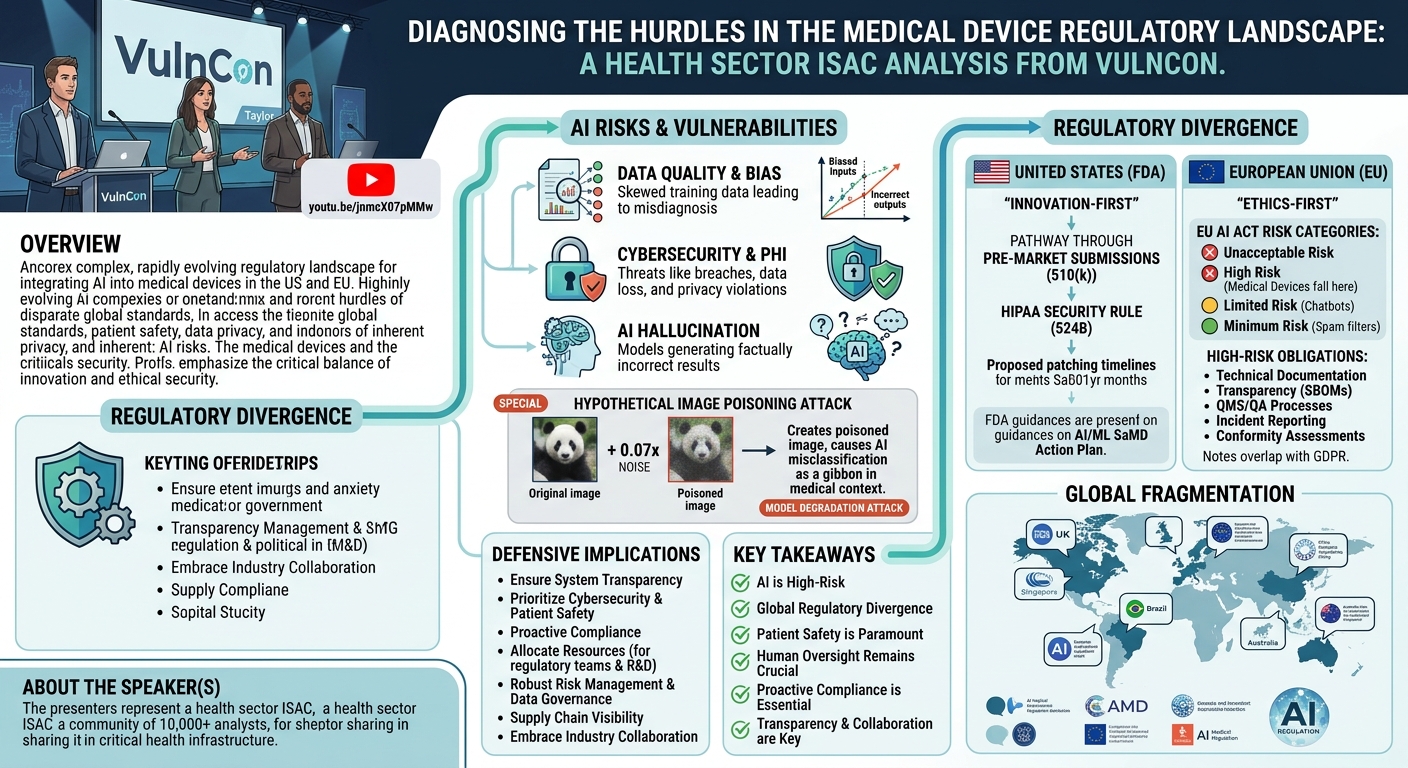
To illustrate a concrete example of these risks, the speakers introduced a hypothetical attack scenario involving the poisoning of images. This demonstrates a model degradation attack, where a threat actor intentionally injects "noise images" (e.g., an original panda image modified with a specific mathematical function like + 0.07x) into the AI's training data. The goal is to degrade the model's effectiveness, leading to AI hallucination—a phenomenon where the AI produces factually incorrect results. In a medical context, such an attack could lead to severe consequences, like a diagnostic AI misclassifying a benign lesion as cancerous, or vice versa, based on subtly manipulated medical images. This underscores the persistent problem of AI hallucination, even in advanced models like OpenAI's GPT-4.5 or Google's Gemini, highlighting the irreplaceable need for human validation and oversight in critical applications.
Key Findings
▶ Watch: Hypothetical attack: AI misclassification via image poisoning (3:10)
The talk identified several critical findings regarding the integration of AI into medical devices and the associated regulatory landscape:
- Divergent Regulatory Philosophies: A primary hurdle is the stark contrast in regulatory approaches between major global players like the United States and the European Union. The EU prioritizes an "ethics-first" approach, emphasizing robust frameworks before widespread AI deployment, while the US tends towards an "innovation-first" model, where regulation often follows technological advancement to maintain a competitive edge. This creates a challenging dynamic for organizations operating internationally, requiring them to navigate two fundamentally different mentalities.
- AI as High-Risk in Healthcare: AI-boosted products in the healthcare sector are consistently classified as high-risk applications by regulatory bodies, particularly under the EU AI Act. This designation triggers stringent compliance obligations, including comprehensive conformity assessments, rigorous data governance, and heightened transparency requirements, significantly impacting development timelines and resource allocation.
- Persistent AI Vulnerabilities: Fundamental issues like data quality, algorithmic bias, and AI hallucination remain persistent problems even in advanced AI models. These vulnerabilities are not merely theoretical but represent significant patient safety risks, as evidenced by the hypothetical image poisoning attack, which could lead to critical misdiagnoses in medical imaging.
- The Indispensable Human Element: Despite AI's capabilities, the need for human oversight and validation ("trust but verify") is paramount. AI is presented as a tool to empower humans, not replace them, particularly when dealing with sensitive information and life-critical decisions in medical contexts.
- Increased Compliance Overhead and Bottlenecks: Medical device manufacturers face significant increased overhead in ensuring local and global compliance. This includes allocating resources for regulatory teams, establishing robust quality management systems, and undergoing extensive documentation processes. Such requirements can lead to bottlenecks in research and development (R&D), potentially slowing down the pace of innovation for companies adhering to stricter ethical frameworks.
- Global Regulatory Fragmentation: Beyond the US and EU, numerous other regions (e.g., UK, Singapore, China, Brazil, Australia) are developing their own AI regulations. While there might be some overlap in the core goal of patient safety, the fragmented nature of these global standards creates a complex, multi-jurisdictional compliance challenge that necessitates proactive, adaptable strategies.
- The "Unknown Unknowns" of AI: The speakers highlighted that while some AI risks are known, many "unknown unknowns" persist. This implies that the full scope of potential vulnerabilities, ethical dilemmas, and societal impacts of advanced AI in medical devices is yet to be fully understood, requiring a proactive, rather than reactionary, approach to threat mitigation and compliance.
Technical Deep Dive
▶ Watch: The critical role of human validation for AI (4:50)
The technical deep dive of the talk focused on the specific mechanisms of AI vulnerabilities and the detailed regulatory frameworks emerging to address them in medical devices.
A key technical concern highlighted was AI hallucination and model degradation attacks. The speakers explained how AI models, particularly those used for image classification in medical diagnostics, can be vulnerable to adversarial attacks. They demonstrated this with an example of poisoning an image classification model. By introducing subtly distorted pixels, referred to as "noise images," into the training dataset, a threat actor can manipulate the model's output. The example cited a mathematical function, + 0.07x, applied to an original image (e.g., a panda) to create a noise image that, while imperceptibly different to the human eye, causes the AI to misclassify it (e.g., as a gibbon). In a medical context, this means that if the training data for an AI diagnosing skin cancer were poisoned, the system could incorrectly identify a benign mole as malignant or vice-versa, leading to severe patient harm. This vulnerability underscores the need for robust data governance and training data integrity checks.
From a regulatory standpoint, the talk detailed the approaches taken by the United States Food and Drug Administration (FDA) and the European Union (EU).
In the United States, the FDA has been increasingly authorizing AI in medical devices, with over 950 approvals between 1995 and 2024. The regulatory pathway primarily involves pre-market submissions and the 510(k) process, which allows devices to be marketed. The FDA has released several draft guidances to assist manufacturers, including:
- "Considerations for Use of Artificial Intelligence to Support Regulatory Decision-Making for Drug and Biological Products."
- The "AI and ML Software as a Medical Device (SaMD) Action Plan."
- A draft guidance on "Artificial Intelligence-Enabled Medical Device Software Functions Life Cycle Management and Marketing Submission," which covers recommendations from development to post-market updates.
A critical emphasis for the FDA is patient safety, which must supersede mere vulnerability patching. The Biden administration had previously issued an executive order on AI use for federal agencies, though this has since been repealed. However, other regulations remain pertinent. Manufacturers must comply with the HIPAA Security Rule (524B), with proposed cybersecurity additions including mandated timelines for patching and risk management (between six months to a year). This signifies a move towards more proactive and regular security maintenance rather than reactive patching.
The European Union has taken a pioneering role with its EU AI Act, being the first organization to release a comprehensive framework for acceptable AI use. The Act classifies AI applications into four risk categories:
- Unacceptable Risk: Prohibited uses, such as large-scale social engineering or involuntary facial recognition for social scoring (e.g., China's social credit system).
- High Risk: Applications that pose significant harm to health, safety, or fundamental rights. Medical devices fall squarely into this category.
- Limited Risk: Systems with specific transparency obligations (e.g., chatbots).
- Minimum Risk: AI with negligible risk (e.g., spam filters), requiring minimal oversight.
For high-risk systems, such as medical devices, the EU AI Act imposes stringent obligations, including:
- Technical Documentation: Detailed records of how the system works.
- Transparency and Provision of Information: Including Software Bill of Materials (SBOMs) to detail components.
- Quality Management System: Ensuring robust Quality Assurance (QA) processes.
- Incident Reporting Apparatus: Mechanisms for prompt remediation of issues.
- Conformity Assessments: Demonstrating adherence to regulations throughout the development lifecycle.
- Post-Marketing Monitoring Procedures: Ongoing compliance checks.
- AI Literacy: Ensuring company personnel have a baseline understanding of ethical AI use.
These requirements mandate significant supply chain transparency and robust data governance. Companies operating in the EU must also comply with the Medical Device Regulation (MDR) and additional data privacy regulations like GDPR, which impose extra requirements for data safeguarding. The EU's "ethics-first" approach, contrasting with the US's "innovation-first" stance, creates a dynamic where companies doing business in both regions must navigate these two distinct mentalities, potentially leading to R&D bottlenecks as they strive for both cutting-edge innovation and rigorous ethical compliance.
Globally, the speakers noted that countries like the UK, Singapore, China, Brazil, and Australia (under the Therapeutic Goods Administration) are also developing their own AI regulations. While the goal of patient safety is universal, the specific regulatory baselines may differ, making global compliance an increasingly complex challenge for manufacturers.
Demo / Proof of Concept
▶ Watch: US FDA's regulatory landscape for AI medical devices (5:45)
While the talk did not feature a live technical demonstration or a specific tool-based proof of concept, it effectively used a hypothetical attack scenario to illustrate a critical vulnerability in AI-enabled medical devices. The example of poisoning medical images with "noise images" (e.g., an original panda image modified by a mathematical function like + 0.07x) to induce AI hallucination served as a powerful conceptual demonstration. This scenario highlighted how subtly altered training data could lead an AI diagnostic model to misclassify medical conditions, directly impacting patient safety. This illustrative example underscored the real-world implications of data quality and adversarial attacks on AI systems without requiring a live technical demonstration.
Defensive Implications
▶ Watch: European Union AI Act and risk classification categories (8:05)
The detailed analysis of AI risks and the evolving regulatory landscape provides critical insights for medical device manufacturers and healthcare organizations on how to bolster their defenses. Proactive measures are essential to navigate the complex compliance environment and mitigate the unique threats posed by AI.
- Ensure AI System Transparency: Manufacturers must prioritize transparency regarding the data used to train their AI models. This includes meticulously documenting data sources, preprocessing steps, and the rationale behind model design. Regular audits of the AI system for bias are crucial. If, for example, a diagnostic AI is continuously fed biased or incomplete patient information, it could lead to incorrect diagnoses and adverse patient outcomes. Maintaining comprehensive records of the data used for training and ensuring it is kept up-to-date is non-negotiable.
- Prioritize Cybersecurity and Patient Safety: The cybersecurity of medical devices, especially those with integrated AI, must be paramount. The focus should shift from merely addressing vulnerabilities to ensuring overall patient safety. This means implementing robust security controls throughout the entire device lifecycle, from design to post-market monitoring. Adherence to regulations like the HIPAA Security Rule (524B) in the US, with its proposed requirements for regular risk management and patching timelines (every six months to a year), is critical.
- Proactive Compliance and Adaptation: Organizations must adopt a proactive stance towards compliance, rather than a reactive one. This involves staying abreast of rapidly evolving global regulations, including the EU AI Act, US FDA guidances, and similar frameworks emerging in regions like the UK, Singapore, and Australia. For companies operating internationally, it is advisable to proactively develop compliance frameworks that can streamline adherence across multiple jurisdictions, leveraging any overlap in requirements (e.g., common needs for transparency, human oversight, and data governance).
- Allocate Resources for Regulatory Teams and R&D Awareness: Significant overhead will be required to ensure local and global compliance. Manufacturers must allocate dedicated resources to establish robust regulatory teams that are well-versed in AI legislation. Furthermore, R&D centers must be made aware of these legislations and equipped with the infrastructure to build compliant products from inception. This includes investing in Quality Management Systems (QMS) and ensuring AI literacy across the organization.
- Implement Robust Risk Management and Data Governance: For high-risk AI systems, particularly in the EU, comprehensive risk management processes are mandatory. This includes identifying, assessing, and mitigating risks associated with the AI's development, deployment, and ongoing operation. Strict data governance policies are essential to manage data quality, privacy (e.g., GDPR compliance), and the security of Protected Health Information (PHI) used by AI. This also extends to implementing incident reporting apparatuses for rapid remediation of any security or safety incidents.
- Embrace Transparency and Supply Chain Visibility: The EU AI Act's requirement for technical documentation and Software Bill of Materials (SBOMs) for high-risk systems highlights the growing need for transparency in the AI supply chain. Manufacturers should proactively provide detailed information about the components and development processes of their AI-enabled devices to regulators and, where appropriate, to users.
- Engage in Industry Collaboration: Given the novelty and complexity of AI risks, industry collaboration is crucial. Sharing insights, best practices, and threat intelligence (e.g., through ISACs) can help accelerate the development of effective defensive strategies. Resources like the MITRE ATLAS matrix (Adversarial Threat Landscape for Artificial-intelligence Systems), which details tactics, techniques, and common knowledge (TTC) used by threat actors against AI, and the OWASP LLM Top 10 white paper series, provide valuable frameworks for understanding and mitigating AI-specific threats.
By adopting these defensive implications, medical device manufacturers can not only ensure regulatory compliance but also build more secure, trustworthy, and ultimately safer AI-enabled devices for patients worldwide. The goal is to smooth the transition into an AI-driven future by proactively mitigating threats rather than reacting to crises.
Key Takeaways
- AI in Medical Devices is High-Risk: AI-enabled medical devices are consistently classified as high-risk applications, particularly under the EU AI Act, necessitating rigorous compliance and oversight due to their direct impact on patient safety.
- Global Regulatory Divergence: Manufacturers face significant challenges navigating disparate regulatory philosophies (e.g., EU's "ethics-first" vs. US's "innovation-first") and fragmented global standards, creating potential R&D bottlenecks.
- Patient Safety is Paramount: All regulatory efforts and defensive strategies must prioritize patient safety above all else, addressing risks like AI bias, data quality issues, and the potential for AI hallucination or misdiagnosis due to adversarial attacks.
- Human Oversight Remains Crucial: Despite AI's advancements, human validation, critical thinking, and oversight are indispensable in medical contexts; AI should be viewed as a tool to empower, not replace, human expertise.
- Proactive Compliance is Essential: Organizations must adopt a proactive approach to compliance, investing in regulatory teams, robust risk management, data governance, and continuous auditing to anticipate and meet evolving global requirements.
- Transparency and Collaboration are Key: Ensuring transparency in AI systems (e.g., training data, SBOMs) and engaging in industry collaboration are vital for building trust, sharing best practices, and collectively mitigating the knowns and "unknown unknowns" of AI risks.
About the Speaker(s)
The speakers for this talk represent a health sector Information Sharing Analysis Center (ISAC). This ISAC is a vital community of over 10,000 security analysts dedicated to empowering sharing and collaboration within critical infrastructure, specifically focusing on the health sector. Their work encompasses not only healthcare providers but also medical device manufacturers, reflecting a comprehensive understanding of the industry's unique cybersecurity and regulatory challenges. One of the presenters mentioned by name during the talk was "Taylor," indicating a collaborative presentation. Their expertise stems from their role in facilitating trust and information exchange within the health community, making them well-positioned to discuss the complex intersection of AI, medical devices, and global regulation.
Reviews
Dr. Zero (Offensive Security Researcher) — WEAK
A policy/regulatory overview talk from a health-sector ISAC on AI in medical devices that covers real terrain — FDA pathways, EU AI Act risk tiers, adversarial ML basics — but executes at the level of a well-researched Wikipedia article rather than an expert briefing. The speakers are clearly competent policy trackers, not researchers or practitioners who have been inside the problem. The adversarial ML content is textbook-shallow (the panda/FGSM example is a decade-old pedagogy staple, not a novel threat framing), the regulatory coverage adds nothing a compliance attorney couldn't pull from public FDA and EU AI Act documentation, and the 'unknown unknowns' framing is used to gesture at…
Heather Calloway (CISO) — SOLID
A competent survey of the AI medical device regulatory landscape from a health sector ISAC, covering FDA pathways, EU AI Act obligations, and persistent AI vulnerabilities like model poisoning and hallucination. The content is relevant and the framing around patient safety is appropriate, but the talk operates primarily as an orientation briefing rather than a decision-forcing instrument. Manufacturers and compliance leads will find it useful as a map. CISOs and board advisors will leave without a clear signal on where accountability breaks down or what to change first.