UC2 Risk Ruler for CVSS 4.0: Visualizing Vulnerability Severity and Data Confidence
CVE/FIRST VulnCon 2025 · Main Stage
Overview
This talk introduces the UC2 Risk Ruler for CVSS 4.0, a novel estimation methodology and toolkit designed to augment the widely used Common Vulnerability Scoring System (CVSS) scores. Developed by Rob, a seasoned cyber risk management expert and volunteer with the CVSS Special Interest Group (SIG), the Risk Ruler addresses a critical limitation of traditional CVSS scores: their inability to convey the underlying precision, confidence, and maturity of the vulnerability assessment. While CVSS provides a precise numeric value, it offers no inherent mechanism to indicate how complete or well-informed the metrics contributing to that score truly are.
Key moments
- 2:00 Purpose of UC2 Risk Ruler for CVSS 4.0
- 2:50 Understanding CVSS 4.0 Metric Groups
- 4:10 CVSS Maturity Model for Score Refinement
- 5:00 Risk Ruler Visualizes Score Maturity (Bottom-Up)
- 8:00 Connecting Risk Ruler to Quantitative Models (FAIR)
- 9:00 Fictitious Vulnerability Example: Vendor vs. Matured Score
UC2 Risk Ruler for CVSS 4.0: Visualizing Vulnerability Severity and Data Confidence
Speakers: Rob, Semi-Retired Cyber Risk Management Guru, CVSS SIG Volunteer
Conference: VulnCon
YouTube: https://www.youtube.com/watch?v=abdjkSJ-BCs
Overview
This talk introduces the UC2 Risk Ruler for CVSS 4.0, a novel estimation methodology and toolkit designed to augment the widely used Common Vulnerability Scoring System (CVSS) scores. Developed by Rob, a seasoned cyber risk management expert and volunteer with the CVSS Special Interest Group (SIG), the Risk Ruler addresses a critical limitation of traditional CVSS scores: their inability to convey the underlying precision, confidence, and maturity of the vulnerability assessment. While CVSS provides a precise numeric value, it offers no inherent mechanism to indicate how complete or well-informed the metrics contributing to that score truly are.
The primary objective of the UC2 Risk Ruler is to enable more transparent and defensible cybersecurity decisions. By visually representing the certainty and completeness of a CVSS score, the tool enhances prioritization efforts and significantly improves communication about vulnerability severity, especially with non-technical stakeholders. It acts as a crucial bridge, translating precise quantitative scores into actionable, qualitative risk insights that are tailored to an organization's specific environment, moving beyond generic vendor-supplied ratings.
Background
▶ Watch: Purpose of UC2 Risk Ruler for CVSS 4.0 (2:00)
The Common Vulnerability Scoring System (CVSS) has become an industry standard for assessing the severity of software vulnerabilities. CVSS 4.0, the latest iteration, categorizes metrics into four main groups: Base, Threat, Environmental, and Supplemental. The initial 11 Base metrics are mandatory and are typically set by vendors (e.g., Cisco, Intel, Juniper) based on their understanding of a vulnerability within their products. However, a significant challenge arises because vendors cannot foresee every possible deployment scenario in their customer base, nor can they accurately predict the evolving threat landscape. Consequently, a vendor-assigned base score, while numerically precise, often lacks the contextual richness required for an organization to make informed risk decisions specific to its own environment.
This inherent limitation of base scores led to the development of the CVSS Maturity Model (currently in draft), which outlines a progression from basic vulnerability assessment to a more comprehensive, context-aware evaluation. At Level 1, only base metrics are considered. As an organization moves to Level 2, Threat intelligence is incorporated. Level 3 adds Environmental information, such as the presence of firewalls or other compensating controls. Finally, Level 4 integrates Supplemental metrics. Each successive level increases the confidence and accuracy of the score relative to a specific deployment. Rob's UC2 (Uniform Confidence and Certainty) methodology, originally developed after his tenure at SIZA for critical infrastructure risk management, forms the foundation for the Risk Ruler. The UC2 Risk Ruler aligns with this CVSS Maturity Model, but uniquely visualizes this progression from a "bottom-to-top" perspective, starting from low confidence and moving towards high precision as more data is integrated. This framework highlights that a vulnerability's true impact is not a static number but rather a dynamic range that narrows with increased contextual understanding.
Key Findings
▶ Watch: CVSS Maturity Model for Score Refinement (4:10)
The central finding presented is that relying solely on a single, numerically precise CVSS score, particularly a vendor-provided base score, can be misleading due to a lack of underlying confidence and contextual maturity. The UC2 Risk Ruler offers a critical solution by visualizing this uncertainty, demonstrating how a vulnerability's perceived severity evolves as more relevant data is incorporated.
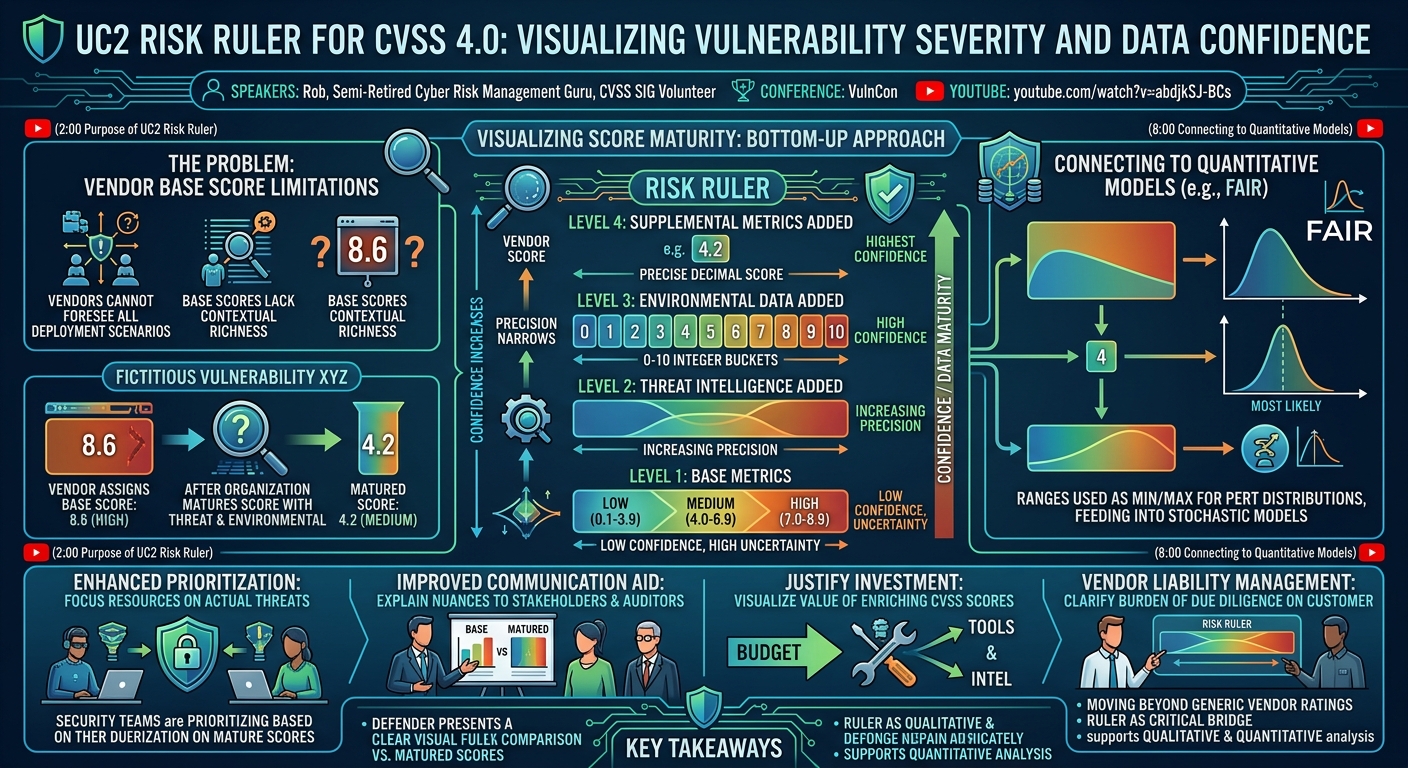
The Risk Ruler visually translates CVSS scores across different levels of maturity and confidence: from a broad range (0-10) when no CVSS is applied, to a wider, often overlapping, qualitative range (e.g., Low, Medium, High) with base metrics, then to more defined qualitative bins, 0-10 numeric buckets, and finally to a precise decimal score. This visual progression explicitly shows how confidence and precision increase with the addition of Threat, Environmental, and Supplemental metrics. A key insight is the concept of "boundary sensitivity," where a slight numeric change can shift a score between qualitative categories. The Risk Ruler addresses this by depicting overlapping qualitative ranges at lower maturity levels, acknowledging the inherent ambiguity without sufficient context.
Furthermore, the methodology provides a practical bridge between qualitative and quantitative risk analysis. For "quants" in the audience, the ranges visualized by the Risk Ruler can be directly used as min/max values for probability distributions, such as a PERT distribution, which can then feed into sophisticated stochastic models like FAIR (Factor Analysis of Information Risk). This interoperability ensures that the qualitative insights gained from the Risk Ruler can be leveraged for deeper, quantitative risk assessments. The illustrative example of a fictitious vulnerability demonstrates how a high base score (8.6) can, with environmental enrichment, mature into a lower, more precise, and contextually accurate score (4.2), showcasing the tangible benefit of investing in score enrichment.
Technical Deep Dive
▶ Watch: Risk Ruler Visualizes Score Maturity (Bottom-Up) (5:00)
The UC2 Risk Ruler's core technical contribution lies in its structured visualization of CVSS score maturity, directly addressing the limitations of relying on raw numeric scores without contextual confidence. It leverages the four main CVSS 4.0 metric groups—Base, Threat, Environmental, and Supplemental—to define escalating levels of score maturity. The speaker outlines a "bottom-to-top" approach to the Risk Ruler, mirroring the CVSS Maturity Model:
- No CVSS: At the lowest level of confidence, if no CVSS score is available, the potential range is the entire 0-10 scale, reflecting absolute uncertainty.
- Base Metrics: When only base metrics are applied (typically by a vendor), the score gains some definition but still carries significant uncertainty. The Risk Ruler depicts this with qualitative bins (e.g., Low, Medium, High) that often overlap. For instance, an 8.6 base score might fall clearly into "High" but also "glance through the median," indicating that without further context, its true impact could span a broad range (e.g., 7-10 or even 0.1-10 from a consumer perspective). This overlap visually represents the "boundary sensitivity" and the low confidence in precise qualitative categorization based solely on vendor-centric data.
- Qualitative Bins: As more metrics are added (e.g., Threat intelligence), the qualitative bins become more defined. These bins align with the explicitly defined categories in the CVSS specification (None, Low, Medium, High, Critical), but the Risk Ruler emphasizes how the certainty of a score landing squarely within one bin increases with maturity.
- 11 Buckets (0-10): Further maturity, often achieved by incorporating Environmental metrics, allows for a more granular, yet still qualitative, interpretation by dropping the decimal point and assigning the score to one of 11 distinct buckets (0 through 10). This level of precision might be sufficient for many organizations' prioritization needs.
- Precise Score: The highest level of maturity, typically achieved with full Supplemental metrics, yields the precise decimal score (e.g., 8.3), representing the highest confidence and most tailored assessment for a specific environment.
The speaker illustrates this with a fictitious vulnerability, XYZ. Initially, a vendor assigns a base score of 8.6. On the Risk Ruler, this 8.6, being a base score, is shown at a low maturity level, falling into the "High" qualitative bin but with visual overlap into "Medium," signaling a wide potential range of impact (e.g., 0.1 to 10) for a consumer. However, after an organization matures this score by incorporating threat and environmental metrics, the score changes significantly to 4.2. At this higher maturity level, the Risk Ruler clearly shows the 4.2 falling "solidly within the four camp" (referring to the 0-10 buckets), indicating a much narrower and more confident range (e.g., 4.0-4.9). This example highlights that organizations can choose their desired level of precision. For instance, if 11 buckets of action are sufficient for prioritization, they may not need to pursue the highest decimal precision.
Beyond qualitative visualization, the UC2 methodology provides a bridge to quantitative risk analysis. The ranges depicted at various maturity levels can be directly utilized in PERT distributions as minimum and maximum values. From these, a most likely value can be derived, feeding into stochastic models like FAIR. This flexibility allows organizations to transition seamlessly between qualitative discussions and rigorous quantitative risk assessments, depending on their analytical needs.
Demo / Proof of Concept
▶ Watch: Connecting Risk Ruler to Quantitative Models (FAIR) (8:00)
The talk effectively demonstrates the UC2 Risk Ruler through a clear, conceptual example rather than a live software demonstration. The speaker utilizes a visual aid—a chart depicting the Risk Ruler itself—to illustrate the core concepts. This chart visually maps the different levels of CVSS score maturity, from a lack of confidence and broad ranges at the bottom to high precision and narrow ranges at the top.
The demonstration centers around a "fictitious vulnerability XYZ." The speaker walks the audience through how a vendor-assigned CVSS base score of 8.6 is interpreted on the Risk Ruler. At this low maturity level, the 8.6 falls into the "High" qualitative bin, but the visualization explicitly shows its overlap with the "Medium" category, emphasizing the inherent uncertainty and wide potential range of impact (e.g., 0.1 to 10) from an organizational perspective. Subsequently, the speaker shows how, after an organization enriches this score with threat and environmental metrics, the score changes to 4.2. On the Risk Ruler, this matured 4.2 is depicted at a higher confidence level, falling "solidly within the four camp" (referring to the 0-10 integer buckets), indicating a much narrower and more certain range of impact. This visual narrative clearly illustrates how the Risk Ruler helps organizations understand and communicate the true confidence and precision behind a CVSS score as it matures.
Defensive Implications
▶ Watch: Fictitious Vulnerability Example: Vendor vs. Matured Score (9:00)
The UC2 Risk Ruler for CVSS 4.0 offers several profound implications for cybersecurity defenders, fundamentally shifting how vulnerabilities are understood, prioritized, and communicated within an organization.
Firstly, it enables enhanced prioritization of vulnerabilities. Defenders can move beyond a simplistic reliance on vendor-supplied base scores, which may overstate or understate actual risk in their specific environment. By incorporating threat intelligence and environmental context, the Risk Ruler allows security teams to derive a more accurate, tailored score, ensuring that resources are allocated to address the vulnerabilities that pose the greatest actual threat to their systems, rather than just the highest reported severity. A vendor's 8.6 "high" vulnerability might, in a well-firewalled and segmented environment, be a 4.2 "medium," redirecting patching efforts to more critical issues.
Secondly, the tool serves as an improved communication aid. It provides a clear, visual framework to explain the nuances of CVSS scores to non-technical leadership, auditors, and other stakeholders. When an auditor questions why a high-severity vulnerability isn't immediately patched, defenders can use the Risk Ruler to demonstrate that while the vendor's base score is high, the organization's enriched score, considering its specific controls and threat landscape, indicates a lower, more manageable risk. This fosters transparency and builds trust, allowing for more defensible cybersecurity decisions.
Thirdly, the Risk Ruler helps justify investment in advanced vulnerability management capabilities. By visually demonstrating how adding threat intelligence and environmental data significantly increases the confidence and precision of vulnerability scores, security leaders can make a compelling case for funding tools, processes, and personnel required to mature their CVSS assessments beyond basic base scores. It concretely shows the value of moving from a broad, uncertain qualitative bin to a precise, context-specific score, thereby enabling a more "well-oiled vulnerability program."
Finally, for vendors, the speaker suggests the Risk Ruler can offer a degree of liability management. By publishing base scores alongside the Risk Ruler's guidance, vendors can transparently show the potential range of impact and implicitly place the burden of due diligence on the customer to tailor the score to their own deployment. This clarifies that a vendor's "high" score is based on a reasonable worst-case scenario, and that an organization's specific controls can significantly mitigate that impact.
Key Takeaways
- CVSS numeric scores, particularly vendor-provided base scores, often lack the necessary context to convey their true precision, confidence, and maturity for a specific operational environment.
- The UC2 Risk Ruler visually augments CVSS 4.0 scores by translating them into qualitative bins that dynamically reflect increasing confidence and certainty as more contextual metrics (Threat, Environmental, Supplemental) are incorporated.
- This tool acts as a critical bridge, enabling organizations to move beyond generic vendor ratings to generate vulnerability scores tailored to their unique risk landscape, facilitating more accurate and defensible prioritization.
- By clearly demonstrating the value of enriching CVSS scores with additional intelligence, the Risk Ruler provides a strong justification for investing in advanced vulnerability management processes and threat intelligence integration.
- It serves as an invaluable communication framework, empowering cybersecurity teams to effectively articulate complex vulnerability assessments and their underlying confidence to non-technical leadership and auditors.
- The methodology supports both qualitative discussions and quantitative risk analysis, allowing the visualized ranges to feed into stochastic models like FAIR, thereby enhancing overall risk management capabilities.
About the Speaker(s)
The speaker, Rob, is a highly experienced and respected figure in cyber risk management. Describing himself as a "semi-retired cyber risk management guru," Rob has a distinguished career that includes working at the cabinet level, providing testimony for Congress, and collaborating with NIST (National Institute of Standards and Technology). He completed a significant stint with SIZA (Cybersecurity and Infrastructure Security Agency), where his focus was on critical infrastructure and risk management. Rob is also the author of a book on cyber risk management and currently volunteers with the CVSS Special Interest Group (SIG), contributing to the development and evolution of the CVSS standard. He is the creator of the UC2 (Uniform Confidence and Certainty) estimation methodology and toolkit, which forms the foundation of the Risk Ruler discussed in this presentation.
Reviews
Dr. Zero (Offensive Security Researcher) — SOLID
Rob brings genuine credentials and a legitimate problem — CVSS base scores are routinely misused, and the lack of any confidence/maturity signal baked into the score is a real, underappreciated issue in vulnerability management. The UC2 Risk Ruler addresses this gap with a conceptually sound visualization framework that aligns with the CVSS 4.0 maturity model. The talk is well-intentioned, clearly explained, and would genuinely help practitioners who are still operating at CVSS maturity level 1. That said, it's a framework talk at a practitioner conference — the core insight (base scores without context are misleading; add threat and environmental metrics to narrow your uncertainty) is not…
Heather Calloway (CISO) — SOLID
Rob's UC2 Risk Ruler addresses a real and underappreciated problem — that a CVSS score's numeric precision creates false confidence when the underlying data quality is low. The visualization of score maturity across CVSS metric layers is a useful framing device, particularly for communicating with non-technical stakeholders and justifying investment in threat and environmental context enrichment. The speaker has genuine credentials and the methodology has clear practitioner roots. But the talk stays in the methodology layer and never quite climbs to the institutional or governance questions that determine whether any of this actually gets implemented. It's a solid contribution to…