Spies and Bytes: Victory in the Digital Age
General Paul M. Nakasone
DEF CON 32 Main Stage · Day 1 · Main Stage
Overview
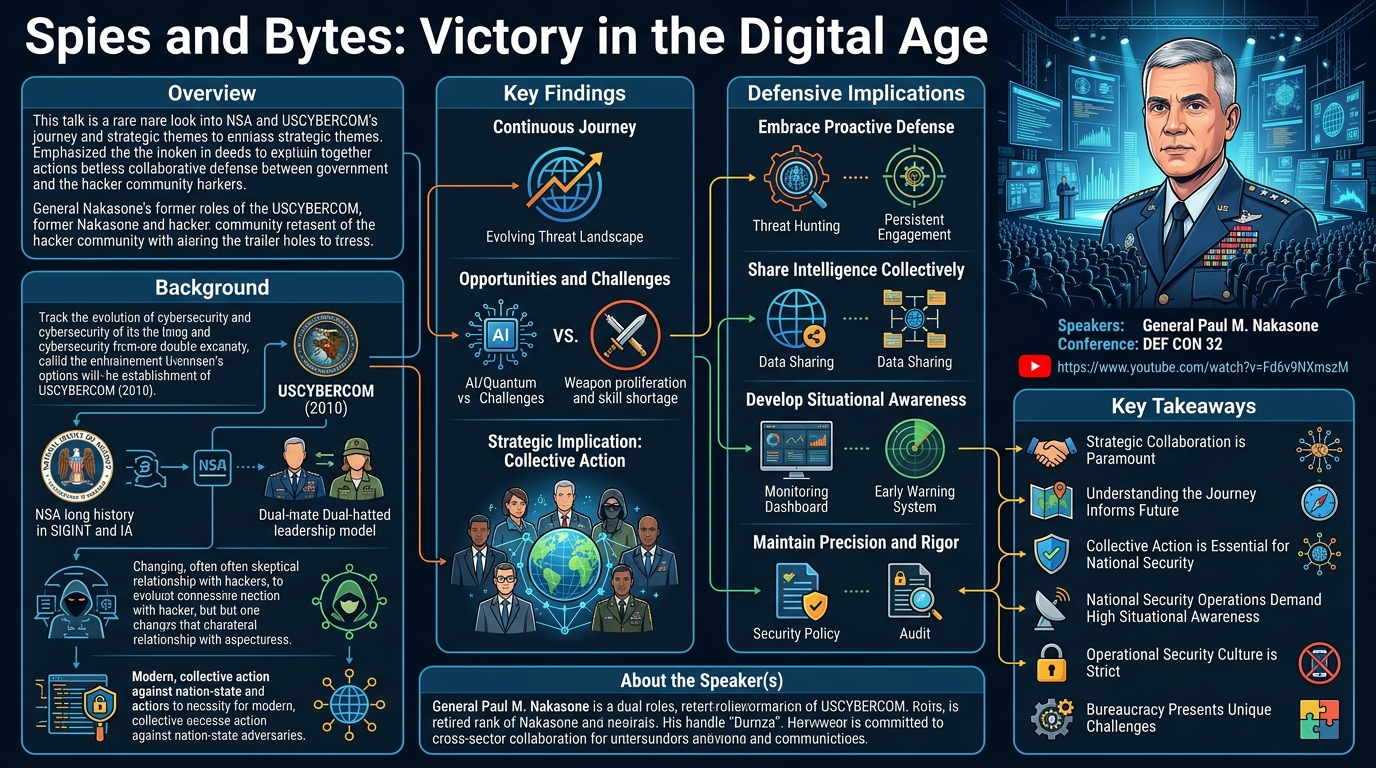
General Paul M. Nakasone, former Commander of U.S. Cyber Command (USCYBERCOM) and Director of the National Security Agency (NSA), delivered a highly anticipated address at DEF CON 32 titled "Spies and Bytes: Victory in the Digital Age." This talk offered a rare glimpse into the strategic thinking and operational journey of the United States' foremost cyber defense and intelligence organizations from the perspective of their recently retired leader. While the provided transcript primarily captures General Nakasone's introductory remarks, personal anecdotes, and the stated agenda for his presentation, his presence at DEF CON itself underscored a significant shift in the relationship between government intelligence agencies and the broader hacker community.
Key moments
- 0:00 Welcome to Defcon, thanks to the hacker community.
- 0:54 Post-retirement background check: "Unable to confirm US citizenship."
- 2:30 Humorous DMV struggles after decades of national service.
- 3:00 NSA vs. Defcon: Cell phone policy culture shock.
- 3:30 Overview of talk: NSA and Cyber Command's journey.
- 3:57 Glimpse inside the highly sensitive National Security Operation Center.
Spies and Bytes: Victory in the Digital Age
Speakers: General Paul M. Nakasone
Conference: DEF CON 32
YouTube: https://www.youtube.com/watch?v=Fd6v9NXmszM
Overview
General Paul M. Nakasone, former Commander of U.S. Cyber Command (USCYBERCOM) and Director of the National Security Agency (NSA), delivered a highly anticipated address at DEF CON 32 titled "Spies and Bytes: Victory in the Digital Age." This talk offered a rare glimpse into the strategic thinking and operational journey of the United States' foremost cyber defense and intelligence organizations from the perspective of their recently retired leader. While the provided transcript primarily captures General Nakasone's introductory remarks, personal anecdotes, and the stated agenda for his presentation, his presence at DEF CON itself underscored a significant shift in the relationship between government intelligence agencies and the broader hacker community.
The importance of this talk lies not only in the speaker's distinguished background but also in the strategic themes he outlined: the historical evolution, impact, current challenges, and future opportunities for NSA and USCYBERCOM in the ever-evolving cyberspace domain. His intention to discuss the "journey of NSA and Cyber Command in Cyberspace" and the necessity for collective action going forward highlights the critical need for collaborative defense against sophisticated nation-state adversaries and other malicious actors. For the DEF CON audience, hearing directly from a figure of General Nakasone's stature represents a crucial step towards fostering mutual understanding and cooperation between the public and private sectors in safeguarding national security in the digital realm.
Background
▶ Watch: Welcome to Defcon, thanks to the hacker community. (0:00)
The landscape of cybersecurity has evolved dramatically over the past few decades, transforming from a niche technical concern into a critical domain of national security, economic stability, and geopolitical competition. The U.S. government established U.S. Cyber Command (USCYBERCOM) in 2010 to unify the direction of cyberspace operations, strengthen DoD capabilities, and centralize command of cyber forces. Simultaneously, the National Security Agency (NSA), with its decades-long history in signals intelligence (SIGINT) and information assurance (IA), has been at the forefront of both offensive and defensive cyber capabilities. The dual-hatted leadership model, where the same individual serves as both the Director of the NSA and the Commander of USCYBERCOM, as General Nakasone did for six years, signifies the intrinsically linked nature of intelligence gathering and military operations in cyberspace.
Historically, the relationship between government intelligence agencies and the independent hacker community has often been characterized by skepticism and, at times, antagonism. Events like the revelations by Edward Snowden in 2013 profoundly deepened this divide, raising questions about surveillance, privacy, and the scope of government power. However, the escalating frequency and sophistication of cyberattacks from nation-states like Russia, China, Iran, and North Korea, as well as non-state actors, have necessitated a re-evaluation of this relationship. The private sector, including the DEF CON community, often possesses unique insights into emerging threats, vulnerabilities, and innovative defensive strategies that are vital for national cyber defense.
General Nakasone's decision to speak at DEF CON 32, just six months after retiring from his pivotal roles, symbolizes a deliberate effort to bridge this gap. His address follows a trend of increasing, albeit carefully managed, engagement between senior U.S. cyber officials and the hacker community. The intent behind such engagements is to foster a shared understanding of the complex cyber threat landscape, encourage talent recruitment into government service, and explore avenues for collective defense. The problem that exists, and that these engagements seek to address, is the asymmetry of information and capabilities; no single entity, whether government or private, can unilaterally secure the digital ecosystem against all threats. Collaborative intelligence sharing, vulnerability disclosure, and strategic partnerships are increasingly recognized as indispensable components of a robust national cybersecurity posture. General Nakasone's talk, even in its introductory phase, aimed to set the stage for such a critical dialogue, emphasizing the "journey" and "impacts" of government cyber efforts as a foundation for future collective action.
Key Findings
▶ Watch: Humorous DMV struggles after decades of national service. (2:30)
Given the brevity and introductory nature of the provided transcript, specific technical findings or detailed operational results were not presented during this portion of General Nakasone's talk. Instead, the "key findings" can be interpreted as the overarching themes and strategic imperatives that General Nakasone intended to convey, reflecting the culmination of his extensive experience leading the NSA and USCYBERCOM. These can be distilled into several critical areas, primarily revolving around the evolving role of national cyber organizations and the imperative for collective action.
Firstly, the talk was framed around the "journey of NSA and Cyber Command in Cyberspace," implying a narrative of continuous adaptation and growth in response to a dynamic threat environment. This theme underscores that cybersecurity is not a static problem but an ongoing challenge requiring constant innovation in strategy, technology, and human capital. While the specific details of this journey were not elaborated in the transcript, the emphasis on "our beginnings," "where we were," "what we've done," and "some of the impacts" suggests that understanding this historical progression is crucial for charting a successful future. This narrative likely includes the shift from purely defensive postures to proactive "defend forward" and "persistent engagement" strategies, which have been hallmarks of USCYBERCOM's operational philosophy under Nakasone's leadership.
Secondly, General Nakasone explicitly stated his intention to discuss "opportunities and challenges" facing both organizations. This indicates a recognition that despite significant advancements, formidable obstacles remain. These challenges likely encompass a broad spectrum, including the rapid pace of technological change, the proliferation of sophisticated cyber weapons, the global shortage of skilled cybersecurity professionals, and the complexities of international law and norms in cyberspace. The "opportunities," conversely, might refer to advancements in artificial intelligence, quantum computing, enhanced public-private partnerships, and innovative approaches to talent development and retention. The very act of speaking at DEF CON is itself an attempt to leverage the opportunity presented by the hacker community's expertise and passion.
Finally, a core "finding" or, more accurately, a central directive, was General Nakasone's stated conclusion: "this is really what we need to do collectively going forward." This emphasizes the indispensable role of collaboration and collective defense across various stakeholders—government, industry, academia, and the hacker community. The increasing interconnectedness of global infrastructure means that no single entity can secure itself in isolation. Critical infrastructure, corporate networks, and individual users are all part of a vast, interdependent digital ecosystem. Therefore, effective cybersecurity demands a unified, coordinated response, characterized by timely intelligence sharing, joint threat analysis, and synchronized defensive operations. General Nakasone's presence and stated agenda at DEF CON served as a powerful testament to the U.S. government's recognition of this imperative, aiming to foster greater trust and engagement with a community traditionally viewed with suspicion by national security apparatuses.
Technical Deep Dive
▶ Watch: NSA vs. Defcon: Cell phone policy culture shock. (3:00)
The provided transcript for "Spies and Bytes: Victory in the Digital Age" does not contain a technical deep dive into any specific cyber operations, vulnerabilities, protocols, or architectures. General Nakasone's remarks, as transcribed, are confined to an introduction, personal anecdotes, and an outline of the talk's intended topics. Consequently, there are no details regarding specific tools, methodologies, code, or technical findings from the NSA or USCYBERCOM's work.
While the talk's title and the speaker's background strongly suggest a potential for rich technical discussion, the content captured in the transcript remains at a high strategic and conceptual level. The speaker's reference to the National Security Operation Center (NSOC) as "among the most sensitive places in the National Security Agency" and a location where "we're able to provide indication warnings to the president, the Secretary of Defense, senior military commanders about what's happening in the world" offers a glimpse into the operational environment but does not elaborate on the technical mechanisms or intelligence processes employed within such a facility.
A comprehensive technical deep dive into the operations of organizations like NSA and USCYBERCOM would typically involve discussions around advanced persistent threats (APTs), zero-day exploits, sophisticated malware analysis, cryptographic techniques (both offensive and defensive), network intrusion detection and prevention systems, cyber-physical system security, or detailed intelligence collection methodologies. However, such specific technical content was not included in the transcribed portion of General Nakasone's address. It is important for readers to understand that the absence of these details in this article is a direct reflection of their omission from the source material, rather than a lack of their relevance to the broader topic of national cyber defense. Any fabrication of such details would violate the core tenets of this article's creation.
Demo / Proof of Concept
▶ Watch: Overview of talk: NSA and Cyber Command's journey. (3:30)
The provided transcript does not include any demonstration or proof of concept. General Nakasone's presentation, as captured, focused on introductory remarks, personal anecdotes, and outlining the strategic themes for his talk, rather than showcasing specific tools, techniques, or operational capabilities.
Defensive Implications
▶ Watch: Glimpse inside the highly sensitive National Security Operation Center. (3:57)
Although the provided transcript does not delve into specific technical details or operational findings, General Nakasone's background and the overarching themes he outlined carry significant defensive implications for individuals, organizations, and nations. The very presence of a former dual-hatted head of NSA and USCYBERCOM at DEF CON underscores the critical shift towards a more collaborative and informed approach to cybersecurity.
Firstly, the emphasis on the "journey of NSA and Cyber Command in Cyberspace" implies that understanding the historical evolution of cyber threats and defensive strategies is paramount. Defenders must recognize that the adversary landscape is constantly evolving, requiring continuous adaptation of security postures. This means moving beyond static defenses to embrace proactive defense-forward strategies and persistent engagement, learning from the adversary by operating in their networks to understand their tactics, techniques, and procedures (TTPs). While the NSA and USCYBERCOM conduct these operations at a national level, the principle translates to organizational security: continuously monitoring, hunting for threats, and adapting defenses based on the latest threat intelligence.
Secondly, the call for collective action is perhaps the most profound defensive implication. No single entity can effectively defend against the full spectrum of cyber threats. For defenders, this means actively seeking out and participating in information-sharing initiatives. This includes sharing threat intelligence with industry peers, government agencies, and cybersecurity communities. Organizations should leverage existing frameworks for intelligence exchange, such as ISACs (Information Sharing and Analysis Centers), and contribute to the broader ecosystem by reporting vulnerabilities and indicators of compromise (IOCs). General Nakasone's vision of "what we need to do collectively going forward" strongly suggests that a unified, cross-sector approach is the most robust defense against sophisticated adversaries.
Furthermore, the mention of the National Security Operation Center (NSOC) providing "indication warnings to the president, the Secretary of Defense, senior military commanders" highlights the importance of situational awareness and early warning systems. Defenders, regardless of scale, must invest in robust monitoring capabilities, threat intelligence platforms, and incident response plans that allow for rapid detection and response to emerging threats. The ability to identify anomalous behavior, correlate events, and disseminate timely warnings internally and externally can significantly mitigate the impact of cyberattacks. This also extends to fostering a culture of cybersecurity awareness within organizations, recognizing that human factors often represent the most exploitable vulnerabilities.
Finally, the anecdotes about bureaucratic hurdles and strict security protocols within government agencies, while seemingly lighthearted, subtly point to the challenges of implementing effective security at scale. Defenders should strive for precision and rigor in their security practices, as emphasized by the DMV anecdote. This includes meticulous asset management, strict access controls, regular security audits, and adherence to established security frameworks. The anecdote about not allowing cell phones in NSA/Cyber Command workplaces, contrasted with attending DEF CON, also highlights the need for context-aware security policies that balance robust protection with operational usability and collaboration needs. Ultimately, the implicit message is that national security in the digital age relies on a concerted, informed, and collaborative effort from every segment of the cybersecurity community.
Key Takeaways
- Strategic Collaboration is Paramount: General Nakasone's presence at DEF CON underscores the critical need for robust collaboration between government intelligence agencies (like NSA/USCYBERCOM) and the private sector, including the independent hacker community, to effectively defend against evolving cyber threats.
- Understanding the "Journey" Informs the Future: The talk's stated agenda to discuss the historical evolution and impact of NSA and USCYBERCOM in cyberspace highlights that understanding past challenges and successes is essential for developing future cyber strategies.
- Collective Action is Essential for National Security: The emphasis on "what we need to do collectively going forward" signals that a unified, cross-sector approach—involving government, industry, academia, and individual experts—is indispensable for securing the digital ecosystem.
- National Security Operations Demand High Situational Awareness: The reference to the National Security Operation Center (NSOC) providing "indication warnings" stresses the critical importance of advanced threat intelligence, monitoring, and early warning capabilities for national defense.
- Operational Security Culture is Strict: Anecdotes about strict policies regarding personal electronic devices at NSA/USCYBERCOM illustrate the rigorous operational security culture maintained within top-tier national security organizations.
- Bureaucracy Presents Unique Challenges: Personal stories about navigating government bureaucracy (e.g., citizenship confirmation, DMV) highlight the often-unseen administrative complexities even high-ranking officials face, which can be symbolic of broader challenges in large-scale operations.
About the Speaker(s)
General Paul M. Nakasone is a highly distinguished figure in U.S. national security and cybersecurity. He recently retired from the U.S. Army after three decades of service, during which he held the unique dual role of Commander of U.S. Cyber Command (USCYBERCOM) and Director of the National Security Agency (NSA). In these capacities, he was responsible for leading the nation's cyber defense, offense, and intelligence collection efforts in the digital domain. His former handle was "Durnza." His leadership was instrumental in shaping the strategies of "defend forward" and "persistent engagement" in cyberspace. General Nakasone's decision to speak at DEF CON 32 just six months after his retirement reflects a continued commitment to engaging with the broader cybersecurity community and fostering collaboration between government and the private sector.
Reviews
Dr. Zero (Offensive Security Researcher) — STRONG ACCEPT
This strategic keynote by General Paul M. Nakasone, former head of NSA and USCYBERCOM, is a significant event for the DEF CON community. While the provided transcript is introductory and lacks technical depth, its value lies in the unparalleled credibility of the speaker and the profound strategic signal it sends regarding government-hacker community collaboration. The emphasis on collective action and the historical journey of national cyber operations provides crucial context and direction for future cybersecurity efforts, making it highly impactful despite its high-level nature.
Heather Calloway (CISO) — STRONG ACCEPT
General Nakasone's introductory remarks at DEF CON 32 represent a critical strategic pivot, signaling the imperative for robust collaboration between government and the private sector in national cyber defense. While the transcribed portion was high-level, his presence and agenda underscored the evolving landscape of cyber warfare, emphasizing shared risk ownership and the necessity of collective action to secure the digital ecosystem against sophisticated adversaries. For security leaders, this talk reinforces that national cybersecurity is a joint accountability, not solely a government burden.